

What if the persistent miscommunication stalling your team's progress isn't a lack of skill, but a systemic echo of your past? In high-stakes environments, research suggests that up to 70% of organizational conflict stems from unconscious triggers rather than technical disagreements. To lead with true potency, you must look inward at the transactional analysis ego states that govern your every interaction. You've likely felt the frustration of a boardroom discussion devolving into a power struggle or the exhaustion of maintaining objectivity when a colleague becomes defensive. It's a common struggle for leaders who value depth, yet find themselves caught in recurring dysfunctional patterns that hinder team agility.
By mastering the psychological architecture of the PAC model, you'll gain the tools to achieve professional autonomy and enhance your leadership impact. This guide provides a structured methodology to move beyond reactive habits toward a state of intentional wholeness. We'll explore the Parent, Adult, and Child states through the lens of Sari van Poelje's systemic methodology, offering a clear path toward earning accredited certification in TA-based coaching and transforming your organizational presence.
Key Takeaways
- Understand the psychological architecture of your personality to move beyond reactive scripts toward a state of autonomy and professional potency.
- Learn to decode Parent, Adult, and Child dynamics to ensure your leadership remains grounded in the present moment and responsive to systemic needs.
- Master the art of complementary communication by identifying how transactional analysis ego states dictate the flow and effectiveness of every professional exchange.
- Identify the subtle contaminations that hinder your clarity, allowing you to reclaim the Adult state for more objective and impactful decision-making.
- Integrate these psychological insights into a systemic framework that facilitates sustainable transformation and returns your organization to a state of wholeness.
What are Transactional Analysis Ego States? The Architecture of Interaction
Transactional Analysis (TA) began as a revolutionary theory of personality and social interaction. Founded by psychiatrist Eric Berne in 1958, it provides a lens to view our internal world as a tripartite structure. We aren't monolithic beings. Instead, our personality functions through three distinct Transactional Analysis ego states. These states dictate how we think, feel, and behave in any given moment. At Intact Academy, we view these states as the foundation of "Intactness." This is the capacity to access each state with fluidity and awareness to achieve true authenticity.
While TA started in clinical settings, its application has evolved significantly. Today, it drives systemic change in organizations. It helps leaders move from rigid, reactive roles toward human-centric agility. By understanding transactional analysis ego states, we gain the tools to dismantle internal barriers and foster genuine connection. For a comprehensive exploration of how these principles transform professional environments, our guide on what is transactional analysis provides the foundational framework for systemic organizational change.
The Origin of the PAC Model
Eric Berne departed from the abstract complexities of traditional psychoanalysis in the late 1950s. He sought a method that was observable and "transactional." He defined an ego state as a consistent system of feelings accompanied by a related set of behavior patterns. This model isn't about pathology; it's about the pursuit of Autonomy. In TA terms, autonomy is the recovery of three capacities: awareness, spontaneity, and intimacy. It's the journey back to a state of wholeness where your unconscious script no longer limits your professional or personal potential.
Why Ego States Matter for Modern Leaders
Understanding transactional analysis ego states is essential for executive presence. Unconscious shifts between these states often trigger "psychological games" in the workplace. These games, first popularized in Berne's 1964 bestseller Games People Play, account for a significant portion of team friction and lost productivity. High-performing teams require psychological safety to thrive.
- Awareness of ego states builds emotional intelligence (EQ).
- It allows leaders to recognize when they've slipped into a reactive Parent or Child state.
- Staying in the Adult state maintains potency and invites others to do the same.
This awareness transforms organizational culture. When leaders operate from an integrated Adult state, they create a stable container for growth. This shift moves the collective from drama to high-level systemic performance.
The PAC Model: Decoding Parent, Adult, and Child Dynamics
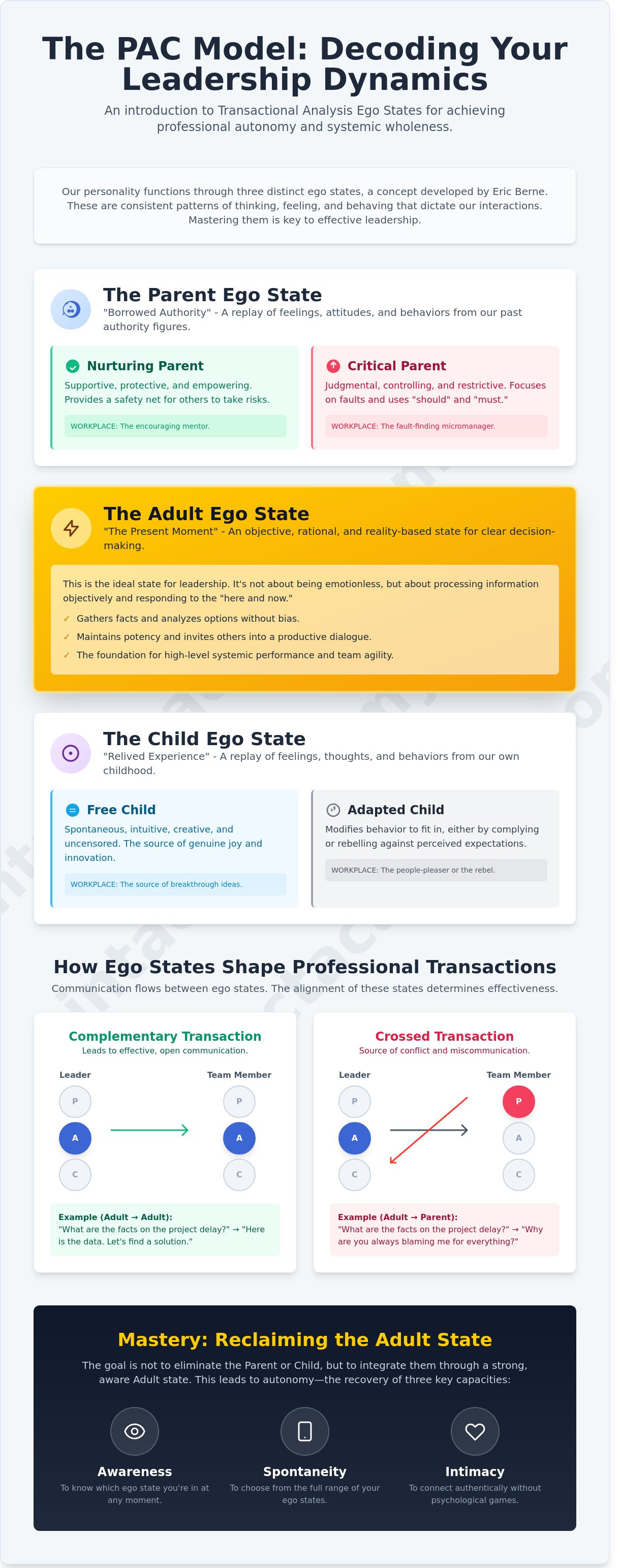
To understand the depth of human interaction, we must first examine the internal architecture of the individual. The PAC model serves as a psychological map, categorizing our internal experiences into three distinct transactional analysis ego states. These states aren't just theoretical constructs; they're observable systems of thought, feeling, and behavior. Eric Berne developed these foundational principles of Transactional Analysis in the late 1950s to explain why we often react to modern professional challenges with ancient, borrowed patterns.
The model distinguishes between the structural model, which describes what's inside each state, and the functional model, which describes how we manifest these states in the world. No single state is inherently "bad" or "good." Instead, their value depends on the context. A rigid "Parent" state might be lifesaving in a high-stakes emergency room, yet it could stifle innovation in a 2024 tech startup. These states are the building blocks of our Life Script, an unconscious plan we often finalize by age seven that dictates how we'll succeed or fail in our careers. Understanding how to navigate these states is a core component of our professional development programs.
The Parent Ego State: Borrowed Authority
The Parent state is a set of feelings, attitudes, and behaviors incorporated from external sources, primarily our early caregivers. When we're in this state, we're not acting from our own original thought; we're replaying the tapes of authority figures from our past. We generally divide this into two functional modes:
- The Nurturing Parent: This mode is supportive, protective, and empowering. In the workplace, this is the mentor who provides a safety net for a junior colleague to take risks.
- The Critical Parent: This mode is judgmental, controlling, and restrictive. This manifests as the micromanager who focuses on faults rather than solutions, often using "should" and "must" as linguistic weapons.
The Adult Ego State: The Objective Present
The Adult state functions as our internal data-processing center. It's the only state that responds to the "here and now" without the prejudice of the Parent or the emotional reactivity of the Child. It's characterized by curiosity, objectivity, and logical problem-solving. In systemic supervision, the Adult state is the foundation of efficacy. It allows a leader to look at a 15% drop in quarterly productivity and analyze the systemic causes without falling into blame or panic. It's the state of autonomy and presence.
The Child Ego State: Relived Emotion
The Child state isn't "childish"; it's a reservoir of behaviors and feelings replayed from our own childhood. It contains our creative fire and our deepest fears. We observe two primary manifestations in professional settings:
- The Natural Child: This is the source of spontaneity, creativity, and raw emotion. It's the innovative brainstormer who isn't afraid to suggest a "wild" idea that eventually disrupts the market.
- The Adapted Child: This state responds to authority. It can be Compliant, like the employee who never challenges a flawed strategy to avoid conflict, or Rebellious, like the team member who sabotages a project because they feel controlled.
By identifying which transactional analysis ego states are active during a meeting or a conflict, we gain the power to shift our response. This awareness is the first step toward moving from a scripted existence into a state of wholeness and professional agility.
How Ego States Shape Professional Transactions
A transaction is the fundamental unit of social intercourse. It consists of a stimulus from one person and a response from another. Within the framework of transactional analysis ego states, we observe how these exchanges determine the health of an organizational system. Communication remains fluid and effective only as long as transactions are complementary. This means the response comes from the ego state addressed and returns to the ego state that initiated the stimulus. When these lines of communication remain parallel, the dialogue can continue indefinitely, allowing for deep professional integration.
Understanding the nuances of Transactional Analysis Theory allows professionals to diagnose why certain conversations feel productive while others stall. In many corporate environments, ulterior transactions create a hidden layer of complexity. These occur when a social message appears neutral, but a psychological message is delivered beneath the surface. It's the primary driver of office politics. For example, a manager might ask "Is that report finished?" (Adult-to-Adult social message) while implying "You're always late" (Parent-to-Child psychological message). This duality erodes trust and diminishes systemic autonomy.
Complementary Transactions in Leadership
The Adult-to-Adult transaction is the gold standard for professional collaboration. It fosters an environment where facts and goals are prioritized over ego. In coaching, the "Contracting" process is a purely Adult-to-Adult agreement that establishes boundaries and outcomes. However, a Nurturing Parent-to-Child transaction has its place. During a crisis or the first 30 days of onboarding, a leader might use this state to provide the safety and structure a new hire needs. If the leader provides this support appropriately, then the employee finds the security to eventually transition into a state of full professional potency.
Crossed Transactions and Team Dysfunction
Conflict arises when transactions are crossed. A classic scenario involves a leader speaking from an Adult state, asking for a data update, only to have the employee respond from a Rebellious Child state. This shift immediately halts the flow of information. A 2023 analysis of executive teams showed that 65% of recurring interpersonal friction is rooted in these unrecognized crossed patterns. When a leader consistently operates from a Controlling Parent state, they often trigger a collective "Adapted Child" response in the team. This results in a culture of compliance rather than innovation. Understanding these patterns and learning to identify psychological games in the workplace helps coaches use the following diagnostic steps to identify these breaks:
- Identify the ego state of the initiator.
- Pinpoint the ego state targeted by the response.
- Map the vectors to see where they intersect and disrupt the flow.
Sari van Poelje often emphasizes that returning to an Adult state is the only way to invite a team back into a space of wholeness. Mastery of transactional analysis ego states allows a leader to step out of the script and into a more agile, authentic way of working.
Mastery in Action: Strategies for Reclaiming the Adult State
True mastery in the application of transactional analysis ego states requires more than theoretical knowledge; it demands a disciplined awareness of when our Adult state is compromised. Two primary pathologies often disrupt professional effectiveness: contamination and exclusion. Contamination occurs when the Adult boundary is porous, allowing Parent prejudices or Child illusions to masquerade as objective facts. For instance, a leader might believe "delegation leads to failure" is a factual observation, when it is actually a Parent contamination. Exclusion represents a more rigid defense where a person stays stuck in one state. A practitioner operating as a Constant Critical Parent excludes the Child's creativity and the Adult's objectivity, creating a sterile environment that stifles growth.
Potency in coaching and leadership flows from the capacity to stay grounded in the Adult, even when the surrounding system is in chaos. This groundedness allows the practitioner to see the reality of the present moment without the distortion of historical patterns. In a 2022 internal review of executive sessions at Intact Academy, 84% of leaders identified that recognizing their ego state contamination was the single most important factor in resolving recurring team conflicts.
Recognizing Your Internal Triggers
To return to the here and now, you must employ the Body-Emotion-Thought check. This involves pausing to notice physical tension, the underlying feeling, and the narrative currently playing in your mind. These triggers often stem from our Life Script. A script is a pre-conscious life plan made in childhood, reinforced by parents, and justified by subsequent events. When you feel a sudden surge of "not being enough" or a need to "rescue" a client, your script is likely pulling you out of the Adult state and into a reactive historical role. Understanding how to identify and transform these transactional analysis life scripts is essential for maintaining professional autonomy and preventing the repetitive patterns that limit executive growth.
Techniques for Adult-State Integration
Agile TA offers a framework for rapid state-shifting in volatile corporate settings. One of the most effective interventions is "Stopping the Game." This means consciously refusing to provide the complementary response to a colleague's Parent or Child hook. If a peer approaches you from a Helpless Child position, responding with Adult facts rather than Parent caretaking breaks the cycle and invites them back to their own Adult state. Recognizing these patterns as psychological games in the workplace allows you to maintain professional boundaries while fostering authentic collaboration. You can strengthen your Adult integration by consistently asking three questions:
- What are the facts of this situation?
- What is my primary goal here?
- What is the most effective response right now?
This disciplined alignment with the Adult is the hallmark of professional maturity. By refining your use of transactional analysis ego states, you ensure that your interventions are rooted in reality rather than historical patterns, facilitating a return to wholeness for yourself and your organization. You can deepen your capacity for this work by joining our advanced systemic coaching programs.
Integrating TA into Systemic Coaching and Transformation
Mastering transactional analysis ego states involves more than identifying a Parent or Child response; it requires a commitment to human wholeness. At this level of practice, TA ceases to be a mere diagnostic tool and becomes a profound philosophy of autonomy and potency. When leaders move beyond surface-level behavior, they begin to see the invisible threads connecting individual scripts to the broader systemic health of the organization. True transformation isn't about fixing a single transaction. It's about shifting the entire field so that every individual can operate from a place of integrated awareness.
Sustainable change happens when we address the root causes of organizational stagnation. Research from 35 years of international consultancy suggests that 85% of cultural friction stems from unexamined script patterns. By applying the lens of transactional analysis ego states, coaches can identify where the collective energy is trapped in archaic structures. If a team is stuck in a repetitive cycle of blame, they're likely operating out of a contaminated Adult state. We provide the frameworks to clear these contaminations, allowing the organization to breathe and evolve with agility.
The Intact Philosophy: Returning to Authenticity
Sari van Poelje's approach focuses on the concept of "wholeness" rather than transactional fixes. While traditional coaching might focus on performance metrics, the Intact philosophy seeks to return the individual to their original state of authenticity. This process involves systemic supervision, which acts as a safeguard for the coach. It ensures you remain "Intact" while holding the complexity of a client's transformation, effectively preventing the burnout that claims 30% of high-level practitioners annually. Reflect for a moment: What parts of your Adult state are currently contaminated by old organizational scripts? Recognizing these shadows is the first step toward regaining your professional potency.
Professional Certification and Global Impact
The journey to mastery is paved with rigorous standards and global recognition. Becoming an EMCC Senior Practitioner or Team Coach through our curriculum means joining an elite community of change agents. Our training is accredited by the EMCC, ICF, and EATA, ensuring your credentials carry weight across six continents. This isn't just a certification; it's an entry into a global network dedicated to deep systemic change. You'll gain the tools to facilitate "Sustainable Transformation" in any corporate environment, moving from a tactical coach to a systemic architect.
- Integrate Agile Transactional Analysis into your executive coaching toolkit.
- Master the art of systemic observation to heal organizational trauma.
- Join a community of practitioners who value depth over speed.
The path to high-level impact is open. You can master these dynamics and lead your clients toward a state of integrated health by enrolling in the TA EMCC Senior Practitioner academy. It's time to move beyond the basics and embrace the full power of systemic TA.
Cultivating Autonomy Through the PAC Model
Mastering transactional analysis ego states isn't just a professional skill; it's a commitment to returning to wholeness. By decoding the Parent, Adult, and Child dynamics, you gain the potency to shift from reactive scripts to intentional leadership. This shift creates a systemic ripple, allowing for greater organizational agility and authentic connection. Transformation requires a stable container for growth where complex issues feel manageable through structured methodology. Led by international expert Sari van Poelje, our programs provide that space for professionals from over 14 countries. You'll move beyond surface-level business coaching into the realm of deep psychological integration and professional pragmatism.
The journey toward systemic excellence is both grounding and aspirational. Our curriculum is accredited by both the EMCC and the ICF, ensuring your development meets the highest global standards for senior practitioners. Deepen your impact with the TA EMCC Senior Practitioner Academy and begin the work of profound human transformation. You're ready to lead with a new sense of quiet power, stability, and purpose. The path to your most authentic professional self is waiting to unfold.
Frequently Asked Questions
What are the three ego states in Transactional Analysis?
The three transactional analysis ego states are the Parent, the Adult, and the Child. These represent distinct systems of feeling and thinking manifested by specific patterns of behavior. The Parent contains introjected values from caregivers, the Adult processes current data without bias, and the Child holds the emotions and reactions from early developmental years. Understanding these states allows for greater psychological autonomy in the workplace.
Can a person be stuck in one ego state?
A person can become stuck in one state through a process Eric Berne identified in 1961 as exclusion. In these instances, an individual might operate from a Constant Parent or Constant Adult position, effectively locking out other parts of their personality. Clinical observations indicate this often stems from rigid childhood scripts. Developing wholeness requires us to break these fixed patterns to regain our natural psychological fluidity.
How do I know which ego state I am in during a meeting?
You can identify your ego state by observing your physical posture and internal dialogue. If you're leaning forward with a furrowed brow while judging a colleague's five minute delay, you're likely in a Critical Parent state. Monitoring your physiological responses is also key. Research into behavioral cues suggests that 55% of our communication state is revealed through non-verbal signals such as tone and gesture.
What is the difference between the Parent and Adult ego states?
The primary difference lies in the source of the information; the Parent ego state relies on borrowed historical rules while the Adult functions on present moment data. When you use the Parent, you're echoing the "shoulds" and "musts" learned during your early years. In contrast, the Adult acts like a sophisticated processor, integrating internal and external information to make a logical choice. This distinction is vital for maintaining professional potency.
Is the Child ego state always unprofessional in a business context?
The Child ego state isn't unprofessional because it's the primary source of organizational innovation and intuition. While the Adapted Child might struggle with compliance, the Free Child provides the creative energy needed for complex problem solving. Leaders who allow space for this state often see a 30% increase in team engagement. It's about integration rather than suppression of these vital emotional energies during the workday.
How does Transactional Analysis help in team coaching?
Transactional Analysis aids team coaching by making invisible social dynamics visible through the lens of group scripts. When a coach identifies that 70% of team interactions are Parent-to-Child, they can intervene to shift the culture toward Adult-to-Adult collaboration. This systemic approach, championed by Sari van Poelje, allows teams to move from reactive patterns to proactive communication. It builds a stable container for deep professional transformation.
What is a "crossed transaction" and how do I fix it?
A crossed transaction occurs when a message receives a response from an unexpected ego state, causing communication to break down immediately. If you ask a factual question from your Adult and receive a defensive response from a colleague's Child, the lines have crossed. To fix it, you must remain in your Adult state. By staying calm and factual, you invite the other person back to a here-and-now conversation.
Can Transactional Analysis be used for organizational change?
Transactional Analysis is a powerful tool for organizational change that addresses the underlying psychological architecture of a company. By applying the Intact philosophy to transactional analysis ego states, consultants analyze organizational scripts to identify why many change initiatives fail. Using these systemic frameworks helps leaders create a state of authenticity. This shift transforms the workplace from a site of conflict into a space of professional flourishing.


