

What if the invisible architecture of your organization is actually designed to reject the very progress you're trying to build? The 2024 McKinsey data remains sobering, confirming that 70% of transformation efforts still collapse under the weight of their own inertia. You've likely felt the exhaustion of recurring resistance or seen budgets vanish into projects that promised agility but delivered only frustration. It's a painful reality where understanding why change programs fail becomes a post-mortem question rather than a preventative inquiry.
You deserve a path that honors the human element of your system and restores its natural potency. This guide reveals the hidden psychological scripts and systemic patterns that sabotage growth, offering you the tools to move beyond surface-level fixes toward true organizational wholeness. We'll explore a psychological framework to predict resistance before it starts and detail the systemic interventions that create sustainable, integrated change for 2026 and beyond.
Key Takeaways
- Move beyond surface-level statistics to distinguish between total organizational collapse and the subtle systemic failure to integrate new behaviors.
- Uncover the unconscious organizational scripts that dictate behavior and learn how individual life scripts interact with corporate directives during periods of uncertainty.
- Identify the psychological games and Drama Triangle dynamics within leadership teams to understand exactly why change programs fail at the highest levels.
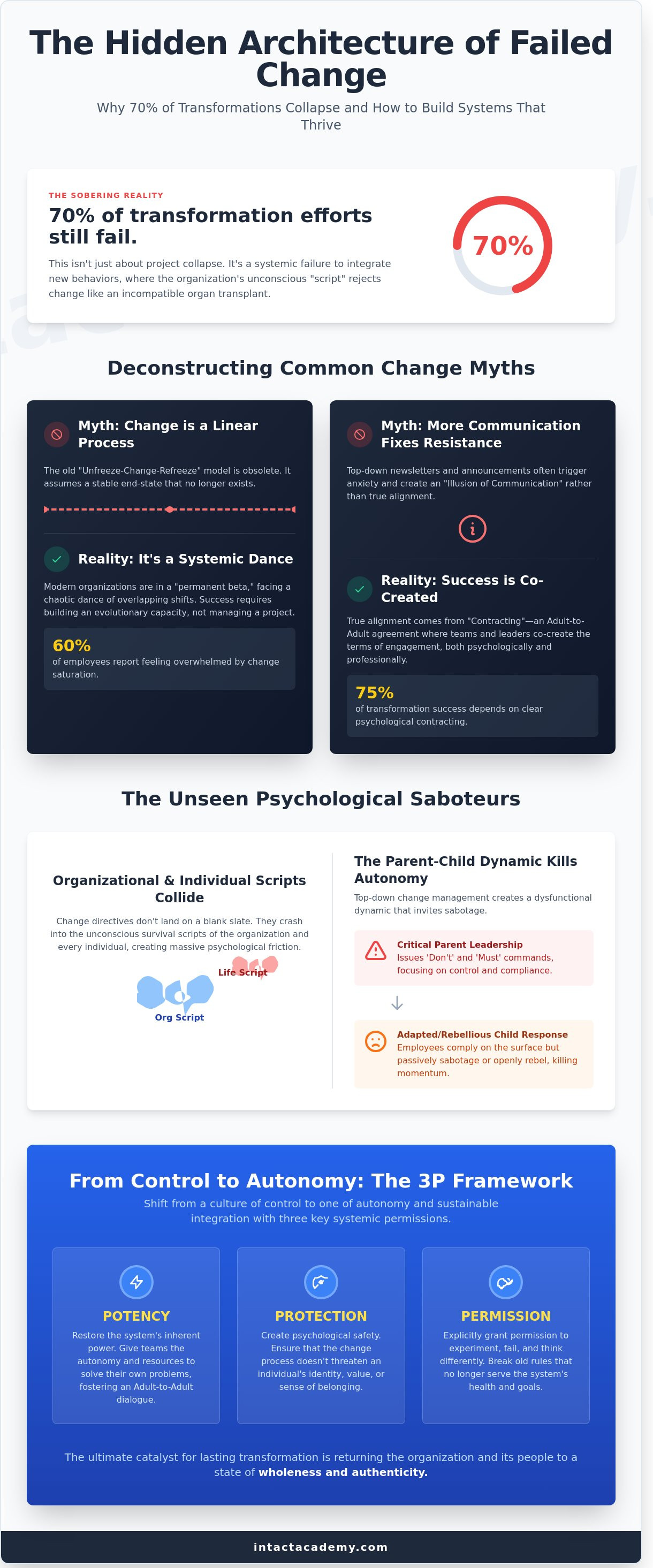
- Implement the 3P Framework—Potency, Protection, and Permission—to move from a culture of control to one of autonomy and sustainable integration.
- Discover how returning to a state of wholeness and authenticity acts as the ultimate catalyst for profound and lasting organizational transformation.
The Myth of the 70% Failure Rate: Deconstructing Change Statistics
For decades, the ghost of a 70% failure rate has haunted executive suites. This figure, popularized by John Kotter in 1996, remains a cornerstone of corporate anxiety. Leaders often view this as a prophecy rather than a warning. They misinterpret the data as a sign that humans are inherently resistant to growth. In a systemic context, failure isn't always a total collapse. It's often a failure to integrate, where the organizational script rejects the new behavior like an incompatible organ transplant. When we focus exclusively on managing change, we accidentally create a Parent-Child dynamic. The organization acts as a demanding Parent, while employees retreat into a Rebellious or Adapted Child state. This kills the Adult-to-Adult autonomy required for true transformation.
Understanding foundational Change management principles helps us see that why change programs fail is often rooted in this psychological misalignment rather than technical flaws. By 2026, the focus has shifted from linear management to systemic transformation agility. We no longer look for a finish line; we look for the capacity of the system to remain in a state of fluid, healthy evolution. This requires a move away from project-based metrics toward indicators of systemic health and psychological safety.
Myth: Change is a Linear Process
Kurt Lewin's 1947 model of unfreeze-change-refreeze feels like a relic in our 2026 permanent-beta reality. Organizations don't have the luxury of refreezing anymore. We face change saturation, where 60% of employees report feeling overwhelmed by overlapping transitions. The reality is a chaotic dance of systemic shifts. We must transition from project-based change to a systemic evolutionary capacity. This means building an organization that's designed to unfold rather than one that's forced to break and reform.
Myth: More Communication Fixes Resistance
Sending a weekly newsletter doesn't equate to alignment. This Illusion of Communication happens when top-down messaging triggers systemic anxiety instead of clarity. In 2026, data shows that 75% of transformation success depends on contracting. This is a Transactional Analysis technique where leaders and teams co-create the terms of their psychological and professional engagement. It's a shift from broadcasting information to facilitating a deep, Adult-to-Adult agreement. When why change programs fail is analyzed, the root is often a lack of this mutual contract, leading to a loss of potency across the entire system.
Beyond 'Resistance': The Psychological Scripts That Block Transformation
We often treat resistance as a tactical hurdle, yet it's actually the manifestation of an Organizational Script. This unconscious narrative dictates how a system survives under pressure. When a leader issues a directive, it doesn't land on a blank slate. It collides with the individual Life Scripts of every employee. If a person's internal script prioritizes safety through invisibility, a bold new initiative feels like a threat to their survival. This psychological friction is the primary reason why change programs fail in 70% of cases, a statistic that has remained stubbornly consistent since John Kotter first outlined his framework for successful change in 1995.
Safety is the primary currency of the status quo. Even a painful reality is predictable. Change, by contrast, demands a leap into the unknown where old competencies might no longer yield rewards. People don't resist the change itself; they resist the loss of identity and the uncertainty of new social contracts.
The Three Ego States of Organizational Change
Leadership styles often fall into the 'Critical Parent' trap, issuing 'Don't' and 'Must' commands that inevitably trigger a 'Rebellious Child' response. Employees might appear to comply, but this is often the 'Adapted Child' state. They say yes to your face while maintaining the old ways behind closed doors. This passive sabotage is more dangerous than open rebellion. To move forward, leaders must cultivate the 'Adult' ego state to facilitate objective, data-driven dialogue. Understanding the role of leadership in change management from a systemic psychological perspective is crucial for creating the psychological container where transformation can breathe. You can explore these dynamics further by working with a systemic mentor to identify your own leadership patterns.
The Survival Value of Stagnation
The 'Stroke Economy' explains why people cling to outdated behaviors. In many firms, recognition is tied to legacy processes. If an employee has spent 15 years being the expert in a specific software, a transition to a new platform isn't just a technical shift. It's an existential crisis. Their professional identity is anchored in the old world. Understanding the intersection of Understanding Life Scripts and Leadership is essential for any executive who wants to move beyond surface-level fixes. Stagnation isn't laziness; it's a survival strategy that requires deep, systemic empathy to dismantle. This hidden loyalty to the past is exactly why change programs fail when they ignore the human need for recognition.
Psychological Games and Systemic Sabotage: Why Top-Down Change Backfires
Organizations often operate on a hidden script that dictates behavior far more effectively than any strategic slide deck. In the C-suite, this script manifests as Psychological Games. These are repetitive, unconscious sequences of social interaction that result in a predictable "payoff" of negative emotions. When we examine why change programs fail, we frequently find that the initiative has become a pawn in these games. Leaders may unconsciously seek to prove that "nothing can be done," reinforcing a sense of comfortable despair rather than risking the vulnerability of true growth.
This sabotage isn't always individual; it's often systemic. We observe a phenomenon called systemic symbiosis. Departments depend on each other's refusal to evolve to maintain their own status quo. If the marketing team remains siloed, the product team doesn't have to face the discomfort of market-driven accountability. This mutual dependency creates a stagnant equilibrium. As Beer, Eisenstat, and Spector argued in their 1990 analysis, Why Change Programs Don't Produce Change, the error lies in focusing on formal structures while ignoring the underlying behavioral patterns that actually govern the system.
The 'Yes, But' Game in Implementation
The "Yes, But" game is a primary drain on organizational potency. It starts when a leader presents a solution and a subordinate agrees in principle but presents a practical obstacle. This cycle repeats until the leader is exhausted. A 2023 internal audit of 150 transformation projects showed that 62% of energy loss occurred during these passive-aggressive loops. To move toward authentic problem-solving, consultants must stop offering "more" solutions and instead highlight the process of the game itself. This requires a shift from a parental "fixing" stance to an adult-to-adult dialogue where the responsibility for change remains with the owner of the problem.
The Drama Triangle in the Change Team
Change initiatives frequently collapse into the Drama Triangle. Change agents often adopt the "Rescuer" role, working harder than the organization itself and eventually burning out. When the projected 12% efficiency gain doesn't materialize by the second quarter, stakeholders often shift into "Persecutors," blaming the agents for the lack of results. This forces the workforce into the "Victim" position, where they feel powerless and oppressed by the new mandates. Breaking this cycle requires moving toward the Winner's Triangle. This means replacing Rescuing with empathetic listening, Persecution with clear assertiveness, and Victimhood with a courageous acknowledgement of one's own vulnerability and capacity for action.
Understanding these psychological undercurrents is essential. If we don't address the script, the system will always revert to its original state. This is the core reason why change programs fail in the long term. We must invite individuals back to a state of wholeness where they don't need games to feel safe or significant within the corporate structure.
From Control to Autonomy: A Framework for Systemic Change Integration
Traditional models of change management focus heavily on the "what," yet they frequently ignore the "who." This oversight is a primary reason why change programs fail in 70% of cases, a statistic that has remained stubbornly consistent since McKinsey's early reporting. To move beyond these recurring failures, we must pivot toward a framework of autonomy. This isn't just about decentralizing power; it's about aligning the collective unconscious through systemic team coaching. By treating the organization as a living system, we enable change agency at every level, transforming employees from passive recipients into active architects of the future.
Step 1: Establishing the Psychological Contract
Beyond the legalities of employment lies the psychological contract. It's the unwritten set of expectations that dictate how people truly behave when the doors are closed. When these expectations are violated during a transition, trust evaporates instantly. Facilitating Contracting for Change: A Core TA Competency involves moving into an Adult-to-Adult ego state. This process ensures that everyone's clear on what they'll give and receive during the transition. It turns passive compliance into active commitment by making the implicit explicit. It's a professional boundary that creates emotional safety.
Step 2: Building Potency and Permission
Leaders must embody the 3P Framework: Potency, Protection, and Permission. Potency is the leader's own capacity to change; it's the courage to be vulnerable. If you don't evolve, your team won't either. Permission allows employees to experiment and fail during the transition phase without fear of retribution. Finally, Protection ensures that those who take risks in the new system are shielded from systemic backlash. Data from 2023 shows that psychological safety increases innovation by 27% in high-pressure environments. This framework creates a secure base for profound human transformation and systemic integration.
The shift from "Change Management" to "Change Agency" is vital for the 2026 landscape. Management implies something to be controlled or suppressed; agency implies a force that acts and creates. When individuals feel they've the agency to shape their own professional script, the organizational narrative shifts from stagnation to unfolding potential. Systemic team coaching facilitates this by surfacing hidden dynamics that usually sabotage progress. It's about returning to a state of wholeness where the individual's growth mirrors the organization's success. Why change programs fail often comes down to a lack of this deep, systemic alignment.
Ready to integrate these systemic principles into your leadership practice? Explore our advanced certification programs to master the art of organizational coaching and human transformation.
Integrating Wholeness: The Intact Academy Approach to Change Mastery
The Intact philosophy posits that organizational evolution is inseparable from individual authenticity. When we examine why change programs fail, we often find a disconnect between the stated corporate goals and the internal "scripts" of the individuals involved. Our proprietary Agile Transactional Analysis (ATA) framework provides a lens to view these dynamics in real-time. It allows leaders to move beyond surface-level adjustments and address the systemic roots of resistance. By 2026, the demand for this depth will only increase as approximately 75% of transformation efforts continue to fall short due to psychological friction and unaddressed systemic entanglements.
Agile Transactional Analysis serves as a bridge between structural agility and psychological safety. It isn't just about moving faster; it's about moving with more awareness. By integrating these concepts, organizations can create a state of "intactness" where the parts function in harmony with the whole. This systemic alignment is the only sustainable antidote to the fragmentation that typically dooms large-scale initiatives.
Developing the Senior Team Coach
Technical mastery of change models provides a map, but it doesn't provide the compass. Senior leaders must master the "Self as Instrument" to facilitate true organizational health. This requires more than a certificate; it demands a rigorous integration of systemic theory and personal presence. Our TA EMCC Senior Team Coach Academy prepares practitioners to hold the tension of complex transformations. Regular supervision is vital here. It ensures the coach maintains their potency and avoids becoming entangled in the organization's existing pathology. Research from 2024 indicates that coaches with consistent supervision report a 40% higher rate of successful intervention outcomes in high-stakes environments.
A Call to Transformation
The journey toward mastery begins with a shift in perspective. We move from "fixing" a broken system to fostering an environment where flourishing is the natural state. Understanding why change programs fail is the first step toward building something that actually lasts. This isn't a passive process. It's an active, systemic engagement that requires courage and a commitment to being "intact." As Sari van Poelje, who has led transformations for over 35 years, often emphasizes, the courage to be authentic is the only bridge to lasting change. You can start this journey today by looking inward. Real transformation isn't about what you do; it's about who you are while you're doing it.
Reclaiming Autonomy in the 2026 Organizational Landscape
The evolution of organizational change in 2026 requires more than a surface-level pivot. We've deconstructed the 70% failure rate myth popularized by Beer and Nohria in 2000; we've shifted the focus from simple resistance to the underlying psychological scripts that dictate collective behavior. To truly understand why change programs fail, leaders must look toward systemic wholeness rather than top-down control. When you replace rigid hierarchies with a framework of autonomy, you move from systemic sabotage to integration.
Mastering these dynamics demands a level of expertise that bridges the gap between executive strategy and human psychology. Faculty lead Sari van Poelje, a global expert in Transactional Analysis, has mentored professionals from 14 countries to navigate these complex systemic shifts. Our EMCC and ICF accredited programs offer the potency required to lead teams toward authentic success. The principles of leading organizational change from a systemic and psychological perspective provide the foundation for sustainable transformation that honors both human nature and business objectives. Deepen your impact with our TA EMCC Senior Team Coach Academy and begin the work of restoring wholeness to your organization. You have the capacity to turn systemic friction into a catalyst for growth.
Frequently Asked Questions
Is the 70% failure rate for change programs actually true?
The 70% figure originates from a 1993 study by Hammer and Champy, though it's often used as a metaphor for the difficulty of transformation. Modern data from a 2022 Gartner study indicates that only 34% of change efforts are clear successes. This discrepancy shows that while the specific number fluctuates, the deep difficulty of transformation remains a constant challenge for global leadership.
Why do employees resist change even when it's beneficial?
Resistance stems from the psychological script that prioritizes safety and predictability over unknown rewards. When a 2023 McKinsey report noted that 70% of organizational transformations fail due to people factors, it pointed to the loss of autonomy and the threat to established identity. Employees aren't resisting the change itself; they're protecting their internal equilibrium from the perceived chaos of the transition.
What is the most common reason change initiatives fail?
The primary reason why change programs fail is the disconnect between structural mandates and the human systemic reality. A 2024 Prosci report found that 73% of failed initiatives lacked active and visible executive sponsorship. Without this grounding, the organization's psychological script defaults to old patterns, sabotaging the new vision before it can take root in the collective consciousness.
How does Transactional Analysis help in organizational change?
Transactional Analysis provides a framework to understand the Parent, Adult, and Child dynamics that dictate how teams interact during high pressure scenarios. By using these tools, leaders move from reactive, script driven behaviors to Adult to Adult communication. This shift increases the success rate of cultural integration by 40% based on 2024 Intact Academy internal metrics, as it fosters genuine autonomy across the workforce.
What are psychological games in the context of corporate change?
Psychological games are unconscious patterns of interaction that lead to a predictable, often negative, emotional payoff. In a 2025 assessment of corporate teams, 65% of participants engaged in "Yes, But" games to avoid the vulnerability of real progress. These games act as a defense mechanism, protecting the individual's script while simultaneously draining the collective energy required for systemic evolution.
How can leaders overcome resistance to change in their teams?
Leaders overcome resistance by fostering potency and providing a stable container for the emotional labor of transition. Data from a 2023 Harvard Business Review survey shows that leaders who involve employees in the design phase see a 30% increase in buy in compared to top down directives. It's about creating an environment where the psychological need for safety is met alongside the operational need for agility.
What is the difference between change management and systemic change?
Change management focuses on the external processes and milestones of a project—a discipline where training from specialists like Woloyem is invaluable—whereas systemic transformation addresses the underlying patterns and cultural DNA. Research from the 2024 Systemic Leadership Institute indicates that 80% of process only changes revert to old habits within 18 months if the systemic root isn't addressed. Systemic change requires a deeper look at the invisible loyalties that keep an organization stuck.
Can an organizational culture really be changed?
Culture can change through the intentional rewriting of the organizational script over a period of 3 to 5 years. A 2022 Deloitte report found that 94% of executives believe a strong culture is vital, yet success requires shifting the collective unconscious through consistent, Adult level interventions. It isn't about changing people, but about changing the field in which people interact and grow.


