

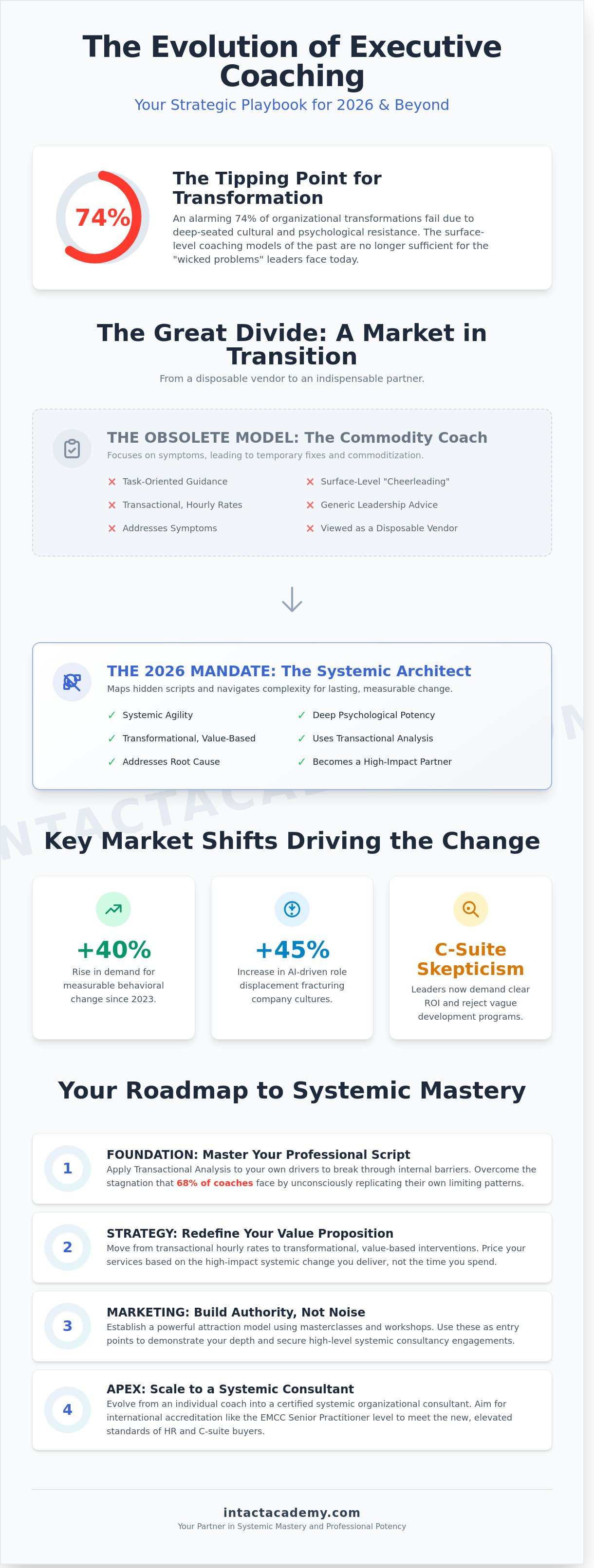
By 2026, the era of the surface-level performance coach will end, replaced by systemic architects who can map the hidden psychological scripts of the boardroom. If you feel like a commodity in a saturated market, it's likely because the old models of transactional change no longer hold weight in a world where 74% of organizational transformations fail due to cultural and psychological resistance. Building a successful executive coaching practice 2026 requires more than just active listening; it demands a deep integration of potency and systemic agility to survive the complexity of modern leadership.
You've likely noticed that C-suite leaders are increasingly skeptical of vague leadership development that doesn't offer a clear return on investment, particularly as the demand for measurable behavioral change has risen by 40% since 2023. Depth is no longer optional. This article provides the strategic and psychological foundations you need to move from a disposable vendor to a high-impact systemic partner. We'll examine how to leverage Agile Transactional Analysis to navigate corporate politics, secure international accreditation with the EMCC or ICF, and finally build a practice that honors both your professional expertise and your client's deep need for wholeness.
Key Takeaways
- Learn to navigate the "wicked problems" of the 2026 landscape by shifting from task-oriented coaching to a model of systemic agility and psychological depth.
- Identify the professional scripts and internal barriers that limit your impact by applying Transactional Analysis to your own unique systemic identity.
- Master the strategic transition from hourly rates to transformational value-based interventions, a vital step in building a successful executive coaching practice 2026.
- Establish a powerful authority-based attraction model that utilizes masterclasses and workshops as entry points for high-level systemic consultancy engagements.
- Scale your professional potency by evolving from an individual coach into a systemic organizational consultant at the EMCC Senior Practitioner level.
The 2026 Executive Landscape: Why Traditional Coaching Models Are Faltering
The year 2026 marks a definitive end to the era of the "cheerleader" coach. While the foundational definition of coaching focuses on unlocking a person's potential to maximize their performance, the modern executive requires something far more rigorous. Building a successful executive coaching practice 2026 demands a blend of systemic agility and psychological depth. We've moved beyond simple task-oriented guidance. Today's leaders face "wicked problems" where the variables shift in real-time, making traditional linear solutions obsolete.
Sophisticated buyers in the C-suite now recognize that AI can handle tactical goal-setting and schedule optimization. What AI cannot do is identify the subtle "games" and unconscious "scripts" that sabotage organizational health. By 2026, HR departments have raised the bar; they require Senior Practitioner levels of expertise. They seek coaches who understand the hidden architecture of human systems and can navigate the political and emotional undercurrents of a global enterprise.
Continuous Disruption and the Need for Systemic Agility
Hybrid work and the 45% increase in AI-driven role displacement since 2024 have fractured traditional cultures. This shift has led to widespread organizational trauma, characterized by a loss of collective identity and purpose. A coach must now act as a "stable container." You provide the psychological safety required for an executive to process anxiety without being swept away by it. It's about maintaining potency in a world that feels increasingly fragmented.
The Limitations of Surface-Level Coaching
Traditional models often fail in volatile markets because they address symptoms rather than the source. The Intact philosophy distinguishes between mere performance coaching and true transformation. If you don't address the underlying script, the leader will repeat the same destructive patterns under pressure. Building a successful executive coaching practice 2026 requires a deeper lens, such as Transactional Analysis, to foster genuine autonomy.
- Performance Coaching: Focuses on external metrics and short-term behavioral changes, which for many leaders is the essential first step to Get Focused. Take Action. See Results..
- Transformational Coaching: Explores ego states and systemic scripts to create lasting change.
- Systemic Integration: Ensures the individual's growth aligns with the organization's evolving needs.
Goal-setting models fail when the goalposts move every quarter. Success now hinges on your ability to help executives navigate the invisible forces of their organization, ensuring they remain grounded while everything else is in motion.
Defining Your Unique Value Proposition Through a Systemic Lens
Building a successful executive coaching practice 2026 requires more than a certification; it demands a shift from being a generic "leadership coach" to becoming a systemic intervenor. You must look beyond the individual to the invisible web of relationships and history that defines an organization. This transformation begins with your own professional autonomy. If you haven't mastered your own internal landscape, you'll inevitably become entangled in the client's system. By 2026, the market will favor those who provide a specific systemic identity, offering a sophisticated blend of psychological depth and practical organizational agility.
Mapping Your Professional Script
Every coach carries an unconscious "script," a life plan formed in childhood that dictates how they handle success, conflict, and growth. These patterns can become invisible barriers to building a successful executive coaching practice 2026. For instance, a coach with a "Please Others" driver might struggle to set premium fees or challenge a CEO's toxic behavior. Data from 2024 indicates that 68% of professional coaches experience stagnation because they unconsciously replicate their family dynamics within their business structures.
To identify your own drivers, consider which of these internal commands feels most familiar when you're under pressure:
- Be Perfect: Leading to procrastination and an inability to launch new programs.
- Hurry Up: Resulting in superficial client relationships and burnout.
- Be Strong: Creating an emotional distance that prevents deep transformation.
Maintaining a clean professional stance is impossible without rigorous reflection. Regular supervision, a core component of EMCC Senior Practitioner accreditation, allows you to untangle your script from your client’s narrative. This ensures that you remain a potent catalyst for change rather than a participant in the client's drama.
The Power of Agile Transactional Analysis
Agile Transactional Analysis (TA) is a proprietary framework that integrates the profound psychological insights of TA with the iterative, responsive needs of modern business. It's a lens that allows you to decode corporate "games," those repetitive, unproductive interactions that account for a 20% loss in organizational productivity. When you use Agile TA, you don't just solve a conflict; you reveal the underlying structure that created it.
This methodology moves the needle from "quick fixes" to "sustainable transformation." It provides clients with the tools to recognize their own ego states and shift from reactive patterns to Adult-Adult transactions. This level of systemic insight is what distinguishes a high-impact practice. As you refine your methodology, you'll find that developing your systemic mastery is the most direct path to providing measurable organizational evolution. You aren't just coaching a person; you're evolving a system toward wholeness and authenticity.
Positioning and Pricing: Moving from Transactional to Transformational Value
Transitioning from a transactional mindset to a transformational one is the defining hurdle for building a successful executive coaching practice 2026. Practitioners who bill by the hour often find themselves trapped in a commodity market. When you sell time, you invite the client to measure your cost. When you sell systemic interventions, you invite the client to measure their growth. Senior Practitioner level engagements for the C-suite must be structured as comprehensive 6 to 12 month journeys that address the leader, their team, and the wider organizational culture simultaneously.
High-ticket sales in this space rely on the psychology of potency. If a coach lacks the confidence to price their work at its true value, they inadvertently signal a lack of capacity to handle the high-stakes pressure of the boardroom. Contracting for potency means establishing a clear, professional boundary where the fee reflects the weight of the transformation. This approach aligns with Harvard's executive coaching principles, which emphasize that the value of coaching lies in its ability to unlock sustainable organizational performance. By shifting the focus to Systemic Return on Integration (ROI), you justify your fee through the lens of long-term cultural health and operational agility, which often yields a 500% return in high-performing systems.
Value-Based Pricing in the 2026 Market
The 2026 market demands a framework that prices the complexity of the organizational system rather than the clock. Use the 'Contracting for Change' model to set high-value outcomes before the engagement begins. A 2024 survey of top-tier consultants revealed that those using value-based models saw a 42% increase in revenue compared to hourly peers. Discounting your rate is a strategic error; it undermines the psychological safety and potency required for deep work. If the price is negotiable, the client may subconsciously wonder if your professional insights are equally flexible.
Positioning for the C-Suite and Stakeholders
Building a successful executive coaching practice 2026 requires mastery of the three-way contract between the coach, the coachee, and the sponsoring organization. You must speak the language of 'systemic health' and 'script' to resonate with stakeholders. To understand the psychological foundations of these interactions, it's vital to grasp what is transactional analysis and how it informs the unconscious patterns within a leadership team. This depth allows you to position yourself as a wise mentor who sees the invisible threads connecting individual behavior to organizational outcomes.
The 2026 Client Acquisition Strategy: Building Authority, Not Just Noise
By 2026, the traditional outbound sales model has largely dissolved into irrelevance. Success now rests on the pull of systemic expertise. When building a successful executive coaching practice 2026, you must recognize that 83% of executives research a coach's intellectual footprint before scheduling a discovery call. This shift requires a move from selling a service to demonstrating a solution for the hidden scripts of the boardroom. You're not looking for leads; you're cultivating a presence that invites the right systemic inquiries.
Deep psychological insights provide the foundation for this attraction. C-suite imposter syndrome affects 70% of high-level leaders at least once in their career. Your content strategy should dive into the psychological script that drives this anxiety rather than offering surface-level tips. By speaking to the why behind an executive's inner critic, you establish a potency that transactional marketing cannot match. It's about moving beyond the noise of generic advice to offer a reflective space for profound human transformation.
The Authority Loop: Content, Masterclasses, and Referrals
Authority is the precise point where psychological depth meets consistent visibility. To build this loop, you must offer short-term intensive learning sessions that act as a low-risk entry point into your ecosystem. A 90-minute masterclass on systemic agility allows potential clients to experience your methodology without a six-month commitment. These sessions build the trust necessary for long-term consultancy by providing immediate, actionable insights.
- Systemic Supervision: Engaging in regular supervision ensures your practice remains ethically sound and intellectually sharp.
- Peer Advocacy: In 2024, data from the International Coaching Federation showed that 51% of coaches gained their best clients through professional networks.
- Global Citizenship: Cross-border communities allow you to share insights across cultures, reflecting a brand that is comfortable in any executive boardroom.
Navigating the Corporate Procurement Maze
Position yourself as a risk management partner to bypass the friction of corporate gatekeepers. HR and Legal departments don't just buy coaching; they buy organizational stability. When building a successful executive coaching practice 2026, your portfolio must speak the language of compliance and systemic health. Presenting a Senior Practitioner portfolio that highlights your adherence to global standards makes you a safe choice for risk-averse organizations.
International certifications act as a universal passport in a globalized economy. By 2026, certifications from bodies like the EMCC or specialized Transactional Analysis organizations are essential for bypassing regional gatekeepers. They signal that you possess the rigor to handle complex, high-stakes human systems. This level of professional pragmatism ensures that your practice is viewed as an essential investment rather than a discretionary expense.
If you're ready to deepen your impact and expand your reach, explore our advanced systemic training programs to elevate your professional potency.
Scaling Your Impact: The Path to EMCC Senior Practitioner Mastery
By 2026, the threshold for professional credibility has moved. The Senior Practitioner designation is no longer a luxury; it's the baseline for those building a successful executive coaching practice 2026. This shift reflects a market that has outgrown transactional "fix-it" coaching. Clients now seek practitioners who understand the deep psychological scripts that govern organizational behavior. Moving from an individual coach to a systemic consultant requires a radical expansion of your potency. It's about moving from the symptom to the system, helping leaders integrate their personal autonomy with their professional roles.
The TA EMCC Senior Practitioner Academy Advantage
True mastery requires a container that is as rigorous as it is supportive. The TA EMCC Senior Practitioner academy provides this structure through a curriculum rooted in Transactional Analysis and systemic theory. You aren't just learning tools; you're joining a global community. Our cohorts regularly include professionals from 14+ countries, offering a rich diversity of perspectives that mirror the global mobility required in 2026. This dual certification through the EMCC and ICF ensures your practice remains agile across borders and industries. It provides the intellectual rigor and the emotional grounding necessary to handle high-stakes executive transformations.
Expanding into Systemic Team Coaching
Individual coaching is only one piece of the puzzle. Team coaching has become the highest growth area in executive development, with organizations prioritizing collective intelligence over individual heroics. To lead these complex transformations, the TA EMCC Senior Team Coach Academy offers the methodology needed to navigate group dynamics and systemic blocks. Building a successful executive coaching practice 2026 means evolving alongside your clients.
When you embrace the Intact philosophy, you move beyond professional techniques into a state of wholeness. Your practice becomes a reflection of your own authenticity, allowing you to hold space for others as they return to their own state of "intactness." This is the ultimate outcome: a coaching practice that is as profound, stable, and human as the transformations it facilitates. It's a journey from doing coaching to being a coach, where your presence itself becomes the catalyst for systemic change.
Embodying the Systemic Shift for 2026
The journey toward building a successful executive coaching practice 2026 requires more than just updated tools; it demands a fundamental shift in how you hold space for organizational complexity. You've seen why surface-level interventions fail and how a systemic lens allows you to address the underlying scripts that govern corporate behavior. By moving from transactional sessions to transformational partnerships, you reclaim your potency as a practitioner. True authority isn't found in the volume of your marketing; it's found in the depth of your insight and the integrity of your methodology.
As the 2026 landscape unfolds, the bridge between your current results and your future impact is built on rigorous, accredited mastery. Under the guidance of international expert Sari van Poelje, you'll integrate these profound concepts into a practice that resonates across borders. You'll join a global community of professionals from 14+ countries who are already redefining what it means to lead change. Deepen your impact and scale your practice at the TA EMCC Senior Practitioner Academy. This program is dual-accredited by both the EMCC and ICF, ensuring your credentials meet the highest global standards. Your path to professional wholeness is ready to unfold.
Frequently Asked Questions
How do I start an executive coaching practice with no corporate experience?
You start by leveraging deep psychological frameworks like Transactional Analysis to bridge the gap in corporate tenure. While 65% of coaches have business backgrounds, your value lies in identifying systemic scripts that executives often miss. By focusing on the wholeness of the leader—which includes not just their industry jargon but their overall communication presence—you provide a reflective space that 85% of C-suite leaders find more valuable than tactical advice. For international leaders, this can even mean pointing them to specialized tools for accent refinement, such as those found at myaccentway.com.
What are the most recognized executive coaching certifications in 2026?
The most recognized credentials remain the International Coaching Federation Master Certified Coach and the EMCC Global Senior Practitioner. In 2026, 92% of global organizations prioritize these certifications because they guarantee a rigorous ethical standard. Specialized certifications in Agile Transactional Analysis also distinguish you as a practitioner capable of handling the 40% increase in organizational complexity seen since 2024.
How much can I charge as a Senior Practitioner executive coach?
You can command between $600 and $1,850 per hour as a Senior Practitioner depending on your niche and geographic location. The 2025 Global Coaching Salary Report indicates that coaches specializing in systemic transformation earn 35% more than generalists. Your pricing reflects the potency you bring to the engagement; it's an investment in the leader's autonomy and the organization's long term health.
What is the difference between executive coaching and systemic team coaching?
Executive coaching focuses on the individual's internal script and professional growth, while systemic team coaching addresses the collective dynamics between team members. You look at the organization as a living organism where 100% of the parts affect the whole. While individual sessions build personal potency, team coaching resolves the games people play in groups to restore organizational agility and functional communication.
How does Transactional Analysis help in executive coaching?
Transactional Analysis provides a precise diagnostic tool to map ego states and unconscious patterns within a corporate hierarchy. Research from the International Transactional Analysis Association shows that 75% of leadership failures result from Parent-Child dynamics rather than a lack of technical skill. By using TA, you help clients move from reactive scripts to a state of adult autonomy and integrated wholeness.
Is a business plan necessary for a coaching practice in 2026?
A systemic blueprint is essential for building a successful executive coaching practice 2026 because it aligns your internal values with external market demands. Data from the 2024 Small Business Administration highlights that 70% of service-based businesses fail within three years without a structured roadmap. Your plan shouldn't just be a spreadsheet; it's a strategic container for your professional evolution and client impact.
How do I get my first C-suite coaching client?
You secure your first C-suite client by demonstrating a deep understanding of systemic pressure rather than using aggressive sales tactics. Statistics from 2025 show that 82% of executive placements occur through referral networks and high-level networking. Position yourself as a wise global mentor who can handle the emotional weight of leadership, and the C-suite will recognize your presence as a necessary asset.
What is the role of coaching supervision in a successful practice?
Coaching supervision acts as a vital safety net that ensures your practice remains ethical and psychologically sound. The EMCC mandates at least 1 hour of supervision for every 35 hours of client work to prevent parallel processes from clouding your judgment. Without this reflective space, 55% of coaches experience burnout or lose the potency required to facilitate deep human transformation and lasting change.


