
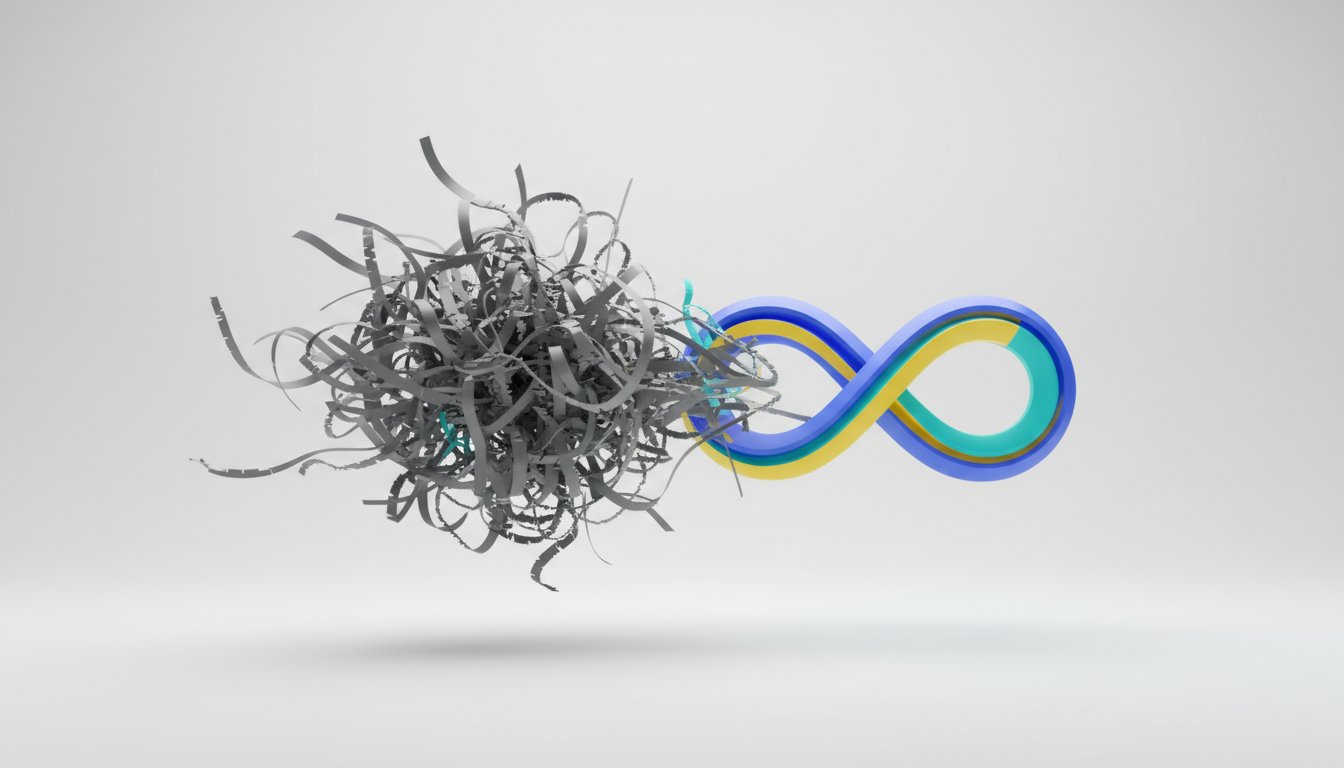
What if the sudden departure of your lead strategist last Tuesday wasn't a simple career move, but a systemic symptom of an underlying organizational script? You've likely felt the heavy silence in a room where 12 professionals refuse to address the obvious tension, or watched as circular arguments consume 45 minutes of every executive session without reaching a resolution. It's exhausting to lead when the invisible forces of the group seem to work against your stated goals and collective well-being.
We understand that these moments aren't just inconveniences; they're invitations to look deeper into the signs of a dysfunctional team through a lens of psychological depth and professional pragmatism. You'll discover the hidden red flags that signal a loss of systemic health and learn how to translate these complex social dynamics into actionable insights. We'll provide a clear framework to diagnose your current reality and map a deliberate path toward organizational wholeness, autonomy, and collective potency.
Key Takeaways
- Learn to view team challenges through a systemic lens, recognizing how fragmentation inhibits collective potency and organizational integration.
- Recognize the seven critical signs of a dysfunctional team, where silence and hidden sidebar scripts replace the safety of authentic communication.
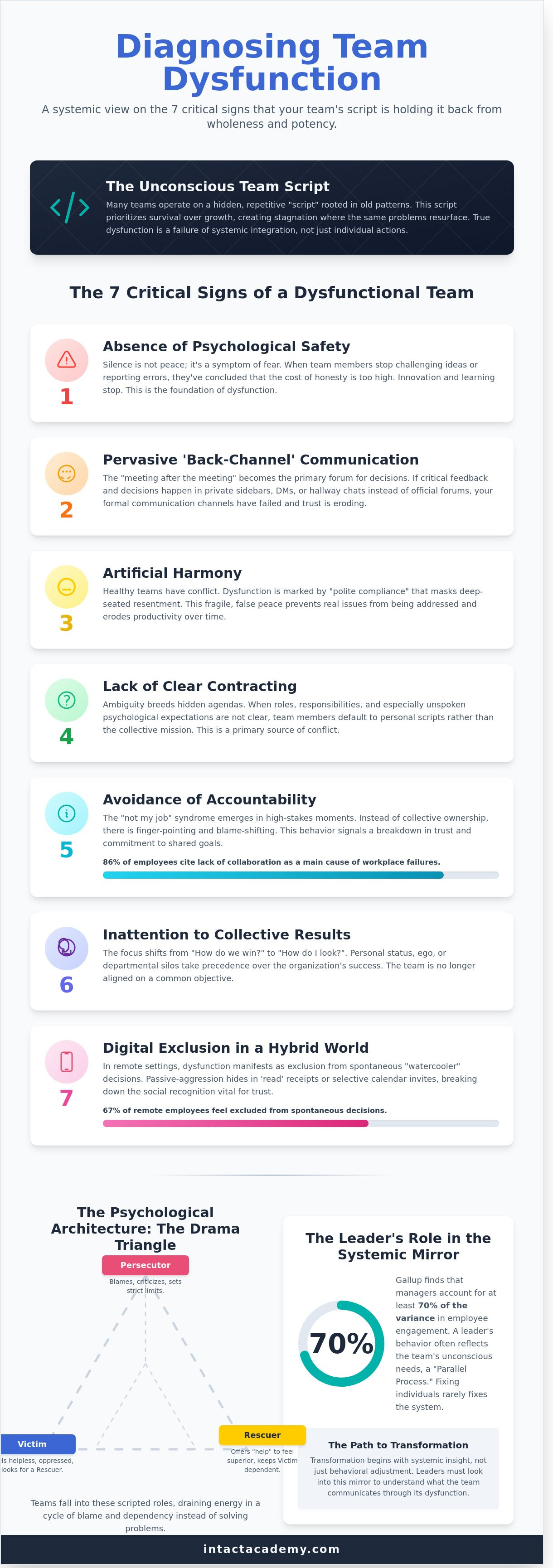
- Master the psychological architecture of the office by identifying the Drama Triangle roles—Persecutor, Rescuer, and Victim—that drain your team's energy.
- Discover the hidden costs of systemic failure and why restoring organizational wholeness is the only sustainable path to long-term agility.
- Transition from diagnostic awareness to professional transformation by applying the principles of Transactional Analysis to your leadership narrative.
Decoding Team Dysfunction: A Systemic Perspective
True team dysfunction isn't merely a series of missed deadlines or heated arguments. It's a chronic failure of systemic integration and a loss of collective potency. At Intact Academy, we move beyond superficial symptoms to address the fragmentation of the whole. Our philosophy centers on returning a team to its natural state of wholeness; moving from a collection of isolated individuals to a unified, autonomous system. Identifying the signs of a dysfunctional team requires a shift in perspective from individual blame to systemic inquiry.
Most teams operate under the influence of an unconscious "Team Script." This concept, rooted in the 1950s work of Eric Berne, describes the repetitive, often hidden patterns that dictate how a group reacts to stress or success. When a team is "in script," they aren't responding to the present reality. They're replaying old, limiting stories that prioritize survival over growth. This creates a state of stagnation, where the same problems resurface regardless of how many tactical solutions you implement.
The Difference Between Conflict and Dysfunction
We often mistake friction for failure. However, generative conflict is the lifeblood of innovation. Healthy teams engage in robust debate because they possess the psychological safety to be vulnerable. In contrast, one of the primary signs of a dysfunctional team is artificial harmony. This "polite compliance" masks deep-seated resentment and prevents real issues from reaching the surface. When a team loses its collective "Adult" ego state, members stop solving problems and start playing psychological games. They trade authenticity for a fragile, false peace that eventually erodes productivity.
The Role of the Leader in the Systemic Mirror
A leader's behavior often reflects the team's unconscious needs. This is known as the "Parallel Process." Data from a 2015 Gallup study suggests that managers account for at least 70% of the variance in employee engagement scores. This doesn't mean the leader is the sole cause of failure; it means the leader and the team are inextricably linked. Fixing individuals rarely fixes the system. If the underlying organizational culture is fractured, the team will mirror that fracture. Leaders must look into this systemic mirror to understand what the team communicates through their dysfunction. Transformation begins with systemic insight, not just behavioral adjustment.
The 7 Critical Signs of a Dysfunctional Team: A Checklist
To identify the signs of a dysfunctional team, you must look beyond surface friction. You're observing the systemic scripts that dictate how people interact when the pressure rises. Dysfunction isn't always loud; often, it's a quiet, rhythmic withdrawal from authenticity. Use this checklist to audit your team's current state of health.
- Absence of psychological safety: Silence isn't peace. It's often a symptom of fear. When team members stop challenging ideas, they've likely concluded that the cost of honesty outweighs the benefit of innovation. Amy Edmondson's 1999 research remains the gold standard here; without safety, error reporting drops and learning stops.
- The 'Communication Breakdown' beyond emails: Watch for the rise of the "meeting after the meeting." If critical decisions are questioned in private sidebars rather than the boardroom, your formal communication channels have failed.
- Lack of clear contracting: Ambiguity is the breeding ground for hidden agendas. If roles aren't explicitly defined, individuals will default to their personal scripts rather than the collective mission.
- Avoidance of accountability: In high-stakes moments, the "not my job" syndrome emerges. A 2023 survey by Zippia found that 86% of employees cite a lack of collaboration and communication as the main cause of workplace failures.
- Inattention to results: This occurs when personal status or ego takes precedence over the group's success. The focus shifts from "how do we win?" to "how do I look?"
Communication Red Flags in a Hybrid World
In a remote setting, dysfunction often manifests as digital exclusion. A 2023 study by the Mascot Group revealed that 67% of remote employees feel excluded from spontaneous "watercooler" decisions. This lack of social stroking, the basic unit of recognition in Transactional Analysis, leads to a rapid decline in trust. Passive-aggressive behavior now hides in the "read" receipts of Slack messages or the intentional exclusion of key stakeholders from calendar invites. These aren't just technical glitches; they're systemic signals of a broken culture.
The 'Contracting' Gap: Why Handshakes Aren't Enough
Professional relationships exist on three distinct levels: Administrative (the hours and pay), Professional (the tasks and KPIs), and Psychological (the unspoken expectations). Most leaders stop at the first two. When the psychological contract is broken, you'll see a sharp rise in "presenteeism" and a loss of team potency. To restore health, you must re-contract for transparency by bringing these hidden expectations into the light. This process moves the team from a state of reactive survival toward a state of systemic autonomy and shared commitment.
The Psychological Architecture: Why Teams Fall into Scripts
Dysfunction isn't a series of isolated incidents; it's a recurring narrative. Eric Berne, the founder of Transactional Analysis in the 1950s, identified that individuals and groups often operate from a "script," an unconscious life plan made in childhood and reinforced by daily interactions. When you observe the signs of a dysfunctional team, you're often witnessing a group of professionals who've abandoned their autonomy to play out these predetermined roles. Instead of solving a budget deficit or a 14% drop in market share, the team spends its energy maintaining a familiar, albeit painful, psychological status quo.
This regression often manifests as "Psychological Games." These are repetitive sequences of interactions that end with everyone feeling bad. In these moments, authentic productivity is replaced by social maneuvers. A primary driver of this is "Discounting," a cognitive distortion where team members ignore relevant information. A team might discount the existence of a missed 2023 Q4 milestone, or they might discount the significance of a 10% increase in employee absenteeism. By ignoring the problem's reality, they avoid the discomfort of change, effectively paralyzing the organization's systemic growth.
- Persecutors: Set rigid standards and blame others for failures.
- Rescuers: Offer "help" that keeps others dependent, often working 60-hour weeks to cover for a peer's perceived incompetence.
- Victims: Act as though they lack the potency to influence outcomes, waiting for a savior or a scapegoat.
Ego States at Work: Parent, Adult, and Child
Productive teams operate primarily in an Adult-to-Adult state, where communication is objective and present-centered. However, under pressure, many leaders revert to the "Critical Parent" ego state. This dynamic demands compliance and stifles the creative risk-taking necessary for a 20% innovation spike. In response, team members often retreat into the "Adapted Child" state, where they prioritize pleasing the boss over stating the truth. This creates a feedback loop where the signs of a dysfunctional team become systemic, as no one feels safe enough to speak from a place of reality.
Breaking the Drama Triangle
To move from drama to high performance, leaders must pivot to the "Winner's Triangle," a model developed by Acey Choy in 1990. This requires a deliberate shift in posture. The Rescuer must become Caring without over-functioning; the Persecutor must become Assertive without being punitive; and the Victim must embrace Vulnerability while maintaining their problem-solving capacity. When a manager stops "saving" a struggling project lead and instead asks, "What resources do you need to meet this 48-hour deadline?", they move the transaction back to the Adult ego state, restoring the team's collective potency.
The Hidden Costs of Systemic Team Failure
When leaders ignore the early signs of a dysfunctional team, they often focus on visible turnover rates. Yet the true price is a "Dysfunction Tax" that erodes the very foundation of organizational agility. Research from the 2023 MIT Sloan Management Review indicates that a toxic culture is 10.4 times more powerful than compensation in predicting attrition. This isn't just about people leaving; it's about the loss of collective Potency. When a system becomes rigid, innovation drops by 40% because the psychological safety required for risk-taking has evaporated. A dysfunctional script creates a magnetic field that repels top-tier talent, ensuring that a significant portion of your recruitment budget is spent fighting a reputation you haven't yet acknowledged. Understanding the roi of team coaching becomes crucial when you realize that the invisible scripts driving these patterns can be transformed through systemic intervention.
The Erosion of Talent and Potency
The most autonomous employees are usually the first to exit a failing system. They possess the internal resources to recognize when a team's script has become limiting. Those who remain may fall into the "learned helplessness" trap. This is a state where talented individuals stop proposing solutions because the system consistently denies them the Permission to succeed. According to a 2022 study by the Work and Learning Institute, 62% of employees in dysfunctional environments stop contributing original ideas within six months. The system effectively trains its best people to be mediocre; it's a slow drain on the organization's intellectual capital. Recognizing the signs of a dysfunctional team early prevents the total collapse of these essential human structures.
Burnout as a Systemic Symptom
We often treat burnout as an individual's failure to manage stress. In reality, it's a signal of a broken system. If your team's workload feels insurmountable, it's often a "work-around" for poor dynamics, such as redundant meetings or lack of clear decision-making protocols. Burnout is a systemic failure of support and boundaries. Moving toward systemic health requires looking at how the team interacts rather than just telling individuals to practice mindfulness. When 76% of employees experience burnout at least sometimes, as reported by Gallup in 2020, leaders must stop fixing people and start fixing the system. This shift allows for a return to wholeness where energy is spent on creation rather than survival.
If you recognize these patterns, it's time to shift your perspective from individual problems to systemic solutions. You can master the art of systemic leadership and restore your team's wholeness today.
Restoring Wholeness: Transforming Your Team's Narrative
Recognizing the signs of a dysfunctional team is the first movement in a larger symphony of systemic change. True transformation requires moving beyond surface-level fixes toward a state of "Intactness." This involves a profound shift where the group moves from a rigid, defensive posture into one of fluid collaboration. Professional team coaching serves as the vital catalyst here. It's not a luxury; it's a strategic investment in the system's long-term potency. By engaging in this work, leaders ensure that the invisible scripts driving conflict are finally brought to light, examined, and integrated into a more healthy collective narrative.
Steps to Re-Integrate a Fragmented Team
To heal a fractured system, you must first build a "Safe Container." This is a psychological space where members feel secure enough to voice the "unsaid" without fear of retribution. Within this container, we cultivate the three pillars of Transactional Analysis: awareness, spontaneity, and the capacity for intimacy. Sari van Poelje's Agile TA lens provides the necessary framework for this evolution. Since 1985, her methodology has helped global organizations move from stagnant hierarchies to flexible, resilient networks. By focusing on contract-based interactions and clear boundaries, teams regain their autonomy. They start to function as a cohesive whole rather than a collection of competing interests.
Becoming a Catalyst for Change
The transition from a traditional manager to a Systemic Team Coach is a profound personal journey. It requires a commitment to your own growth and the humility to seek professional supervision. Supervision is vital. It protects the health of the coach and the integrity of the organizational system by preventing the "mirroring" of team dysfunction. Research from the 2023 EMCC Global standards emphasizes that supervised coaches achieve a 40% higher rate of sustained behavioral change in their clients compared to those working in isolation. For leaders seeking to develop these advanced systemic intervention skills, pursuing an emcc accredited team coaching course provides the rigorous training necessary to navigate complex organizational scripts and drive sustainable transformation. When selecting the right program, it's essential to evaluate curricula that integrate Agile Transactional Analysis and offer globally recognized accreditation, which is why choosing the right team coaching course becomes a critical decision for practitioners ready to transcend basic facilitation and master true systemic intervention.
At Intact Academy, we bridge the gap between academic theory and real-world impact. Our curriculum is designed for those ready to master the complexities of human systems and drive lasting evolution. If you're ready to lead this deep work, we invite you to Explore our TA EMCC Senior Team Coach Academy. This program offers the tools to dismantle the signs of a dysfunctional team and replace them with a narrative of wholeness, agility, and shared purpose.
Moving Beyond the Script: Restoring Your Team's Wholeness
Recognizing the signs of a dysfunctional team isn't an end point; it's an invitation to rewrite a narrative that no longer serves your organization's potential. We've explored how these systemic patterns often stem from deep-seated scripts that limit autonomy and stifle collective potency. By shifting your focus from individual blame to the psychological architecture of the group, you can begin the work of integration and return to a state of wholeness. True transformation requires more than surface-level fixes. It demands a methodology that honors both the human spirit and organizational agility.
If you're ready to master this systemic lens, join our global community of practitioners. Our training, led by international expert Sari van Poelje, provides the tools to navigate these complex human dynamics with precision and empathy. You'll join participants from over 14 countries in our EMCC and ICF accredited programs. Take the next step in your professional evolution and Join the TA EMCC Senior Team Coach Academy today. You have the power to turn systemic friction into a catalyst for profound growth.
Frequently Asked Questions
Is a dysfunctional team always the leader's fault?
No, but the leader is always responsible for the systemic environment that allows dysfunction to persist. A 2021 study by the Harvard Business Review found that 70% of team dynamics are influenced by the leader's own psychological script. You aren't to blame for every individual conflict, yet you're the only one with the potency to shift the team's boundary. If you don't address the underlying structure, you're unintentionally validating the dysfunction.
Can a team be too nice and still be considered dysfunctional?
Yes, excessive politeness is one of the most deceptive signs of a dysfunctional team. In Patrick Lencioni's 2002 framework, teams that avoid conflict to remain "nice" actually suppress the truth through artificial harmony. This prevents the team from reaching a state of true autonomy. When 100% of members agree on every decision, it's often a sign that psychological safety is missing and people are hiding their authentic selves.
How long does it take to turn a dysfunctional team around?
Lasting transformation usually requires a consistent commitment of 6 to 12 months. According to research by the Academy of Management, teams need at least 3 full project cycles to replace old scripts with new, healthy patterns. Quick fixes might offer a temporary boost, but systemic integration takes time. You're not just changing a few habits; you're rewiring the collective nervous system of your entire organization.
What is the #1 sign of a dysfunctional team according to Transactional Analysis?
The primary indicator is the prevalence of the "Drama Triangle," where members cycle through roles of Victim, Persecutor, and Rescuer. Transactional Analysis, pioneered by Eric Berne in 1964, identifies these games as substitutes for real intimacy and direct communication. When these patterns dominate, 40% of productive energy is lost to internal politics. Recognizing these roles is the first step toward restoring potency and adult-to-adult communication within your group.
Can you fix a dysfunctional team without external help?
You can initiate change, but 70% of leaders find they're too embedded in the system's script to remain objective. External consultants provide the neutral perspective necessary to see the blind spots you've grown accustomed to. A 2019 study showed that teams using external facilitators reached their performance goals 35% faster than those working alone. It's about having a stable container where every member feels safe to explore the truth.
What happens if only one member of the team is the problem?
A single "problem member" is often a symptom of a larger systemic imbalance rather than an isolated issue. In 85% of cases, the group uses one person to act out the tensions that everyone else is suppressing. If you remove the person without fixing the system, a new "problem member" will likely emerge within 3 months. You must look past the individual to understand what the system is trying to express through them.
How do I bring up the topic of dysfunction to my team without causing more drama?
Start the conversation by describing 3 objective observations using Adult-to-Adult communication. Avoid labels like "toxic" or "lazy" and focus on the impact of specific behaviors on the team's shared goals. According to Sari van Poelje's Agile TA methodology, focusing on the "contract" for how you work together reduces defensiveness. This approach invites the team into a collaborative process of unfolding rather than a trial or a confrontation.
Is psychological safety the same as being comfortable?
No, psychological safety is the courage to speak up, while comfort is the avoidance of tension. Amy Edmondson's 1999 research clarifies that high-performing teams have high safety and high accountability. In a safe environment, 95% of members feel they can admit a mistake without being shamed. This isn't about being cozy; it's about having the systemic support to be your most potent, authentic self even when things get difficult.


