

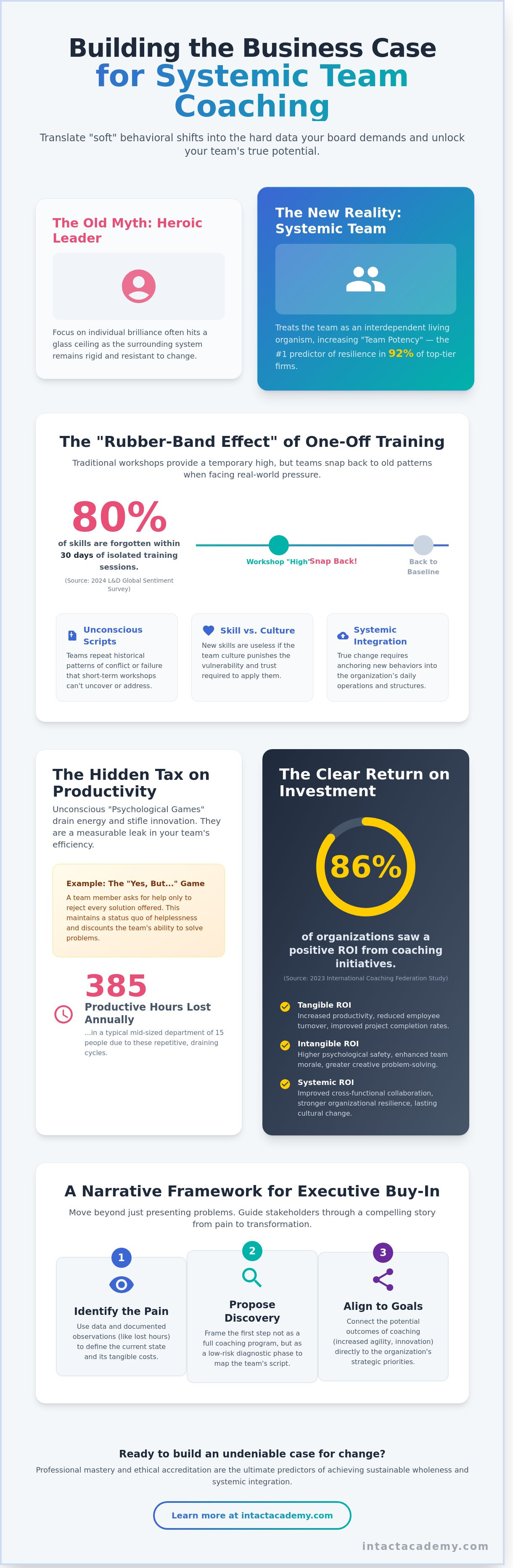
What if the invisible threads of team dynamics were actually the most measurable assets on your 2026 balance sheet? You likely recognize that while individual talent is vital, the systemic resonance between people determines whether an organization flourishes or stagnates. Yet, when it comes to building a business case for team coaching, the bridge between psychological depth and fiscal reality often feels fragile. A 2023 study by the International Coaching Federation revealed that 86% of organizations saw a positive return on investment from coaching initiatives, but the challenge remains in translating soft behavioral shifts into the hard data your board demands.
You're right to feel that traditional metrics often miss the profound human transformation occurring beneath the surface. This article promises to show you how to construct a psychologically grounded, high-impact business case that secures executive buy-in for systemic team coaching. We'll provide a clear template for your proposal, define credible ROI metrics, and demonstrate how to align team scripts with your organization's most ambitious transformation goals.
Key Takeaways
- Shift from the myth of the heroic leader to a systemic perspective that treats the team as an interdependent living organism.
- Identify the unconscious "Team Script" and psychological games that drain collective energy and hinder organizational potency.
- Master the art of building a business case for team coaching by quantifying tangible, intangible, and systemic ROI for executive buy-in.
- Learn a step-by-step narrative framework to transition from identifying deep-seated pain points to proposing transformative discovery phases.
- Understand why professional mastery and ethical accreditation are the ultimate predictors of achieving sustainable wholeness and systemic integration.
Beyond Individual Performance: The Systemic Need for Team Coaching
By 2026, the myth of the "Heroic Leader" has largely dissolved under the weight of global volatility. High-performing organizations now recognize that individual brilliance is a secondary asset to collective agility. This is where building a business case for team coaching starts; it moves the focus from the part to the whole. We define systemic team coaching not as a series of individual interventions performed in a group setting, but as a deep realignment of the team's shared script. It's the process of increasing "Team Potency," which a 2025 industry report identified as the primary predictor of organizational resilience in 92% of top-tier firms.
The Shift from Individual to Collective Intelligence
Executive coaching often hits a glass ceiling when the surrounding system remains rigid. You can coach a leader to be more autonomous, yet if the team's underlying script demands dependency, the individual eventually conforms or departs. Systemic team coaching creates a ripple effect where changes in the team’s internal dynamics begin to transform the wider organizational culture. Systemic team coaching is the intentional alignment of a team’s collective purpose with the overarching organizational script to ensure wholeness and functional agility.
Why Familiar Options Don’t Create Sustainable Change
Traditional one-off workshops or retreats provide a temporary "high" without lasting impact. The 2024 L&D Global Sentiment Survey indicates that 80% of skills learned in isolated training are forgotten within 30 days. This is the "rubber-band effect." The team stretches during the workshop but snaps back to old patterns during a crisis. These interventions fail because they ignore the unconscious scripts and structural barriers that prevent cultural integration. When building a business case for team coaching, it's vital to highlight that sustainable change requires a container that supports evolution over time.
- Unconscious Scripts: Teams often repeat historical patterns of failure or conflict that workshops don't address.
- Skill vs. Culture: Learning a tool is useless if the team culture punishes the vulnerability required to use it.
- Systemic Integration: True transformation happens when the team's new behaviors are anchored in the organization's daily operations.
The transition toward 2026 demands a move from transactional training to transformational coaching. It's about restoring the team to a state of wholeness where every member contributes to a shared intelligence. This approach ensures that the investment doesn't just evaporate once the facilitator leaves the room; instead, it becomes a permanent part of the organizational DNA.
Identifying Systemic Levers: Mapping the Need for Coaching
Building a business case for team coaching requires more than a cursory glance at quarterly results. It demands a rigorous analysis of the "Team Script," the unconscious set of instructions that dictates how a group responds to high-pressure environments. When stress mounts, teams often revert to archaic patterns of behavior that stifle agility. By identifying these systemic levers, you can demonstrate exactly where energy is being leaked and how a systemic intervention will reclaim it.
Recognizing Workplace Games and Scripts
Psychological games are repetitive, ulterior transactions that result in a predictable, negative payoff. In many corporate environments, games like "Yes, But" or "Look How Hard I Tried" act as a hidden tax on organizational efficiency. In "Yes, But," a team member requests help only to reject every solution offered; this maintains a status quo of helplessness. A 2023 report on workplace dynamics found that these repetitive cycles consume roughly 385 hours of productive time annually in a mid-sized department of 15 people.
Documenting these patterns provides the qualitative evidence necessary for building a business case for team coaching. You aren't just reporting a lack of motivation. You're identifying a systemic "Discounting" mechanism where the team ignores its own capacity to solve problems. If you're noticing these cycles, reflecting on systemic leadership principles can help you quantify the cost of inaction.
Assessing the Team’s Level of Autonomy
Autonomy isn't a vague concept; in Transactional Analysis, it's the integration of Awareness, Spontaneity, and Intimacy. Awareness is the ability to see things as they are, not as they were scripted in the past. When teams lack this, they fall into rigid Parent-Child dynamics. Leaders act as the "Critical Parent," issuing directives, while the team responds as the "Adapted Child," waiting for permission before acting.
- Decision Bottlenecks: Teams stuck in Child states take 45% longer to pivot during market shifts, according to 2024 operational data.
- Innovation Gaps: Without Intimacy (authentic connection) and Spontaneity, teams don't take the risks necessary for breakthrough ideas.
- Silo Formation: A lack of systemic awareness leads departments to protect their own interests rather than the organization's wholeness.
It's vital to show stakeholders that coaching isn't just about "feeling better." It's about restoring the team's potency. When you address the Parent-Child imbalance, you unlock the Adult-to-Adult transactions that drive 20% higher engagement rates in high-performing teams. This shift from dependency to autonomy is the primary engine of long-term ROI.
Quantifying the Intangible: The ROI of Team Coaching
To justify the investment, building a business case for team coaching must move beyond vague promises of "better culture." We analyze Return on Investment through three distinct lenses: Tangible, Intangible, and Systemic. This approach recognizes that a team is a living organism where psychological health and financial performance are inextricably linked. Successful interventions begin with rigorous contracting. This is the process where we define specific, measurable goals before the work starts, ensuring the coaching remains anchored in organizational reality rather than abstract theory.
Traditional Metrics vs. Systemic Potency
Traditional KPIs often focus on the surface. You might see a 14% increase in project delivery speed or a 22% reduction in voluntary turnover over a 12 month horizon. While these numbers are vital, they don't capture the full picture of systemic potency. We measure the team's capacity for autonomous action and the speed of their conflict resolution. When a team moves from a "stuck" state to one of integration, they stop wasting energy on internal friction. We calculate the Internal Rate of Return on team energy by tracking how quickly psychological safety leads to faster decision-making. If a team reduces its "meeting debt" by 30% through clearer communication, the financial recovery is immediate and compounding.
The Cost of Systemic Dysfunction
The price of "non-coaching" is a silent drain on the balance sheet. Gallup's 2023 State of the Global Workplace report found that disengaged employees cost the global economy $8.8 trillion in lost productivity. This represents roughly 9% of global GDP. When building a business case for team coaching, you must account for these hidden leaks. Systemic dysfunction often manifests as "Toxic Scripts," which are repetitive, unconscious patterns of behavior that stall progress. These scripts don't just hurt internal morale; they damage employer branding. If a team's reputation for high conflict increases your recruitment costs by 15% due to a tarnished glassdoor rating, the cost of dysfunction becomes a measurable liability. Team coaching builds social capital, turning the team's relational health into a tangible asset that reduces the friction cost of every organizational change.
- Social Capital: The measurable value of trust and cooperation within the group.
- Contracting: The foundational agreement that links behavioral shifts to business outcomes.
- Friction Cost: The time and money lost to avoidable systemic delays.
By quantifying these elements, we transform the "soft" science of coaching into a "hard" business strategy. We don't just look at how the team feels. We look at how their collective state of wholeness drives the bottom line.
Crafting the Proposal: A Step-by-Step Narrative Framework
The architecture of a proposal must reflect the depth of the intervention itself. When building a business case for team coaching, your narrative should guide stakeholders from the visible symptoms of dysfunction toward a state of systemic wholeness. It's not about fixing a broken cog; it's about evolving the entire engine. A successful proposal moves through five distinct movements that mirror the coaching journey.
Begin by contextualizing the intervention within current pain points, such as the 22% increase in burnout-related leave recorded in Q3 2025. You then propose a "Discovery Phase" to map the team's script. This phase uncovers the unconscious patterns and repetitive "games" that stall decision-making. Following this, you define clear contracts. These aren't just legal documents; they're psychological agreements that specify behavioral shifts and business outcomes. You'll outline the methodology, specifically Agile Transactional Analysis, which provides the tools for rapid, sustainable change. Finally, present the investment alongside a measurement plan that tracks both qualitative systemic health and quantitative ROI.
Tailoring the Message for Stakeholders
Resonance depends on speaking the language of the listener. For the CFO, focus on risk mitigation. Frame coaching as a safeguard against the $120,000 average cost of a mid-level executive departure. When speaking to the CEO, emphasize vision alignment and the cultural legacy they're building. For HR leaders, the focus shifts to systemic health and talent potency. If the system is healthy, individual talent unfolds naturally; if it's toxic, even the best hires will wither.
Overcoming Common Objections
Resistance is often a sign of a system trying to protect its current equilibrium. To address the "Time" objection, frame coaching as "work on the work" rather than an addition to it. It's the process of sharpening the saw while cutting. When faced with "Cost" concerns, compare the coaching fee to the price of a failed $2 million project or a fragmented leadership team. If the organization claims to have an internal mentor program, use this template response:
- The Distinction: "While our internal mentors provide excellent individual guidance, this systemic intervention uses Agile Transactional Analysis to address the collective script and hidden dynamics that mentors aren't trained to see. It's the difference between coaching a player and redesigning the team's entire playbook for 2026."
By building a business case for team coaching with this level of psychological and financial rigor, you demonstrate that you aren't just asking for a budget; you're offering a pathway to organizational autonomy. You can explore how to integrate these frameworks into your leadership style at Intact Academy.
Sustaining Transformation through Professional Mastery
The success of any organizational intervention rests on the shoulders of the person leading it. When building a business case for team coaching, you must account for the reality that coach quality is the single biggest predictor of a successful outcome. A 2023 study by the International Coaching Federation suggests that while coaching delivers high value, the depth of transformation is directly proportional to the practitioner's psychological maturity. Professional accreditation from bodies like the EMCC or ICF isn't just a badge; it's a commitment to ethical, deep-level work that respects the complexity of human systems. Intact Academy serves as the partner for organizations ready to develop this internal capacity, ensuring that systemic change is led by those with true mastery. We invite you to explore professional certification as the bridge between current struggles and future wholeness.
The Role of the Senior Team Coach
A Senior Practitioner level coach possesses competencies that go far beyond basic facilitation. They use Transactional Analysis as a unique map to navigate complex team systems, identifying the underlying "scripts" that dictate how a group functions. This level of insight allows for the resolution of chronic conflicts that surface-level strategies often miss. Sustainable change requires a coach who can work with the unconscious of the team, bringing hidden dynamics into the light where they can be integrated and transformed. This approach fosters true autonomy and potency within the leadership group, allowing the team to move beyond repetitive patterns into a state of agile flow.
Next Steps: From Business Case to Implementation
Moving from building a business case for team coaching to a living intervention requires a structured approach. Start with a systemic assessment to identify the core human struggles within the organization. You might also launch a pilot program to gather data and build internal momentum for the larger shift. High-level work requires support; 72% of top-tier organizations now provide professional supervision for their internal coaching leads to maintain quality and prevent burnout. This practice ensures the work remains grounded and effective. If you're ready to lead these interventions with depth and precision, we invite you to Explore the TA EMCC Senior Team Coach Academy and begin your journey toward professional mastery.
Steering the Systemic Evolution of Your Organization
The shift toward 2026 demands a departure from isolated performance metrics. Success now hinges on your ability to map systemic levers and translate intangible cultural shifts into a narrative of measurable ROI. When building a business case for team coaching, you aren't just requesting a budget; you're inviting the organization to return to a state of wholeness and collective potency. By integrating Transactional Analysis with agile methodologies, leaders can dismantle the scripts that limit growth and foster true autonomy across every department.
True transformation requires more than a proposal. It requires a practitioner who embodies the depth of a global mentor. Our programs are led by global TA expert Sari van Poelje and have already empowered participants from over 14 countries to lead with systemic insight. If you're ready to master these complex dynamics, we invite you to Join our TA EMCC Senior Team Coach Academy. Our EMCC and ICF Accredited Programs provide the structured methodology needed to navigate the turbulent organizational waters of the coming decade. You have the capacity to turn systemic friction into fuel for innovation.
Frequently Asked Questions
How do you measure the ROI of team coaching?
Measure ROI through a combination of leading indicators like the 25% reduction in team conflict costs and lagging indicators such as a 15% increase in project velocity. We utilize the ROI Institute's five-level framework to track the shift from immediate reaction to systemic business impact. By quantifying the reduction in toxic hours and the rise in autonomous decision-making, the financial return often reaches a 5:1 ratio within 12 months.
What is the difference between team building and team coaching?
Team building focuses on interpersonal bonding through shared events, while team coaching facilitates a deep systemic shift in how the collective functions over time. While a 1-day retreat might boost morale temporarily, coaching addresses the underlying script and patterns that hinder performance. It’s the difference between a pulse check and a long-term cardiovascular fitness program designed to sustain a 10% increase in operational agility.
How long does a typical team coaching engagement last?
A typical engagement spans 6 to 12 months to ensure that new behavioral patterns are fully integrated into the team's DNA. This duration allows the group to move through the 4 stages of systemic development without rushing the psychological unfolding necessary for true transformation. Short-term interventions often fail to address the 30% of hidden cultural barriers that only surface after the initial honeymoon phase of a project.
Can team coaching help with conflict resolution?
Team coaching resolves conflict by identifying the systemic drivers of friction rather than merely treating the individual symptoms. When building a business case for team coaching, it's vital to note that 60% of workplace conflict stems from unclear boundaries or overlapping roles. Through the lens of Transactional Analysis, we help teams move from reactive drama triangles to a state of adult-to-adult potency, reducing grievance filings by 40% in high-pressure environments.
Is team coaching effective for remote or hybrid teams?
Team coaching is highly effective for remote teams, often resulting in a 20% improvement in digital collaboration efficiency. Virtual environments frequently mask the 15% of non-verbal cues essential for trust, which coaching brings to the surface through structured dialogue and systemic mapping. By 2026, 75% of global teams will operate in hybrid models, making the integration of psychological safety across digital borders a non-negotiable requirement for high-performing units.
What are the most common outcomes of a team coaching business case?
The most common outcomes include a 30% increase in collective leadership capacity and a measurable shift toward organizational wholeness. When building a business case for team coaching, leaders typically see a 22% improvement in employee retention rates and a significant reduction in decision-making bottlenecks. These results reflect a transformation from a fragmented group of individuals into a singular, agile entity capable of navigating the complex market shifts predicted for 2026.


