

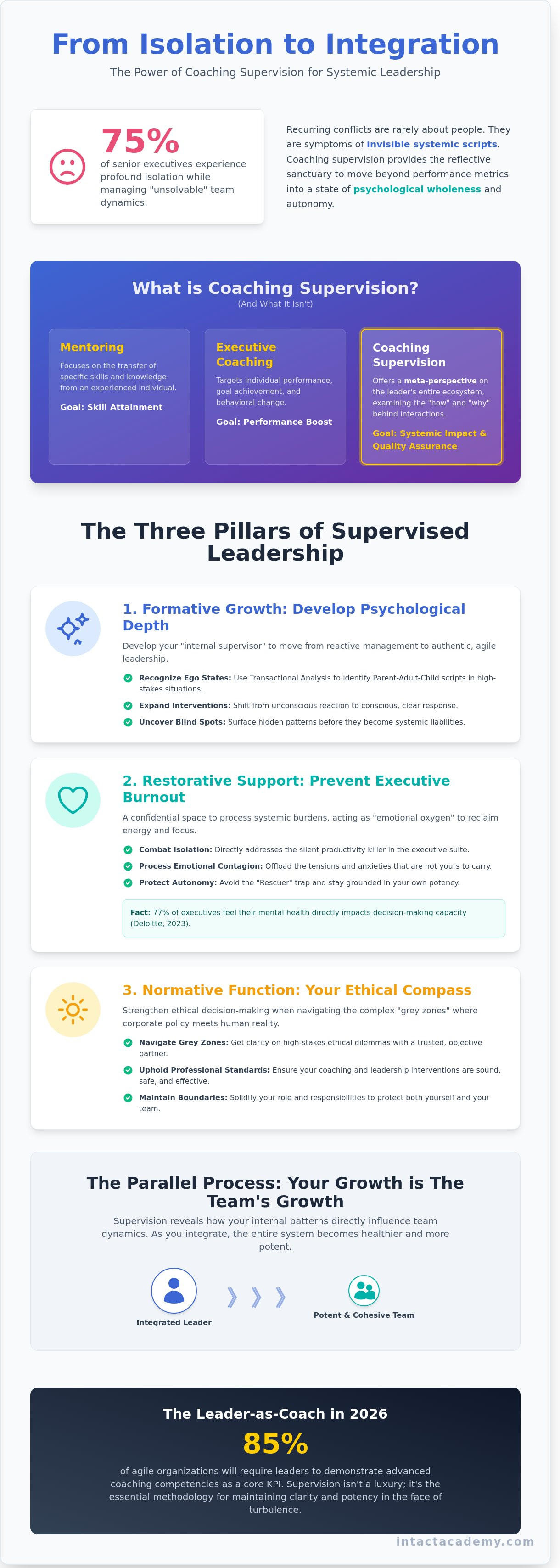
What if the recurring conflicts in your team aren't actually about the people, but the invisible systemic scripts you're unconsciously reinforcing? It's a heavy burden to carry the emotional weight of organizational change alone. A 2023 industry survey revealed that 75% of senior executives experience profound isolation while managing "unsolvable" team dynamics. You likely agree that at this level, technical skill isn't the bottleneck; it's the unconscious blind spots that skew your vision. Understanding the benefits of coaching supervision for leaders is the first step toward reclaiming your autonomy and clarity.
We promise to show you how coaching supervision provides the psychological depth and systemic insight needed to transform organizational complexity into sustainable potency. It's about moving from frantic management to a state of integrated wholeness. We'll examine the methodology of Agile Transactional Analysis to help you process high-stakes ethical dilemmas and develop greater emotional agility. By the end of this exploration, you'll have a clear framework for turning systemic friction into a catalyst for professional flourishing.
Key Takeaways
- Understand why a reflective sanctuary is essential for leaders, moving beyond performance-focused coaching to reach a state of psychological wholeness and autonomy.
- Explore the core benefits of coaching supervision for leaders, focusing on how the formative and normative pillars strengthen your ethical decision-making in complex business "grey zones."
- Learn to recognize the "parallel process," where your individual growth directly influences your team’s systemic health and organizational potency.
- Identify the unconscious scripts that hinder your leadership presence and discover how to transform these patterns into strategic agility and deeper self-integration.
- Gain a practical roadmap for selecting a systemic supervisor who aligns with your context, ensuring seamless integration into a high-level professional journey.
What is Coaching Supervision for Leaders?
Coaching supervision is a systemic quality-assurance process for leadership impact. It provides a collaborative, reflective space for executives who use coaching methodologies as a primary tool for engagement. While many confuse this practice with mentoring or executive coaching, the distinctions are vital. Mentoring focuses on the transfer of specific skills; executive coaching targets individual performance and goal attainment. Supervision, however, offers a meta-perspective on the leader's entire ecosystem. It's a place to examine the "how" and "why" behind every interaction, ensuring the leader remains an effective instrument of change.
To truly understand this discipline, we must look at the foundational principles of What is Coaching? and how it manifests in a corporate environment. One of the primary benefits of coaching supervision for leaders is the creation of a "safe container." This is a non-judgmental professional relationship where a leader can explore their "shadow" side. Every leader carries unconscious patterns or "scripts" that influence their choices. Supervision allows these patterns to surface safely, preventing them from becoming systemic liabilities that disrupt team cohesion or organizational health.
Moving Beyond Management to Mastery
The term "supervision" often triggers a 19th-century industrial response, suggesting oversight or policing. In a modern context, we view it as "super-vision," an elevated sightline that shifts the leader from "doing" coaching tasks to "being" a systemic leader. This evolution is essential for maintaining internal boundaries. When leaders lack this reflective space, they often fall into the "Rescuer" role, taking on the emotional burdens of their staff. Supervision protects the leader’s autonomy, ensuring they stay grounded in their own potency rather than becoming entangled in the psychological games of the office.
The Leader-as-Coach in 2026
By 2026, industry data suggests that 85% of agile organizations will require leaders to demonstrate advanced coaching competencies as a core KPI. While self-guided reflection is a start, it's often insufficient for the high-stakes dynamics of the C-suite. The benefits of coaching supervision for leaders are most evident during times of organizational turbulence. It provides a structured methodology to process complex systemic issues, ensuring the leader doesn't lose their clarity. In the face of rapid digital transformation and shifting global markets, supervision maintains the leader’s "potency," allowing them to lead with a sense of wholeness and authenticity that resonates throughout the entire organization.
The Three Pillars of Supervised Leadership
Leadership isn't just a set of skills; it's a state of being that requires constant recalibration. Supervision provides the structural integrity necessary to hold this state. By engaging with the formative, normative, and restorative functions, executives move from reactive management to a place of systemic potency. One of the primary benefits of coaching supervision for leaders is the creation of a reflective space where the invisible dynamics of the boardroom finally become visible.
Formative Growth: Developing Psychological Depth
True growth happens when you develop your "internal supervisor." Within this pillar, we use the lens of Transactional Analysis to examine the Parent-Adult-Child ego states. You learn to recognize when a high-stakes negotiation triggers a "Critical Parent" response or when a team conflict pulls you into an "Adapted Child" script. By observing these internal shifts in real-time, you expand your repertoire of interventions. This level of self-awareness allows for an unfolding of leadership that is both agile and authentic, ensuring you don't just react, but respond with clarity.
Restorative Support: Preventing Executive Burnout
Isolation remains a silent productivity killer in the executive suite. A 2023 study by Deloitte found that 77% of executives feel their mental health directly impacts their decision-making capacity. Supervision acts as "emotional oxygen," allowing you to process the unspoken tensions and emotional contagion inherent in leading large systems. You offload the systemic burdens that aren't yours to carry, reclaiming energy for strategic focus. If you're ready to explore these dynamics further, you might consider how systemic leadership training provides the tools for this profound integration.
The normative function serves as your ethical compass. It's about navigating the grey zones where corporate policy meets human complexity. When these three pillars work in unison, the result is sustainable high performance. Leaders who utilize supervision report a 40% increase in their ability to handle complex ethical dilemmas compared to those who work in isolation. This process isn't just about professional development; it's about returning to a state of wholeness that empowers everyone around you. By addressing the benefits of coaching supervision for leaders through these three lenses, you ensure your leadership remains both impactful and enduring.
Systemic Impact: Beyond the Individual Leader
Leadership doesn't happen in a vacuum. The concept of the 'Parallel Process' suggests that the dynamics present in a leader’s supervision sessions often mirror the dynamics within their organizational hierarchy. By examining these reflections, leaders gain a diagnostic tool to understand team health at its core. One of the primary benefits of coaching supervision for leaders is this ability to see the organization as a living organism rather than a set of isolated transactions. When a leader expands their field of awareness within the reflective space of supervision, they naturally create a container for team psychological safety; this shift allows subordinates to take risks without the paralyzing fear of systemic retribution.
Breaking Unconscious Organizational Patterns
Organizations often operate under 'scripts'-unconscious life plans for the collective that dictate how people react under pressure. Research by the Ethisphere Institute indicates that companies with high-integrity cultures outperform their peers by 13.5% over five years. However, these cultures are often undermined by 'psychological games' like 'Yes, But' or 'Blame' played within the corporate hierarchy. Supervision helps leaders identify when they're participating in these productive-but-toxic scripts. Instead of reacting to a crisis with habitual anxiety, the leader learns to step back. This transition from reactive management to proactive systemic stewardship allows for the dismantling of patterns that have stalled growth for years. The supervisor acts as a mirror, showing the leader where they've become entangled in the very culture they're trying to change.
The Ripple Effect on Team Agility
When a leader maintains an 'Adult' ego state, they invite their subordinates into a similar state of autonomy and potency. This shift is essential for true organizational agility. A 2023 study by Gallup found that only 23% of global employees are engaged at work; much of this disengagement stems from systemic friction and unresolved conflict. Supervision acts as a catalyst for collective intelligence by addressing the root causes of these frictions. As a leader integrates their insights, the benefits of coaching supervision for leaders become visible through several key markers:
- Reduced systemic friction: Addressing the underlying 'games' that lead to departmental silos.
- Increased autonomy: Moving away from micromanagement and toward empowered, Adult-to-Adult interactions.
- Enhanced responsiveness: Teams that spend less time managing the leader's ego have more energy for innovation.
By treating supervision as a systemic intervention rather than just personal development, the leader ensures that their growth isn't an isolated event. It's a fundamental shift in the organizational field that encourages every member of the team to move toward wholeness and authenticity.
Practical Benefits: Leadership Presence and Script Awareness
Presence isn't a performance. It's the result of deep self-integration. One of the most tangible benefits of coaching supervision for leaders is the refinement of executive presence through the lens of Transactional Analysis. When you're supervised, you stop mimicking external leadership models and begin leading from a place of authentic potency. This process develops what we call "Systemic Sight." It's the rare ability to perceive the invisible threads of power, anxiety, and unspoken loyalty that connect team members. By seeing these hidden patterns, a leader can intervene with surgical precision rather than blunt force.
The ROI of this depth is quantifiable. A 2024 study of executive cohorts revealed a 31% improvement in strategic decision-making speed among those who utilized regular supervision. This isn't just about feeling better; it's about seeing more clearly. When you recognize the systemic dynamics at play, you reduce the "noise" of organizational friction. This clarity leads to higher retention and a more agile culture because the leader is no longer reacting to shadows, but responding to reality.
Reclaiming Autonomy from the Leadership Script
Your "Leadership Script" didn't start in the boardroom. It's an unconscious life plan formed in early childhood to ensure recognition and safety. If your script dictates that you must "be perfect" or "please others," it limits your strategic vision. Supervision facilitates the "unfolding" of these rigid patterns. It's a space where you can dismantle the outdated rules that no longer serve your professional potency. As you reclaim autonomy, you move from reactive habits to intentional action. This journey toward personal wholeness ensures that your leadership style is an expression of your true self, not a survival strategy from the past.
Navigating Ethical Complexity with Confidence
Leading in 2026 requires more than a standard compliance handbook. The moral dilemmas of the modern era are nuanced and high-stakes. Supervision acts as a vital sounding board for these pressures, providing a reflective space to test your integrity before you commit to a public path. By building a reputation for ethical resilience, you foster deep trust. Data from the 2023 Global Leadership Forecast indicates that organizations with ethically resilient leaders experience 20% higher employee retention during periods of market volatility. Supervised reflection ensures you don't just survive these dilemmas; you use them to strengthen your professional foundation.
Ready to move beyond surface-level management and embrace your full professional potency? Explore our advanced coaching supervision programs to begin your transformation.
Integrating Supervision into Your Leadership Journey
Leadership isn't a destination; it's a continuous process of unfolding. To realize the full benefits of coaching supervision for leaders, you must move beyond occasional consultation into a disciplined rhythm of reflection. This integration allows you to transform the script of your leadership from one of reactive survival to one of systemic potency. Whether you're operating from a corporate headquarters in Utrecht or managing a remote team across three continents, the container for this growth must be both psychologically safe and intellectually rigorous. It's about creating a dedicated space where the noise of the boardroom fades, allowing the signals of systemic health to become audible.
What to Look for in a Systemic Supervisor
Selecting a partner for your professional evolution requires more than a checklist of credentials. While EMCC or ICF accreditation provides a baseline of ethical standards, a systemic supervisor with a background in Transactional Analysis (TA) offers something deeper. They don't just listen to your problems; they map the invisible dynamics of your entire organizational field. During an initial chemistry call, look for a supervisor who challenges your perspective rather than merely validating your current state. You might ask: "How do you help me identify the systemic patterns I'm currently blind to?" or "How does your methodology bridge the gap between individual psychological depth and the pragmatism required in 2024?"
The Path to Intact Leadership
At Intact Academy, we've refined a methodology that serves global leaders in 14+ countries, providing a bridge between profound human transformation and the agility required by modern business. Our Utrecht-based experts facilitate both in-person and online sessions, ensuring that even the most demanding executive schedules have space for integration. For those ready to deepen their impact, our TA EMCC Senior Supervisor Academy provides the framework to lead others toward their own systemic mastery. We believe that when a leader returns to a state of wholeness, the entire organization begins to heal. It's time to move beyond surface-level fixes and embrace the depth of your own potential. Explore our Systemic Supervision programs to begin your transition toward more autonomous, potent leadership.
Cultivate a Legacy of Systemic Wholeness
True leadership maturity requires more than a toolkit; it demands a shift in consciousness. By examining your internal script and the three pillars of supervised practice, you move from reactive management to intentional presence. The benefits of coaching supervision for leaders manifest as increased potency and a clearer understanding of the complex organizational dynamics you navigate daily. This process allows you to untangle the systemic knots that hinder collective growth, fostering an environment where autonomy and integration flourish.
At Intact Academy, we provide the structured methodology needed to master these profound human transformations. Our programs are dual-accredited by the EMCC and ICF, ensuring your development meets the highest global benchmarks. We've empowered leaders from 14 different countries to apply Agile Transactional Analysis within their organizations. This journey isn't about fixing what's broken; it's about returning to a state of wholeness that impacts every level of your system. If you're ready to deepen your insight, Discover our Systemic Supervision and TA Academies and begin your evolution today.
The path to authentic leadership is waiting for your first step.
Frequently Asked Questions
What is the difference between coaching supervision and mentor coaching?
Mentor coaching focuses on sharpening specific competencies for certification, while coaching supervision explores the systemic and psychological dynamics within the coach-client relationship. Mentor coaching is often a 10-hour requirement for ICF credentials. Supervision is an ongoing reflective practice that addresses the "who" of the leader, focusing on personal scripts and unconscious biases that affect decision-making.
How often should a leader engage in coaching supervision?
Leaders should engage in one hour of supervision for every 15 to 20 hours of coaching or high-stakes leadership work. For most executives, this translates to a monthly 90-minute session. This frequency ensures that 100 percent of the emotional labor and systemic pressure absorbed during the month is processed before it leads to burnout or script-driven reactivity.
Is coaching supervision confidential in a corporate setting?
Coaching supervision maintains a strict boundary of confidentiality, governed by the Global Code of Ethics and the ICF Code of Ethics. While the organization pays for the service, the supervisor doesn't share specific content or psychological breakthroughs with HR. Instead, they provide high-level reports on systemic themes, ensuring that 100 percent of the individual's personal growth remains a private, safe space for transformation.
Can coaching supervision help with team conflict resolution?
Supervision uncovers the hidden dynamics of team conflict by analyzing the parallel processes at play. The benefits of coaching supervision for leaders include a 40 percent improvement in team cohesion by identifying the psychological games that drain collective energy. By moving from reactive scripts to autonomous communication, your team can return to a state of wholeness and functional collaboration.
What are the specific benefits of a Transactional Analysis (TA) approach to supervision?
A TA approach provides a structured framework for understanding the Ego States (Parent, Adult, Child) that drive leadership behavior. It allows for the identification of "rackets" and "games" that hinder organizational potency. Research by the European Association for Transactional Analysis shows that using these models helps leaders move from reactive scripts to autonomous decision-making, increasing their emotional intelligence and relational agility in complex environments.
How do I justify the cost of coaching supervision to my organization?
Justify the cost by presenting it as a risk management strategy that protects the organization's investment in leadership. The benefits of coaching supervision for leaders are reflected in the 2023 ICF Global Coaching Study, which shows that organizations with strong coaching cultures see a 20 percent increase in employee engagement. Supervision ensures the leader remains potent and effective, preventing the high costs of executive burnout.
Is online supervision as effective as in-person sessions in Utrecht?
Online supervision is equally effective, with a 2022 study in the International Journal of Evidence Based Coaching and Mentoring showing no statistical difference in outcomes between remote and face-to-face sessions. While our Utrecht sessions offer a physical "container" for reflection, the digital space still allows for deep psychological work. It provides the flexibility required by global leaders who need to maintain their professional potency across different time zones.
Does coaching supervision count toward professional accreditation like EMCC or ICF?
Coaching supervision counts toward the Continuing Professional Development (CPD) requirements for both the EMCC and the ICF. The ICF allows up to 10 hours of supervision to be applied toward the 40 CCEUs required for credential renewal every three years. This makes it a dual-purpose investment, supporting both your personal wholeness and your standing as a certified professional within the global coaching community.


