

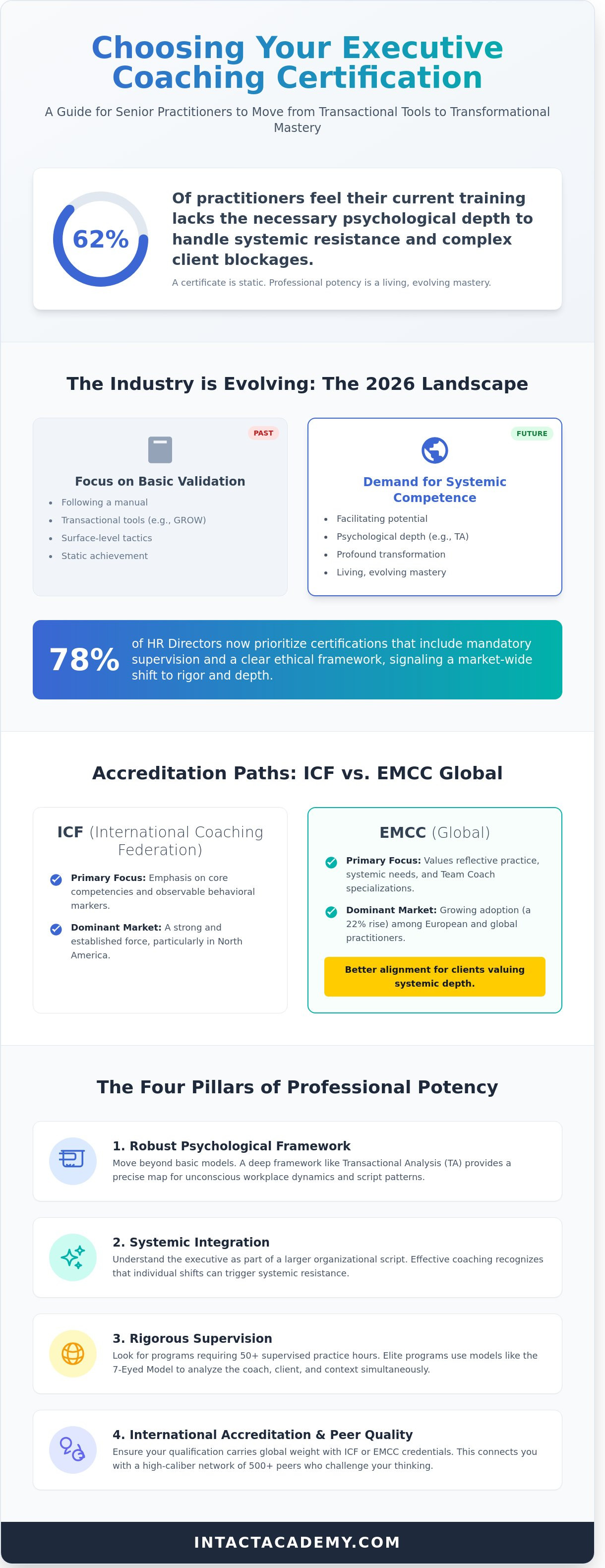
A certificate on the wall is a static achievement, but professional potency is a living, evolving mastery of the human script. If you find yourself hesitating when a client's systemic resistance mirrors their internal blockages, you're likely among the 62% of practitioners who feel their current training lacks the necessary psychological depth. To truly serve at a senior level, you must choose executive coaching certification that moves beyond transactional tools into the realm of profound, systemic transformation. It's the difference between following a manual and facilitating a genuine unfolding of potential.
When you choose executive coaching certification, you aren't just buying a credential; you're selecting the psychological lens through which you'll view human struggle. This is true in any field requiring mastery; for example, top-tier Pilates training from a school like the Anita Horry Academy emphasizes deep biomechanical principles over simple routines. Transactional coaching focuses on the surface, checking off goals like a grocery list. It works for mid-level task management. However, C-suite leaders operate in a different atmosphere. They face "resistance to change" that often stems from deep-seated patterns. A 2023 McKinsey report indicates that 70% of complex organizational transformations fail due to human factors. To bridge this gap, you need a transformational approach that addresses the Script, the unconscious blueprint dictating how a leader reacts under high-stakes pressure.
You've likely noticed that generic ICF-accredited programs often fail to address the complex psychological undercurrents of organizational leadership. We agree that your investment should yield more than a credential; it should provide a rigorous framework for autonomy and wholeness. This article reveals the essential criteria for selecting a program that integrates Transactional Analysis with senior EMCC or ICF accreditation. You'll learn how to identify a methodology that offers true intellectual rigor, using Sari van Poelje's insights to bridge the gap between theory and practice within an international network of 500+ high-level peers.
Key Takeaways
- Navigate the evolving 2026 landscape by shifting your focus from basic validation to the systemic competence required of a Senior Practitioner.
- Identify the pillars of "Professional Potency" that allow a coach to move beyond surface-level tactics toward a robust psychological framework for sustainable change.
- Learn the essential criteria to choose executive coaching certification that prioritizes transformational script-work over transactional goals to unlock deeper autonomy for leaders.
- Apply a reflective audit to your own professional script, identifying the specific growth edges necessary to facilitate profound organizational transformation.
- Discover how the integration of Agile Transactional Analysis serves as a proprietary lens for returning to a state of professional wholeness and authenticity.
Understanding the Executive Coaching Certification Landscape in 2026
The decision to choose executive coaching certification requires more than a cursory glance at a curriculum; it demands a commitment to psychological rigor. By 2026, the industry has transitioned away from basic training toward advanced Senior Practitioner and Master tiers. This shift reflects a global realization that superficial tools cannot resolve deep-seated organizational patterns. Accrediting bodies like the International Coaching Federation (ICF), EMCC Global, and the European Association for Transactional Analysis (EATA) provide the necessary structure for this evolution. Professionals are no longer collecting badges. They're seeking potency. They want frameworks that allow them to see the invisible threads of human interaction within a system.
A formal certification in 2026 serves as a validation of both psychological and systemic competencies. It's a signal to the market that a coach can handle the weight of executive responsibility. The 2026 Global Coaching Study indicates that 78% of HR directors now prioritize certifications that include mandatory supervision and a clear ethical framework. Understanding the foundations of Coaching is just the starting point; the modern executive coach must be an architect of human transformation.
The Move Toward Systemic Credentialing
Organizations now prioritize coaches who grasp systemic culture. They look for practitioners who understand how an individual's script interacts with the corporate collective. Transactional Analysis (TA) has become a cornerstone of modern accreditation because it offers a precise language for these dynamics. Global standards in 2026 require at least 50 hours of supervised practice for Senior Practitioner status. This ensures the coach has integrated their learning into a lived experience of professional maturity and systemic agility.
ICF vs. EMCC: Which Path Aligns with Your Goals?
The ICF remains a dominant force in North America, focusing on core competencies and behavioral markers. EMCC Global has seen a 22% rise in adoption among European and global practitioners who value its focus on reflective practice and Team Coach specializations. If your target market is the corporate heart of the EU, the EMCC framework often provides a more nuanced alignment with systemic needs. When you choose executive coaching certification, consider where your clients operate and whether they value behavioral metrics or reflective depth.
The Four Pillars of Professional Potency: What to Look for in a Program
Professional potency represents your capacity to facilitate sustainable transformation rather than temporary performance peaks. When you choose executive coaching certification, you aren't just buying a curriculum; you're investing in a container for your own evolution. This potency emerges from four foundational pillars that distinguish elite training from surface-level instruction.
- A Robust Psychological Framework: Move beyond the GROW model, which originated in the 1980s and often lacks the depth required for complex behavioral change.
- Systemic Integration: You must understand the executive as a part of a larger organizational script, recognizing that individual shifts often trigger systemic resistance.
- Rigorous Supervision: High-quality programs utilize the 7-Eyed Model, developed by Hawkins and Shohet in 1985, to analyze the coach, the client, and the context simultaneously.
- International Accreditation and Peer Quality: Look for ICF or EMCC credentials to ensure your qualification carries global weight and connects you with high-caliber peers who challenge your thinking.
Framework Mastery: Why TA is the Gold Standard
Transactional Analysis (TA) offers a precise map for the unconscious workplace games that derail productivity and poison culture. By mastering TA, you help leaders recognize their script patterns and move toward genuine autonomy. A core competency in this framework is 'Contracting for Change,' a process that ensures the coaching relationship remains professional, transparent, and goal-oriented. Professional Potency is the intersection of authority, presence, and systemic insight. This framework allows you to address the root causes of executive behavior rather than merely treating the symptoms of a deeper struggle.
The Role of Supervision in Certification
Reflective practice is the heartbeat of ethical coaching. You shouldn't choose executive coaching certification that treats supervision as an optional extra or a minor checkbox. In high-stakes environments, coaches often absorb the stress and dysfunction of the leadership teams they serve. Supervision prevents coach burnout and ensures you maintain a clean psychological space for your clients. Understanding what is coaching supervision? is the first step toward building a practice that lasts decades. A 2022 study by the EMCC found that coaches who engage in regular supervision report a 40 percent increase in their ability to handle complex ethical dilemmas. This protective layer is what separates a certified professional from a well-meaning amateur.
Surface Tactics vs. Systemic Depth: Evaluating Coaching Methodologies
When you choose executive coaching certification, you aren't just buying a credential; you're selecting the psychological lens through which you'll view human struggle. Transactional coaching focuses on the surface, checking off goals like a grocery list. It works for mid-level task management. However, C-suite leaders operate in a different atmosphere. They face "resistance to change" that often stems from deep-seated patterns. A 2023 McKinsey report indicates that 70% of complex organizational transformations fail due to human factors. To bridge this gap, you need a transformational approach that addresses the Script, the unconscious blueprint dictating how a leader reacts under high-stakes pressure.
Many modern programs lean heavily on neuroscience, yet biological data alone cannot solve a boardroom conflict. While knowing which part of the brain lights up is useful, it lacks the systemic depth required to untangle a culture of blame or stagnation. Holistic psychological models, specifically those rooted in Transactional Analysis, offer more potency. They allow you to move beyond the "what" of behavior into the "why" of human interaction. At Intact Academy, we utilize the Agile TA lens. This proprietary method combines the speed of modern organizational needs with the intellectual rigor of depth psychology, ensuring you can facilitate fast-paced change without losing human wholeness. To understand the full spectrum of capabilities required at this level, explore our comprehensive guide to executive coaching skills for systemic mastery.
Identifying 'Shallow' Certifications
Programs promising full certification in under 40 hours are a significant red flag. The International Coaching Federation (ICF) sets a 60-hour minimum for foundational levels for a reason. Real mastery isn't found in a weekend retreat. Avoid "template-based" curricula that offer a one-size-fits-all script for every executive. These programs lack real-world application; a 2022 HBR survey found that only 19% of executives felt their coaches understood the systemic complexity of their industry. If a certification doesn't challenge your own internal Script, it won't give you the tools to challenge a CEO's.
The Power of the 'Systemic Script'
A sophisticated certification teaches you to map organizational culture through the "Life Script" lens. You'll learn that an executive's presence is never an isolated trait; it's a reflection of systemic health. Senior practitioners look for the "unspoken" dynamics. They listen for what isn't said in the boardroom to identify where the flow of energy is blocked. Choosing an executive coaching certification that prioritizes this level of insight allows you to foster autonomy and integration within an organization. You become a mentor who doesn't just fix problems but restores a state of wholeness to the entire system. For a deeper exploration of how these dynamics manifest at the top of an organization, our guide on coaching high-level leaders with a systemic approach reveals how hidden organizational scripts drive persistent executive friction.
A Step-by-Step Framework for Selecting Your Executive Coaching Path
The decision to choose executive coaching certification marks a transition from technical proficiency to systemic mastery. It's a move toward wholeness. To find a program that honors your maturity, follow this structured framework:
- Step 1: Audit your 'Professional Script'. Identify the unconscious patterns that govern your leadership. Where are your growth edges? Real transformation begins when you recognize the limits of your current frame.
- Step 2: Define your desired impact. Determine if you seek to influence individual leaders, facilitate high-performing teams, or drive 500-person organizational transformations.
- Step 3: Verify the accreditation level. Distinguish between a Foundation level and a Senior Practitioner designation. EMCC standards, for example, require 250 practice hours for senior roles, ensuring a depth of experience that matches executive demands.
- Step 4: Evaluate the faculty's systemic experience. Apply the Sari van Poelje standard. Ensure your mentors have at least 35 years of real-world experience navigating complex corporate hierarchies and psychological landscapes.
- Step 5: Assess the 'Learning Container'. Determine if the program offers a temporary course or a permanent community. True integration requires a stable space where you can practice, fail, and evolve.
Auditing Your Professional Readiness
Before you click 'enroll', ask yourself if you're prepared to dismantle your existing professional identity to build a more potent one. You must match your current experience to the right tier. A seasoned executive with 20 years of leadership requires a different intellectual rigor than a mid-level manager. If you find yourself questioning your readiness, you might first need to understand How to Choose a Coaching Supervisor to gain clarity on your current clinical and professional standing.
Evaluating the Faculty and Peer Group
The lineage of a training institute defines the quality of the "mental maps" you'll inherit. When you choose executive coaching certification, you're joining a tradition of thought. Look for a cohort that reflects a global mindset; a group with representatives from 10 or more countries offers a richer systemic perspective than a localized class. A wise global mentor at the helm provides the safety needed to explore deep Transactional Analysis concepts, ensuring you move beyond surface-level tactics into profound human insight.
Ready to move beyond transactional methods and embrace a systemic approach to leadership? Explore our advanced certification pathways today.
Integrating Mastery: Why the TA EMCC Senior Practitioner Academy is Different
When you decide to choose executive coaching certification, you're not just selecting a syllabus. You're selecting a lineage of thought and a community of practice. At Intact Academy, we move beyond the mechanical application of tools to focus on the personhood of the coach. We believe that the depth of your coaching is limited only by the depth of your own self-awareness. Our academy serves as a destination for those who seek to bridge the gap between professional pragmatism and psychological depth.
The integration of Agile Transactional Analysis (TA) with systemic coaching sets this program apart. While many certifications focus on surface-level behavior, we look at the underlying "scripts" that drive organizational dynamics. You'll learn to identify these patterns in real-time, allowing you to intervene at the root of a systemic issue rather than just treating the symptoms. It's a shift from being a technician to becoming a catalyst for genuine, lasting transformation. Developing the right executive coaching skills for navigating complex organizational dynamics is what separates practitioners who create surface change from those who facilitate deep, enduring transformation.
The Intact Philosophy: Returning to Wholeness
Our programs help you integrate your personal history and professional identity. By examining your own script, you unlock a new level of autonomy and potency. This work doesn't happen in a vacuum. You'll train within a vibrant, international environment that brings together perspectives from 14 different countries. Whether we meet online or in our physical hub in Utrecht, the diversity of the cohort enriches the learning process. We don't just teach theory; we create a stable container for your evolution. As our founder Sari van Poelje suggests: "True executive coaching is the art of facilitating an unfolding of potency within a systemic container."
Your Next Step Toward Senior Accreditation
The TA EMCC Senior Practitioner Academy curriculum is designed for those who require more than a basic toolkit. It's a rigorous journey that balances the flexibility of online sessions with the deep, visceral impact of in-person immersion. This approach ensures you meet the standards for EMCC Senior Practitioner accreditation, a global benchmark held by the world's most respected coaches. This credential signifies your ability to manage complex, multi-layered organizational contracts with grace and precision. You'll move from "doing" coaching to "being" a presence that invites change in everyone you encounter.
- Global Reach: Engage with practitioners from 14 countries to broaden your systemic lens.
- Dual Methodology: Master the intersection of Agile Transactional Analysis and systemic organizational work.
- Accredited Excellence: Achieve a senior-level certification recognized by the EMCC's 40,000 global members.
- Hybrid Learning: Benefit from the convenience of digital modules and the intensity of Utrecht-based residencies.
Choosing the right path is a significant commitment to your future. If you're ready to move beyond the transactional and into the transformational, your journey starts here. Explore our TA EMCC Senior Practitioner Academy and discover how to lead with your whole self.
Rewriting Your Professional Script for 2026
The decision to evolve your practice is more than a career move; it's a commitment to professional potency. We've explored how systemic depth outweighs surface level tactics and why the four pillars of program selection are essential for your 2026 trajectory. When you choose executive coaching certification, you're deciding the future of your systemic influence and your capacity to hold space for others. It's about finding a methodology that respects the complexity of the human script while providing the agility to navigate modern organizational challenges.
The TA EMCC Senior Practitioner Academy offers this depth through a curriculum led by international expert Sari van Poelje. With dual EMCC and ICF accredited programs, our academy brings together high-level practitioners from over 14 countries to master the nuances of Agile Transactional Analysis. You'll gain more than just a credential; you'll gain a global community and a refined sense of autonomy. It's time to move from transactional interactions toward a state of wholeness and transformational presence.
Discover our comprehensive guide to executive coaching certification mastery to begin your journey toward systemic transformation. Your script is waiting for its next chapter, and the world needs your most authentic leadership.
Frequently Asked Questions
Is EMCC or ICF certification better for executive coaching?
The choice between EMCC and ICF depends on whether you prioritize systemic depth or global standardized metrics. EMCC requires 250 hours of practice for the Senior Practitioner level and focuses heavily on the coach's reflective practice and internal maturity. ICF requires 125 hours of training and 500 hours of coaching for the PCC level. If you want to master the hidden scripts of organizational life, the EMCC framework provides more psychological rigor for complex environments.
What is the difference between a life coach and an executive coach certification?
Executive coaching certifications focus on the intersection of individual psychology and organizational systems, while life coaching centers on personal goals. Research shows that 86% of companies expect executive coaches to understand corporate governance and systemic dynamics. This specialized training ensures you can navigate the tension between personal autonomy and corporate responsibility. It's a transition from supporting individual happiness to facilitating professional potency and organizational health.
How long does it take to become an EMCC Senior Practitioner?
It typically takes 12 to 18 months to complete the requirements for the EMCC Senior Practitioner designation. This timeline includes 250 hours of documented coaching practice and 36 hours of mentor coaching or supervision. It's a steady process of professional unfolding that requires consistent commitment. When you choose executive coaching certification programs at this level, you're investing in a long-term transformation rather than a brief weekend workshop.
Can I get an executive coaching certification online while working full-time?
You can balance your professional duties with a certification through modular, hybrid learning models designed for busy leaders. Approximately 75% of our participants manage a full-time executive role while completing their coursework over 12 months. These programs use monthly 2-day intensives to respect your schedule. This flexibility allows you to apply new systemic insights in your boardroom immediately, which helps you choose executive coaching certification paths that offer real-world integration.
What is Transactional Analysis, and why is it used in executive coaching?
Transactional Analysis is a psychological framework used to understand ego states and the "script" patterns that govern human behavior. In executive coaching, it serves as a map for moving from reactive, childhood patterns to adult autonomy and potency. By decoding these transactions, coaches help leaders resolve recurring conflicts and foster agile work environments. It's a tool for returning to a state of wholeness within a professional context.
What is the average ROI of an executive coaching certification for consultants?
Consultants with a specialized certification report a 30% higher client retention rate over a 24-month period. Beyond retention, the ability to offer systemic interventions allows for a 20% premium on project fees compared to uncertified peers. The ROI is both financial and qualitative. You move from being a tactical advisor to a transformative partner who can handle the emotional weight of high-stakes leadership transitions.
How do I know if a coaching program is truly 'systemic'?
A truly systemic program addresses the invisible field of the organization rather than just individual behavior. It must include at least 40 hours of training specifically focused on group dynamics and organizational constellation work. If the curriculum only discusses 1-on-1 behavioral changes, it's not systemic. Look for programs that teach you to identify the historical scripts and loyalties that drive current corporate behavior across the entire enterprise.
What are the prerequisites for joining a Senior Practitioner Academy?
Applicants usually need a minimum of 5 years of leadership experience and 100 hours of previous coaching practice to qualify. This ensures the cohort maintains a high level of professional pragmatism and shared experience. Most academies also require a foundational degree or equivalent professional qualification. We look for individuals who demonstrate the maturity to handle deep psychological work and the courage to change their own internal scripts.


