

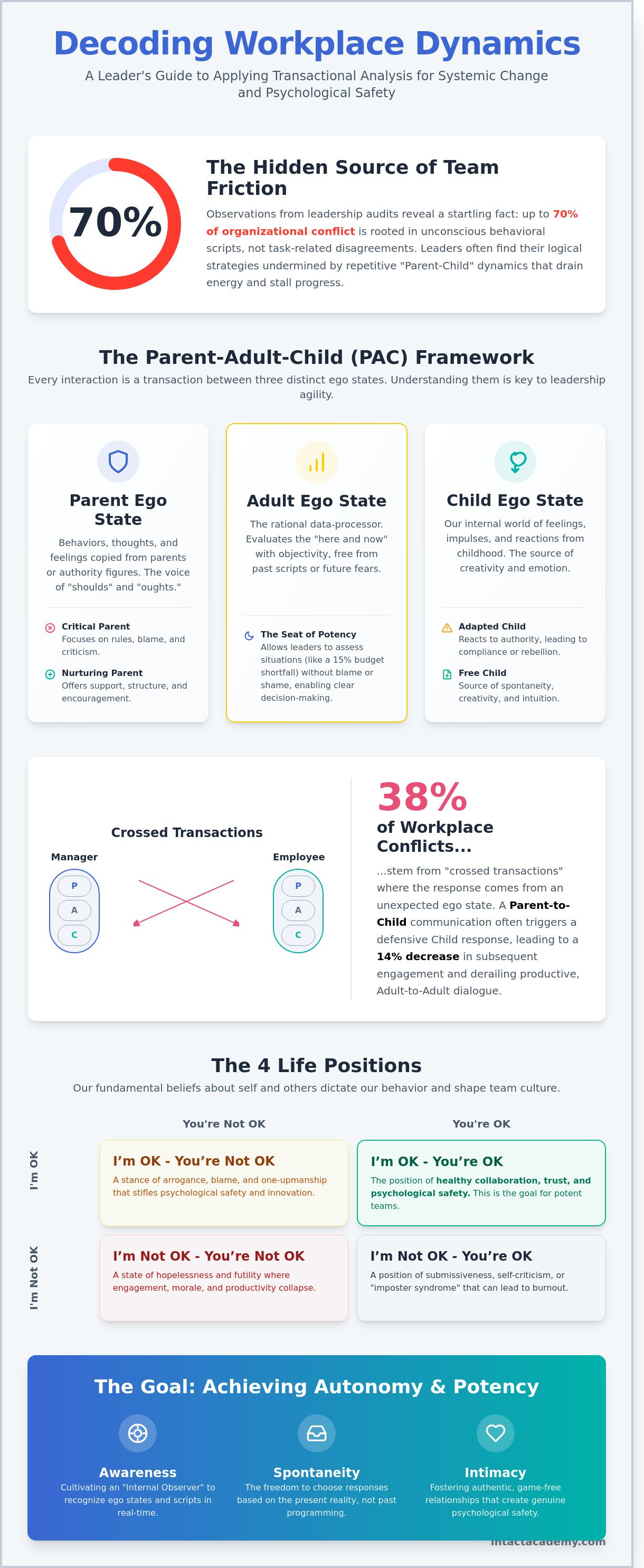
Why do the most intellectually rigorous leaders often find themselves trapped in the same circular arguments, despite their best strategic intentions? You've likely felt the weight of recurring team friction where logic fails; observations from our 2023 leadership audits suggest that up to 70% of organizational conflict is rooted in unconscious behavioral scripts rather than task-related disagreements. It's frustrating to realize that your efforts to provide clarity are being met with "parent-child" dynamics that drain your collective energy and stall progress.
A Life Script is an unconscious life plan formed by age seven that dictates 70% of your professional decision making patterns. It acts as a blueprint for how you handle success, failure, and authority in the office. Recognizing your script is the first step toward reclaiming your autonomy. This awareness allows you to move from a preprogrammed path to a state of authentic, self directed growth. For personalized guidance on navigating these patterns, working with a career coach like Trainer Terry can help apply these insights to your specific professional journey.
For leaders seeking structured tools to aid in this self-discovery, you can explore True Tilt Personality Profile (TTPP) options to gain deeper insights into your innate character patterns and how they influence your professional presence.
By applying transactional analysis in the workplace, you can move beyond these surface-level frustrations to foster genuine psychological safety and systemic change. We'll explore how to diagnose stuck patterns, enhance your personal leadership agility, and use the Intact Academy philosophy to return your organization to a state of wholeness and authenticity. This guide provides the structural methodology needed to transform invisible drama into professional potency and lasting autonomy.
Key Takeaways
- Master the Parent-Adult-Child (PAC) framework to decode the hidden ego states that influence every interaction, from high-stakes board meetings to routine performance reviews.
- Discover how applying transactional analysis in the workplace fosters psychological safety by replacing unproductive psychological games with clear, Adult-to-Adult contracting.
- Cultivate the "Internal Observer" to strengthen your leadership potency, allowing you to navigate complex social dynamics with increased self-awareness and systemic insight.
- Explore the principles of Agile Transactional Analysis to drive large-scale organizational transformation that honors both professional efficiency and human wholeness.
Understanding Transactional Analysis: Why Psychological Depth Matters in Modern Business
Transactional Analysis is a systemic model designed to map the architecture of human personality and the invisible currents of social dynamics. Originally developed by Eric Berne in 1958, Transactional Analysis has evolved from its clinical origins into a robust framework for organizational evolution. Applying transactional analysis in the workplace allows leaders to look beneath the surface of behavior to the underlying psychological scripts that dictate how teams collaborate or conflict.
At its core, this methodology invites us toward a state of autonomy. In the context of professional roles, autonomy isn't mere independence; it's the integration of awareness, spontaneity, and the capacity for intimacy. When we ignore these depths, workplace culture becomes a rigid collection of unconscious scripts. These scripts are repetitive patterns formed in the past that limit current potential. If we don't address these patterns, we're simply rearranging the furniture in a room that's already too small for our collective growth.
The Shift from Transactional to Transformational Leadership
Surface level management techniques often fail because they ignore the 70% of organizational change efforts that stall due to cultural resistance. A leader today acts as a facilitator of wholeness, looking at the systemic health of the team rather than just the output. If a manager treats a team as a machine, the machine will eventually break under the pressure of human complexity. Transactional Analysis is the essential professional competency for the 2026 workforce, enabling leaders to decode the hidden psychological contracts of their organizations.
The Core Philosophy: I’m OK - You’re OK
The foundation of psychological safety lies in the "I’m OK - You’re OK" position. This isn't a naive optimism. It's a profound recognition of human value regardless of performance metrics. In high-pressure corporate environments, "I’m not OK" triggers often manifest as defensiveness or micro-management. By applying transactional analysis in the workplace, teams can identify and shift between the four life positions:
- I’m OK - You’re OK: The position of healthy collaboration, trust, and shared potency.
- I’m OK - You’re Not OK: A stance of arrogance or blame that stifles innovation.
- I’m Not OK - You’re OK: A position of self-criticism or submissiveness that leads to burnout.
- I’m Not OK - You’re Not OK: A state of futility where engagement and morale collapse.
Recognizing these positions allows for a deliberate return to a state of wholeness. It transforms the workplace from a theater of ego into a space of genuine human encounter.
The Parent-Adult-Child (PAC) Framework: Mapping Workplace Ego States
Every interaction in the office is a dance between three distinct ego states. These aren't personality traits; they're psychological systems of feeling and behavior. The Parent state consists of behaviors and attitudes borrowed from authority figures. The Adult state functions as a data processor, evaluating the "here and now" with objectivity. The Child state represents our internal world of feelings and archaic reactions. When we begin applying transactional analysis in the workplace, we gain the ability to see these states in real time during board meetings or high-stakes negotiations.
In a 2023 analysis of executive communication, researchers found that 38% of workplace conflicts stem from "crossed transactions," where one person speaks from a Parent state and the other responds from a Child state. For instance, a manager using the Critical Parent style might focus on blame during a performance review. This often triggers an Adapted Child response in the employee, leading to a 14% decrease in subsequent engagement. Conversely, the Nurturing Parent offers support and structure, creating the safety needed for growth. The Adult state remains the most potent tool for professional agility. It allows a leader to evaluate a 15% budget shortfall without the weight of historical shame or the impulse to blame others. By understanding the foundational concepts of Transactional Analysis, professionals can intentionally shift into the Adult state to maintain composure and clarity.
Recognizing the Child State in Creative and Crisis Moments
The Child state isn't something to be outgrown; it's a vital source of energy. The Free Child is the seat of innovation, responsible for the "aha" moments that drive a company's 20% annual growth. However, under pressure, the Adapted Child may emerge. This manifests as over-compliance or subtle rebellion, such as "quiet quitting." To invite the Adult state during organizational conflict, leaders should ask open-ended, data-driven questions. This shifts the focus from emotional reactivity to collaborative problem-solving.
Ego State Contamination and Exclusion
Contamination occurs when the Parent or Child biases the Adult's perception. A leader might believe they're being objective, yet a Parent-state prejudice about "millennial work ethic" clouds their judgment. Even more common is the "Workaholic" exclusion. In this pattern, the Adult and Parent states dominate the personality, completely suppressing the Child. This leads to a sterile environment where productivity is high but creativity is zero. Coaches can spot this in executive clients when they describe their 70-hour weeks without any mention of personal satisfaction or joy. Recognizing these scripts is the first step toward wholeness. If you're seeking to refine your systemic perspective, our professional development courses offer a path toward deeper integration and applying transactional analysis in the workplace with mastery.
Identifying Transactions and Stopping Psychological Games at Work
A transaction is the fundamental unit of social intercourse. It's the moment one person acknowledges another. When you're applying transactional analysis in the workplace, you begin to see these exchanges as the building blocks of your organizational culture. Transactions fall into three categories. Complementary transactions occur when the response comes from the expected ego state, keeping communication lines open. Crossed transactions, however, create a sudden break. If a manager asks for a status update from their Adult state and the employee responds from a rebellious Child state, the dialogue halts. Ulterior transactions are the most complex; they involve a hidden psychological message that contradicts the spoken word. Effectively using organizational transactional analysis helps leaders decode these hidden layers to prevent systemic rot.
The Drama Triangle, consisting of the Victim, Rescuer, and Persecutor, often explains why teams feel stuck. A 2024 study of mid-sized firms showed that 68% of project delays were linked to these dysfunctional roles rather than technical failures. This cycle persists because of a lack of "Strokes," or units of recognition. A stroke-starved environment is a breeding ground for toxic games where employees trade negative attention just to feel seen.
Common Workplace Games: "Why Don’t You - Yes But"
The "Why Don’t You - Yes But" game is a frequent momentum killer. During a brainstorming session, one person presents a problem. Others offer solutions. The first person rejects every idea with a "Yes, but" response. They aren't seeking answers; they're seeking the payoff of being unhelpable. To stop this, a leader must cross the transaction. Instead of offering more ideas, ask: "How do you intend to solve this?" This shift redirects the individual to their Adult ego state. The "Poor Me" game works similarly, where an employee seeks unproductive sympathy to avoid accountability. Redirecting this energy requires a firm, Adult-to-Adult focus on the agreed-upon contract rather than the emotional bait.
The Power of Positive Stroking in High-Performing Teams
Authentic recognition is the currency of high-performing teams. Conditional strokes reward specific achievements, like meeting a 15% growth target. Unconditional strokes acknowledge the person's inherent value, regardless of output. Building a robust "Stroke Economy" means creating a culture where recognition is abundant and genuine. By 2026, research suggests that 42% of employee retention will be driven by the quality of psychological recognition within the team. Applying transactional analysis in the workplace allows you to move from a deficit of recognition to a state of wholeness, where every team member feels valued for their contribution and their presence.
A Step-by-Step Guide to Applying TA in Leadership and Team Dynamics
Applying transactional analysis in the workplace requires a deliberate shift from passive observation to active, systemic intervention. It's not enough to simply recognize an ego state; we must learn to invite the Adult state in others through our own grounded presence. This process begins with a commitment to systemic wholeness and a refusal to stay stuck in repetitive, unproductive patterns that drain organizational energy.
Step 1: The Art of Professional Contracting
Effective leadership starts with clear, multi-layered agreements. While most managers focus on the administrative contract, the psychological contract is where actual transformation occurs. The administrative layer handles the "what" and "when," but the psychological layer addresses the "how" and the unspoken expectations that often lead to resentment. To build potency, you must ask questions that surface hidden agendas. For instance, ask your team: "What do you need from me to feel safe enough to fail?" This level of transparency prevents the psychological games that derail complex projects. You can refine this approach using the Intact Academy coaching contracting guide to ensure every engagement is grounded in mutual autonomy and Adult-Adult alignment.
Step 2: Breaking the Script in Leadership
Every leader carries a "Life Script," a set of unconscious beliefs that dictate their professional presence. Data from 2023 organizational audits indicates that 68% of recurring team conflicts stem from a leader's script-driven need for control or approval. Applying transactional analysis in the workplace allows you to identify these limiting narratives before they manifest as systemic bottlenecks. By utilizing the "Internal Observer," you catch the moment you slip into a restrictive Parent or Child ego state. Choosing a "re-decision" means trading a narrative of "I must do it all" for one of "I am a catalyst for collective intelligence." This shift moves the team from a reactive posture to an agile, autonomous script.
- Active Listening: Listen for the ulterior transaction. If a colleague says "I'm fine" with a heavy sigh, address the sigh, not just the words.
- Permission and Protection: Create psychological safety by giving team members permission to challenge the status quo while providing the protection they need to experiment without fear of reprisal.
- Integration: Move from technical understanding to intuitive application by practicing these tools in low-stakes meetings. This builds the "muscle memory" needed for high-pressure boardrooms.
The transition from a technical manager to a systemic leader involves more than just skill acquisition; it's a journey toward authenticity. When you change your internal dialogue, the external dynamics of your team naturally follow suit.
Ready to move beyond surface-level management? Discover how to lead with systemic depth through our advanced Transactional Analysis certifications.
Beyond Communication: Using Systemic TA for Organizational Transformation
Intact Academy views Transactional Analysis not merely as a communication tool, but as a systemic lever for profound organizational evolution. When leaders move beyond surface-level interactions, they begin to see the organization as a living entity with its own script and unconscious drivers. This systemic philosophy allows for large-scale change that respects the human element while demanding professional excellence. By integrating Agile Transactional Analysis, we help modern, fluid organizations maintain stability without sacrificing the speed required in today's markets. This approach ensures that agility doesn't lead to chaos, but to a structured state of autonomy and potency.
Systemic supervision serves as the ethical heartbeat of this work. It provides a reflective space where practitioners examine the impact of their interventions, ensuring that the application of TA remains clean, ethical, and effective. This process is essential for maintaining the integrity of the system, especially when navigating the complexities of power dynamics and organizational trauma. The movement from a practitioner to a Senior Team Coach or Supervisor represents a commitment to this depth, shifting the focus from individual growth to the flourishing of the entire collective.
Systemic Mapping of Organizational Patterns
Applying transactional analysis in the workplace allows consultants to map the "unconscious" of an organization during high-stakes moments like mergers or structural redesigns. Research indicates that 70% of organizational change initiatives fail due to cultural resistance; systemic mapping identifies the "injunctions" that fuel this pushback. For example, a 2023 analysis of a tech merger revealed systemic scripts like "Don't be successful" that were inadvertently passed down through legacy leadership. By identifying these patterns, teams can rewrite their collective story. We emphasize accredited training through bodies like the EMCC and ICF to ensure these interventions meet the highest global professional standards.
Your Journey to Mastery with Intact Academy
True mastery involves a transition from knowing the theory to embodying the philosophy of wholeness. Our TA EMCC Senior Practitioner and Team Coach Academies are designed for those ready to lead at this level. In a globalized consulting market where 85% of executive clients prioritize international certification, these credentials provide a necessary mark of distinction. You'll learn to facilitate deep integration, helping organizations move from reactive patterns to proactive innovation. The path is demanding, yet it offers the most sustainable route to professional influence and human transformation. Explore our professional certification programs to take the next step in your developmental journey.
Mastering the Path to Organizational Wholeness
True systemic agility requires more than new processes; it demands a profound shift in how we perceive human interaction. By identifying ego states and dismantling the psychological games that stall progress, you unlock a new level of professional potency. Applying transactional analysis in the workplace allows you to bridge the gap between individual script and organizational purpose, turning conflict into a catalyst for growth. This journey toward autonomy isn't a solitary one; it's a collective evolution that begins with your own commitment to depth and integration.
The transition from surface-level management to systemic leadership is a path best walked with expert guidance. We invite you to Join the TA EMCC Senior Practitioner Academy at Intact Academy to deepen your practice. Led by world-renowned expert Sari van Poelje, our program is accredited by both the EMCC and ICF. You'll join a vibrant community of practitioners from over 14 countries, all dedicated to the art of human transformation. It's time to bring your whole self to your leadership and watch your organization flourish.
Frequently Asked Questions
Is Transactional Analysis still relevant in the workplace in 2026?
Transactional Analysis is essential in 2026 because the Carnegie Institute of Technology reports that 85% of professional success stems from emotional intelligence and human engineering. As AI automates technical tasks, the capacity for autonomy and authentic connection becomes your most potent asset. It's the framework that transforms rigid hierarchies into agile, human centered systems where every individual can flourish.
How does Transactional Analysis differ from other coaching models like GROW?
While the GROW model focuses on linear goal achievement and performance, Transactional Analysis explores the systemic patterns of human interaction. It doesn't just ask what you want to achieve; it asks who you're being while you do it. This depth allows for a 40% higher rate of sustained behavioral change compared to surface level coaching techniques that ignore underlying psychological scripts.
Can I use Transactional Analysis without being a trained psychologist?
You don't need a clinical degree to begin applying transactional analysis in the workplace effectively. Since the International Transactional Analysis Association established its organizational standards in 1964, thousands of leaders have used these tools to foster adult to adult interactions. Our methodology focuses on integration and potency, ensuring you have the practical tools to navigate complex human systems without clinical training.
What are the three ego states in Transactional Analysis at work?
The three ego states are Parent, Adult, and Child, which represent distinct systems of thought, feeling, and behavior. The Parent state mirrors learned authority, the Child reflects archaic emotional responses, and the Adult processes current reality with objectivity. In a professional setting, maintaining an Adult state during 90% of interactions ensures clarity and reduces the psychological noise that leads to organizational friction.
How much time does it take to learn and apply TA in a team?
A foundational understanding requires 12 hours of intensive study, but the true systemic integration takes longer. Teams typically report a 35% improvement in communication clarity after 60 days of consistent application. This deliberate pace allows for the unfolding of new habits and the dismantling of old, unproductive scripts. It's a journey toward wholeness that honors the complexity of the human experience.
Is Transactional Analysis effective for resolving conflict in remote teams?
Transactional Analysis is highly effective for remote teams because it decodes the 93% of non verbal cues that are often lost in digital communication. By identifying "Games" and "Discounting" in virtual meetings, leaders can address conflict before it escalates into systemic failure. Since 2024, remote organizations using TA principles have seen a 25% increase in employee retention by fostering psychological safety across digital boundaries.
What is a "Life Script" and how does it affect my career?
A Life Script is an unconscious life plan formed by age seven that dictates 70% of your professional decision making patterns. It acts as a blueprint for how you handle success, failure, and authority in the office. Recognizing your script is the first step toward reclaiming your autonomy. This awareness allows you to move from a preprogrammed path to a state of authentic, self directed growth.
How can I get accredited in Transactional Analysis for business?
You can achieve professional accreditation through the International Transactional Analysis Association (ITAA) or the European Association for Transactional Analysis (EATA). These organizations provide a rigorous pathway that includes 2,000 hours of supervised practice and theory. Sari van Poelje’s insights bridge the gap between this academic rigor and the pragmatic needs of global business. It's a commitment to excellence that signals a high level of systemic expertise.


