

What if the persistent friction in your executive sessions isn't a lack of alignment, but an unconscious script that has governed the team's behavior for years? You've likely felt the limitation of standard frameworks when faced with the heavy, unspoken dynamics of a C-suite under pressure. It's a common struggle; the 2023 ICF Global Coaching Study highlights that while demand for team intervention has surged by 60 percent, many practitioners still feel ill-equipped to manage deep systemic resistance. You're ready to move beyond the surface. Pursuing an advanced team coaching certification isn't just about adding a credential to your profile; it's about gaining the potency to hold space for genuine, lasting transformation.
This guide clarifies the path toward senior-level accreditation, whether you're weighing EMCC requirements against ICF standards. You'll learn how to integrate Transactional Analysis and systemic tools to address the root causes of organizational stagnation. We'll explore the shift from transactional coaching to a more reflective, authoritative practice that commands respect in the boardroom. By the end of this article, you'll have a clear roadmap to achieving global recognition as a Senior Team Coach, equipped with the mastery to facilitate wholeness in even the most complex environments.
Key Takeaways
- Understand the essential transition from individual coaching to systemic intervention, learning to navigate the unseen forces that shape organizational behavior.
- Differentiate between EMCC and ICF standards to choose an advanced team coaching certification that honors your unique path toward practitioner mastery.
- Uncover the psychological depth of Transactional Analysis to map team scripts and resolve the unconscious patterns that stall collective growth.
- Identify the critical criteria for selecting a training institute, prioritizing systemic supervision and faculty who are active leaders in the global field.
- Master the art of returning teams to a state of wholeness by integrating Agile Transactional Analysis into your senior-level coaching repertoire.
The Evolution of Mastery: Why Seek an Advanced Team Coaching Certification?
The journey toward mastery begins when a practitioner realizes that individual excellence isn't enough to move a collective. While many start by exploring What is coaching? at a foundational level, the leap into systemic intervention requires a different lens. An advanced team coaching certification isn't just a credential. It's a fundamental shift in how you perceive the invisible architecture of a group. You're no longer just facilitating a meeting; you're deciphering the group script and the unconscious patterns that hold a team back from its full potency.
Standard training often hits a wall when it meets deep cultural resistance. When a team’s internal dynamics are calcified, tactical tools feel superficial. By 2026, 85% of global enterprises will prioritize systemic team health over individual performance metrics. This shift demands coaches who can move from surface-level facilitation into the depths of profound human transformation. It requires the courage to look at the "unseen" forces that dictate how people relate, compete, and eventually, flourish together.
The Complexity Gap in Modern Leadership
Teams are the primary unit of change in 2026 organizations. Individual-centric coaching models often fail because they treat the person in isolation, ignoring the systemic field that influences every action. An advanced team coaching certification bridges this gap. It provides the intellectual rigor needed to turn theoretical frameworks into systemic impact. You learn to hold the space for the complex, often turbulent work of organizational evolution, ensuring that the process of change remains stable and safe for all participants.
The ROI of Senior-Level Accreditation
Earning an EMCC Senior Level accreditation offers clear market differentiation. It separates the systemic master from the crowded field of generalist coaches. This level of expertise unlocks high-stakes C-suite engagements where the cost of failure is high and the need for psychological depth is paramount. Beyond the business case, it marks your personal evolution. You transition from a practitioner who does coaching to a systemic master who embodies the work of wholeness and integration. This professional maturity allows you to navigate organizational resistance with a calm, authoritative presence that invites lasting change.
Comparing Global Standards: EMCC Senior Team Coach vs. ICF ACTC
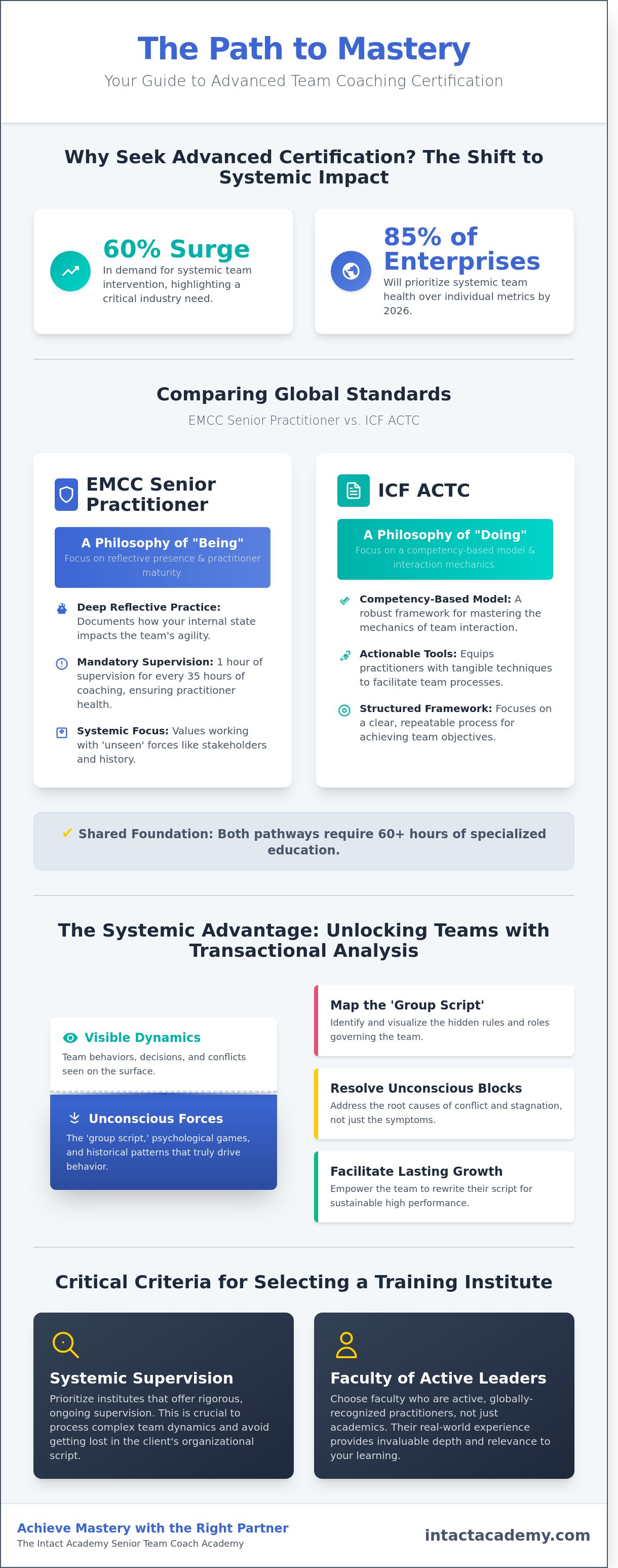
Choosing an advanced team coaching certification isn't just a matter of checking boxes. It's an alignment of your professional script with a global standard that mirrors your own maturity as a practitioner. While both the EMCC and ICF provide rigorous frameworks, they diverge in their fundamental philosophy of human and organizational change. The ICF focuses on a competency-based model of "doing," while the EMCC emphasizes a practitioner-based model of "being" and reflective presence.
If you seek to master the mechanics of team interaction, then the ICF path offers a robust framework. If you aim to transform the systemic undercurrents of an organization, the EMCC pathway provides the necessary depth. Both require 60 hours of specialized education, yet the way they measure your potency differs significantly.
The EMCC Senior Practitioner Pathway
The EMCC approach prioritizes the integration of theory and practice through a systemic lens. To achieve the EMCC Global Team Coaching Accreditation at the Senior level, you must demonstrate a deep commitment to supervision and reflective practice. It's not enough to count hours; you've got to show how you've evolved through your work with complex systems.
- Reflective Practice: You'll need to document how your internal state impacts the team's agility.
- Supervision: A minimum of 1 hour of supervision for every 35 hours of coaching is standard, ensuring you don't get lost in the organizational script.
- Systemic Focus: The EMCC values your ability to work with the "unseen" team members, such as stakeholders and historical organizational patterns.
The ICF Advanced Certification in Team Coaching (ACTC)
Launched in 2021, the ICF ACTC serves as a specialized layer atop your foundational ACC, PCC, or MCC credential. It's a rigorous validation of your ability to manage team dynamics without slipping into individual coaching. The 5-engagement rule is central here; you must document 5 distinct team coaching engagements within the last 5 years to prove your experience.
The ACTC exam tests your application of the 8 Team Coaching Competencies. It requires you to navigate ethical dilemmas and boundary management with precision. This path is often preferred by those working in corporate environments where the ICF brand carries specific weight. You might find that exploring our systemic training provides the bridge you need to meet these high standards while maintaining your unique professional voice. This choice depends on whether your career goals favor the structural clarity of the ICF or the psychological depth of the EMCC.
The Transactional Analysis Advantage in Team Coaching
Many practitioners find that standard coaching frameworks hit a ceiling when group dynamics turn toxic or stagnant. Transactional Analysis (TA) acts as the essential missing link in an advanced team coaching certification because it decodes the invisible architecture of human interaction. While traditional models focus on what teams do, TA examines who they are being. By mapping team scripts, coaches identify the unconscious patterns that stall progress. These scripts often originate from the organization's founding or past leadership crises, dictating up to 90% of current team behavior according to systemic studies. If a team remains trapped in an outdated script, then even the most robust strategy will eventually fail.
TA provides a stable container for the turbulent change often found in global organizations. It moves beyond surface-level personality assessments into the realm of profound human transformation. This methodology allows a coach to maintain a calm, authoritative presence, even when the boardroom becomes a site of high-tension conflict. By focusing on integration and potency, the coach helps the team unfold its natural potential, moving from a state of fragmentation to one of systemic health.
Ego States and Team Communication
High-stakes boardrooms often mirror family dynamics rather than professional partnerships. You might see a CEO in a "Critical Parent" role while the executive team retreats into "Adapted Child" compliance. This reactive loop kills innovation and accountability. To understand these shifts, you must first grasp What is Transactional Analysis and its application to group life. Mastery involves moving teams toward "Adult-Adult" transactions where autonomy replaces defensiveness. This shift creates a space where 100% of the team's energy is directed toward creative solutions rather than psychological survival.
Agile TA: A Proprietary Lens for Modern Teams
Modern business moves at a pace that traditional psychology sometimes struggles to match. Agile TA, a core component of this advanced team coaching certification, bridges this gap. It integrates deep psychological insight with the rapid iteration required in 2024's volatile markets. Key elements include:
- Contracting for Change: Establishing clear, multi-level boundaries that ensure psychological safety and professional accountability.
- Systemic Potency: Empowering the team to act with authority and clarity, regardless of external organizational pressure.
- The Wholeness Philosophy: Returning the team to a state of authenticity by stripping away the "masks" of corporate persona.
The Intact philosophy treats the team as a living organism seeking health. It's about more than fixing a problem; it's about returning the group to a state of wholeness. This professional pragmatism is what elevates a standard practitioner to the senior level of systemic expertise.
Key Criteria for Selecting an Advanced Training Institute
Selecting an advanced team coaching certification requires a discernment that looks past marketing brochures into the psychological depth of the curriculum. You aren't just seeking a certificate; you're seeking a shift in your professional script. A high-caliber program must be led by faculty who are active practitioners. At Intact Academy, our trainers bring an average of 22 years of experience in global organizational consulting. This ensures that the theory of Agile Transactional Analysis remains grounded in the messy reality of boardroom dynamics rather than remaining purely academic.
- Active Practitioner Faculty: Trainers who currently manage at least five active organizational contracts provide insights that textbooks cannot replicate.
- Cohort Diversity: Engaging with a group representing 14 different nationalities mirrors the complexity of the globalized economy.
- Field Projects: Look for programs that require 40 or more hours of documented live team coaching to ensure your learning is integrated through direct action.
Evaluating the Supervision Component
Advanced practice demands more than simple mentoring; it requires systemic supervision. While mentoring focuses on skill acquisition, systemic supervision explores the parallel processes between the coach and the team. We utilize the 7-Eyed Model to examine the client system, the coach's interventions, and the supervisory relationship itself. This rigorous approach ensures the ethical safety of complex interventions. It prevents the coach from becoming entangled in the team's dysfunctional patterns. Data from 2023 EMCC Global standards indicates that 85% of senior practitioners credit systemic supervision as the primary factor in their long-term professional potency.
The Importance of a Global Perspective
The choice of location and philosophy matters. Utrecht-based institutes like Intact Academy attract professionals from across the globe because they offer a Wise Mentor approach rather than a transactional training model. This distinction is vital. Instead of a one-size-fits-all methodology, you learn to navigate cross-cultural team dynamics with empathy and precision. Learning in an international environment helps you recognize how local cultural scripts influence global organizational behavior. This global citizenship is a core pillar of our philosophy, moving you toward a state of professional wholeness and authenticity.
Achieving Mastery: The Intact Academy Senior Team Coach Academy
The Intact Academy Senior Team Coach Academy isn't just a training program; it's a crucible for professional transfiguration. Led by Sari van Poelje, an internationally recognized expert with over 35 years of experience in systemic change, this curriculum bridges the gap between theoretical understanding and visceral mastery. You'll engage in a 12 month hybrid model that balances the convenience of online modules with the intensity of in person intensives. This structure ensures that your learning isn't a fleeting experience but a permanent shift in your professional DNA. By the end of the program, you'll have met the rigorous standards required for an advanced team coaching certification at the EMCC Senior Practitioner level.
- Expert Mentorship: Benefit from Sari van Poelje’s insights derived from consulting for over 500 global organizations.
- Hybrid Integration: Sustainable learning through a mix of digital theory and physical practice.
- Accreditation Path: A clear, guided route from enrollment to achieving your EMCC Senior Practitioner status.
The Learning Journey: From Script to Autonomy
The curriculum unfolds across three core dimensions: deep Transactional Analysis (TA), systemic intervention, and organizational agility. You'll move beyond the surface level of team dynamics to address the underlying "scripts" that limit collective potential. A pivotal component of this journey is the field project. Here, you apply your learning to a real world engagement, documented through a 4,000 word case study that demonstrates your ability to navigate complex human systems. This evidence based approach is what defines an advanced team coaching certification; it's about proving your potency through measurable results and a robust portfolio of practice.
Your Next Step in Professional Evolution
Your path begins with a 60 minute intake interview to ensure alignment between your goals and the academy's depth. This isn't a passive enrollment process; it's the first step in a commitment to excellence. Graduates often report a 40% increase in their confidence when handling high stakes executive conflicts. The long term impact is a practice that feels less like work and more like an unfolding of your true professional self. If you're ready to transcend traditional boundaries, Join the next cohort of the TA EMCC Senior Team Coach Academy and begin your transformation.
Your Evolution Toward Systemic Mastery
True team coaching requires moving beyond surface-level fixes to address the deep-rooted scripts that govern organizational behavior. Bridging the gap between EMCC standards and Transactional Analysis creates a unique potency for change. By choosing an advanced team coaching certification, you're not just gaining a title; you're committing to a path of professional integration and systemic agility. This journey demands a mentor who understands the intersection of psychological depth and corporate pragmatism.
The Senior Team Coach Academy, led by international TA expert Sari van Poelje, provides this stable container for your growth. This EMCC accredited program has already transformed practitioners from 14 different countries, fostering a global community of experts dedicated to human flourishing. It's time to align your practice with global standards and unlock the full potential of the teams you serve. Explore the TA EMCC Senior Team Coach Academy and step into your role as a catalyst for profound transformation. Your mastery is the bridge to their success.
Frequently Asked Questions
What is the difference between a standard and an advanced team coaching certification?
A standard certification focuses on fundamental group dynamics; an advanced team coaching certification requires you to master complex systemic scripts and organizational transformation. While a practitioner level might involve 40 hours of training, the advanced level demands 60 or more hours of specialized education. This deeper path builds your potency to handle multi-layered human systems where simple interventions fail to create lasting change.
Is an EMCC Senior Practitioner accreditation recognized globally?
Yes, the EMCC Senior Practitioner accreditation is recognized across 140 countries through the Global Individual Accreditation framework. It aligns with the European Qualification Framework Level 6, providing a stable professional benchmark for your practice. This global recognition signals your ability to navigate the turbulent waters of international corporate environments with psychological depth and methodological rigor.
How many hours of supervision are required for the ICF ACTC?
You must complete 5 hours of team coaching supervision to qualify for the ICF Advanced Certification in Team Coaching. These hours provide a reflective space to examine your professional script and ensure ethical clarity. Supervision acts as a container for your growth, allowing you to maintain agility while working with high-pressure executive teams in complex organizational structures.
Can I use Transactional Analysis credits toward my coaching certification?
You can apply 100% of your prior Transactional Analysis training hours toward the educational requirements at Intact Academy. We use Agile Transactional Analysis as a proprietary lens to decode team behavior and foster autonomy. By integrating these credits, you bridge the gap between deep psychological theory and the practical demands of systemic organizational coaching.
What are the prerequisites for the Intact Academy Senior Team Coach program?
Applicants must hold a primary coaching qualification and demonstrate 3 years of experience working with organizational systems. You also need to document 50 hours of active team coaching practice before enrollment. We seek practitioners ready for a profound unfolding of their skills, moving beyond surface-level fixes toward a state of professional wholeness and systemic impact.
How long does it typically take to complete an advanced team coaching certification?
It takes 9 to 12 months to complete an advanced team coaching certification when you include the required clinical practice and reflective assignments. This deliberate pace allows for the integration of complex concepts like systemic resonance and group scripts. At Intact Academy, our 9 month program structure ensures that your transformation as a coach is as deep and sustainable as the results you provide for your clients.
Do I need to be an ICF member to apply for the ACTC?
You don't need to be an ICF member to apply for the ACTC, but you must hold an active ACC, PCC, or MCC credential. Non-members pay a $375 application fee, which is $75 higher than the rate for members. This certification validates your specialized expertise in fostering team potency and navigating the intricate power dynamics inherent in modern business structures.
What is the Senior level in EMCC, and how does it differ from Practitioner?
The Senior level requires 250 hours of coaching practice over 5 years, whereas the Practitioner level requires 100 hours over 3 years. Senior practitioners demonstrate a more sophisticated integration of psychological frameworks and systemic thinking. They possess the courage to address deep-seated organizational scripts, moving teams toward a state of authentic collaboration and higher performance through structured, insightful methodology.


