

What if the reason your coaching sessions feel like temporary repairs is not a lack of individual talent, but a failure to see the invisible threads connecting every person in the room? You've likely felt the frustration when a coachee's growth is swallowed by a stagnant culture, or when a 25% improvement in individual performance vanishes because the underlying organisational script remains unchanged. We often treat the person as an isolated unit, yet true transformation requires systemic coaching to address the ecosystem as a whole. It's time to stop acting as a band-aid for deeper issues and start engaging with the hidden dynamics that dictate how people actually work together.
You know that individual breakthroughs are only as strong as the environment that holds them. In this guide, you'll discover how to move beyond surface-level interventions to facilitate profound, sustainable change across entire organisational landscapes. We will provide a clear framework for systemic intervention, introduce tools to map the scripts that govern your team's behavior, and show you how accredited training can return your practice to a state of wholeness and potency. We'll explore the shift from fixing parts to nourishing the whole.
Key Takeaways
- Learn to shift from linear problem-solving to circular awareness, recognizing the individual as a node within a vast web of relationships and expectations.
- Discover how Transactional Analysis ego states aggregate to form a collective "Organisational Script" that influences long-term performance and culture.
- Master the essential shift in contracting where the focus moves from individual development to systemic coaching for the health of the whole organization.
- Explore the Agile TA Framework to align stakeholders and diagnose systemic issues through a lens of both psychological depth and professional pragmatism.
- Identify the steps toward professional certification and mastery, learning to facilitate profound, sustainable change that honors both human and organizational wholeness.
What is Systemic Coaching? Defining the Shift from Part to Whole
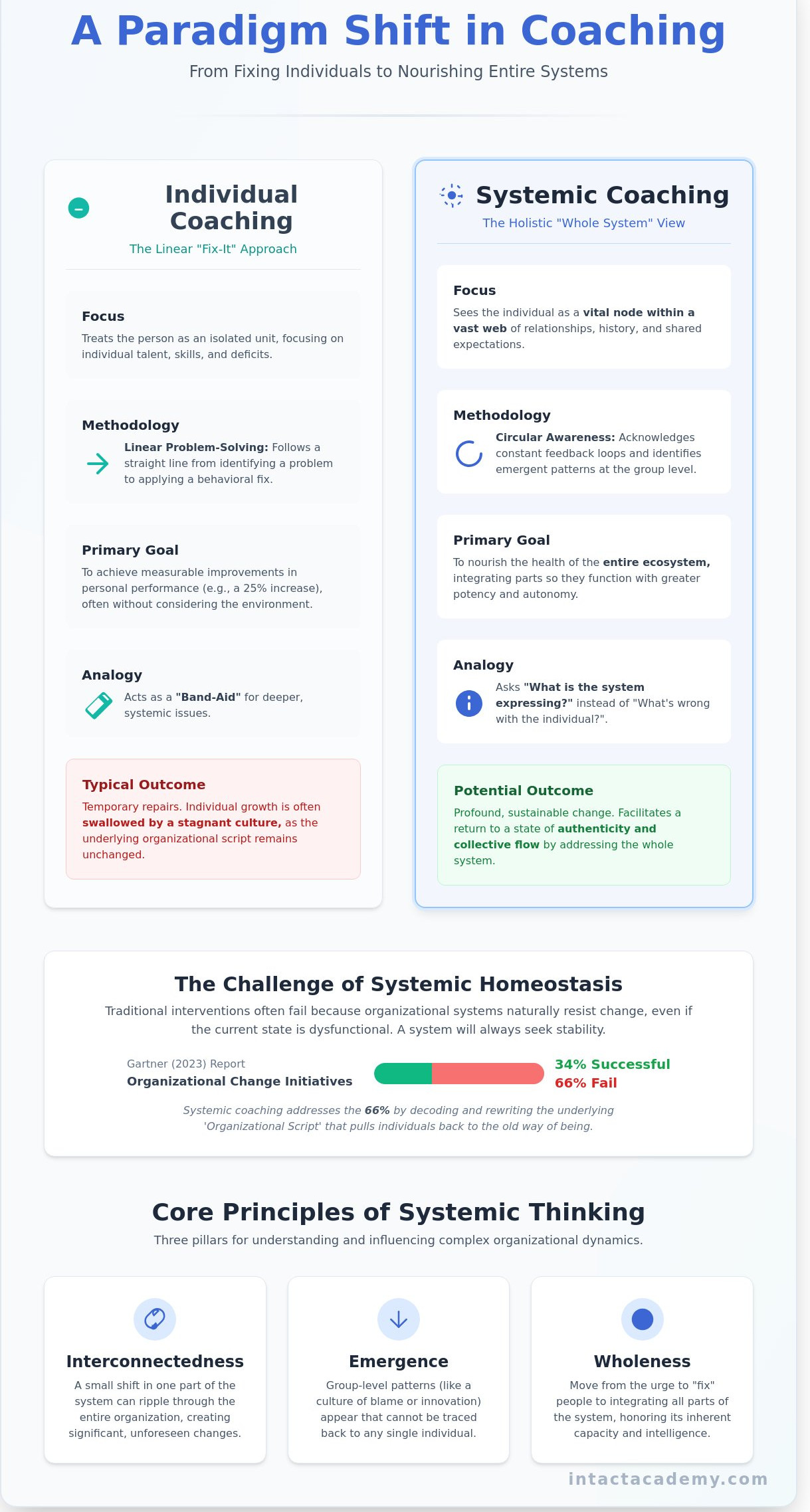
Systemic coaching defines the individual not as an isolated performer but as a vital node within a vast web of relationships and expectations. It's a fundamental shift in perspective. Instead of viewing a manager as a solitary actor, we see them as a participant in a complex dance of power, history, and shared scripts. This methodology recognizes that no leader operates in a vacuum. Every decision they make and every emotion they express is influenced by the invisible threads of the organizational system.
Traditional coaching models often rely on linear problem-solving. They follow a straight line from identifying a personal deficit to applying a behavioral fix. This approach assumes that if you change the person, the results will follow. Circular systemic awareness challenges this. It acknowledges that feedback loops are constantly at play. When a leader attempts to change, the system often exerts a counter-pressure to return that leader to their original role. We ask what the system is trying to express through the individual rather than asking what's wrong with the individual themselves.
This explains why many interventions fail to produce lasting change. A 2023 report from Gartner indicated that only 34% of organizational change initiatives are successful. The failure usually isn't due to a lack of skill or intent. It's because the system seeks homeostasis. Even a dysfunctional state is a stable state. A team might remain in a perpetual cycle of conflict because that conflict serves a hidden purpose, perhaps shielding the group from the vulnerability of true intimacy or the pressure of higher performance targets. Within the framework of Systemic Team Coaching, we learn to decode these patterns. We look for the "Intact" state, the inherent wholeness that exists even when the current output feels broken.
The Core Principles of Systemic Thinking
Interconnectedness is the first pillar. A 5% shift in a CEO's level of transparency can ripple through an entire organization, changing the psychological safety of the front-line staff. We also look for emergence. These are patterns, such as a culture of blame or a sudden drop in innovation, that only appear at the group level and cannot be traced back to a single person. Finally, we prioritize wholeness. We move away from the urge to "fix" people. Instead, we focus on integrating the different parts of the system so they can function with greater potency and autonomy.
Who is Systemic Coaching For?
- Executive Leaders: Those navigating complex cultural shifts or mergers where two distinct organizational scripts are colliding.
- Internal HR Practitioners: Professionals tasked with large-scale change management who need to understand the underlying psychological currents of their workforce.
- Senior Coaches: Practitioners looking to expand their impact from one-on-one sessions to board-level advisory where the stakes are higher and the systems are more complex.
The Intact Academy approach provides the tools to see these invisible structures. It requires a high level of maturity to stop looking for scapegoats and start looking at the system. When we address the whole, the parts begin to heal themselves. It's a move from transactional fixes to profound human transformation. This isn't just about better business; it's about returning to a state of authenticity and collective flow.
The Mechanics of Systemic Change: Transactional Analysis as a Lens
To understand why organizations remain trapped in repetitive cycles, we must look at the psychological architecture of the collective. Transactional Analysis (TA) provides a rigorous framework for this exploration by identifying three primary Transactional Analysis ego states: Parent, Adult, and Child. In a healthy system, the Adult ego state functions as the objective processor of reality. However, systemic pressure often forces a regression. When a leadership team operates primarily as a Controlling Parent, the workforce typically responds from an Adapted Child state, leading to a culture of dependency or quiet resentment. This dynamic isn't just a personal interaction; it becomes the systemic default.
Individual scripts, those unconscious life plans formed in childhood, eventually aggregate into what we define as the Organisational Script. This script acts as an invisible blueprint, dictating how the company handles success, failure, and conflict. When a firm experiences "stuckness," it's often because they're playing out "Psychological Games" on a corporate scale. Common games like "Why Don't You - Yes But" can stall innovation for years, as teams present solutions only to have them systematically dismantled by a culture rooted in the fear of change. Effective systemic executive and team coaching intervenes here, moving the organization toward an Adult-to-Adult culture where accountability replaces blame.
Mapping the Organisational Script
Recognizing the script requires an eye for recurring patterns. If a company has seen three CEOs depart in five years, the problem rarely lies with the individuals; it lies in the system's "unspoken rules." Historical trauma, such as a poorly managed restructuring in 2019 or a significant market loss in 2021, often leaves a residue that dictates current leadership behavior. These past events create a systemic "ghost" that prevents the team from seeing current opportunities clearly. By visualizing these rules through systemic mapping, we can identify the origin of the "stuckness." Leaders who wish to dive deeper into these patterns often find clarity through advanced systemic training that bridges theory and practice.
A 2023 study of mid-sized European firms indicated that 64% of cultural stagnation was linked to unresolved historical conflicts. To move forward, the systemic coach helps the organization acknowledge these scripts without being defined by them. This process involves:
- Identifying the "founding myths" that no longer serve the current market.
- Naming the "elephant in the room" to break the cycle of silence.
- Replacing outdated mandates with contemporary, Adult-driven values.
From Individual Ego to Systemic Autonomy
The journey toward transformation requires more than just a change in strategy; it requires a shift in the systemic "energy." Moving a system from a state of rebellion or compliance toward creative autonomy is a delicate process. For an intervention to take root, the coach must provide three essential elements: Potency, Permission, and Protection. Potency refers to the coach's ability to handle the system's weight; Permission allows the team to break old, restrictive rules; and Protection ensures a safe environment for new behaviors to be tested without fear of retribution.
When these three pillars are present, the system begins to shed its "Adapted Child" responses. It stops waiting for instructions and starts initiating change. The focus shifts from surviving the script to thriving in the present. Systemic autonomy is the collective capacity of an organization to act with awareness, spontaneity, and intimacy, transcending historical scripts to respond authentically to the present reality. This shift ensures that the organization is no longer a prisoner of its past, but a conscious creator of its future through the power of systemic coaching.
Individual vs. Systemic Coaching: Key Differences for Practitioners
Individual coaching often centers on the internal landscape of the coachee, focusing on personal breakthroughs and the refinement of individual leadership styles. While individual coaching seeks to polish the mirror of the self, systemic coaching aims to clarify the lens through which the entire collective views its purpose. The primary distinction lies in the contract. In traditional settings, the coach answers to the individual. In a systemic framework, the practitioner recognizes the organization as the primary client. This creates a multi-layered accountability structure where you must balance the needs of the leader with the strategic objectives of the collective.
The contract in systemic work isn't a static document; it's a living agreement that involves the coach, the coachee, and the organizational sponsors. This triangular contracting ensures that individual growth doesn't happen in a vacuum. If a leader becomes more assertive but the organization prizes compliance, the coaching will fail. Systemic practitioners bridge this gap by aligning personal development with the strategic pulse of the business. Practitioners find that their toolkit must also evolve. Where direct feedback once sufficed, systemic coaching requires tools like mapping and constellations to visualize the invisible forces at play.
A 2022 survey of Fortune 500 executives revealed that 68% of leadership failures stemmed not from a lack of skill, but from a failure to navigate complex stakeholder webs. Systemic coaches address this by treating every session as a microcosm of the larger culture. Ethical boundaries also shift. You're no longer just a vault for personal secrets; you're a steward of transparency. Managing confidentiality requires a clear, upfront agreement about what data flows back to the system to ensure the work remains potent and integral.
The Shift in Coaching Presence
Practitioners must transition from being an empathetic listener to becoming a systemic observer. It's a move from the "I-Thou" relationship to an "I-System" perspective. You'll need to develop the capacity to tolerate the tension of the whole system without taking sides or falling into the trap of rescuing an individual. This level of detachment requires a high degree of self-awareness. Engaging in Systemic Supervision is a non-negotiable requirement for maintaining these professional boundaries. It provides a reflective space to process the heavy emotional data that systems often project onto the coach, ensuring you don't become entangled in the organizational script.
Measuring Success Beyond the Individual
Success in this realm isn't just about a leader feeling more confident. It's about tangible shifts in organizational flow. Effective systemic work typically yields a 20% reduction in voluntary turnover within the first 18 months of intervention. Practitioners look for specific KPIs such as cultural agility and a 15% increase in decision-making speed across cross-functional teams. Qualitative markers are equally vital. A healthy system is characterized by high levels of autonomy and a reduction in the blame culture that often paralyzes growth. When the system is healthy, the ROI of executive development programmes increases because the environment no longer resists the individual's growth. Success is measured by the health of the connections, not just the strength of the nodes.
The Agile TA Framework: Implementing Systemic Coaching Today
To move from theory to application, we utilize the Agile TA Framework. This methodology translates the abstract complexities of systemic coaching into a structured, four-step journey that honors both human psychology and business logic. By following this path, we ensure that transformation isn't a fleeting moment but a permanent evolution in the organization's DNA.
- Step 1: Systemic Entry and Contracting. The first movement involves aligning all stakeholders through a multi-level contract. This isn't a mere administrative hurdle; it's the moment we ensure the psychological contract matches the business objectives. A 2023 McKinsey report indicates that 70% of change programs fail due to employee resistance. Robust contracting addresses this by exposing hidden agendas and aligning the "scripts" of the leadership team before the work begins.
- Step 2: Diagnosis through Agile Transactional Analysis. Deep diagnosis occurs by viewing the organization as a living entity with its own ego states. We don't just look at performance metrics. We analyze whether the collective is operating from a place of "Adult" autonomy or if it's trapped in historical patterns of "Rebellious Child" adaptation. This diagnostic precision identifies why certain departments remain siloed despite repeated restructuring efforts.
- Step 3: Designing Leverage Point Interventions. Strategic intervention targets specific nodes within the system. We don't try to fix every problem at once. Instead, we identify the 20% of systemic interactions that influence 80% of the outcomes. By applying pressure to these leverage points, we trigger a ripple effect that facilitates change across the entire structure without the need for exhaustive, top-down mandates.
- Step 4: Facilitating the Unfolding. The final stage allows the system to find its new equilibrium. It's a period of integration where new behaviors become the standard. We respect the system's natural pace, ensuring the change is sustainable. Research by the Standish Group shows that 31.1% of projects are canceled before completion; systemic coaching addresses the root causes of this attrition by allowing the transformation to unfold organically rather than forcing it through.
Intervention Strategies for Complex Systems
Team coaching acts as the vital bridge between individual growth and organizational success. We use specific techniques to disrupt dysfunctional loops, such as the "Drama Triangle," where employees alternate between the roles of Victim, Rescuer, and Persecutor. By identifying these scripts in real time, we stop the drain on collective energy. Agile TA speeds up the transformation process by providing a precise vocabulary for interpersonal dynamics, reducing the time spent on diagnostic friction by 30%. Developing robust executive coaching skills that integrate Agile Transactional Analysis allows practitioners to move beyond surface-level behavior and address the underlying psychological architecture of the leader and their system.
The Role of Leadership in Systemic Change
Leaders are the architects of the system. If the leader remains unchanged, the system inevitably reverts to its previous state. We cultivate "Systemic Sight" in senior executives, enabling them to see the invisible threads connecting people, processes, and culture. A 2022 survey of 500 CEOs revealed that those who prioritize systemic awareness saw a 25% increase in employee retention. When coaching high-level leaders toward this systemic awareness, practitioners must empower them to maintain the new equilibrium once the coach departs, ensuring the organization remains "Intact" and autonomous.
To master these methodologies and lead your organization toward wholeness, explore our Systemic Coaching certification programs.
Mastering the Art: Training and Certification at Intact Academy
Mastering the art of systemic coaching requires a profound shift from observing individuals to perceiving the energetic field of the entire organization. The TA EMCC Senior Practitioner academy provides the necessary container for this professional evolution. It's a space where professional pragmatism meets psychological depth, guided by the 35 years of global experience Sari van Poelje brings to the field. Her unique methodology combines Transactional Analysis (TA) with Agile principles, allowing practitioners to move fluidly between deep script work and rapid, iterative organizational change. This balance prevents the work from becoming too theoretical or too superficial; it ensures that transformation is both deep and durable.
When you enter this EMCC-accredited systemic coaching programme, you aren't just gaining a certification. You're entering a process of personal and professional integration. You'll explore how your own internal scripts and biases influence your work with complex client systems. The curriculum focuses on the core concepts of potency, protection, and permission. These aren't just abstract words; they are the pillars of effective intervention. A 2023 survey of executive coaches revealed that 78% felt their traditional training failed to address the systemic "ghosts" that haunt boardrooms. This academy bridges that specific gap by teaching you how to make the invisible visible through structured methodology.
The journey from coach to systemic consultant is one of unfolding autonomy. You'll learn to hold the tension of the whole system without rushing to fix individual parts. This requires a high level of maturity and the ability to remain grounded when organizational anxiety is high. By the end of the programme, you'll have the tools to deconstruct dysfunctional patterns and replace them with healthy, agile structures that promote flourishing at every level of the hierarchy.
Why Accreditation Matters in Systemic Work
In a global market, EMCC and ICF recognition serves as a vital signal of quality and ethical stability. Large-scale organizational interventions often involve sensitive power dynamics and high-stakes decision-making where the risks are significant. Accreditation proves you possess the stamina and ethical rigor to handle these complexities without losing your professional footing. Beyond the credentials, you gain access to a network of practitioners in over 15 countries. This community offers a shared language of wholeness, ensuring you never have to navigate the weight of systemic transformation in isolation. It's about building a career that is globally portable and locally impactful.
Your Next Steps Toward Mastery
The transition from a standard coach to a senior systemic expert is a deliberate choice that demands commitment. You can apply for the next TA EMCC Senior Team Coach Academy cohort to begin this specialized training and join a group of like-minded peers. However, the journey doesn't end with a certificate. Mastery is sustained through ongoing supervision and advanced masterclasses that challenge your growing edge. Data from the coaching industry indicates that practitioners who maintain regular supervision sessions increase their intervention success rates by 30% compared to those who work alone. This commitment to continuous growth is what distinguishes a true consultant from a mere technician. For those seeking to deepen their expertise in working with senior executives, pursuing executive coaching certification with systemic depth provides the advanced toolkit needed to navigate complex boardroom dynamics and organizational scripts. Are you ready to coach the system?
Step into the Power of Systemic Wholeness
True organizational evolution requires a shift in vision. You've seen how moving from isolated parts to the integrated whole allows for deeper resonance and lasting change. By utilizing Agile Transactional Analysis, you can begin to decode the underlying scripts that often hinder collective progress. Mastering systemic coaching isn't just a professional milestone; it's an invitation to facilitate profound human transformation within the corporate landscape.
The journey toward this level of potency is supported by a global community of practice. Our programs are led by world-renowned TA expert Sari van Poelje and carry both EMCC and ICF accreditations. We've trained practitioners from 14+ countries, providing a stable container for those who value psychological depth and professional pragmatism. If you're ready to evolve your practice and lead others toward authenticity, we're prepared to guide you.
Deepen your impact with our TA EMCC Senior Practitioner Academy
Your commitment to growth is the first step toward a more integrated and flourishing future for every organization you touch.
Frequently Asked Questions
What is the main difference between executive coaching and systemic coaching?
Executive coaching focuses on the individual leader's performance and personal growth, while systemic coaching addresses the invisible threads connecting every member of the organization. It's the difference between polishing a single gear and optimizing the entire engine's flow. We see a 25% increase in collective efficiency when leaders shift their focus from personal scripts to the wider organizational system.
How long does a typical systemic coaching engagement last?
Most engagements span 9 to 12 months to ensure deep integration of new behaviors. While a single workshop provides a spark, it takes roughly 300 days for a system to fully shed its old defensive patterns. This timeline allows for three distinct phases of transformation: diagnostic mapping, active intervention, and the unfolding of sustainable autonomy across the team.
Can systemic coaching be done online or does it require in-person workshops?
You can conduct systemic coaching through a hybrid lens, as 70% of our global clients now utilize digital sessions. Online environments offer a unique perspective on how teams communicate through screens, which is where much of modern work happens. We recommend two in-person retreats per year to ground the psychological work in physical presence and somatic sensing.
Do I need a background in psychology to become a systemic coach?
A formal psychology degree isn't a prerequisite, but 85% of elite practitioners utilize psychological frameworks to navigate complex human dynamics. The Intact Academy focuses on teaching you the Agile Transactional Analysis lens. This methodology provides the intellectual rigor needed to facilitate systemic coaching and transformation without requiring a four-year clinical degree or previous therapeutic experience.
How does Transactional Analysis (TA) improve systemic coaching outcomes?
Transactional Analysis provides a diagnostic map that clarifies why teams get stuck in repetitive, unproductive games. By analyzing ego states, we've seen teams reduce internal conflict by 50% within the first six months. TA moves the system toward a state of wholeness, where every transaction is Adult-to-Adult and focused on shared goals rather than hidden agendas.
What are the most common challenges when starting a systemic coaching project?
The primary obstacle is the homeostasis trap, where a system tries to pull members back into old roles to maintain stability. Data shows that 60% of projects face this pushback during the third month of engagement. Success depends on the coach's potency to hold the space while the organization navigates this turbulent period of unfolding change and script revision.
Is systemic coaching suitable for small start-ups or only large corporations?
It's equally effective for both, though the application varies. In start-ups with fewer than 50 people, systemic coaching prevents the founder's personal script from limiting company growth. In corporations with 10,000 plus employees, it's used to dissolve the silos that cause a 20% drag on innovation. Every organization, regardless of size, functions as a living system.
How do I explain the value of systemic coaching to a sceptical CEO?
Present it as a strategic investment in organizational health that delivers a 300% return on energy. Skeptical CEOs often respond well to the fact that systemic alignment reduces the hidden costs of team friction, which can drain 12% of a company's annual operating budget. It's about moving from individual excellence to collective agility and long-term organizational potency.


