

What if the executive resistance you encounter isn't a lack of professional alignment, but a silent, subconscious loyalty to a systemic script that's no longer functional? You've likely sat in rooms where leaders nod with conviction, yet their subsequent actions remain tethered to old patterns. When coaching executives through organizational change, the pressure to deliver immediate results often forces us to focus on surface-level symptoms while the underlying psychological roots remain untouched. This misalignment doesn't just stall progress; it leads to profound executive burnout and a sense that transformation is merely an exhausting performance.
You understand that true leadership evolution requires more than a new strategy or a shift in KPIs. It demands a return to wholeness. This guide offers a sophisticated framework for mastering the systemic dynamics and psychological depth required to guide leaders through high-stakes transitions. We'll examine how to identify hidden resistance, apply systemic mastery to root causes, and ensure that behavioral changes actually stick. By the end, you'll have the tools to facilitate sustainable organizational transformation that honors both the individual's growth and the system's health.
Key Takeaways
- Distinguish between external shifts and internal psychological transitions to address the human factors behind why most change initiatives fail.
- Identify how an executive's "Life Script" and early survival strategies can become unconscious liabilities when they're navigating complex organizational evolution.
- Master a systemic framework for coaching executives through organizational change that resolves internal resistance and aligns personal growth with systemic health.
- Move beyond linear problem-solving by using systemic diagnosis to map the hidden dynamics that influence leadership behavior in high-pressure environments.
- Understand why true mastery in transformation depends on the coach's own commitment to personal development and specialized training at the senior practitioner level.
Beyond Linear Models: The Psychology of Executive Change
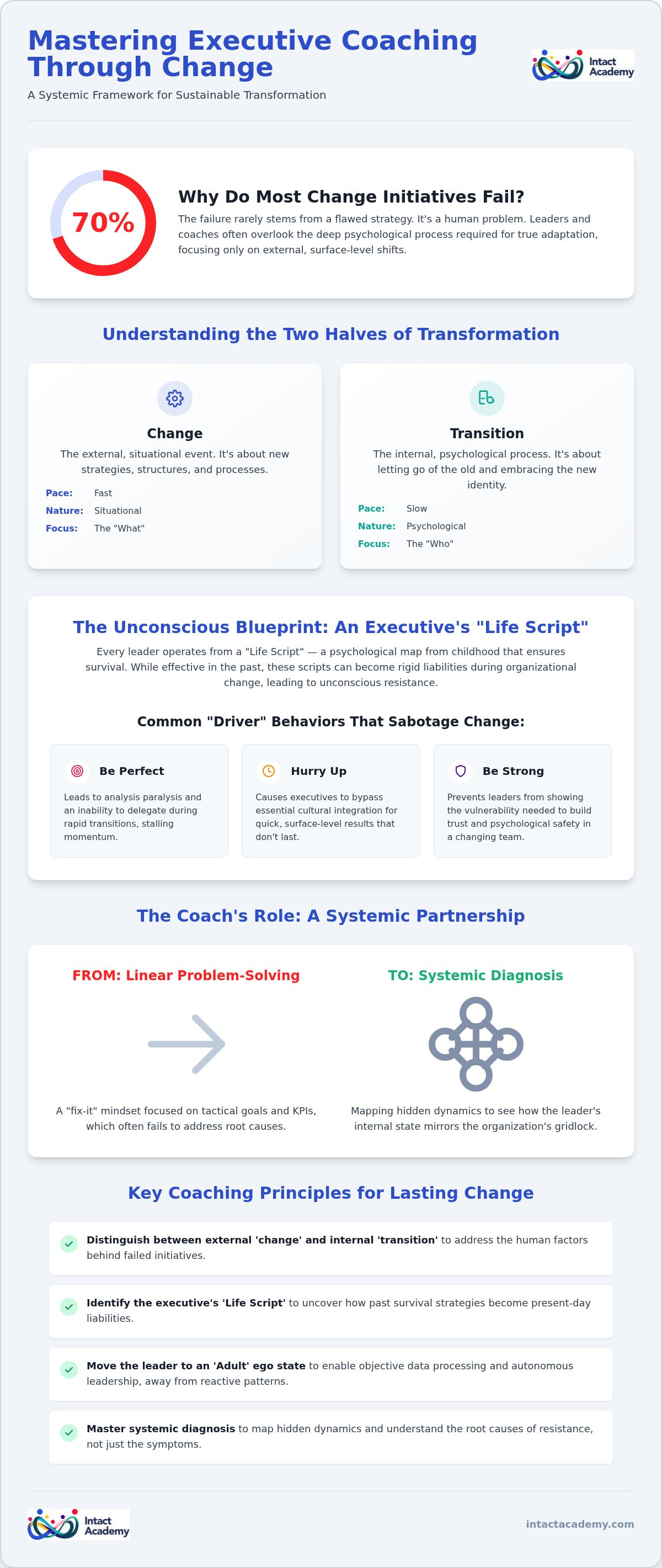
Most approaches to organizational change management focus on the external architecture of the shift. They map milestones, reallocate resources, and redesign workflows. Yet, research consistently indicates that roughly 70% of change initiatives fail. This failure rarely stems from a flawed strategy. Instead, it arises because leaders and coaches overlook the distinction between change, the external event, and transition, the internal psychological process people must navigate to reach a new state. Change is fast; transition is slow. Change is situational; transition is psychological.
When coaching executives through organizational change, we must recognize the leader's role as the primary container for organizational anxiety. During periods of upheaval, employees look to the executive not just for direction, but for emotional stability. If the executive cannot hold the tension of the unknown, the system will fragment. Transactional Analysis (TA) offers a vital tool for mapping these invisible dynamics. By understanding ego states, coaches can identify when a leader is reacting from a place of past conditioning rather than present-moment reality. This insight transforms the coaching room from a space of tactical planning into a laboratory for systemic evolution.
The Limits of Tactical Coaching
Standard coaching often relies on goal-setting and KPIs. While these tools have their place, they're insufficient when an executive is operating from a survival ego state. In this state, the brain prioritizes safety over innovation. Coaching for performance during systemic upheaval is like polishing the deck of a ship during a storm. It ignores the fundamental reality that the leader's internal world is under siege. We must move from a fix-it mindset to a systemic partnership. This shift allows the executive to move out of reactive patterns and into a state of autonomous leadership that can actually sustain the weight of the transformation.
The Executive as a Systemic Mirror
A leader's internal conflict often manifests as organizational gridlock. If an executive feels stuck between old loyalties and new demands, their department will likely mirror that hesitation. This is the parallel process at work. It's a phenomenon where the dynamics within the coaching relationship reflect the dynamics within the executive's team. By observing these patterns, we gain clues about the root causes of systemic resistance. Systemic coaching is the art of seeing the whole through the individual. When the leader finds internal clarity, the organization often follows suit.
Mapping the Executive Life Script in Transformation
Every executive carries an unconscious blueprint formed long before they entered the boardroom. In Transactional Analysis, we call this the Life Script. It's a psychological map created in childhood to ensure survival and recognition. While these scripts often propel individuals to high-level success, they can become rigid liabilities during periods of systemic upheaval. When coaching executives through organizational change, our task is to help them recognize when they're leading from an outdated script rather than responding to the present-moment needs of the organization.
Leadership scripts are often reinforced by internal "Drivers." These are subconscious directives that dictate behavior under pressure. Consider these common patterns:
- Be Perfect: Leads to analysis paralysis and an inability to delegate during rapid transitions.
- Hurry Up: Causes executives to bypass essential cultural integration in favor of immediate, surface-level results.
- Be Strong: Prevents leaders from showing the vulnerability necessary to build trust in a changing environment.
By applying the Parent-Adult-Child ego state model, we can decode C-suite communication. An executive stuck in a "Critical Parent" state may stifle innovation, while one in a "Rebellious Child" state might covertly sabotage new directives. Effective coaching equips leaders for rapid change by moving them into an "Adult" ego state, where they can process data objectively and lead with genuine autonomy.
Uncovering Unconscious Resistance
It's a common frustration: a highly logical executive makes seemingly illogical decisions when facing a redesign. This happens because the proposed change threatens the leader's script-based identity. If a leader's script is built on being the "sole provider of answers," a move toward a decentralized, agile structure feels like a personal erasure. We use TA to decode the hidden messages in this pushback. The resistance isn't to the strategy itself; it's a defense mechanism against the uncertainty of a new organizational culture that doesn't yet have a place for their old identity.
Rewriting the Leadership Narrative
True transformation occurs through the process of "re-decision." This isn't a mere change in habit; it's a profound shift in how a leader views their role within the system. Coaching facilitates the move from script-bound reactions to autonomous action. By letting go of old leadership identities, executives can return to a state of completeness and lead from their authentic selves. Integrating these deep psychological concepts is a cornerstone of our executive coaching certification pathways. At Intact Academy, we believe that for an organization to change, the leader must first have the courage to evolve their own internal narrative.
Overcoming 'Immunity to Change': Addressing Executive Objections
Executives often present a paradox: they champion transformation while simultaneously anchoring themselves to the status quo. This phenomenon, known as "Immunity to Change," creates a state where the leader has one foot on the gas and the other on the brake. When coaching executives through organizational change, we frequently encounter the objection that deep psychological work is a luxury they cannot afford. "I don't have time for this," they say, pointing to a calendar filled with tactical firefighting. They view the inner world as a distraction from the outer mission.
Addressing the root cause is the ultimate act of efficiency. Tactical fixes only treat symptoms; they don't prevent the fire from reigniting. By reframing depth as a strategic shortcut, we move the leader from a cycle of exhaustion to a position of systemic clarity. For this work to succeed, psychological safety is non-negotiable. An executive must feel safe enough to be vulnerable, knowing the coaching space is a secure container where their professional identity can evolve without being dismantled. Without this safety, the "brake" of self-protection will always override the "gas" of strategic intent.
Identifying the Competing Commitments
Stagnation is rarely a lack of will; it's the result of hidden competing commitments. An executive might commit to "empowering the team" while holding a simultaneous, unconscious commitment to "maintaining total control to avoid failure." These commitments are fueled by "Big Assumptions," which are deeply held beliefs like "If I delegate, I lose my value" or "If I'm not the smartest person in the room, I'm irrelevant." As coaches, we act as a secure base. This allows the leader to test these assumptions in a controlled environment. They often discover that letting go of control actually increases their systemic impact rather than diminishing it.
Creating a Container for Transformation
Sustainable change requires contracting for depth from the very first session. If we only contract for surface results, the work remains transactional and the impact stays shallow. We must also address the executive’s fear that psychological growth might cause them to "lose their edge." There's often a concern that becoming more self-aware means becoming "soft." We counter this by showing that wholeness leads to a more resilient, quiet power. Our role is to balance deep empathy with high-challenge interventions, pushing the leader toward their growth edge while providing the support needed to cross it. This structured methodology ensures that organizational transformation isn't just a temporary shift, but a lasting evolution of character and culture.
A 5-Stage Systemic Framework for Coaching Through Change
Effective transformation requires a shift from linear checklists to a dynamic, systemic rhythm. This framework provides a stable container for the often-turbulent work of leadership evolution. When coaching executives through organizational change, we move through five distinct stages that honor the complexity of both the human and the system, ensuring that growth is not just a temporary adjustment but a permanent state of becoming.
Stage 1: The Systemic Scan
Diagnosis begins by mapping the field. We don't just look at the executive; we look at the executive's place within the entire organizational web. Utilizing tools for leading organizational change, such as stakeholder mapping and culture audits, allows us to identify "systemic holes." These are areas where energy, leadership, or clarity is missing. We also assess the "Life Space" of the executive, weighing the internal psychological pressures against the external market demands to see where the system is out of balance.
Stage 2: Contracting for Wholeness. We align the executive’s personal growth goals with the organization’s strategic needs. This ensures that the coaching work serves the whole system rather than operating in a vacuum. Stage 3: De-Scripting. Building on our previous exploration of Life Scripts, we identify the unconscious patterns that hinder change. We challenge the leader to let go of survival strategies that no longer serve the current organizational reality.
Stage 4: Behavior in the System
Transformation is realized when the executive begins to change the "systemic dance" by changing their own steps. We coach the leader to practice new behaviors in high-stakes scenarios, moving from a top-down command style to one of systemic facilitation. This shift relies on Adult-to-Adult transactions, which foster a culture of psychological safety and accountability. When the leader stays in an Adult ego state, it invites the team to do the same, reducing reactive friction across the department.
Stage 5: Sustainable Autonomy. The final stage ensures the leader can maintain these shifts without the coach. We focus on integrating the new leadership identity so it becomes second nature. The goal is a state of completeness where the leader is equipped to navigate future turbulence with steady, internal authority. If you're ready to master these deep systemic frameworks, our organizational change programs offer the structured methodology needed for professional mastery.
Cultivating Depth: The Intact Academy Approach to Mastery
Mastery in coaching executives through organizational change isn't a destination; it's a continuous process of returning to wholeness. It requires the coach to possess the same courage they ask of their clients. Sari van Poelje has spent decades refining this path, integrating the structural agility of modern business with the psychological depth of Transactional Analysis (TA). This unique methodology ensures that leaders don't just "do" change; they "become" the change. The TA EMCC Senior Practitioner academy is designed for those ready to move beyond surface-level interventions and into the realm of profound systemic transformation.
This level of work demands a shift in the coach's identity. You're no longer just a facilitator of goals; you're a systemic visionary who can see the invisible threads connecting individual behavior to organizational outcomes. This evolution doesn't happen in isolation. It requires a rigorous commitment to your own growth and a willingness to explore the scripts that drive your own professional practice. By doing this work, you provide a stable, authentic presence that allows executives to navigate their most turbulent transitions with clarity.
The Role of Supervision in Change Coaching
Coaching at the C-suite level during periods of upheaval is high-risk work. It's easy for a coach to get sucked into the organizational script, becoming an unconscious participant in the very dynamics they're meant to resolve. Professional supervision provides the necessary distance to remain objective. By using the 7-Eyed Model, we examine not just the executive's behavior, but the systemic impact of the coaching relationship itself. This oversight ensures you remain a secure base for your client rather than a mirror of their anxiety. Supervision is the safeguard that keeps the coaching container clean and effective.
Joining a Global Community of Mastery
The journey from practitioner to systemic visionary requires a commitment to lifelong professional development for coaches. At Intact Academy, we've built a learning environment that reflects the global nature of business today. Whether you join us online or at our campus in Utrecht, you'll be part of a community that has delivered training to participants from 14+ countries. This diversity enriches the learning process, offering a global perspective on human behavior and business systems.
Stepping into a deeper level of impact means having the humility to look inward before you look outward. It's about mastering the art of systemic presence and the science of human transformation. We invite you to join the TA EMCC Senior Practitioner academy to refine your craft and redefine what it means to lead through change. Your evolution is the catalyst for theirs.
Embracing the Future of Systemic Leadership
True transformation begins when we look past the tactical surface and address the psychological architecture of leadership. By distinguishing between external shifts and internal transitions, you provide executives with the clarity needed to lead with genuine autonomy. We've explored how the Life Script and unconscious resistance can stall even the most robust strategies, and how a structured, systemic framework can turn these obstacles into opportunities for growth. Mastery in coaching executives through organizational change is about more than just solving problems; it's about facilitating a return to wholeness for the individual and the system alike.
If you're ready to deepen your impact and join a global community of practitioners across 14+ countries, it's time to refine your craft. Our EMCC and ICF accredited programs, led by international expert Sari van Poelje, provide the intellectual rigor and emotional depth required for high-stakes coaching. Explore the TA EMCC Senior Practitioner Academy at Intact Academy and step into your role as a systemic visionary. The path to mastery is deliberate, rewarding, and essential for the leaders of tomorrow. You possess the capacity to guide others through the unknown; now, allow your own development to be the catalyst for theirs.
Frequently Asked Questions
How does Transactional Analysis (TA) help in executive coaching?
TA provides a map of the unconscious patterns and ego states that drive behavior. It helps identify when a leader is reacting from a past script rather than a present Adult state. This creates clarity in high-pressure environments. By decoding transactions, a coach can help an executive communicate more effectively with their team. It turns invisible systemic dynamics into manageable data for professional growth and leadership excellence.
What is the biggest challenge when coaching executives through organizational change?
The primary challenge when coaching executives through organizational change is overcoming the 'Immunity to Change,' where survival scripts conflict with new goals. Executives feel immense pressure to maintain an image of strength while navigating deep uncertainty. This creates a subconscious resistance that stalls progress. Successful coaching requires creating a safe container where the executive can explore these fears without losing their professional edge. It's about moving from reactive habits to systemic autonomy.
Can systemic coaching work in an agile or fast-paced corporate environment?
Systemic coaching is highly effective in agile settings because it addresses the root causes of friction rather than just symptoms. By using Transactional Analysis, coaches can quickly map the ego states and script patterns that cause bottlenecks in rapid-fire decision-making. This depth increases efficiency because leaders don't have to waste time on tactical firefighting. It allows leaders to remain grounded and clear-headed while navigating the turbulent waters of constant organizational evolution.
How do you measure the success of a systemic coaching engagement?
Success is measured by the leader's ability to maintain Adult ego states and systemic clarity under pressure. We look for tangible shifts in organizational culture, such as increased psychological safety and reduced gridlock. While traditional KPIs matter, the ultimate proof is sustainable autonomy. This means the executive can navigate future challenges without constant coaching support. The true value lies in the leader's return to completeness and their capacity to lead from a state of genuineness.
What is the difference between executive coaching and organizational change consultancy?
Consultancy typically focuses on the external architecture of change, such as milestones and resource allocation. In contrast, coaching executives through organizational change focuses on the internal psychological transition of the leader. While a consultant redesigns the system, a coach ensures the executive is capable of leading within it. Coaching addresses the human factors and unconscious scripts that often cause strategic initiatives to fail, bridging the gap between plan and execution.
How can a coach help an executive who is resisting a board-mandated change?
The coach helps the executive identify the competing commitments that fuel their resistance. Often, this pushback isn't about the board's directive but a fear that the change threatens the executive's identity or script. By exploring these internal dynamics in a safe space, the coach facilitates a re-decision. This allows the leader to find a new way to align their personal values with the organization's needs, moving from covert sabotage to active facilitation.
Is EMCC Senior Practitioner accreditation necessary for change coaching?
While not legally mandated, this accreditation is a critical differentiator for high-stakes work. Senior Practitioner level training, like our TA EMCC Senior Practitioner academy, ensures the coach has the psychological depth to handle complex systemic dynamics. It provides a structured methodology and a commitment to professional supervision. This accreditation signals to global organizations that you possess the rigor and integrity required for profound human transformation and sustainable organizational success.
How long does a typical systemic coaching engagement last?
Engagements typically range from six to twelve months to allow for deep psychological integration. While tactical shifts can happen quickly, rewriting a leadership script and embedding new systemic patterns takes time. A six-month engagement is common for specific transitions, while a year-long partnership provides a more stable container for sustainable change. The rhythm is deliberate, mirroring the process of deep learning and the evolution of the executive's leadership identity within the organization.


