

What if the most significant barrier to your professional evolution isn't a lack of skill, but the absence of a structured, systemic map to guide your growth? You likely feel the weight of the sprawling TA landscape, often losing your way between clinical requirements you don't need and the specific transactional analysis certification path suited for organizational experts. It's a common struggle to feel that the deep time and financial commitment required for mastery lacks a clear, tangible return.
We understand that the technical demands of international associations can feel overwhelming when you're seeking to bridge the gap between individual psychology and organizational health. This guide clarifies the precise steps to becoming a certified professional in the organizational and coaching fields for 2026. You'll learn how to integrate these certifications with EMCC and ICF standards. We'll explore how to transform your practice into a vessel for profound systemic change, ensuring your expertise is met with the global recognition it deserves.
Key Takeaways
- Distinguish between a simple certificate of attendance and the profound depth of professional certification to ensure your credentials carry global authority.
- Identify the critical differences between clinical and organizational specializations so you don't waste energy on training tracks that don't serve your systemic goals.
- Map your journey along the transactional analysis certification path, starting with the foundational TA 101 and progressing toward recognized international mastery.
- Discover how to bridge the gap between psychological theory and professional practice by integrating TA with EMCC and ICF coaching standards.
- Gain a clear understanding of the requirements for the TA EMCC Senior Practitioner academy to align your growth with high-level organizational change.
Understanding the Transactional Analysis Certification Landscape
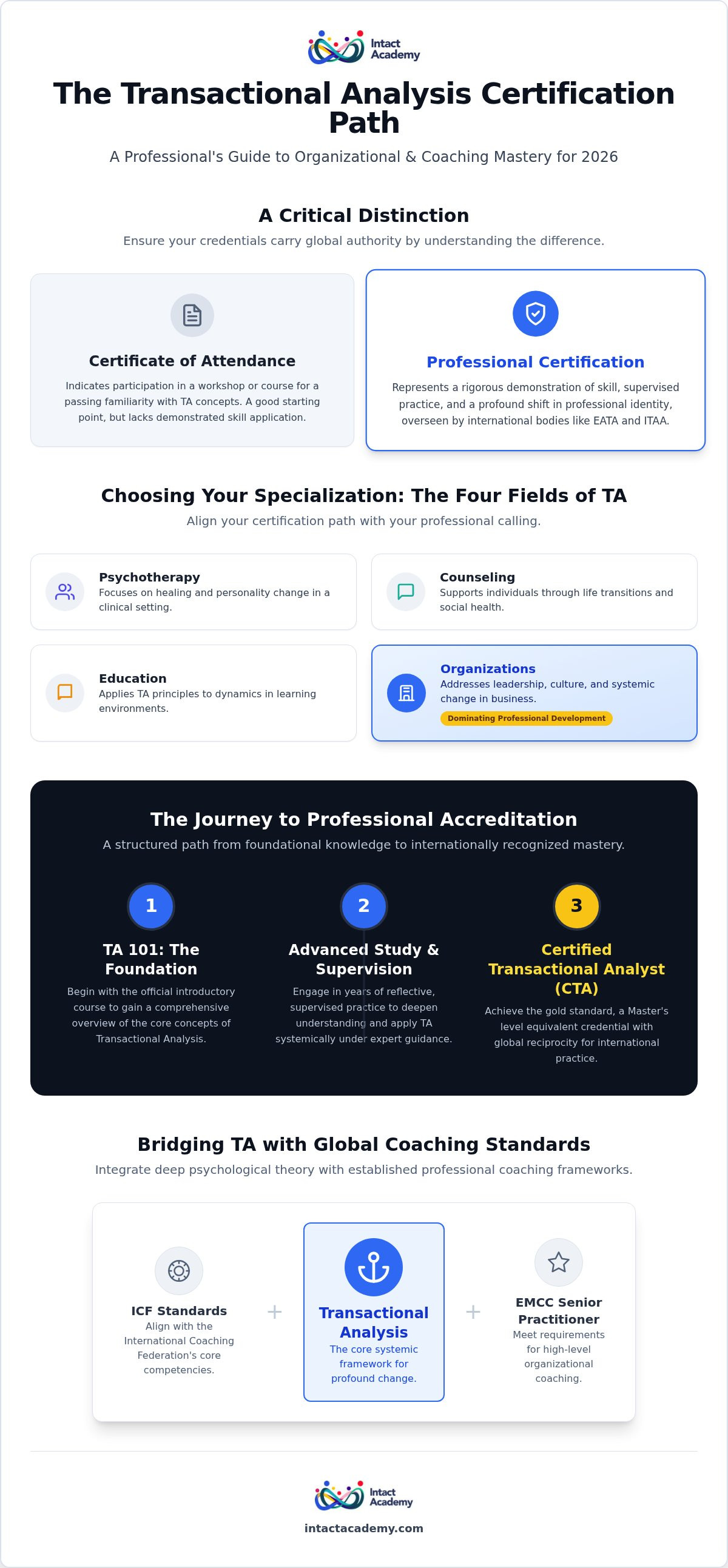
Choosing to embark on a transactional analysis certification path is a commitment to seeing beyond the surface of human interaction. It's a journey from observing behavior to understanding the underlying scripts that drive organizational culture. There's a vital distinction to make early in this process: the difference between a certificate of attendance and professional certification. While many attend workshops to gain a passing familiarity with the concepts, true certification requires a rigorous demonstration of skill, supervised practice, and a profound shift in one's professional identity.
The rigor of Transactional Analysis lies in its dual nature as both a comprehensive personality theory and a systemic framework for change. Unlike shorter, tool-based coaching courses, TA demands years of reflective practice. This depth is overseen by international bodies like the European Association for Transactional Analysis (EATA) and the International Transactional Analysis Association (ITAA). These organizations ensure that whether you're in Utrecht or Singapore, the standard of excellence remains consistent. As we move through 2026, the psychologically informed leader is no longer a luxury; it's a necessity for managing the complexities of global systems.
The Value of a Recognized TA Credential
In the competitive executive coaching market, a recognized credential acts as a beacon of credibility. It signals to clients that you possess a sophisticated map for addressing complex organizational dynamics. You move beyond surface-level interventions, instead targeting the systemic roots of conflict and stagnation. This approach allows for deep, sustainable impact, helping leaders return to a state of completeness and genuineness within their roles. By mastering the transactional analysis certification path, you gain the authority to guide others through profound human transformation.
The Global Standard of the CTA
The Certified Transactional Analyst (CTA) designation is the gold standard of the field. It's widely recognized as a Master’s level equivalent in many regions, reflecting the academic and practical intensity required to achieve it. One of the most significant advantages of the CTA is its reciprocity. Because the standards are governed by global associations, your qualification travels with you across borders. This global citizenship is essential for practitioners working in international contexts; it provides a stable container for the often-turbulent work of personal and professional change.
The Four Fields of TA: Choosing Your Professional Specialization
Transactional Analysis is far more than a clinical modality; it is a profound social psychology designed to illuminate the inner workings of all human systems. While its roots are deep in the soil of psychotherapy, the branches of TA reach into every area where people interact, grow, and work together. Choosing your transactional analysis certification path begins with identifying which of the four distinct fields of specialization aligns with your professional calling.
- Psychotherapy: This field focuses on healing, personality change, and the resolution of deep-seated psychological issues within a clinical setting.
- Counseling: Here, the emphasis shifts toward social health, developmental growth, and supporting individuals through life transitions or situational crises.
- Education: This specialization applies TA principles to learning environments, focusing on the dynamics between teachers, students, and the broader school system.
- Organizations: This field addresses leadership, organizational culture, and systemic change, providing tools to understand the collective "script" of a business.
Why the Organizational Field is Dominating Professional Development
Modern leadership requires more than just management techniques; it demands a deep understanding of human dynamics. The demand for systemic coaches who can decode transactional analysis ego states has surged as organizations recognize that cultural transformation starts with psychological insight. In this field, we move away from the clinical impulse to "fix people" and focus instead on optimizing systems. By applying TA to team dynamics, you help organizations return to a state of effectiveness and genuineness, creating environments where both the individual and the collective can flourish.
Selecting the Right Field for Your Career Goals
Your choice of field defines your peer group, your supervision requirements, and the specific competencies you'll develop. Determining whether you belong in Counseling or Organizations often comes down to the nature of your contract with clients. Are you supporting personal development, or are you driving systemic performance? While the ITAA certification process allows for some flexibility, switching fields mid-stream can be complex. It's vital to find a supervisor who matches your chosen field early in your transactional analysis certification path to ensure your hours and practice align with professional standards. For those ready to deepen their impact, exploring a systemic professional academy offers a path toward true mastery by bridging the gap between psychological depth and organizational success.
Clinical vs. Organizational Paths: Navigating the Core Requirements
Every profound journey begins with a shared language. Whether you're drawn to the healing arts or the strategic complexity of global business, the transactional analysis certification path starts on common ground. This foundation ensures that every practitioner, regardless of their eventual field, shares a rigorous understanding of human architecture and systemic dynamics. However, as you move past the basics, the distinction between clinical and organizational requirements becomes a vital compass for your professional identity.
The "Core 101" – Your Entry Point to the Path
The TA 101 is the official gateway to the modality. It's a two-day or 12-hour immersion into the core theory, covering ego states, transactions, and life scripts. In 2026, many professionals choose online options for this foundation, though the depth of in-person interaction remains highly valued for its experiential weight. This certificate acts as your "passport," a prerequisite for any advanced training recognized by international bodies. For example, the TA credentialing pathways clearly define this as the non-negotiable first step. You can expect to invest around £399 for this introductory course, which serves as a vital filter for those serious about systemic mastery.
After the 101, the paths diverge sharply. Clinical training focuses on personality change and the resolution of pathology. Organizational training, however, pivots toward systemic health and cultural transformation. This distinction is most visible in supervision requirements. While a clinical trainee seeks supervision on therapeutic boundaries, an organizational practitioner focuses on the "parallel process" between a coach and an entire business system. Even the personal growth requirement differs; while clinical paths mandate personal psychotherapy, the organizational path emphasizes deep personal development to ensure the practitioner doesn't project their own "script" onto the client system.
Advanced Training and the "Contractual" Journey
Accreditation isn't a sprint; it's a methodical process of becoming. The journey to becoming a Certified Transactional Analyst (CTA) typically spans 4 to 5 years. During this time, you'll enter a formal training contract with a Principal Supervisor. This contract is valid for 5 years, providing a stable container for your evolution. You'll track your hours across three categories: training, supervised practice with clients, and supervision itself. This structured methodology ensures that by the time you reach your oral and written examinations, your professional identity is grounded in both theory and lived experience. The total investment for this level of mastery often ranges between $8,000 and $15,000, reflecting the depth of the transactional analysis certification path and the commitment required to reach international standards.
From TA 101 to CTA: Step-by-Step Toward Professional Accreditation
The transactional analysis certification path is a deliberate process of becoming; it is a journey that transforms how you perceive and influence human systems. It begins with the TA 101, the essential 12-hour introduction to the model’s core concepts. Following this, you’ll typically enroll in a Foundation or Year 1 program. You’ll find this phase is crucial for deepening your systemic understanding before you commit to the full accreditation process. It's a time to ground yourself in the language of ego states and scripts.
The heart of the journey lies in the Training Contract with EATA or ITAA. Under the guidance of a qualified supervisor, you’ll spend several years accumulating 2,000 hours of professional activity. Crucially, 750 of these hours must be TA-specific, focusing on the direct application of the theory. The final threshold is the examination, which consists of a comprehensive written case study and an oral board exam where you demonstrate your integration of the modality.
Accumulating Your Hours: A Strategic Approach
Many professionals leverage their existing coaching practice to fulfill their professional hours. You don't have to abandon your current work; instead, you integrate TA principles into your sessions. Diverse supervision is the cornerstone of this growth. By participating in individual, group, and peer supervision, you expose your practice to different viewpoints. Documenting this journey in a professional logbook is essential. It serves as both a record for accreditation and a reflective diary of your professional evolution.
The Final Exam: Demonstrating Systemic Competence
The final evaluation is a rigorous test of your ability to apply TA with nuance and depth. Examiners aren’t just checking for theoretical knowledge; they’re looking for the integration of theory and practice. They want to see how you manage complex systemic issues with clarity. The Oral Board is a significant rite of passage into the global TA community. It’s an invitation to step into your authority as a certified professional. Preparing for this stage of the transactional analysis certification path involves deep reflection on your case work and a commitment to professional wholeness.
Ready to begin your journey toward mastery? Explore how the TA EMCC Senior Practitioner academy can support your development.
Integrating TA into Executive Coaching: The Intact Academy Path
While the broader transactional analysis certification path offers a rigorous theoretical foundation, the modern professional requires a bridge between psychological depth and executive application. Intact Academy serves as this bridge, transforming abstract theory into a vessel for organizational change. We recognize that for a coach or consultant, the value of TA lies in its power to decode the unspoken architecture of a system. By integrating these insights into a professional framework, we move beyond surface-level interventions toward a state of systemic mastery.
The unique synergy between TA and our executive coaching certification allows you to achieve dual accreditation. This path leads to both TA mastery and the prestigious EMCC Senior Practitioner status. It is a rigorous process that honors your maturity and intelligence, providing a stable container for your growth. Our philosophy focuses on "returning to wholeness." We believe that by uncovering the authentic self within the leader, we can revitalize the entire organization. This focus on genuineness acts as a thematic North Star, distinguishing our approach from more transactional training providers.
The TA EMCC Senior Practitioner Academy
Designed specifically for the 2026 professional landscape, this program maps TA competencies directly to EMCC coaching standards. You aren't just learning two separate disciplines; you're discovering how they inform and strengthen one another. The curriculum is built on the belief that profound psychological concepts must remain accessible and actionable. The cohort-based, international learning environment ensures that your perspective is constantly expanded by peers from over 14 countries. This global citizenship is essential for anyone leading in an interconnected world where systemic issues feel increasingly complex.
Next Steps: Embarking on Your Systemic Journey
Meaningful professional development for coaches requires a psychological foundation that can withstand the pressures of organizational life. If you feel called to move beyond surface-level coaching and into the realm of profound human transformation, the next intake at Intact Academy is your entry point. The transactional analysis certification path is a marathon, not a sprint. It requires patience, courage, and a commitment to your own evolution. We invite you to take the first step toward becoming a systemic expert who leads with both insight and integrity, ensuring that human flourishing remains at the heart of business success.
Stepping Into Your Authority as a Systemic Leader
The journey toward mastery is as much about internal evolution as it is about external accreditation. By clarifying the distinctions between clinical and organizational fields, you ensure your energy is directed toward the systems you actually serve. You've seen that the transactional analysis certification path is a methodical process of becoming, requiring a commitment to both theoretical depth and supervised practice. This structure provides the safety and reliability needed to manage the often turbulent work of professional change.
When you align your growth with recognized standards, you gain a global passport for your expertise. At Intact Academy, we offer EMCC Accredited training led by world-renowned expert Sari van Poelje. Here, you join a global community of professional peers dedicated to returning human systems to a state of wholeness. It's a space where complex challenges feel manageable through insight and a structured methodology that honors your professional maturity.
We invite you to explore the TA EMCC Senior Practitioner academy at Intact Academy and discover how to bridge the gap between psychological depth and organizational success. The path to mastery is a marathon, and your commitment to this deep learning will be the foundation for your flourishing as a systemic expert. You don't have to walk this path alone.
Frequently Asked Questions
How long does it take to get a Transactional Analysis certification?
Achieving full Certified Transactional Analyst (CTA) status typically requires a four to five year commitment. This duration allows for the deep integration of theory and the accumulation of supervised professional hours. The journey begins with the TA 101, followed by years of advanced training and practice. It isn't a race; it's a profound process of professional evolution that ensures you possess the stability to handle complex human systems with integrity.
Do I need to be a psychologist to start the TA certification path?
You don't need to be a psychologist to embark on the transactional analysis certification path. TA is a social psychology accessible to coaches, managers, and educators. While a background in human behavior is helpful, the training itself provides the necessary psychological depth. The focus is on understanding human systems and communication, making it an ideal framework for anyone committed to facilitating growth and facilitating sustainable organizational change.
What is the difference between a TA 101 and a CTA?
The TA 101 is an introductory course, while the CTA is a comprehensive professional certification. Think of the TA 101 as a two-day "passport" that provides a foundational overview of the theory. In contrast, becoming a Certified Transactional Analyst involves years of training, 2,000 hours of professional activity, and a final examination. The CTA represents a Master’s level equivalent of expertise and a commitment to professional wholeness and systemic mastery.
Can I use Transactional Analysis in executive coaching without being a therapist?
You can absolutely apply Transactional Analysis to executive coaching without being a therapist. By choosing the organizational field, you focus on leadership, team dynamics, and cultural scripts rather than clinical healing. This distinction is vital; organizational practitioners use TA to optimize systems and enhance professional effectiveness. It allows you to address deep-seated patterns within a business context while maintaining clear professional boundaries and honoring the maturity of your clients.
Is TA certification recognized by the ICF or EMCC?
Yes, specific TA training programs are recognized and accredited by global bodies like the EMCC and ICF. For example, the TA EMCC Senior Practitioner academy at Intact Academy bridges the gap between TA theory and international coaching standards. This dual recognition ensures that your expertise is valued across multiple professional landscapes, providing you with high-level credentials that are respected worldwide. It creates a space where complex systemic issues feel manageable through structured methodology.
What are the costs associated with the full TA certification path?
The total investment for the transactional analysis certification path varies based on your location and chosen training institute. Generally, the journey involves costs for introductory courses, multi-year tuition, ongoing supervision, and examination fees. While the financial commitment is significant, it reflects the depth and rigor of the modality. Many professionals view this as a long-term investment in their systemic authority and the high-level impact they can provide to global organizations.
How do I find a qualified TA supervisor for the organizational field?
Finding a qualified supervisor requires looking for a Teaching and Supervising Transactional Analyst (TSTA) specifically within the organizational field. It's essential that your supervisor understands the nuances of business systems rather than clinical therapy. You can find these experts through international associations like EATA or ITAA. Joining specialized training environments like Intact Academy also provides access to a global network of senior practitioners who have seen the inner workings of countless organizations.
What happens if I want to change my TA field of application later?
Changing your field of application is possible, but it often requires additional training and supervision hours specific to the new field. While the core theory remains the same, the application and professional competencies differ significantly between education and organizations. If you decide to pivot, you'll work with a supervisor to identify gaps in your experience. This methodical approach ensures you maintain the intellectual rigor and safety required for professional practice in a new context.


