

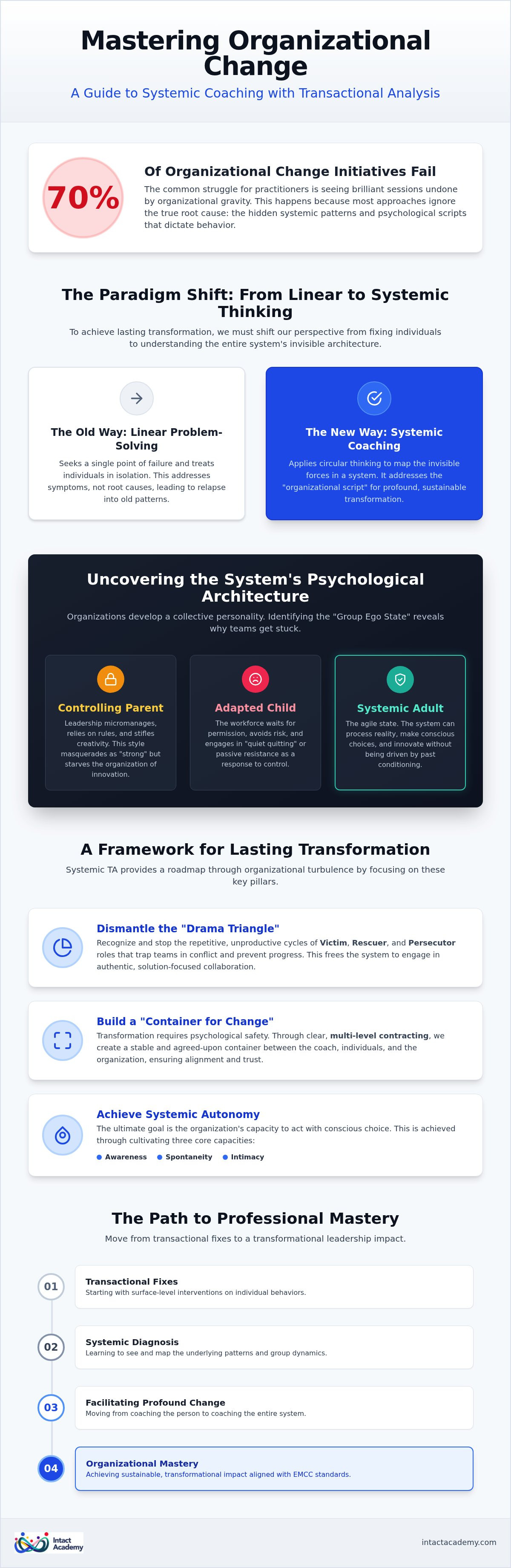
What if the "difficult" leader or the team that perpetually reverts to old patterns isn't actually the problem, but rather a symptom of a hidden psychological script? You've likely felt the frustration of delivering a brilliant session only to see the organizational gravity pull everyone back into their familiar, stuck roles. It's a common struggle for practitioners who recognize that 70% of organizational change initiatives fail because they ignore these underlying systemic patterns. Mastering systemic coaching with transactional analysis allows you to see the invisible architecture of a system, moving beyond individual fixes to facilitate profound, sustainable transformation.
This guide promises to help you transition from surface-level interventions to a state of organizational mastery by blending psychological depth with professional pragmatism. We'll explore sophisticated diagnostic tools for culture, practical techniques for high-stakes team coaching, and the path toward EMCC-aligned professional mastery in 2026. Together, we'll examine how to create a stable container for change, allowing ideas to resonate and helping leaders return to a state of completeness and genuineness.
Key Takeaways
- Understand how to bridge the gap between individual psychology and organizational systems, shifting your perspective from linear problem-solving to circular systemic thinking.
- Identify the hidden "organizational scripts" and collective ego states that drive team behavior, allowing you to address the root causes of stagnation rather than just the symptoms.
- Master the art of systemic coaching with transactional analysis to navigate complex multi-level contracting and provide a stable container for high-stakes organizational change.
- Learn to recognize and dismantle the systemic "Drama Triangle," preventing teams from falling into repetitive cycles of Victim, Rescuer, and Persecutor roles.
- Discover a structured methodology for professional mastery that aligns with EMCC standards, helping you move from transactional fixes to transformational leadership impact.
What is Systemic Coaching with Transactional Analysis?
Systemic coaching with transactional analysis represents a sophisticated evolution in organizational development. It isn't merely a set of tools; it's a way of seeing. By combining the psychological rigor of Transactional Analysis with the broad lens of systems theory, practitioners can map the invisible forces that dictate corporate behavior. This hybrid approach moves us from linear thinking, which seeks a single point of failure, to circular thinking. In a circular model, we recognize that every action is both a cause and an effect within a wider web. As we look toward the complexities of 2026, this methodology becomes essential for leaders who need to navigate hybrid structures and rapid digital shifts without losing their human essence.
The Intersection of Depth Psychology and Business Pragmatism
Traditional coaching often hits a glass ceiling because it treats the individual in isolation. You might help a manager find their voice, but if the surrounding culture is rooted in a collective "Don't Speak" injunction, the change won't last. A systemic observer doesn't just look at the person; they look at the space between people. To truly understand why patterns persist, one must first grasp what is transactional analysis in a professional setting. It’s about uncovering the "Organizational Script," that unconscious blueprint that determines whether a company is destined for recurring crisis or sustainable flourishing. When we coach the script rather than just the person, we unlock the potential for profound, permanent shifts.
Key Pillars of the Systemic TA Framework
The framework rests on several key pillars that turn complex theory into actionable mastery. By applying these concepts, systemic coaching with transactional analysis provides a roadmap through organizational turbulence. The work focuses on:
- Group Ego States: We apply the Parent, Adult, and Child models to entire departments. Does the leadership team act as a Controlling Parent, stifling the Child-like creativity of the workforce?
- The Goal of Autonomy: In a systemic context, autonomy means the organization's capacity to act with awareness, spontaneity, and intimacy. It's the move from reactive habit to conscious choice.
- Contracting as a Container: Transformation requires safety. We use multi-level contracting to create a stable container between the coach, the individual, and the organizational system, ensuring everyone is aligned on the desired outcome.
By integrating these pillars, we move beyond fixing a broken part to evolving the entire living system. It’s a process of returning to a state of completeness, where the organization’s outward actions finally match its inner potential.
The Psychological Architecture: Ego States and Scripts in Systems
Organizations aren't just structures of logic and profit; they're living psychological entities with a subconscious life of their own. When we apply systemic coaching with transactional analysis, we stop looking at individual quirks in isolation and start observing the collective personality of the system. Every team develops a unique psychological architecture that dictates how it responds to pressure, how it handles success, and why it might repeat the same mistakes despite having the best talent. Understanding this architecture is the first step toward moving an organization from a state of reactive habit to one of conscious choice.
Mapping the Systemic Ego States
Teams often fall into what we call "Group Ego States," where the collective behavior mirrors the Parent, Adult, or Child models found in individuals. A leadership team that relies on micro-management typically operates from a Controlling Parent state. This dynamic inevitably forces the rest of the workforce into an Adapted Child state, where employees wait for permission rather than taking initiative. In high-stress environments, you might see teams regress into a Rebellious Child state, where sabotage and "quiet quitting" become the norm. Parental leadership styles often masquerade as "protective" or "strong," yet they effectively starve the organization of its capacity to innovate. The Systemic Adult state is the key to organizational agility, as it allows the system to process reality and make decisions without the distortion of past biases or future fears.
Uncovering the Invisible Corporate Script
Every company follows an "Organizational Script," an unconscious plan that determines its destiny. This script is frequently an extension of the founders' own Life Scripts. If a founder carried a "Don't Succeed" or "Don't Exist" injunction, the company might consistently fail just as it reaches a significant breakthrough. Unresolved history, such as a traumatic merger or a sudden firing, can leave a lasting imprint that dictates current performance. We also must consider the "Imago," the internal mental map each member holds of the organizational system. The Imago acts as a subconscious blueprint; it's the way a person "sees" the team in their mind's eye. When these individual maps are misaligned, the system experiences friction that no amount of project management software can fix. Identifying these patterns is vital for leading organizational change because you aren't just changing a process; you're rewriting the system's script. Developing this level of perception requires a commitment to deep learning, often found within a specialized coaching environment where these dynamics are studied in depth.
Individual Transactions vs. Systemic Dynamics: A Comparison
To truly understand an organization, we must look beyond the individual dialogue. While a micro view focuses on the specific transaction between two colleagues, systemic coaching with transactional analysis examines the macro patterns—the invisible threads that connect every member of the team. We often find that what appears to be a personal conflict is actually a systemic resonance. By addressing the "spaces between" people, we shift our focus from individual blame to collective responsibility, allowing the system to heal its own fractured dynamics.
Stroking, or the exchange of recognition, serves as the primary currency of organizational culture. In healthy systems, positive strokes flow freely, reinforcing Adult-to-Adult interactions and genuine collaboration. In dysfunctional ones, negative strokes—or even worse, a total lack of recognition—drive employees into the systemic trap of the Drama Triangle. This triangle, consisting of the Victim, Rescuer, and Persecutor roles, often defines entire departmental relationships. A "Rescuer" HR department might constantly step in to solve conflicts, inadvertently keeping managers in a "Victim" state where they never learn to lead. Breaking this cycle requires a move toward autonomy and a refusal to play the assigned roles.
From Psychological Games to Systemic Solutions
Common workplace games like "Why Don’t You... Yes But" often stall boardroom progress. One person presents a solution, and the other systematically shoots it down with perceived obstacles, creating a loop where no action is taken. A systemic coach interrupts this cycle, not by solving the problem, but by highlighting the game itself. This intervention restores Adult-to-Adult communication, a core skill emphasized in professional development for coaches. When the game ends, the real work of the organization can finally begin.
The Role of the Systemic Coach
The systemic coach acts as a mirror, reflecting back the patterns that the organization cannot yet see. This role requires a delicate balance of the "Nurturing" and "Structuring" Parent ego states. You must provide the empathy needed for people to feel safe while maintaining the firm structure required to challenge toxic habits. Maintaining neutrality in multi-stakeholder environments is your greatest asset. You aren't coaching for one person's win; you're coaching for the flourishing of the entire system. It's a rhythmic process of observation, reflection, and gentle provocation that leads to lasting evolution.
Practical Frameworks for Systemic TA Coaching
Moving from theory to the room requires a disciplined, step-by-step approach. Systemic coaching with transactional analysis provides a structured methodology to handle the complexity of organizational life without becoming overwhelmed by it. This process begins with clear boundaries and moves through deep diagnosis toward targeted action. It ensures that the coach remains a stable presence even when the system's dynamics are turbulent.
- Step 1: Multi-level Contracting. We establish clear agreements between the individual, the team, and the organization to align expectations and goals.
- Step 2: Systemic Diagnosis. Using the ego state and script models, we map the psychological architecture to understand the root causes of dysfunction.
- Step 3: Intervention Design. We choose the specific level of the system—individual, group, or culture—where a nudge will create the most significant positive ripple.
- Step 4: Monitoring and Reflection. We use supervised reflection to ensure the change is sustainable and that the coach remains neutral and effective.
The Art of Systemic Contracting
The "Three-Cornered Contract" is the foundation of any successful systemic engagement. It manages the delicate triangle between the coach, the coachee, and the sponsoring organization. Without this, you risk becoming a pawn in someone else's political game. We define clear, observable outcomes at each level to ensure the work remains grounded in reality. During the diagnostic phase, we look for "Hidden Agendas." These are unspoken expectations that can derail even the most well-intentioned coaching if they aren't brought into the light of the Adult state.
Tools for Systemic Intervention
Once the contract is firm, we use tools like Script Workshops to rewrite a team's future narrative. This isn't just brainstorming; it's a deep dive into the unconscious plan the team has been following. We also apply the Discount Matrix to identify what the organization is ignoring. Discounting is the systemic avoidance of reality, where teams minimize problems or their ability to solve them. By identifying these gaps, we restore the organization's power to act. To master these practical applications, many professionals choose to join a TA EMCC Senior Team Coach Academy, where these frameworks are practiced in a high-stakes, supportive environment.
Cultivating Mastery: The Intact Academy Methodology
Achieving true proficiency in systemic coaching with transactional analysis requires more than just intellectual understanding; it demands a transformation of the coach themselves. At Intact Academy, this journey begins with the TA Foundation Year, a prerequisite that ensures a solid grounding in the psychological depth necessary for systemic work. This foundational year invites you to return to a state of genuineness, providing the stability needed to hold the complex, often-turbulent dynamics of modern organizations. It's a space where you're prompted to look inward before taking outward action, ensuring your presence as a coach is as impactful as your methodology.
Sari van Poelje’s unique approach, often described as "Agile Transactional Analysis," bridges the gap between deep psychological frameworks and the rapid pace of the 2026 business world. It’s an evolution that moves beyond static models into fluid, responsive interventions that honor both the individual and the system. By integrating these agile principles, you learn to navigate organizational scripts with precision and empathy. This ensures that your impact is both immediate in its pragmatism and sustainable in its psychological depth, catering to a sophisticated global audience that values maturity and insight.
The TA EMCC Senior Practitioner Academy
Stepping into the Senior Practitioner Academy means engaging with a Level 7 accreditation program designed for those ready to lead at the highest levels of organizational development. You won't be learning in isolation; you'll join a global cohort representing over 14 countries, creating a rich tapestry of cultural perspectives and professional experiences. Sari van Poelje facilitates this space, bringing decades of global executive experience to bridge the gap between high-level theory and the gritty, real-world challenges of the boardroom. This peer-learning environment acts as a stable container for deep learning, mirroring the very systems you aim to transform.
The Path to Systemic Impact
While obtaining an executive coaching certification is a significant milestone, it's truly only the beginning of your journey toward systemic impact. This path builds the market authority required to consult on large-scale organizational change and high-stakes team dynamics. Through supervised practice and a commitment to professional wholeness, you move from being a practitioner who does coaching to a mentor who embodies the work. If you're ready to evolve your practice and master systemic coaching with transactional analysis, the first step is a conversation. We invite you to Book an Intake Meeting with Intact Academy to explore which path aligns with your professional destiny and your commitment to human flourishing.
Embracing the Path to Organizational Wholeness
Mastering the invisible architecture of a system is a journey that moves beyond mere business tactics into the realm of profound human transformation. By integrating systemic coaching with transactional analysis, you gain the capacity to identify the hidden scripts that bind teams and the collective ego states that either stifle or spark innovation. This methodology doesn't just fix problems; it evolves the entire organizational culture toward a state of genuineness and autonomy. To truly embody this work, you need a stable container for your own development.
Led by international expert Sari van Poelje, Intact Academy has already trained 3600+ participants globally, bridging the gap between depth psychology and executive reality. If you're ready to achieve the EMCC Senior Practitioner Level 7 Accreditation, now is the time to deepen your impact. We invite you to apply for the TA EMCC Senior Practitioner Academy and step into your role as a wise mentor for the systems you serve. The courage to change begins with the insight to see the whole.
Frequently Asked Questions
Is systemic coaching with Transactional Analysis different from regular executive coaching?
Systemic coaching with transactional analysis differs from standard executive coaching by integrating the psychological depth of human behavior with the complexity of organizational systems. While traditional coaching often focuses on individual performance goals, this approach uncovers the invisible scripts and collective ego states driving the entire system. It provides a more sophisticated diagnostic lens, allowing you to facilitate sustainable transformation rather than surface-level fixes that often fail to stick in high-pressure environments.
Do I need to be a psychologist to learn Transactional Analysis for coaching?
You don't need a background in psychology to master these tools for professional application. Transactional Analysis was designed to be accessible and actionable for anyone committed to understanding human dynamics. It's important to clarify that Intact Academy focuses strictly on organizational and coaching applications, not clinical psychotherapy. The methodology provides a clear language for complex behaviors, making it an ideal framework for leaders, HR professionals, and consultants seeking deeper impact.
How long does it take to become an EMCC-accredited Senior Practitioner?
Becoming an EMCC-accredited Senior Practitioner typically involves a year of dedicated study and practice. The 2026 standards require a minimum of 250 hours of coaching practice and at least one supervision session per quarter. Our academy programs are structured to guide you through these requirements methodically. This journey ensures you don't just learn the theory but also embody the professional mastery and ethical rigor expected at this senior level of international accreditation.
Can TA be used for team coaching as well as individual leadership development?
Yes, Transactional Analysis is a powerful tool for team coaching and collective development. By identifying "Group Ego States," you can observe how a team might collectively act from a Controlling Parent or Adapted Child position. This systemic perspective allows you to address the "Organizational Script," which is the unconscious plan that dictates how a group handles success or failure. It moves the intervention from the individual to the relationships and patterns within the whole team.
What are the core ego states used in systemic coaching?
The core ego states, Parent, Adult, and Child, serve as the primary diagnostic tools in systemic work. In an organizational context, the Parent represents the rules and values of the system, the Adult processes current reality without bias, and the Child holds the creativity and emotional history. Systemic coaching aims to strengthen the "Systemic Adult" state. This allows the organization to function with awareness and spontaneity rather than repeating outdated, reactive patterns from its past.
How does systemic TA help with organizational change management?
Systemic TA facilitates change management by uncovering the "invisible architecture" that often sabotages new initiatives. Many change projects fail because they ignore underlying injunctions like "Don't Succeed" or "Don't Change" embedded in the corporate culture. By rewriting the organizational script and addressing the "Drama Triangle" within departments, we create a stable container for evolution. This methodology ensures that structural changes are supported by the necessary psychological shifts for long-term health and genuine cultural transformation.
Is the Intact Academy training available online or in person?
Intact Academy offers a flexible, hybrid learning model to accommodate our global cohort from over 14 countries. We provide both immersive online sessions and in-person training at our base in Utrecht. This dual approach ensures that participants can experience deep learning and peer connection regardless of their location. Each format is designed to mirror the process of deep learning itself, providing a stable and methodical environment for personal and professional growth.
Who is Sari van Poelje and what is her role in the academy?
Sari van Poelje is the founder of Intact Academy and an internationally recognized expert in Transactional Analysis and organizational change. Since founding the academy in 2013, she has trained over 3,600 participants globally, bringing decades of executive experience to her role as a wise mentor. Sari bridges the gap between high-level psychological theory and the pragmatic demands of global leadership, helping professionals return to a state of completeness and genuineness in their work.


