

What if the friction you encounter during a session isn't a barrier to progress, but the essential raw material for transformation? Many facilitators find themselves overwhelmed by the invisible currents of group conflict, or they feel the frustration of watching a team circle the same surface-level issues without ever reaching a meaningful core. It's a heavy burden to track a dozen simultaneous transactions while holding the space for growth. You aren't alone in seeking more effective group coaching techniques to help you navigate these turbulent human dynamics with grace and precision.
Mastering these skills requires a fundamental shift in how you perceive the human system. By applying the principles of systemic Transactional Analysis, you'll discover how to decode the "Group Script" and navigate the unconscious games that often stall collective evolution. This article provides a structured framework to move from surface-level facilitation to deep, systemic mastery. We'll explore how to handle high-stakes dynamics with confidence, ultimately paving your path toward senior-level accreditation and a state of professional wholeness. It's time to move beyond transactional management into the realm of profound human flourishing.
Key Takeaways
- Learn to perceive the group as a single psychological entity, shifting your focus from individual interactions to the collective systemic narrative.
- Identify how Parent, Adult, and Child Ego States manifest within a group to understand the hidden drivers of behavior and decision-making.
- Recognize and interrupt the unconscious psychological games and "Group Scripts" that keep teams trapped in cycles of surface-level discussion.
- Apply advanced group coaching techniques like systemic contracting and circular questioning to reveal deep-seated organizational patterns.
- Understand the developmental path toward senior-level EMCC accreditation and the mastery required to facilitate high-stakes systemic change.
Beyond One-on-One: The Shift to Systemic Group Coaching Techniques
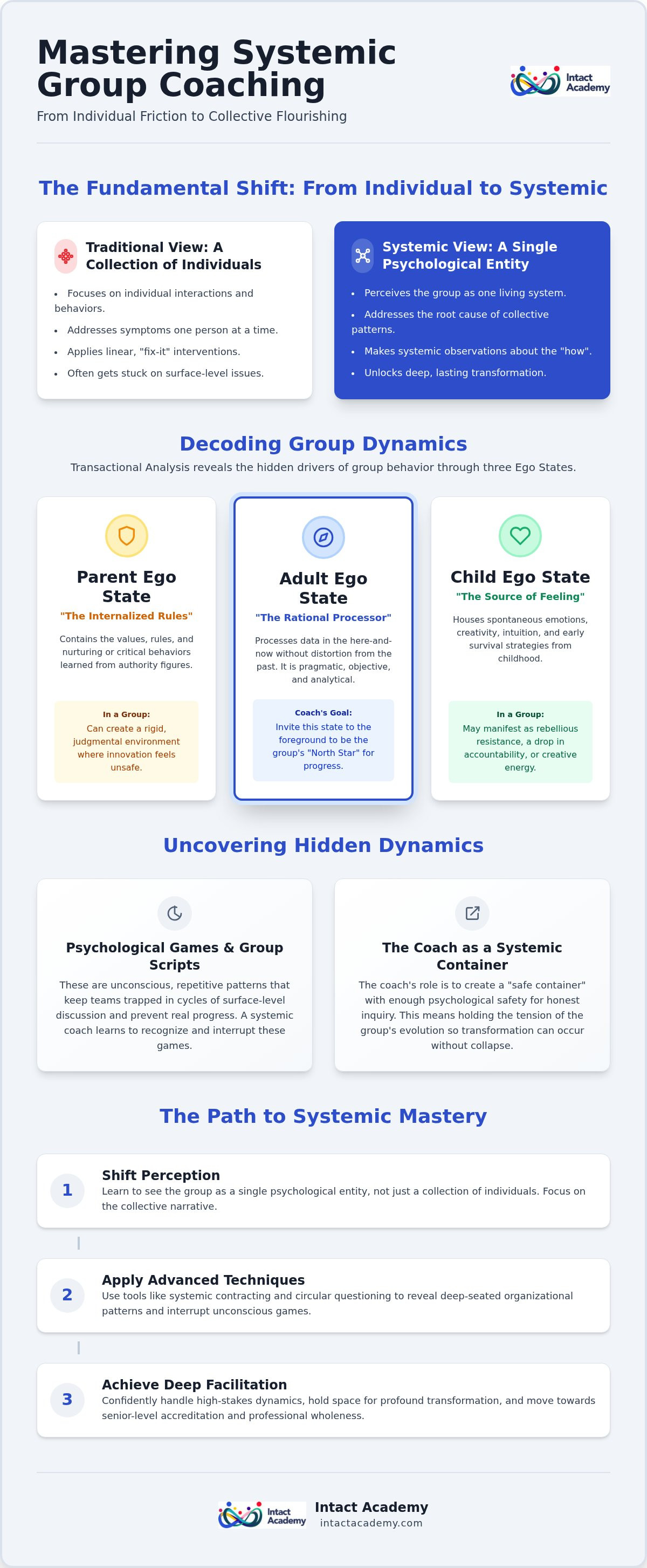
Transitioning from individual coaching to group work isn't just about managing a larger number of people. It's a fundamental leap into a different dimension of human interaction. Most practitioners treat a group as a simple collection of individuals, but true mastery lies in seeing the group as a single, breathing psychological entity. Surface-level facilitation often fails in high-stakes executive settings because it addresses individual symptoms rather than the systemic source. When we employ sophisticated group coaching techniques, we stop looking at just the "who" and start seeing the "how" of the entire system.
It's vital to distinguish between group coaching and team coaching. Group coaching typically focuses on a shared learning journey among peers who might not work together daily. Team coaching involves an intact unit striving toward a specific, shared organizational objective. Both modalities require the coach to act as a systemic container. You must hold the tension of the group's evolution so that transformation can occur without the system collapsing into defensive chaos. You aren't just a teacher; you're a steady presence facilitating the process of becoming.
The Group as a Living System
Every group eventually develops its own "Group Mind," a collective consciousness that operates beyond the immediate awareness of its members. This is where understanding group dynamics becomes essential for the practitioner. We observe how individual "Life Scripts"—those unconscious life plans formed in early development—intersect and weave together to create a broader group narrative. Instead of linear interventions that attempt to fix one person at a time, we make systemic observations. We ask what the group is trying to express through a specific conflict. This shift allows you to address the root of organizational stagnation rather than chasing temporary behavioral changes.
The Power of Collective Reflection
Real transformation requires a "Safe Container," a professional space where the group feels secure enough to drop their corporate masks. This isn't about making people comfortable. It's about creating enough psychological safety to permit honest, sometimes painful, inquiry. We balance the rhythm of individual insight with the broader evolution of the collective. By using parallelisms, we can show how a leader's internal growth directly mirrors the success of their department. Just as the individual seeks clarity, the group seeks coherence. This connection between the inner world and the outer result is the hallmark of sophisticated systemic group coaching techniques. It's a methodical process of returning to a state of genuineness within a professional context.
The Psychology of the Group: Applying Transactional Analysis Ego States
To truly excel at group coaching techniques, you must develop the ability to hear the unspoken frequency of a room. Transactional Analysis (TA) provides a robust framework for this through the concept of Ego States. These are coherent systems of thought and feeling that manifest in behavior. In any professional gathering, participants oscillate between three primary states: the Parent, the Adult, and the Child. When you observe a group through this lens, you stop seeing mere conflict and start seeing the structural patterns of their interaction.
The Parent ego state contains the values, rules, and nurturing behaviors we've internalized. The Child state houses our spontaneous emotions, creativity, and early survival strategies. The Adult ego state is our capacity to process data in the here-and-now without the distortion of past scripts. A sophisticated group coaching model relies on the coach’s ability to invite the Adult state into the foreground, ensuring that professional pragmatism remains the group's North Star.
Reading the Room Through Ego States
Mapping the dominant ego state in a session is a vital skill. You might notice a group falling into a collective "Child" state, characterized by a sudden drop in accountability or an air of rebellious resistance. Conversely, a group might adopt a "Parent" stance, creating an environment of rigid judgment where innovation feels unsafe. Identifying these shifts allows you to adjust your intervention. If the "Child" is resisting, you don't react with a "Parent" lecture. Instead, you use the Adult ego state to name the dynamic, inviting the group to reflect on their own process. This is the essence of systemic coaching.
Facilitating Healthy Transactions
Transactions are the building blocks of group dynamics. They can be complementary, where the response is expected, or crossed, where the response triggers a shift in state. Most dangerously, they can be ulterior, where a hidden message is sent beneath the surface of professional talk. Understanding what is transactional analysis allows you to decode these hidden messages in real-time. By redirecting crossed or ulterior transactions toward Adult-to-Adult clarity, you create a space where genuine transformation can occur. For those seeking to deepen this expertise, the TA EMCC Senior Team Coach Academy offers a path to professional mastery in these complex dynamics.
Navigating Group Dynamics: Identifying Psychological Games and Scripts
Beyond individual ego states, we must observe how these states interact to form repetitive patterns. In Transactional Analysis, we call these "Games." A group might engage in "Yes, But," where every suggestion for improvement is met with a reason why it won't work. The payoff isn't a solution; it's the group’s ability to remain exactly where they are. These games are the visible threads of a much deeper "Group Script"—a collective unconscious plan that dictates whether a team is destined for success or stagnation. Using advanced group coaching techniques allows you to name these games, bringing the ulterior messages into the light of the Adult ego state.
The Drama Triangle is a frequent drain on organizational ROI. When members occupy the roles of Victim, Rescuer, or Persecutor, the focus shifts from professional goals to emotional survival. Some industry reports suggest that while coaching investments can yield returns as high as 600%, these gains are easily eroded if a group remains trapped in these roles. To stop this, you must learn to "cross the transaction." When a group member invites you to rescue them, you respond with an Adult inquiry instead. This halts the game and forces the system to recalibrate toward its primary task.
Uncovering the Organizational Culture
Every group session acts as a micro-laboratory for the wider organization. By identifying the repetitive games played in a small room, you gain a profound understanding of the broader culture. We use the framework of leading organizational change to understand how these hidden scripts prevent large-scale transformation. When you reveal these patterns, you empower the group to move from unconscious games to conscious, adult collaboration. It's a journey from repetitive failure to intentional success.
Interrupting the Drama Triangle
The most common trap for a facilitator is the role of the Rescuer. If you find yourself working harder than the group, you've likely been pulled into their triangle. You must empower members to step out of "Victim" roles by returning the responsibility for change to the collective. This requires a high level of self-awareness and professional maturity. Engaging in systemic supervision is a non-negotiable practice for senior coaches. It provides the external perspective needed to ensure you remain a container for growth rather than a player in the group's drama. Mastering these group coaching techniques is the difference between surface facilitation and deep systemic transformation.
Essential Facilitation Techniques for High-Impact Group Coaching
While basic group coaching techniques like active listening are foundational, they often fail to address the complexity of high-stakes organizational environments. True impact requires a shift from managing individuals to facilitating the system. This involves a precise set of interventions designed to reveal the invisible architecture of the group. You aren't just directing a conversation; you're holding a space where the collective can witness its own evolution.
Contracting for Professional Mastery
Systemic work begins long before the first session. We utilize the Three-Cornered Contract to align the coach, the group, and the organizational sponsor. This ensures that the work remains focused on professional outcomes rather than becoming entangled in personal preferences. Effective professional development for coaches emphasizes that clear boundaries are the bedrock of transformation. Without a solid contract, the group script will inevitably pull the coach into its repetitive games. As the group evolves, re-contracting becomes a vital tool to acknowledge shifts in the collective consciousness and maintain a state of Adult clarity. Just as the coach holds the boundaries, the group holds the potential for change.
Advanced Facilitation Interventions
High-performing teams require more than just encouragement. They need psychological safety rooted in systemic insight. We use circular questioning to reveal how one member's behavior reflects a broader organizational pattern. By asking "Who else in the company feels the weight of this silence?", we shift the focus from an individual's reticence to a systemic symptom. We also employ visualizations like the "Empty Chair" or "Constellations" to make the invisible visible. These tools allow the group to see their dynamics from a distance, fostering a sense of collective responsibility and courage.
Drawing on Sari van Poelje's insights on mastering systemic change, we learn that the most powerful intervention is often silence. Knowing when to hold the space allows the group to find its own path to wholeness. We conclude with a "Closing Transaction," ensuring that the insights gained are integrated into the organizational reality. To master these high-level group coaching techniques, consider joining our TA EMCC Senior Team Coach Academy, where sophisticated theory meets transformative practice.
Mastering Complexity: Advancing Your Practice with the Team Coach Academy
Reaching the peak of professional practice requires more than a collection of tools. It demands a shift in identity. While basic group coaching techniques might suffice for simple facilitation, high-stakes organizational change requires a deeper level of systemic rigor. You must become a steady presence capable of holding the most turbulent group dynamics without losing your Adult clarity. This level of expertise isn't found in a weekend workshop. It's forged through a methodical process of learning, supervision, and reflection. It's about providing a stable container for the often-turbulent work of professional change.
Pathways to Senior Practitioner Status
The transition to senior-level coaching involves a commitment to global standards. The TA EMCC Senior Team Coach Academy bridges the gap between psychological theory and organizational practice. It provides the systemic supervision necessary to ensure you don't become a player in the group's unconscious games. By achieving accreditation through bodies like the EMCC and ICF, you signal to the market that you possess the depth to handle complex human systems. This journey toward senior practitioner status is as much about your internal evolution as it is about your external skills. You learn to move fluidly between high-level theoretical frameworks and direct, punchy interventions that spark real movement.
Joining a Global Community of Change Makers
When you join Intact Academy, you enter a space shared by experts from over 14 countries. This global citizenship is vital for coaches working in diverse executive environments. Led by international expert Sari van Poelje, the training moves beyond transactional skills into the realm of profound transformation. We emphasize a return to a state of completeness and genuineness. This core philosophy acts as your North Star, distinguishing your work from surface-level training providers. Whether you engage through online modules or in-person sessions, you're part of a community dedicated to human flourishing. Mastering these group coaching techniques at a senior level allows you to navigate the inner workings of countless organizations with quiet power. You become a wise mentor, capable of guiding others through the process of becoming. This commitment to depth ensures that your practice remains grounded in integrity and the courage to change.
Elevating Your Impact Through Systemic Mastery
Moving from surface facilitation to deep systemic transformation requires a fundamental shift in perception. You've explored how identifying ego states and interrupting psychological games can reshape the collective narrative of any group. By seeing the group as a single psychological entity rather than a collection of parts, you unlock the potential for profound organizational change. These advanced group coaching techniques are the key to navigating the complex interpersonal transactions that often stall progress in high-stakes environments.
Mastery is a journey of returning to professional genuineness. To reach this level of expertise, you need a learning environment that matches your maturity and ambition. Our EMCC Senior Practitioner Level training is led by world-renowned expert Sari van Poelje and connects you with an international community from over 14 countries. It's time to move beyond the transactional and embrace the systemic. Begin your journey to systemic mastery with the TA EMCC Senior Team Coach Academy. Your evolution as a leader of change starts with the courage to look deeper and the commitment to flourish.
Frequently Asked Questions
What is the primary difference between group coaching and team coaching?
Group coaching serves individuals who are pursuing parallel growth paths, while team coaching addresses an intact unit working toward a shared organizational outcome. In a group, the focus is often on personal development within a collective setting. In a team, the focus shifts to collective performance and systemic alignment. Both require the coach to act as a container, but the team coach must also navigate the specific functional interdependencies of the organization’s structure.
How does Transactional Analysis improve group coaching outcomes?
Transactional Analysis offers a precise language for decoding the unconscious patterns that drive group behavior. By identifying Parent, Adult, and Child ego states, coaches can understand why a team might be stuck in repetitive cycles. This psychological depth allows you to move beyond surface-level facilitation into the realm of the collective script. It provides a clear framework for facilitating Adult-to-Adult transactions, ensuring that professional discussions remain grounded, productive, and genuinely transformative.
What are the most effective group coaching techniques for resistant teams?
The most effective group coaching techniques for resistant teams involve naming the underlying dynamic without judgment. We use circular questioning to reveal how individual resistance might actually be a symptom of a larger systemic issue. By shifting the focus from the person to the pattern, we reduce defensiveness. This approach allows the group to look inward at their collective Child state resistance and choose a more mature, Adult path forward together.
How do I handle conflict or "psychological games" in a group coaching session?
Handling psychological games requires the coach to "cross the transaction" by responding from a different ego state than the one being invited. If a group member attempts to pull you into a Rescuer role within the Drama Triangle, you must remain in your Adult state. You might ask a reflective question that returns the responsibility for change to the collective. This intervention halts the repetitive game and invites the group back into a space of professional accountability.
Why is systemic contracting important in group coaching?
Systemic contracting is essential because it establishes the professional boundaries necessary for deep work. It involves the Three-Cornered Contract, which aligns the coach, the group, and the organizational sponsor on shared goals. Without this clarity, the coach risks being co-opted by the group’s unconscious script or conflicting organizational expectations. Clear contracts create the safety required for honest inquiry and ensure that the transformation remains focused on sustainable, high-level professional outcomes.
Can I use these techniques for online group coaching sessions?
Yes, these systemic group coaching techniques are highly effective in virtual environments. Intact Academy supports a global community of change makers from over 14 countries through both online and in-person training. While the medium changes, the psychological principles of ego states and group dynamics remain constant. Facilitating online requires a heightened sensitivity to non-verbal cues and a deliberate approach to creating a safe container that transcends the digital screen.
How do I become an EMCC-accredited Senior Team Coach?
Becoming an EMCC-accredited Senior Team Coach requires completing a rigorous, accredited program like the TA EMCC Senior Team Coach Academy. This path involves a combination of theoretical study, practical application, and systemic supervision. You'll learn to integrate Transactional Analysis into your coaching practice, demonstrating the depth and maturity required for senior-level work. The journey culminates in a professional accreditation that signals your capacity to facilitate high-stakes transformation on a global stage.
What role does the coach’s own "Life Script" play in group facilitation?
The coach’s Life Script is the unconscious plan that can either support or hinder the facilitation process. If you aren't aware of your own patterns, you might inadvertently fall into a Rescuer or Parent role during a session. This is why systemic supervision is a cornerstone of professional mastery. By understanding your own script, you can remain a neutral and steady presence, ensuring that your interventions serve the group’s growth rather than your own unconscious needs.


