

What if the resistance you encounter during a major restructure isn't a sign of failure, but the survival mechanism of a system trying to protect its hidden script? You've likely felt the exhaustion of a technically perfect strategy stalling because of invisible cultural walls or silos that refuse to collaborate. This is the central challenge of leading systemic transformation in 2026, where the complexity of global shifts demands more than just tactical management. You know that logic alone doesn't move people; something deeper is at play within the organizational field.
By mastering the psychological dynamics and systemic frameworks required for evolution, you can turn these obstacles into catalysts for growth. This article provides a path to move beyond surface-level fixes and address the root causes of stagnation. We'll explore a repeatable framework for diagnosing organizational health and the skills needed to facilitate high-stakes team transitions. You'll learn how to align individual evolution with systemic success, creating a stable container for profound human and professional change that honors the maturity of your workforce.
Key Takeaways
- Understand why traditional change management often falters and how to embrace systemic evolution by addressing the hidden scripts that govern organizational behavior.
- Learn to apply Transactional Analysis (TA) to map Ego States within your hierarchy, revealing the psychological dynamics that drive team interactions.
- Cultivate the internal presence and mastery required for leading systemic transformation, moving beyond transactional management into a role of deep organizational stewardship.
- Master the professional art of "Contracting" to ensure administrative, professional, and psychological alignment during high-stakes team transitions.
- Explore the pathway to becoming an EMCC-accredited Senior Practitioner, bridging the gap between sophisticated psychological insight and pragmatic business success.
Beyond Linear Change: Defining Systemic Transformation in 2026
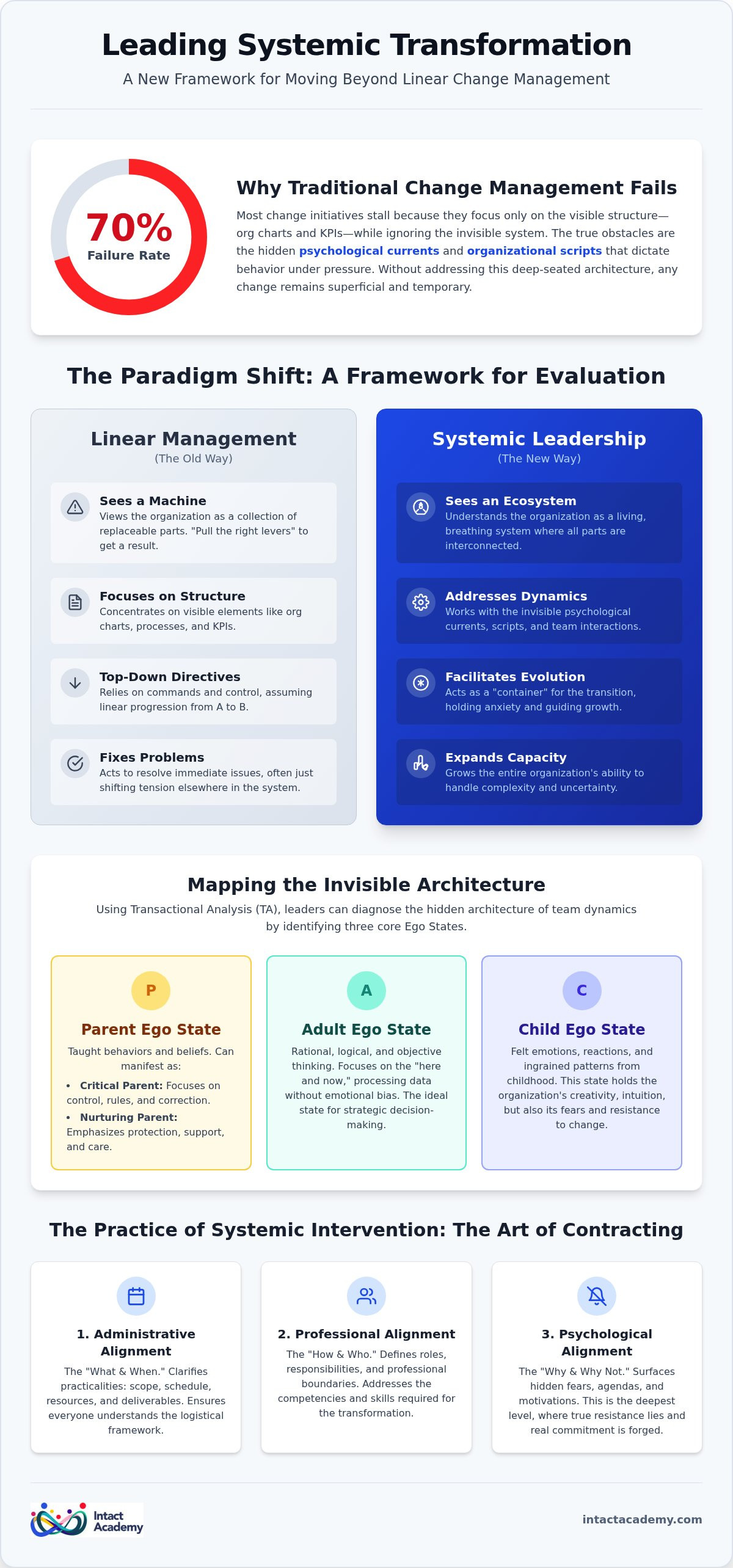
The old model of change management assumes that an organization is a machine with replaceable parts. It suggests that if you pull the right levers, you'll arrive at a predetermined destination. But as we look toward the complexities of 2026, this linear "A to B" thinking has become a liability. Leading systemic transformation requires a shift in perception. You must see the organization not as a collection of silos, but as a living, breathing ecosystem where every part is in constant dialogue with the whole.
Research consistently shows that roughly 70% of change initiatives fail to meet their objectives. They stall because leaders focus on the visible structure, the org charts and KPIs, while the invisible system remains untouched. These invisible forces are the psychological currents that dictate how people actually behave when the pressure is on. If you don't address the underlying architecture of the system, any technical change will be superficial and fleeting.
To lead effectively, you must become a "container" for the transition. This means holding the anxiety of the system without being consumed by it. It's a role that demands presence, stability, and a profound understanding of human behavior. This capacity to hold space for uncertainty is what distinguishes a technically competent manager from a transformational leader.
The Interconnectedness of Individual and Organizational Scripts
Every individual carries a life script, a set of unconscious patterns formed early in life. When these people come together, their scripts aggregate into a collective organizational narrative. This narrative is the organizational "unconscious." It determines what's possible and what's forbidden within the culture. If your strategy conflicts with this script, the script wins every time. This is why psychological depth in executive coaching is no longer a luxury. It's the only way to ensure a genuine return on investment by aligning the human spirit with the business objective. You aren't just changing a workflow; you're evolving the story the organization tells about itself.
Why Traditional Change Management Is No Longer Enough
Top-down directives often shatter against the reality of a complex, volatile world. Traditional methods focus on "fixing problems," which often just moves the tension from one department to another. Evolving the system is different. It's about expanding the capacity of the entire organization to handle complexity. This shift draws heavily from the field of Organizational development, yet it adds a layer of psychological rigor. When you are leading organizational change, you aren't just rearranging the furniture. You are changing the room itself. By adopting a systemic lens, you move from being a manager of tasks to a steward of evolution, ensuring the organization doesn't just survive but flourishes.
The Invisible Architecture: Mapping Organizational Scripts and Ego States
If the organization is a living ecosystem, then Transactional Analysis (TA) is the map of its nervous system. When you're leading systemic transformation, you aren't just managing people; you're managing the invisible transactions between them. TA provides a rigorous framework for diagnosing why certain departments refuse to talk or why a perfectly logical strategy is met with irrational pushback. By mapping the three Ego States, Parent, Adult, and Child, within your corporate hierarchy, you can begin to see the hidden architecture that either supports or sabotages your vision.
Collaboration often stalls not because of a lack of skill, but because of "Psychological Games." These are repetitive, unconscious patterns of interaction that end in a predictable negative payoff. When a leader understands these games, they can intervene before the system retreats into its "Organizational Script." This script is the unconscious plan, often formed at the company's inception, that dictates the limits of its success. It's the silent director of every high-stakes meeting.
Ego States in the C-Suite: Recognizing Patterns of Leadership
In the C-suite, leadership styles often oscillate between the "Critical Parent," which focuses on control and correction, and the "Nurturing Parent," which emphasizes protection and support. While both have their place, systemic agility in 2026 requires an "Adult-to-Adult" culture. This state is characterized by objective data processing and mutual respect, allowing for rapid adaptation. Conversely, during mergers and acquisitions, we often see an "Adapted Child" response from the acquired team. This manifests as either over-compliance or subtle rebellion. Recognizing these patterns allows you to steer the system back toward its Adult capacity.
Decoding the Organizational Script
Every organization is shaped by its founding stories and past traumas. A startup that survived a near-bankruptcy a decade ago might still operate from a script of scarcity, even with significant capital. Spotting these repetitive patterns is essential for anyone facilitating high-stakes team transitions. As explored in the Stanford Graduate School of Business research on Strategy-Making and Organizational Evolution, the evolution of a firm is deeply tied to its historical internal dynamics. To begin this work, it's helpful to explore what is transactional analysis and how it applies to professional transformation. Those seeking to master these interventions often find the TA EMCC Senior Practitioner academy a grounding space for their professional development.
Linear Management vs. Systemic Leadership: A Framework for Evaluation
Linear management views the organization as a puzzle to be solved, piece by individual piece. Systemic leadership, however, recognizes that the essence of a system lies not in its components, but in the relationships between them. While a manager might focus on "fixing" a struggling department, a leader committed to leading systemic transformation asks what that department’s struggle reveals about the whole. This is the shift from "solving for the part" to "sensing for the whole." It requires a move from reactive firefighting to a proactive stewardship of the organizational field.
The efficacy of this shift depends entirely on the internal state of the leader. Technical competence is the baseline, but mastery and presence are the true catalysts. A leader who remains trapped in their own reactive patterns cannot facilitate the evolution of others. To lead a system toward health, you must first find a state of completeness within yourself. This presence acts as a stable container, allowing the often-turbulent work of change to occur without the system collapsing into chaos or retreating into old defenses.
The Practitioner’s Evolution to Systemic Mastery
Moving beyond surface-level tools requires a journey into psychological depth. It's about developing the "internal eye" to see the invisible transactions that dictate team behavior. This is where professional development for coaches becomes vital. It isn't just about learning new techniques; it's about expanding your own capacity to remain Adult-centered in high-pressure environments. Self-awareness is not a soft skill here. It's the primary tool for any systemic interventionist. Without it, you aren't leading a transformation; you're simply participating in the system's existing script.
Measuring Systemic Impact Beyond the Bottom Line
While financial metrics are essential, they are often lagging indicators of systemic health. A truly evolved system shows its strength through cultural resonance and psychological safety. When you address the Organizational Script, the ROI manifests as a resilient culture capable of navigating the complexities of 2026 with grace. Consider the indicators of a healthy system:
- Psychological Safety: The ability for members to take risks and speak truthfully without fear of retribution.
- Systemic Alignment: How well the organizational script supports, rather than sabotages, the stated strategy.
- Agility: The speed at which the system can return to an Adult state after a major disruption.
For example, shifting a tech firm from a "survival" script, characterized by burnout and hoarding information, to a "flourishing" script of transparency and shared mastery creates value that lasts. You're no longer just managing a business; you're facilitating a profound human transformation that secures the future of the enterprise.
The Practice of Systemic Intervention: Contracting and Facilitating Change
The shift from theory to practice begins with a single, often overlooked step: the contract. In Transactional Analysis, contracting isn't merely an administrative formality; it's a multi-layered alignment of intentions. When leading systemic transformation, you must navigate three distinct levels of agreement. First, the administrative contract handles the logistics and timelines. Second, the professional contract defines the goals and methods. Most critically, the psychological contract addresses the unspoken expectations and fears that often derail change before it starts. If these three layers aren't aligned, the system will eventually pull back toward its old, comfortable scripts.
Facilitating change at this depth requires more than a checklist. It demands an ability to uncover and neutralize organizational resistance without making the system feel attacked. Resistance is often a sign that a core value of the system feels threatened. By acknowledging the protective function of the old behavior, you can guide the team toward new patterns that serve the same need in a more healthy, Adult way. This ensures that the transformation isn't just a temporary peak in performance, but a sustainable evolution that the system can "hold" long after the intervention ends.
Contracting for Systemic Success
In the complex organizational landscapes of 2026, the multi-party contract is essential. You aren't just contracting with a single executive; you're aligning stakeholders across various levels of the system. This process sets clear boundaries and expectations, preventing the interventionist from falling into "The Rescue Triangle." In this common consultancy trap, the consultant becomes the "Rescuer," the leader the "Victim," and the resisting staff the "Persecutor." Staying in an Adult-to-Adult contract keeps the focus on the system’s own capacity for growth rather than creating a dependency on the practitioner.
Facilitating High-Performing Teams
High-stakes team coaching through a systemic lens involves creating "Stable Containers." These are psychological spaces where teams feel safe enough to dismantle their dysfunctions and experiment with new ways of relating. The power of Sari van Poelje’s agile systemic methodology lies in its ability to address these deep-seated issues with both speed and depth. It moves beyond superficial team-building exercises into the realm of profound structural redesign. For those ready to master these high-stakes interventions, the TA EMCC Senior Team Coach Academy offers the rigorous training needed to facilitate these complex transitions. By mastering these tools, you ensure that leading systemic transformation becomes a repeatable, grounded process of organizational flourishing.
Mastering the Art of Systemic Change with Intact Academy
The journey toward leading systemic transformation is not merely an acquisition of new skills, but a profound shift in how you perceive the organizational field. It requires moving beyond the visible surface of corporate charts into the deep, often turbulent currents of human behavior. At Intact Academy, we've crafted a space where psychology meets business with uncompromising rigor. Our approach ensures that the sophisticated insights of Transactional Analysis are grounded in the pragmatic realities of executive leadership, allowing you to address root causes rather than symptoms.
By engaging with our methodology, you aren't just attending a training; you're entering a stable container for your own professional evolution. You become part of a global network of change agents from over 14 countries, all committed to the flourishing of their organizations and themselves. This diversity of thought is vital for navigating the interconnected challenges of 2026, where the ability to sense the whole system is the primary differentiator of successful leadership. It's an invitation to move from theory into a practice that has a profound, measurable impact on the human spirit and the bottom line.
The TA EMCC Senior Team Coach Academy
The TA EMCC Senior Team Coach Academy represents the ultimate training for those tasked with facilitating high-stakes organizational shifts. The curriculum is a balanced blend of depth, science, and systemic impact, designed to prepare you for the most complex 2026 organizational challenges. You'll learn to navigate the intricate dance of multi-party contracting and the nuances of systemic team coaching within an international, diverse cohort. This certification doesn't just validate your expertise; it expands your capacity to remain Adult-centered while leading a system through the often-painful process of letting go of old, unsuccessful scripts.
Achieving Mastery and Wholeness
Our core philosophy is centered on the idea of returning to a state of completeness and genuineness. We believe that professional mastery is inseparable from the personhood of the leader. As you progress, you'll find that pursuing an executive coaching certification transforms your own internal state as much as it does your clients' organizations. This journey toward wholeness allows you to act as a thematic North Star for others, providing a sense of safety and reliability in a volatile world. If you're ready to embrace the art and science of profound change, the TA EMCC Senior Practitioner academy is your next step toward a career of depth and lasting significance.
Stepping into the Future of Organizational Stewardship
The transition from managing isolated problems to stewarding a living ecosystem is the most significant shift a leader can make. By moving beyond linear strategies and addressing the invisible organizational scripts that dictate behavior, you've begun the work of genuine evolution. You've seen how Transactional Analysis and rigorous psychological contracting provide the stable container needed for teams to flourish. Leading systemic transformation in 2026 requires this blend of technical precision and psychological presence, ensuring that change isn't just a temporary peak, but a permanent state of becoming.
Intact Academy offers a unique space where this depth meets professional pragmatism. Led by world-renowned expert Sari van Poelje, our EMCC and ICF accredited programs have empowered professionals from 14+ countries to drive sustainable change. This is your invitation to move toward completeness and professional impact. It's time to align your internal mastery with the external needs of your organization.
Your commitment to this level of depth ensures that your organization doesn't just survive the complexities of the future; it evolves into its most genuine state. We're here to support you on that journey.
Frequently Asked Questions
What is the difference between organizational change and systemic transformation?
Organizational change often targets specific processes or structures to fix a local problem. Systemic transformation involves a fundamental shift in the entire ecosystem's consciousness and behavior. While change is often linear and transactional, leading systemic transformation requires addressing the underlying psychological architecture that governs how all parts of the organization interact. It isn't just about changing what people do; it's about evolving who they are in relation to the whole.
How does Transactional Analysis apply to corporate leadership?
Transactional Analysis (TA) provides a rigorous framework for understanding interpersonal dynamics through Ego States: Parent, Adult, and Child. In corporate settings, it allows leaders to diagnose and shift "Psychological Games" that stall collaboration. By fostering an Adult-to-Adult culture, leaders can move beyond reactive power struggles into a state of systemic agility. This psychological depth ensures that leadership interventions are grounded in human reality rather than just management theory.
What is an organizational script and why does it matter?
An organizational script is the unconscious plan, often rooted in founding stories or past traumas, that dictates a company's limits and repetitive behaviors. It matters because this hidden narrative often sabotages the most brilliant technical strategies. If the script is one of scarcity or distrust, no amount of capital or restructuring will create lasting success. Recognizing and evolving this script is essential for achieving wholeness and sustainable growth in any system.
How long does a typical systemic transformation process take?
The timeline for transformation varies based on the system's size and complexity, but it is rarely a quick fix. Profound cultural shifts typically require 18 to 36 months of consistent intervention to ensure the new behaviors are integrated into the organizational script. In 2026, the focus has shifted from rapid, disruptive change to a more methodical, rhythmic process of evolution that allows the system to remain stable while it grows.
Is EMCC Senior Practitioner accreditation necessary for leading change?
While not legally mandatory, the TA EMCC Senior Practitioner academy provides the advanced psychological rigor and systemic frameworks required for high-stakes interventions. This accreditation signals a level of mastery that goes beyond surface-level business coaching. It ensures the practitioner can hold a stable container for the anxiety and turbulence that accompany profound organizational shifts. For those operating in complex global environments, this level of recognized expertise is often a prerequisite for trust.
How can I measure the success of a systemic intervention?
Success is measured through a combination of lagging financial indicators and leading cultural markers. You should look for increased psychological safety, reduced departmental silos, and the system's ability to return to an Adult state after a disruption. A successful intervention results in systemic alignment, where the unconscious organizational script finally supports the stated business strategy. Ultimately, the most profound measure is the flourishing of both the individuals and the organization as a whole.
Can systemic coaching be done virtually for global teams?
Yes, systemic coaching is highly effective in virtual environments when facilitated with the right methodology. Intact Academy has trained professionals from over 14 countries using hybrid models that combine online depth with focused in-person sessions. The key isn't the physical location, but the ability of the coach to sense the "field" and facilitate transactions between members regardless of the medium. Digital tools can even help map systemic patterns across global time zones.
What are the first steps to diagnosing a dysfunctional organizational system?
Diagnosis begins with observing the repetitive patterns of interaction and the Ego States most frequently occupied by leadership. You must look for "Psychological Games" and silos that indicate a misalignment between the strategy and the underlying script. Initial steps involve deep listening to the founding narrative and identifying where the system feels "stuck." This process requires an Adult-centered presence to see the system clearly without being pulled into its existing dysfunctions.


