

Imagine sitting in a boardroom where the CEO's demand for performance masks a hidden agenda to sideline a difficult manager, while the team looks to you as their only source of psychological safety. You feel the weight of a secret shared in a private session pressing against the collective silence. This is the moment you realize that ethical dilemmas in team coaching aren't just obstacles to be avoided. They're the catalyst for systemic transformation and the doorway to professional maturity.
It's natural to feel caught in the middle of organizational politics or anxious about maintaining confidentiality in a group setting. You've likely questioned where the boundary lies between deep team development and clinical therapy. We'll show you how to master these complexities by moving beyond rigid rules into a systemic framework for professional mastery. By the end of this guide, you'll possess a clear methodology for navigating conflicting agendas and a defined path toward EMCC Senior Practitioner accreditation. We'll examine the 2025 ICF Code of Ethics updates regarding AI and explore how systemic supervision provides the essential container for your growth as a wise, authoritative practitioner.
Key Takeaways
- Identify the primary beneficiary in multi-stakeholder contracts to move beyond the confusion of conflicting organizational agendas.
- Use Transactional Analysis to recognize unconscious "games" and the Drama Triangle, ensuring you remain in a professional Adult state during ethical dilemmas in team coaching.
- Move from the myth of absolute confidentiality to a systemic transparency model that fosters trust without compromising professional integrity.
- Apply a structured five-step framework to navigate complex ethical decisions with the confidence required for EMCC Senior Practitioner accreditation.
- Build ethical resilience through systemic supervision, creating a stable container to hold the tensions of deep organizational transformation.
The Complexity of the Multi-Stakeholder Contract in Team Coaching
Individual coaching often feels like a duet, a private dialogue focused on a single soul's journey. Team coaching, however, is a complex symphony where the coach, the team members, and the organizational sponsors all hold different expectations of the performance. This multi-stakeholder reality is the primary source of ethical dilemmas in team coaching. Unlike one-to-one engagements, where the lines of loyalty are relatively linear, team interventions require you to balance the needs of the individual, the collective team, and the sponsoring organization simultaneously.
The central question that determines your ethical ground is: "Who is the client?" While the organization usually pays the invoice, the team is the recipient of the work, and the individuals within that team are the ones who must risk vulnerability. If the sponsoring executive intends to use the coaching as a diagnostic tool to identify "weak links" for termination, you're no longer a coach; you've become an unwitting consultant for HR. Identifying the primary beneficiary early is not just a business step. It's a foundational act of integrity that prevents you from becoming a pawn in organizational politics.
These challenges are more frequent in team settings because every additional person introduces a new layer of psychological contracts. The formal business contract defines the hours, the fees, and the measurable KPIs. The psychological contract, however, governs the unwritten expectations of trust, safety, and transformation. When these two contracts diverge, ethical friction is inevitable.
The Three-Cornered Contract: A Systemic View
To navigate this complexity, we must visualize the relationship as a three-cornered contract between the coach, the team, and the organizational sponsor. Each corner has its own set of desires and fears. A sponsor might desire rapid results while fearing a loss of control. A team might desire better collaboration while fearing that honesty will lead to retribution. Hidden agendas often hide in the shadows of these corners, pulling the coach away from their professional neutrality. The systemic contract is the conscious alignment of all stakeholder needs into a shared agreement that serves as the psychological safety net for the coaching journey.
Identifying Conflicting Agendas Early
Ethical mastery begins during the very first meeting. You must watch for red flags that signal future ethical dilemmas in team coaching, such as a leader who refuses to participate in the sessions or a sponsor who asks for private "status reports" on specific individuals. Transparency is your most powerful tool for managing these stakeholder expectations from day one. By being explicit about what you will and will not share, you create a container where growth can happen without the threat of betrayal.
Understanding what is transactional analysis allows you to map these organizational expectations through the lens of ego states. You can identify when a system is acting from a "Critical Parent" stance, demanding that you "fix" a "Child-like" team. This insight allows you to remain in your "Adult" ego state, maintaining professional boundaries while inviting the system into a more mature, functional way of being.
Psychological Games and the Drama Triangle in Team Ethics
Ethical breaches in team coaching rarely stem from a conscious desire to do harm. Instead, they often arise from unconscious "games" played within the organizational system. When we lose our footing in the Adult ego state, we become vulnerable to the Drama Triangle, a psychological model that describes the shifting roles of Persecutor, Rescuer, and Victim. In the high-pressure environment of a dysfunctional team, a coach might find themselves pulled into these roles, leading to significant ethical dilemmas in team coaching.
These games are driven by systemic "scripts," which are the unwritten rules and historical patterns that govern how a team behaves. If a coach isn't aware of their own psychological hooks, they may unwittingly join the team’s script rather than helping them rewrite it. This loss of neutrality isn't just a tactical error; it's an ethical failure that compromises the integrity of the coaching container and stalls the process of transformation.
The Coach as the 'Rescuer'
The most common role for a professional is that of the Rescuer. You might feel a profound pressure to "fix" a team that appears stuck or suffering. While this impulse feels benevolent, "rescuing" is actually a form of disrespect. It assumes the team is incapable of solving their own problems. When you take responsibility for the team's outcomes or over-deliver to compensate for their lack of engagement, you breach the ethical boundary of the contract. Maintaining an "I'm OK, You're OK" stance means trusting the team's inherent capacity for growth, even when the process feels slow or painful.
Transference and Countertransference in Teams
Teams often project their collective history onto the coach. If a team has a history of "Persecutory" leadership, they may look to you as a "Victim" seeking protection or a "Rescuer" who will finally slay the dragon. This is transference. Countertransference occurs when you respond to these projections by siding with one party against another. For example, you might find yourself protecting a marginalized team member against a leader you've labeled as a "bully." While it feels like you're standing up for justice, you've actually lost your systemic perspective and entered the Drama Triangle yourself.
Developing the psychological depth to recognize these patterns is a hallmark of professional maturity. Those seeking to refine this level of awareness often find that the TA EMCC Senior Team Coach Academy provides the necessary mirror to identify these unconscious hooks before they manifest as ethical breaches. By understanding your own script, you can provide a stable, neutral container for even the most turbulent organizational changes.
Confidentiality vs. Transparency: The Great Team Dilemma
In the intimate space of individual coaching, confidentiality is a sacred, simple vault. In the systemic world of teams, that vault often becomes a cage. One of the most pervasive ethical dilemmas in team coaching arises when a coach attempts to apply one-to-one privacy rules to a multi-stakeholder system. Total confidentiality in a team setting is often a myth that inadvertently protects dysfunction rather than people. When information is siloed, it creates power imbalances and fuels the very "games" we seek to dismantle.
Navigating "parking lot" conversations requires a firm, pre-established stance. If a team member corners you to share a secret they "don't want the leader to know," you're suddenly carrying a systemic burden. By accepting the secret, you've entered into an unethical alliance that compromises your neutrality. Sari van Poelje advocates for radical transparency within systemic contracts, suggesting that the coach's role isn't to be a secret-keeper, but to facilitate the team's ability to speak the unspoken. This approach ensures that the coach remains a clear mirror for the system rather than a container for its hidden tensions.
Defining the 'Confidentiality Boundary'
Establishing what stays in the room and what belongs to the organization is a delicate art. You must distinguish between personal vulnerability, which deserves protection, and organizational behavior, which requires visibility. Collusion between the coach and the team leader is a high-risk area. If a leader shares "off the record" insights about a member's performance, your ability to coach that member without bias is destroyed. To prevent this, create a "Confidentiality Manifesto" at the start of the engagement. This document should explicitly state that any information relevant to the team's collective function will be brought back to the group for resolution.
Managing Sensitive Information
The ethical landscape shifts dramatically when you discover illegal or harmful behavior. In these rare instances, your primary duty of care expands to the sponsoring organization and the law. It's helpful to distinguish between "privacy" and "secret-keeping." Privacy protects the individual's dignity; secret-keeping protects the system's pathology. The transparency threshold is the point where a private disclosure directly impacts the team’s ability to function safely and effectively. Once this threshold is crossed, the coach must guide the individual to share the information themselves or, in extreme cases, invoke the pre-agreed reporting protocols established in the formal contract.
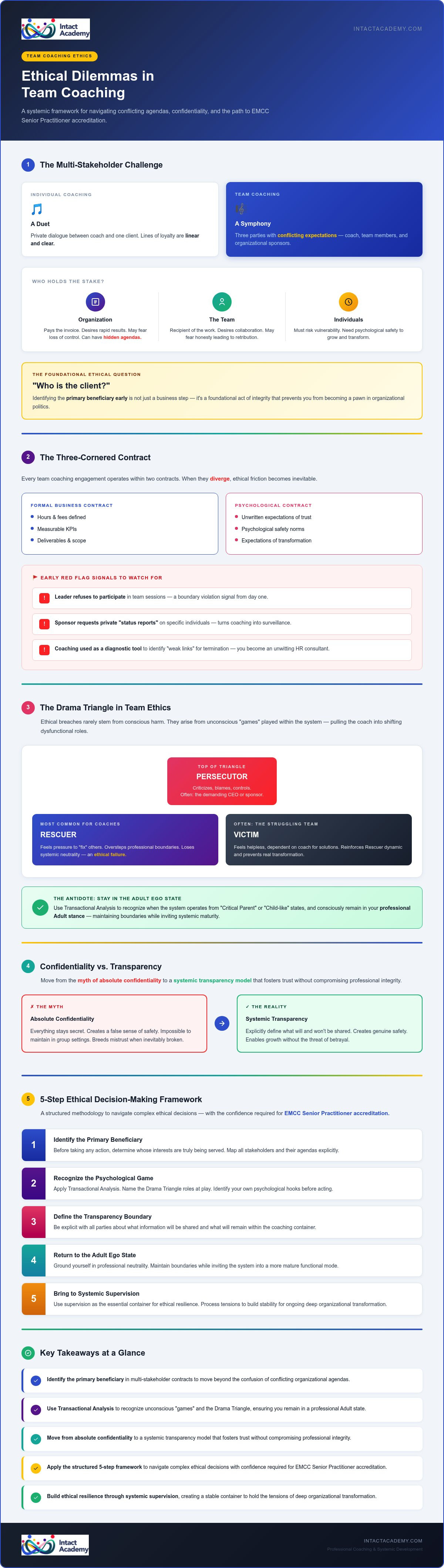
A 5-Step Framework for Ethical Decision-Making
Navigating ethical dilemmas in team coaching requires more than just a moral compass. It demands a structured, sequential process that allows the coach to slow down and observe the system before intervening. This framework provides a stable container for processing the complex multi-stakeholder tensions we've previously explored. It moves you from a reactive state into a position of reflective mastery.
- Step 1: Identify Systemic Stakeholders. Map the diverse interests of every party involved. The organization's strategic goals may clash with the team's need for psychological safety.
- Step 2: Consult Professional Codes. Look to the EMCC or ICF for concrete guidance. The 2025 ICF Code of Ethics update now mandates specific disclosure regarding AI tools and data privacy, a critical factor if you're using digital notes or analysis software.
- Step 3: Analyze Psychological Payoffs. Ask yourself what unwritten "game" you might be playing. If you choose to keep a secret, what's the payoff for your ego? Are you seeking to be the "favored" confidant?
- Step 4: Engage Supervision. Bring the dilemma to a supervisor to gain a "third-eye" perspective. This external view helps uncover the blind spots created by your own systemic countertransference.
- Step 5: Re-contract. Ethical resolution usually requires a shift in the agreement. Bring the resolution back to the team and organization, adjusting the boundaries to reflect the new systemic reality.
Consulting the Professional Standards
The EMCC Global Code of Ethics isn't a static document; it's a living framework for professional excellence. In a team context, these standards help you distinguish between individual confidentiality and systemic transparency. Aligning your decisions with these benchmarks is a core component of professional development for coaches. Integrity isn't just about avoiding complaints. It's a fundamental competency required for those pursuing senior-level accreditation, demonstrating that you can hold the tension of opposing needs with poise.
The Power of the 'Third-Eye' Perspective
Self-reflection is a powerful tool, yet it's often insufficient when you're deeply embedded in an organizational script. You can't see the water you're swimming in. Systemic supervision acts as a "third-eye," offering a perspective that is both outside the team and outside your own psychological filters. When presenting one of your ethical dilemmas in team coaching to a supervisor, focus on the emotional "hooks" you felt. This clarity allows you to step out of the Drama Triangle and return to the Adult ego state.
For those ready to move from tactical response to systemic mastery, the TA EMCC Senior Team Coach Academy offers the immersion needed to integrate these ethical frameworks into your daily practice, ensuring you remain a stable force in even the most turbulent environments.
Cultivating Ethical Resilience through Systemic Supervision
Ethical resilience is the quiet power to remain centered when the organizational storm rages; it is the capacity to hold the paradox of the multi-client contract without succumbing to the pressure of quick, surface-level fixes. In the face of complex ethical dilemmas in team coaching, resilience isn't merely about following a code. It's about developing the psychological stamina to stay in the "Adult" ego state when everyone around you is pulled into the "Drama Triangle." This inner stability allows you to move from transactional coaching—where you solve immediate problems—to transformational systemic mastery, where you facilitate deep, lasting change.
The TA EMCC Senior Team Coach Academy recognizes that ethics cannot be a standalone module. Instead, it's the very air the program breathes. By integrating systemic ethics into every interaction, the academy helps practitioners bridge the gap between theoretical knowledge and the "art and science" of organizational change. This depth of practice directly impacts the ROI of your engagements. When a coach can navigate ethical friction with integrity, the team builds a level of trust that accelerates performance and fosters a culture of genuine wholeness.
Why Supervision is Non-Negotiable for Senior Coaches
Supervision serves as the essential container for your professional soul. It prevents the ethical fatigue that often leads to coach burnout, providing a space where you can process the emotional weight of systemic "scripts" without judgment. Senior coaches who prioritize weekly or monthly reflection sessions are better equipped to identify subtle countertransference before it compromises their neutrality. By joining the global community at Intact Academy, you aren't just gaining a credential; you're entering a stable sanctuary of practitioners dedicated to the flourishing of human systems.
Next Steps for Your Professional Journey
Mastering the intricacies of ethical dilemmas in team coaching is a continuous process of becoming. It requires a commitment to looking inward before acting outward. As you evaluate your current ethical "fitness," consider where your boundaries might be thinning or where organizational politics have begun to cloud your systemic lens. Identifying these areas is the first step toward the professional mastery required for senior-level accreditation.
If you're ready to deepen your systemic impact and master the complexities of multi-stakeholder ethics, the path forward is clear. Discover how the TA EMCC Senior Team Coach Academy provides the structured methodology and psychological depth needed to transform your coaching practice into a catalyst for profound organizational growth.
Embodying the Art of Systemic Integrity
Mastering the complexities of human systems requires more than a checklist; it demands a fundamental shift in how you hold the space between individual needs and organizational goals. We've explored how systemic transparency and a robust 5-step framework can transform ethical dilemmas in team coaching from sources of anxiety into opportunities for profound growth. By recognizing the unconscious games of the Drama Triangle and grounding your practice in professional supervision, you become a stable container for transformation.
If you're ready to transcend transactional methods and embrace a deeper level of professional mastery, the next step is waiting. Advance your mastery at the TA EMCC Senior Team Coach Academy. Our curriculum, designed by global expert Sari van Poelje and recognized by both the EMCC and ICF, focuses on the intersection of human behavior and systemic success. This is your invitation to return to a state of completeness and lead with quiet power. Your journey toward becoming a wise global mentor starts with the courage to look deeper.
Frequently Asked Questions
What is the most common ethical dilemma in team coaching?
The most frequent ethical dilemmas in team coaching involve navigating the "triangular contract" where the interests of the organization, the team leader, and the team members diverge. You often find yourself pressured to serve the sponsor's strategic goals at the expense of the team's psychological safety. Resolving this requires a return to the primary beneficiary identified in your initial contract. Without a clear agreement on who the client is, you risk becoming a pawn in internal politics.
How do I handle a team leader who wants to use coaching to 'fire' a specific employee?
You must address this demand directly by re-contracting with the leader and the HR sponsor. Using coaching as a diagnostic tool for termination is a breach of professional integrity and destroys the trust necessary for systemic change. Your role is to facilitate growth, not to provide evidence for performance management. If the leader insists on using your sessions to sideline an individual, you must maintain your boundary or consider terminating the engagement to protect your professional neutrality.
Is it ethical to coach individual team members while also coaching the team as a whole?
It's ethical only if you establish radical transparency and clear disclosure protocols before the engagement begins. You must explicitly define what information from individual sessions will be shared with the collective team. Without these boundaries, you risk creating "secret alliances" that fuel systemic games and undermine the group's trust. Many senior practitioners prefer to use separate coaches for individuals to maintain a clean systemic container, ensuring that no single person feels sidelined by the coach's dual role.
What should I do if the organization's goals conflict with the team's psychological safety?
You should facilitate an open, systemic dialogue between the organization's sponsors and the team members. When strategic objectives threaten safety, the coach acts as a mirror, reflecting this tension back to the system rather than trying to solve it secretly. By bringing the conflict into the "Adult" space, you allow stakeholders to re-negotiate their psychological contract. If the organization refuses to prioritize safety, you must evaluate whether the coaching can continue without causing harm to the participants.
How does the EMCC Code of Ethics differ for team coaching versus individual coaching?
The EMCC Code of Ethics for teams places a significantly higher emphasis on managing multi-stakeholder accountability and the "collective" client. While individual coaching focuses on the growth of one person, team ethics require you to consider the impact of your work on the wider organizational system. This includes specific obligations regarding transparency, the management of shared data, and the navigation of power imbalances. It demands a sophisticated level of systemic awareness to ensure that no stakeholder is marginalized during the process.
When should a coach terminate a team coaching contract for ethical reasons?
Termination is necessary when the coaching process is being manipulated to mask illegal activity, systemic bullying, or psychological harm. If you find that your neutrality is permanently compromised or that the organization refuses to honor the agreed-upon ethical boundaries, staying in the contract becomes a form of collusion. A wise practitioner recognizes that their greatest tool is their integrity. Withdrawing from an unethical system preserves your professional standing and protects the long-term ROI of the coaching profession itself.
How can Transactional Analysis help me resolve ethical conflicts in the workplace?
Transactional Analysis provides a precise language for identifying the unconscious "games" and "scripts" that trigger ethical dilemmas in team coaching. By mapping ego states, you can see when a system is acting from a "Critical Parent" stance or when you've been pulled into a "Rescuer" role within the Drama Triangle. This psychological depth allows you to step back into your "Adult" state, facilitating a more mature and functional dialogue that honors the intelligence and autonomy of every stakeholder involved.
What is the role of a coaching supervisor in resolving ethical dilemmas?
A coaching supervisor acts as a "third-eye," helping you uncover the blind spots and countertransference that inevitably arise in complex organizational settings. They provide a stable container where you can process the emotional weight of a team's history without judgment. Supervision is not just a requirement for accreditation; it's a vital practice for maintaining ethical resilience. By reflecting on your work with an experienced mentor, you ensure that your interventions remain grounded in systemic integrity and professional mastery.


