

Have you ever finished a session feeling as though the team’s unresolved tension has somehow become your own? It's a heavy burden when the group’s dysfunction begins to mirror itself in your coaching relationship, leaving you feeling more like a participant in their chaos than a catalyst for their growth. You likely recognize this as the parallel process, a phenomenon that can drain your professional vitality and cloud your judgment in high-conflict environments. This guide demonstrates how team coaching supervision acts as a vital systemic container, allowing you to navigate complex group dynamics and multi-party contracting with renewed clarity. We'll explore the path toward professional mastery in 2026, covering the latest EMCC and ICF accreditation shifts and specialized Transactional Analysis frameworks for managing the group unconscious. By grounding your practice in structured, systemic reflection, you'll learn to restore your energy and deepen your impact within even the most turbulent organizational systems. This isn't just about professional survival; it's about returning to a state of wholeness that allows you to lead others toward their own profound transformation.
Key Takeaways
- Recognize the transition from individual focus to systemic inquiry, treating the team as a singular living entity with its own unconscious patterns.
- Utilize Transactional Analysis as a diagnostic map to navigate the complex "Field" and identify the scripts that dictate organizational success or failure.
- Discover how team coaching supervision provides the essential containment needed to process parallel processes and maintain neutral perspective in high-conflict environments.
- Adopt adapted frameworks like the 7-Eyed Model to handle the expanded scope and psychological weight of working with multi-party organizational systems.
- Chart a clear course toward professional mastery and senior-level accreditation by bridging the gap between theoretical systemic depth and pragmatic supervisory action.
Defining the Container: What Makes Team Coaching Supervision Unique?
Team coaching supervision is far more than a simple professional debrief. It’s a collaborative, systemic inquiry into the coach’s work with a group, serving as a protective container for both the practitioner and the organizational system. While foundational Coaching often focuses on the growth and performance of an individual, team coaching supervision addresses the messy, overlapping realities of a collective. In this space, the supervisor doesn't just look at the coach; they look at the coach looking at the team, creating a meta-perspective that reveals what is hidden in plain sight.
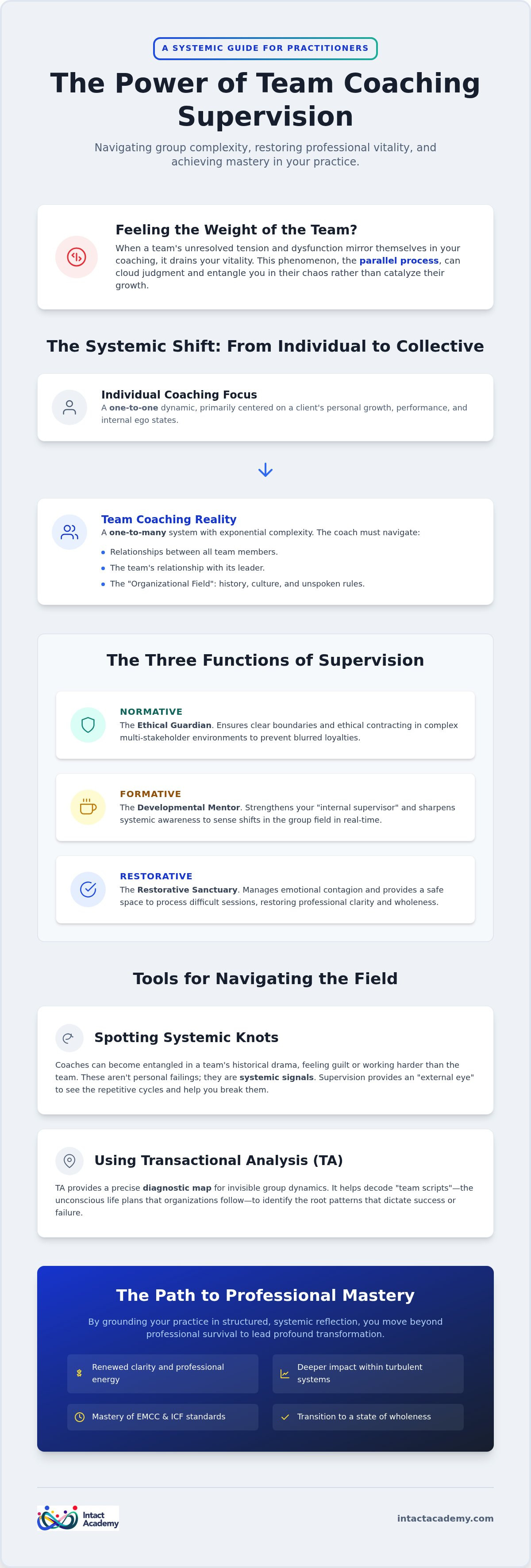
Moving from a "one-to-one" dynamic to a "one-to-many" system introduces exponential complexity. You aren't just managing the relationship between yourself and a client. You're managing the relationships between every team member, the team’s relationship with its leader, and the "third party" in the room: the organizational field. This field is a living entity, carrying the history, culture, and unspoken rules of the company. By 2026, senior practitioner standards require you to move beyond tactical advice. You must master the art of holding this field with psychological rigor and systemic presence.
The Systemic Shift: From Individual to Collective
In a typical individual session, focusing on a client’s personal ego states might provide a sufficient breakthrough. However, in a team setting, an individual’s behavior is often a symptom of a larger systemic pressure. If you only see the individual, you miss the system. The supervisor’s role is to help you spot "parallel processes," where the very dysfunctions the team is struggling with begin to manifest in your own coaching relationship. Team supervision acts as a systemic mirror for organizational health, reflecting back the hidden dynamics that are too close for the coach to see alone.
The Three Functions of Supervision in 2026
Modern professional standards categorize the supervisory role into three vital functions that ensure long-term mastery:
- Normative: This focuses on the "contracting for change." It ensures ethical boundaries are maintained in multi-stakeholder environments where loyalties can easily become blurred between the team, the leader, and the HR department.
- Formative: This is the developmental arm of team coaching supervision. It strengthens your "internal supervisor," sharpening your systemic awareness so you can sense shifts in the group field in real-time.
- Restorative: Team interventions are emotionally taxing. This function manages emotional contagion and the risk of "group-think," providing a safe space where you can return to a state of professional wholeness and clarity.
Navigating the Systemic Field: The Psychological Depth of Team Supervision
Across the shifting terrain of organizational change, the "Field" exists as a living, breathing entity. It represents the collective unconscious of a group, containing every unspoken conflict, historical trauma, and cultural bias that defines the team's current reality. For a practitioner, entering this field is akin to stepping into a powerful current. Without the anchor of team coaching supervision, you risk being swept away by the group’s internal gravity, losing your neutrality and your ability to lead effectively.
Systemic Knots occur when a coach inadvertently becomes entangled in the team’s historical drama. You might find yourself working harder than the team itself, or feeling a strange sense of guilt for their lack of progress. These are rarely personal failings. They're systemic signals. The supervisor acts as an essential "external eye," standing outside the current to help you see the knots you’ve become part of. This objective perspective is what allows you to break the repetitive cycles that keep teams stuck in unproductive patterns.
Transactional Analysis as a Supervision Tool
Understanding what is transactional analysis provides a precise map for these invisible group dynamics. TA allows us to decode team scripts, the unconscious life plans that organizations follow, often to their own detriment. By identifying "Psychological Games" like "Yes, But" or "Cornered," you can see how a team might be inviting you into a specific role to maintain their status quo.
In high-stakes corporate settings, Parent-Adult-Child dynamics are often at play. A team might collectively regress into a "Child" ego state, looking for a "Parent" in the coach to provide all the answers. Recognizing these transactions in real-time requires a high level of systemic mastery. If you're looking to deepen these diagnostic skills, exploring the curriculum of a TA EMCC Senior Supervisor academy can provide the rigorous framework necessary for this level of work.
The Parallel Process: When the Team Enters the Supervision Room
The most profound moments in team coaching supervision often occur when the coach inadvertently mimics the team’s behavior during the session. This is the parallel process. If a team is experiencing a stalemate, the coach might present their case in a way that feels equally stuck and immovable. The supervisor’s task is to name this reflection, resolving the unconscious mirror so the coach can return to the team with fresh energy.
Consider a coach who feels uncharacteristically anxious and "small" during a supervision session. By exploring this feeling, they realize they are mirroring a team that feels oppressed by a dominant leader. Once the supervisor names this dynamic, the "spell" is broken. The coach regains their "Adult" perspective, transforming a moment of professional anxiety into a powerful systemic intervention.
Individual vs. Team Coaching Supervision: A Framework for Mastery
While the core pillars of reflective practice remain constant, the systemic load and scope of team coaching supervision expand significantly. In individual work, the supervisor holds the space for a bipartite relationship. In a team context, that container must expand to hold a web of interconnected loyalties, historical grievances, and collective aspirations. It's the difference between navigating a single stream and managing the complex, often turbulent currents of an entire delta. The "load" isn't just heavier; it's qualitatively different, requiring a supervisor who can track multiple ego states and systemic signals simultaneously.
The 7-Eyed Model, a staple in supervisory practice, requires a wider lens when applied to a group. Instead of focusing on one client’s internal world, the supervisor helps the coach scan the relationships between members, the team’s relationship with the organization, and the coach's own systemic position. Transference issues are not merely present; they're multiplied by the number of people in the room. Each member may project different "Parent" or "Sibling" dynamics onto the coach, creating a dense psychological fog. Supervision provides the high-altitude perspective needed to see through this fog and return the focus to the relationship between the members rather than the individual egos of the leaders.
Key Differentiators in Practice
- Contracting: Moving from bipartite agreements to multi-party contracts involving HR, the team leader, and the collective group requires a higher level of ethical agility.
- Focus: The shift is from individual growth to systemic alignment. We aren't just looking for personal breakthroughs; we're looking for how those breakthroughs serve the organizational impact.
- Conflict: Supervision helps you distinguish between interpersonal friction, which is often surface-level, and systemic dysfunction, which is rooted in the organization’s history.
Selecting the Right Approach for Your Career
Choosing the right supervisory path depends on the complexity of your current assignments. If you find yourself increasingly entangled in multi-stakeholder politics or feeling drained by "group-think," seeking a team specialist is no longer optional. This evolution in professional development for coaches is a hallmark of the Senior Practitioner level. It marks the transition from being a facilitator of conversations to becoming a steward of systemic health.
Peer-group team coaching supervision can also serve as a powerful laboratory for learning. In these settings, the group itself becomes a microcosm of the teams you coach. By observing how the peer group handles its own dynamics, you gain immediate, lived insight into the very systemic patterns you're trying to resolve in your client organizations. This reflective inquiry ensures that your growth as a coach mirrors the maturity you're asking of the teams you lead.
Integrating Transactional Analysis into Team Supervision Practice
The "Contracting for Change" model serves as the psychological bedrock of effective team coaching supervision. In a multi-stakeholder environment, the contract isn't merely a legal document; it's a dynamic agreement that defines the boundaries of growth and the depth of intervention. Without a clear multi-party contract, the coach often becomes a "rescuer" in the system, attempting to fix problems that the organization isn't yet ready to acknowledge. Supervision allows you to step back and analyze these contracts, ensuring you aren't unconsciously colluding with a team's resistance to change.
Maintaining an "I’m OK, You’re OK" stance is perhaps the greatest challenge in high-conflict group environments. When a team is aggressive or deeply passive, it’s easy for a coach to slip into a "Parent" role, becoming either overly critical or overly protective. The supervisor’s role is to help you return to your "Adult" ego state, where you can observe the team's behavior without being emotionally hooked by it. This stance of mutual respect and neutrality is what allows you to decode the unspoken rules of a corporate culture, revealing the "hidden transcripts" that drive daily behavior.
Mapping Team Scripts in Supervision
Teams, much like individuals, operate according to unconscious life plans. A team script is the collective unconscious plan for the group that dictates how members interact and respond to change based on shared historical narratives. If a team has experienced a series of failed leadership transitions, their script might be one of "Don't Succeed" or "Don't Trust." In supervision, we map these scripts to understand why a team sabotages its own progress. By naming the script, the supervisor helps the coach guide the team toward "re-scripting" their narrative, replacing old patterns of failure with new possibilities for collective achievement.
Sari van Poelje’s Systemic Influence
Integrating the insights of Sari van Poelje into your daily practice transforms the coaching intervention from an ego-based exercise into one of systemic impact. Her "Agile TA" approach is particularly vital in 2026’s fast-moving tech and corporate environments, where traditional, slow-moving models often fail to keep pace with organizational reality. Supervision in this context focuses on rapid diagnostic cycles and the ability to pivot as the systemic field shifts. It moves the coach away from individual performance metrics and toward a deeper understanding of how the entire system can return to a state of wholeness and genuineness.
If you're ready to transition from tactical facilitation to profound systemic mastery, the TA EMCC Senior Supervisor academy provides the rigorous, psychologically-informed training necessary to lead at the highest levels of organizational change.
Advancing Your Practice with the TA EMCC Senior Supervisor Academy
Professional mastery isn't a destination but a continuous process of becoming. For practitioners who have navigated the turbulent waters of group dynamics, the TA EMCC Senior Supervisor academy represents the next stage of professional evolution. This program is the gold standard for those seeking systemic mastery, offering a sophisticated blend of psychological depth and professional pragmatism. By synthesizing Transactional Analysis with advanced systemic theory, the academy prepares you for high-level organizational consultancy, where you don't just solve problems but facilitate profound human transformation.
The master-mentor approach ensures you aren't learning in a vacuum. You join a global community of practitioners, a collective of wise mentors committed to professional flourishing and integrity. This environment provides the quiet power and stability needed to explore the often-turbulent work of personal and professional change; it ensures your growth as a supervisor mirrors the depth of the systems you serve.
What to Expect from the Academy
The journey is both methodical and transformative, mirroring the process of deep learning itself. You'll experience a deep dive into the art and science of systemic supervision, ensuring that complex psychological concepts remain accessible and actionable. The curriculum covers several key pillars:
- Practical live supervision sessions that offer a safe space for experimentation and expert feedback.
- Rigorous exploration of the intersection between TA, systemic theory, and team coaching supervision.
- A structured path toward EMCC Senior Supervisor accreditation, ensuring you meet the 120 hours of supervision practice required for the ESIA credential in 2026.
The Impact of Systemic Mastery
Becoming a supervisor fundamentally alters your relationship with the systems you serve. It marks the shift from "doing" coaching to "being" a systemic presence, a state where your mere presence acts as a catalyst for organizational health. You'll find that your own team coaching supervision practice becomes more grounded, allowing you to hold the field with greater ease and empathy. This focus on wholeness and genuineness acts as a thematic North Star, distinguishing your work from surface-level training providers. It reflects a brand that is as comfortable in an executive setting as it is in a developmental environment.
Join our TA EMCC Senior Supervisor Academy to master the systemic field.
Stepping into Systemic Wholeness
The journey toward professional mastery requires a courageous shift from managing individual performance to holding the collective field. By embracing team coaching supervision, you move beyond the surface-level noise of group conflict and begin to address the underlying psychological scripts that dictate organizational success. You've explored how Transactional Analysis provides the map for these unconscious patterns and how the 2026 standards demand a more rigorous, systemic lens for senior practitioners. This evolution isn't merely about accreditation; it's about returning to a state of genuineness that allows you to act as a stable container for change.
If you're ready to deepen your impact and join a global community of senior practitioners, the path forward is clear. Founded by systemic expert Sari van Poelje, our EMCC accredited training offers the intellectual rigor and empathetic space needed for this transformation. Master the field at the TA EMCC Senior Supervisor Academy and refine your ability to lead with quiet power and systemic clarity. The teams you serve are waiting for the depth only a supervised master can provide.
Frequently Asked Questions
How is team coaching supervision different from individual coaching supervision?
Team supervision shifts the focus from a bipartite relationship to a multi-layered systemic field. While individual supervision explores the coach-client dyad, team coaching supervision examines the relationships between team members, the leader, and the organizational culture. It requires the supervisor to hold a larger container for the increased psychological load and complexity that arises when multiple ego states and systemic loyalties interact simultaneously within a group.
Why is Transactional Analysis particularly useful in team supervision?
Transactional Analysis (TA) provides a sophisticated map for decoding the unconscious scripts and psychological games that teams play to maintain their status quo. It allows supervisors to help coaches identify Parent-Adult-Child dynamics in high-stakes settings and name the "hidden transcripts" within a corporate culture. By using TA, practitioners move beyond surface-level facilitation into profound systemic transformation, ensuring that organizational change is both sustainable and deeply human.
What are the EMCC requirements for becoming a Senior Supervisor?
To achieve EMCC’s ESIA accreditation in 2026, practitioners must document 120 hours of supervision practice. This requirement ensures that senior supervisors possess the depth of experience necessary to handle complex systemic interventions. Additionally, candidates are expected to demonstrate continuous professional development through accredited programs, such as those offered by Intact Academy, which emphasize a grounded understanding of systemic theory and ethical multi-party contracting.
Can I use team coaching supervision hours toward my ICF or EMCC accreditation?
Yes, supervision hours are a core requirement for both maintaining and advancing your professional credentials. As of 2026, the EMCC recommends a ratio of one hour of supervision for every 35 hours of coaching practice. For those pursuing the ICF Advanced Certification in Team Coaching (ACTC), working with a qualified supervisor who holds a specialization like the CSS is increasingly essential for meeting the rigorous standards of professional mastery.
What is the "7-Eyed Model" of supervision and how does it apply to teams?
The 7-Eyed Model is a systemic framework that looks at the client, the coach’s interventions, the coach-client relationship, and the wider organizational context. When applied to teams, this model expands to include the "eye" of the collective group dynamic and the "eye" of the organizational field. It helps the supervisor and coach track how the team's historical drama might be mirrored in the supervision room through the parallel process.
How often should a professional team coach meet with their supervisor?
Professional standards in 2026 suggest that Senior Practitioners should participate in at least one supervision session per quarter. However, the recommended frequency is one hour of supervision for every 35 hours of active coaching. For coaches working in high-conflict environments or on complex systemic change projects, more frequent sessions are advisable to manage emotional contagion and maintain the professional clarity needed for impactful intervention.
What should I look for when choosing a team coaching supervisor?
You should prioritize a supervisor who possesses a blend of psychological depth and practical organizational experience. Look for credentials like the EMCC ESIA or the ICF CSS, but also evaluate their ability to hold a systemic container. A supervisor trained in Transactional Analysis can offer unique insights into group unconscious processes. Ultimately, you want a wise mentor who honors your intelligence and provides a safe space for profound human transformation.
How does supervision help with ethical dilemmas in multi-party contracts?
Supervision acts as a normative anchor, helping you navigate the blurred loyalties that often arise between team leaders, HR, and the collective group. It provides a reflective space to analyze "Contracting for Change" models, ensuring that your interventions remain ethical and aligned with the agreed-upon systemic goals. By naming these tensions in supervision, you can avoid unconscious collusion and maintain the integrity required for high-level organizational consultancy.


