

What if the most critical intervention you ever make with a team happens before the coaching contract is even signed? You've likely experienced those initial meetings where the rapport feels pleasant, yet you sense a deeper, unspoken tension beneath the surface. It's frustrating to realize, months into an engagement, that you've been caught in the crossfire of team politics or that you failed to identify the "hidden" client who truly holds the power. When you rely on standard team coaching questions for discovery session, you often receive surface-level answers that mask the systemic reality you're there to transform.
We believe that the discovery phase isn't a prelude to coaching; it's the first systemic entry that sets the stage for wholeness or failure. This article provides a robust diagnostic framework to help you move beyond the obvious. You'll discover how to ask high-impact questions that reveal profound dynamics, allowing you to handle high-stakes facilitation with renewed confidence. We'll explore how to master the art of contracting, ensuring your long-term engagements are built on a foundation of psychological depth and professional pragmatism.
Key Takeaways
- Learn to view the team as a single, collective entity, shifting your focus from individual rapport to the systemic entry required for deep transformation.
- Master the three levels of Transactional Analysis contracting, covering administrative, professional, and psychological dimensions, to build a stable foundation for complex change.
- Utilize a layered diagnostic framework of team coaching questions for discovery session to uncover the hidden subtext of the team's primary task and internal processes.
- Recognize and interpret team resistance not as a barrier, but as valuable systemic data that reveals the underlying script and psychological games at play.
- Transition from a facilitator to a Senior Team Coach by integrating high-level systemic methodologies that address the core of human and organizational flourishing.
The Systemic Shift: Why Team Coaching Discovery Requires a Different Lens
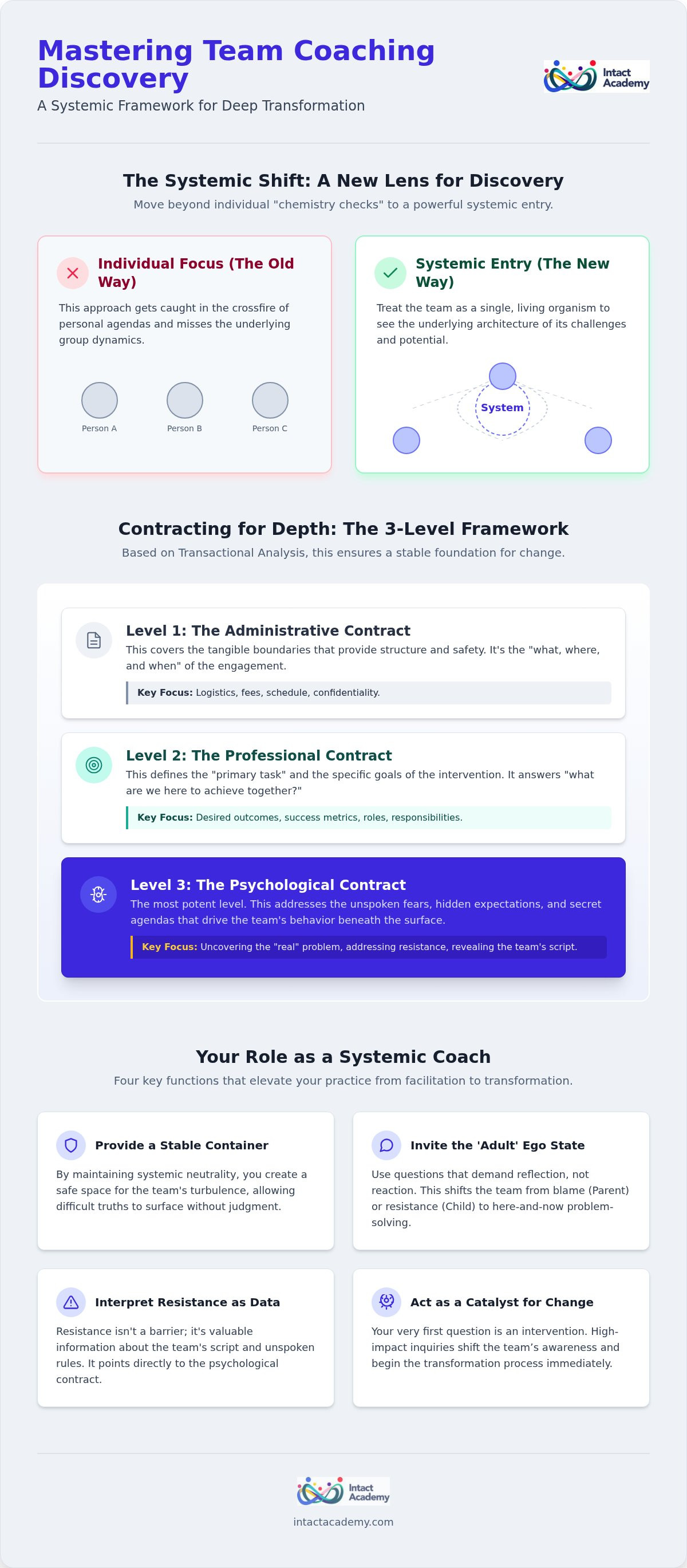
Many practitioners approach the initial meeting as a "chemistry session," a term frequently borrowed from one-on-one engagements. In that context, the goal is often personal alignment and rapport. However, when working with a collective, this individualistic model fails. We must shift our perspective toward a "systemic entry." This is the precise moment you step into the team’s energetic field; your presence is never neutral. While the foundational definition of coaching often centers on facilitating individual growth, team coaching demands that we honor the complexity of the group as a single, living entity.
When you rely on surface-level inquiries, you inevitably receive surface-level results. In organizational change, the "real" problem is rarely what's written on the initial brief. If you get caught in the crossfire of individual agendas, you lose your ability to lead the system toward wholeness. Mastering the team coaching questions for discovery session allows you to bypass the noise and listen for the collective voice of the system, which often speaks through silence, tension, or repetitive patterns.
The Team as a Systemic Organism
To coach a team effectively, you must define its boundaries. Who is truly part of this system? Often, the most influential stakeholders aren't even in the room. They are the "hidden" clients whose expectations shape the team's behavior from the shadows. During discovery, your task is to look past the presenting problems. A team might complain about "lack of trust," but the systemic root could be a lack of clear permission to fail. By treating the team as an organism rather than a collection of parts, you begin to see the underlying architecture of their struggle.
The Coach as the First Intervention
Your very first question acts as a catalyst for change. It isn't just data collection; it's an intervention that begins to shift the team’s awareness immediately. By maintaining systemic neutrality, you provide a stable container for their turbulence. We often use the "Adult" ego state from Transactional Analysis to invite a professional, transformative space. This modeling is essential. If you can remain calm and observant while the team displays its typical dysfunctions, you provide them with a new possibility for being. You become the mirror that reflects their potential back to them.
Contracting for Depth: The Transactional Analysis Approach to Discovery
In the world of systemic work, the discovery session is far more than a logistical gatekeeper. It's the birthplace of the contract. Within Transactional Analysis (TA), we define a contract as a bilateral commitment to a well-defined outcome. This moves beyond the sterile legalities of a signed document into a living agreement between the coach and the team system. When you prepare your team coaching questions for discovery session, you aren't just gathering facts; you're building a stable container for the turbulence that inevitably accompanies growth.
The Administrative vs. The Psychological Contract
Effective discovery requires us to operate on three distinct levels simultaneously. The administrative level covers the tangible boundaries: time, fees, and logistics. It provides the safety of structure. The professional level defines the "primary task" and the specific goals of our systemic intervention. However, the most potent level is the psychological contract. This addresses the unspoken fears and hidden expectations that reside beneath the surface. Is the team asking you to "fix" a difficult member, or are they seeking a scapegoat for collective stagnation? Uncovering this "secret contract" is vital. If you don't address what the team isn't saying, you risk becoming a pawn in their existing script.
Inviting the Adult Ego State
A team in distress often retreats into defensive ego states. You might encounter the "Critical Parent," looking to blame, or the "Rebellious Child," resisting any hint of change. Your inquiry must be designed to invite the "Adult" ego state, the part of the personality that can process reality in the here-and-now without distortion. By asking questions that demand reflection rather than reaction, you create a space where wholeness and genuineness can emerge.
This shift allows the group to move from a "contract for maintenance," where they simply want to feel better without changing, to a "contract for change." Mastering these nuances is a core competency explored in our TA EMCC Senior Team Coach Academy, where we bridge the gap between theory and transformative practice. By establishing these boundaries early, you ensure the coaching relationship is a vehicle for evolution rather than a reinforcement of the status quo.
Essential Team Coaching Questions for Discovery: A Diagnostic Framework
To diagnose a system, we must look beyond individual symptoms. A robust set of team coaching questions for discovery session acts as a surgical tool, revealing the underlying architecture of the group. We categorize these inquiries into three levels: the task, the process, and the systemic. This framework ensures that we don't just fix problems; we transform the soil in which those problems grew. By moving through these layers, you invite the team to move from reactive complaints toward a state of reflective awareness.
Questions for the Team Leader
The leader is the guardian of the team's boundary. We must assess their alignment with the primary task and their willingness to be part of the solution. You might ask: "What is the mission that this team, and only this team, can fulfill?" This question forces a distinction between a collection of individuals and a functional, purposeful unit. We also explore personal responsibility: "How do you, as a leader, contribute to the current dynamics you wish to change?" Finally, we test the stakes by asking what happens if the engagement is wildly successful, and conversely, what happens if it fails. This brings the reality of the work into sharp focus.
Questions for the Team Collective
A team speaks through a shared narrative, often hidden behind professional jargon. To uncover this, use metaphorical inquiry. "If this team were a story, what chapter are we currently in?" This reveals whether they feel they're at a beginning, a climax, or an ending. To identify the cultural script, ask: "What are the unspoken rules that everyone here follows?" This often exposes the rigid patterns that prevent growth. Perhaps most importantly, we address the shadow: "What is the one thing this team is afraid to talk about in front of the leader?" This question measures psychological safety and the presence of "elephants in the room."
Systemic and Environmental Inquiries
No team exists in a vacuum. They are influenced by the wider organizational field. We must ask: "Who is missing from this conversation whose influence is felt in the room?" This identifies the "hidden" stakeholders who might sabotage or support change from a distance. We also examine environmental support: "How does the wider organizational culture support or hinder this team’s growth?" Understanding these external pressures is a cornerstone of leading organizational change with a systemic perspective. Using these team coaching questions for discovery session allows you to map the entire ecosystem, ensuring your interventions are both grounded and sustainable.
Facilitating the Discovery Session: Managing Resistance and Subtext
Facilitating a discovery session is an exercise in deep listening. You aren't just looking for literal answers to your team coaching questions for discovery session; you're listening for the subtext that lives in the gaps between words. How does the team breathe together? Who interrupts whom, and who remains in the shadows? These subtle cues are the true indicators of systemic health. When you enter the room, your presence acts as a systemic mirror, reflecting the team’s internal dynamics back to them before a single intervention is even named.
Identifying Psychological Games
Teams often engage in unconscious patterns to avoid genuine contact or the discomfort of change. One common pattern is the "Yes, But" game. You offer a systemic reflection, and the team immediately disqualifies it with a reason why it won't work in their specific context. This is a defensive maneuver. By using Transactional Analysis, you can map the Drama Triangle in real-time. Are they casting you as the Rescuer who must fix them? Are they playing the Victim to the organization's perceived Persecution? Remaining in an "I’m OK, You’re OK" position allows you to observe these games without being drawn into the fray, maintaining the integrity of the systemic container.
Uncovering the Team Script
Every team follows a script, a repetitive pattern of behavior that dictates how they succeed and how they fail. While formulating your team coaching questions for discovery session, remember that the goal is to reveal this unconscious script. Listen closely to the language they use; it reveals the cultural script of the wider organization. You might ask a single, piercing sentence: "If this team had a collective motto that explained why you keep ending up in this exact situation, what would it be?" Reflecting this script back to them acts as a powerful catalyst for awareness, moving the conversation from surface-level symptoms to the core of their collective identity.
Resistance isn't a hurdle to be cleared; it's a diagnostic signal. When a team hesitates or meets your inquiry with silence, they're telling you something about their systemic boundaries. Silence is your ally. By allowing the team to sit with their own reflections, you invite them to look inward. This level of mastery requires a deep understanding of human behavior and systemic dynamics. If you're ready to deepen your expertise, exploring a comprehensive team coaching course can provide the theoretical grounding you need. You can begin this journey of professional evolution by joining our TA EMCC Senior Team Coach Academy to refine your systemic lens.
From Discovery to Mastery: Building Your Path as a Senior Team Coach
The transition from a facilitator to a Senior Team Coach marks a profound shift in professional identity. While a facilitator might manage a meeting's agenda, a Senior Team Coach manages the system's evolution. This mastery begins with the quality of your inquiry. The specific team coaching questions for discovery session you choose aren't merely tools for data collection; they are reflections of your capacity to hold space for complexity. Moving beyond transactional interactions requires a commitment to your own professional wholeness and a willingness to look deep into the psychological undercurrents of organizational life. This evolution represents a movement from doing coaching to being a coach, where your presence becomes a stable container for the team's transformation.
The Path to Senior Team Coach Accreditation
Accreditation through the EMCC isn't simply a pursuit of credentials. It is a rigorous validation of your ability to navigate high-stakes systemic interventions with grace and authority. The competencies required at the Senior Team Coach level demand more than just rapport building. They require an integrated understanding of group dynamics, power structures, and the unconscious scripts that drive team behavior. Our TA EMCC Senior Team Coach Academy is designed to prepare you for this depth, bridging the gap between theoretical Transactional Analysis and pragmatic organizational change. Supervision remains a cornerstone of this journey, providing the essential reflective space necessary to maintain the quality of your interventions. It ensures that your systemic lens remains clear and that you don't become entangled in the very dynamics you're seeking to transform.
Embracing the Role of a Global Mentor
As you refine your use of team coaching questions for discovery session, you move naturally toward the role of a global mentor. This role isn't defined by hierarchy, but by the profound impact you have on the flourishing of individuals and the systems they inhabit. You become a catalyst for systemic change, joining a global community of practitioners who value integrity, depth, and the courage to transform. This journey is about returning to a state of completeness, where your professional expertise and human genuineness meet in a powerful synthesis. It is a path of constant becoming, where each discovery session is an opportunity to practice the art of systemic entry. If you're ready to advance your practice and step into this level of systemic mastery, we invite you to Explore our professional development for coaches. Your path toward professional wholeness starts with the courage to ask deeper questions and the commitment to see the system as a whole.
Stepping into Systemic Mastery
The journey from a standard discovery call to a profound systemic intervention requires a shift in both perspective and practice. By moving beyond surface-level rapport, you begin to see the team not as a collection of individuals, but as a living organism with its own history and hidden scripts. We've explored how a robust diagnostic framework and high-impact team coaching questions for discovery session allow you to uncover the psychological subtext that defines organizational life. This depth of inquiry is the foundation of effective contracting; it transforms the initial meeting into the first catalyst for genuine, lasting change.
Mastering these complexities is a path toward professional wholeness and global impact. If you're ready to evolve your practice through a systemic approach rooted in Transactional Analysis, we invite you to Master the art of systemic intervention at the TA EMCC Senior Team Coach Academy. Our EMCC and ICF accredited programs, led by global expert Sari van Poelje, provide the stable container you need to lead high-stakes organizational change. Embrace the courage to ask deeper questions and guide your clients toward a state of completeness and flourishing.
Frequently Asked Questions
How long should a team coaching discovery session typically last?
A comprehensive discovery session usually requires between 60 and 90 minutes to move beyond surface-level introductions. This duration allows enough time for the systemic dynamics to reveal themselves and for the coach to establish a stable container. Rushing this process often results in incomplete contracting. If the team is large or the issues are complex, you might consider a series of shorter meetings to ensure all voices are heard and the primary task is clearly defined.
Should I charge for a team coaching discovery session?
Charging for discovery is a professional choice that reflects the value of the intervention itself. Many senior practitioners view discovery as the first stage of the coaching contract rather than a sales pitch. If you provide a diagnostic report or immediate systemic insights, a professional fee is appropriate. This practice establishes a professional boundary from the outset. It signals that your expertise is a resource for transformation, moving the engagement away from a transactional session toward a committed partnership.
What is the most important question to ask the team leader?
The most critical question addresses the leader's personal contribution to the system's current state. You might ask: "How do you, as a leader, contribute to the dynamics you are asking me to help change?" This inquiry tests the leader's readiness for genuine transformation. It moves the focus from "fixing" the team to shared responsibility. When using team coaching questions for discovery session, this specific prompt reveals whether the leader is willing to model the Adult ego state required for growth.
How do I handle a team member who is openly hostile during discovery?
Hostility should be treated as valuable systemic data rather than a personal affront. Stay in an "I’m OK, You’re OK" position and observe the resistance with curiosity. You might reflect the behavior back to the group by asking how this tension serves the team’s current script. Don't attempt to "fix" the hostility immediately. Instead, hold the space and allow the team to witness their own dynamics. This approach maintains your systemic neutrality and prevents you from being pulled into a drama triangle.
What is the difference between a chemistry call and a systemic discovery session?
A chemistry call focuses on individual rapport and personal liking, whereas a systemic discovery session is a diagnostic intervention. While chemistry is about "fit," systemic discovery explores the boundaries, tasks, and unconscious patterns of the entire team organism. It moves beyond the individual to identify the collective voice. In our training, we emphasize that team coaching questions for discovery session are designed to reveal the psychological contract, ensuring that the work addresses root causes rather than just surface-level symptoms.
Can I use Transactional Analysis if I am not a therapist?
Transactional Analysis is a robust framework designed for understanding human behavior and organizational systems. Its application at Intact Academy is strictly focused on professional development, leadership growth, and systemic change. Our programs provide coaches and consultants with the methodology to map communication patterns and script dynamics within a business environment. This ensures that your interventions are grounded in deep insight while remaining focused on the flourishing of individuals and the organizations they serve.
How many people should be involved in the discovery session?
Ideally, the entire team should be present to ensure the collective voice is represented. If the team is exceptionally large, you might begin with the leadership core and then hold focus groups with representative members. The goal is to map the system's boundaries accurately. Excluding key members can lead to a "secret contract" or sabotage later in the engagement. Including all relevant stakeholders from the beginning creates a sense of shared ownership and sets the stage for a more robust professional contract.
What happens if the team and the leader have conflicting goals?
Conflicting goals are a common feature of systemic life and should be addressed openly during the contracting phase. Your role is to facilitate a dialogue that uncovers the "primary task" of the team. Use your discovery questions to explore these discrepancies without taking sides. By reflecting the conflict back to the group, you invite them to move toward a unified professional contract. This process of alignment is essential for creating a stable foundation for the coaching work that follows.


