

What if the reason your team sessions feel stuck isn't a lack of tools, but a failure to see the invisible threads binding the group together? You've likely felt that familiar tension; the unspoken conflict that lingers while the team politely discusses KPIs. It's frustrating to leave a session knowing you only touched the surface. Traditional, linear team coaching models and frameworks often fail because they treat organizations like machines rather than living, breathing systems. You aren't alone in feeling that these surface-level results don't match the complexity of the challenges your clients face.
This guide offers a different path, one grounded in psychological depth and professional pragmatism. You'll discover how to move beyond basic facilitation by mastering systemic frameworks that address the deep psychological dynamics of high-performing teams. By adopting a sophisticated diagnostic lens, you'll gain the confidence to lead high-stakes organizational change. We'll preview the essential methodologies, including Transactional Analysis, that serve as pathways toward EMCC or ICF senior-level accreditation. Prepare to evolve your practice from transactional interventions to a state of mastery and profound human transformation.
Key Takeaways
- Shift your perspective from coaching individuals within a group to addressing the "group-as-a-whole" for truly sustainable transformation.
- Master advanced team coaching models and frameworks that move beyond linear logic to navigate the non-linear complexities of modern organizational systems.
- Integrate Transactional Analysis to identify unconscious "group scripts" and ego state dynamics that often hinder high-level decision-making.
- Develop a sophisticated diagnostic lens to assess systemic readiness, ensuring your interventions are timed for maximum organizational impact.
- Gain clarity on the 2026 pathways toward EMCC Senior Team Coach accreditation to solidify your authority as a master practitioner.
Why Traditional Coaching Models Often Fail in Complex Teams
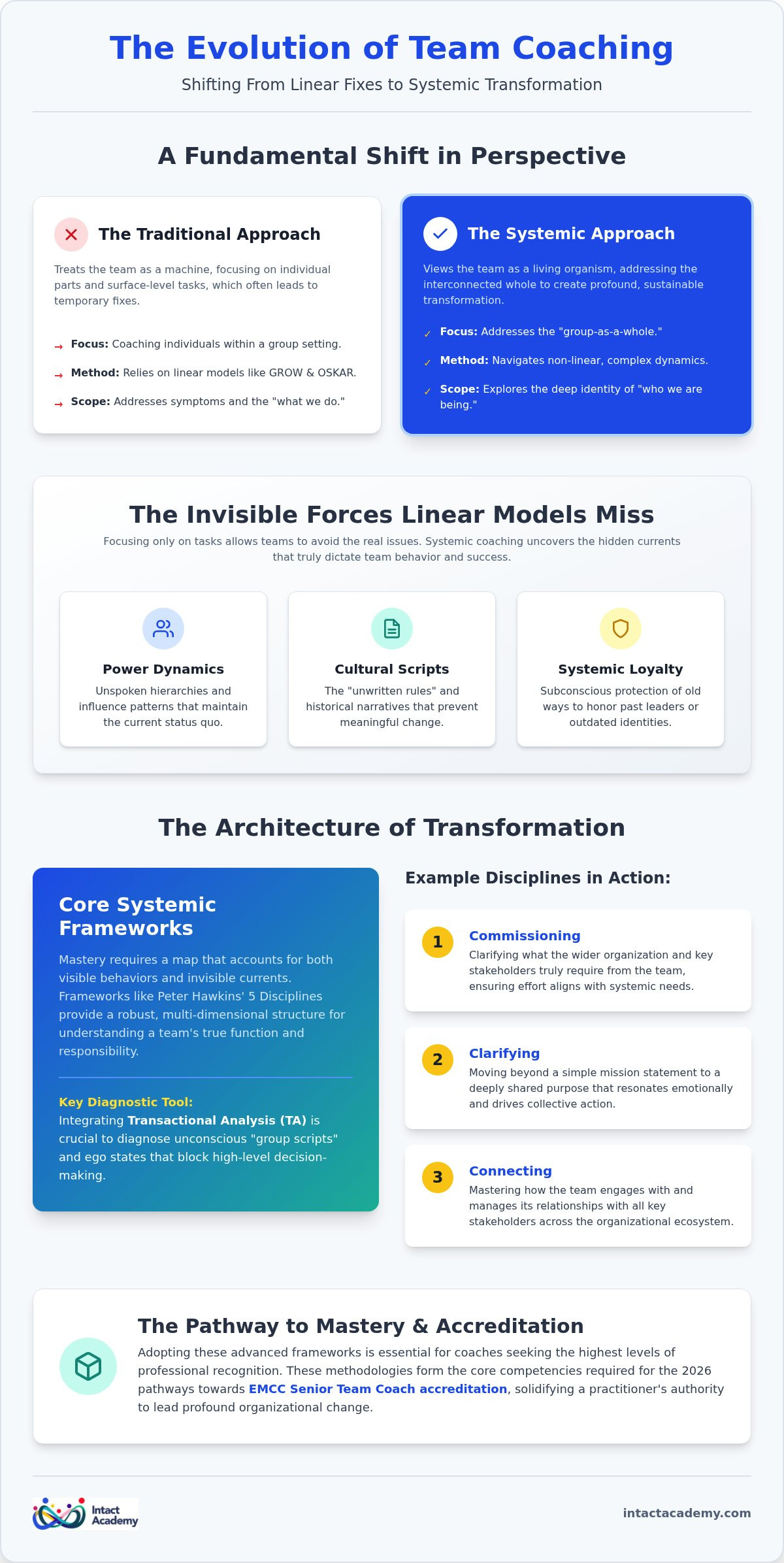
Teams aren't merely collections of individuals; they're complex, non-linear organisms. While traditional business and executive coaching often focuses on the performance of the person, team coaching requires a much broader lens. Many practitioners rely on linear team coaching models and frameworks like GROW or OSKAR, assuming that clear goals and action plans will naturally lead to success. However, these models often fail because they ignore the systemic "drag" caused by unconscious group patterns. When we treat a team like a machine that just needs better instructions, we miss the human depth that actually drives behavior.
Coaching individuals in the presence of others isn't team coaching. True transformation happens when we address the "group-as-a-whole." This means looking at the invisible forces that dictate how the team functions:
- Power Dynamics: Who holds the influence, and how is it used to maintain the status quo?
- Cultural Scripts: What "unwritten rules" or historical narratives prevent the team from changing?
- Systemic Loyalty: Are members subconsciously protecting old ways of working to honor past leaders or outdated identities?
Moving from transactional feedback to transformational impact requires us to see these patterns clearly. It's a shift from fixing a problem to evolving a system.
The Trap of the GROW Model for Teams
In high-stakes environments, the GROW model can actually become a defense mechanism. By rushing into goal-setting, a team avoids the uncomfortable work of addressing their internal friction. It's often easier to talk about "what we do" than "who we are being" as a collective. This focus on symptoms leaves the systemic cause intact. If a team's underlying culture is built on mistrust, no amount of SMART goals will fix the lack of collaboration. We must shift the focus from surface-level tasks to the deep psychological roots of the team's identity.
Defining Systemic Team Coaching in 2026
Systemic team coaching is a purposeful intervention into the entire organizational system, focusing on the relationships and patterns between the parts rather than the parts themselves. In 2026, the coach acts as a stable container for the inevitable turbulence that arises during change. This role requires profound systemic awareness, as the coach must remain grounded while the team navigates its own evolution. Without this maturity, a coach risks being pulled into the very dynamics they're meant to transform. Professional development must therefore move beyond simple tools toward a state of systemic mastery and wholeness.
The Architecture of Transformation: Core Systemic Team Coaching Models
To move beyond surface-level interventions, a coach must operate with a map that accounts for both visible behaviors and invisible currents. The architecture of a team is rarely obvious to those living within it; it requires a structured yet fluid approach to reveal the underlying structures. Mastery in 2026 demands a shift toward team coaching models and frameworks that prioritize the system over the individual. This begins with a 5-Step Systemic Model that tracks the intervention from the very first contact through to a sustainable ending, ensuring that the work is grounded in reality from the start.
Central to this process is the "Contracting" model. In Transactional Analysis, contracting isn't just a legal agreement; it's a multi-layered alignment of professional, psychological, and organizational expectations. By establishing these boundaries early, you create a safe container where the team can explore their deepest challenges without losing focus on their strategic goals. This level of rigor distinguishes a senior practitioner from a generalist facilitator.
The 5 Disciplines of High-Performing Teams
Peter Hawkins' 5 Disciplines provide a robust framework for understanding a team's multi-dimensional responsibilities. It starts with Commissioning, where the coach helps the team understand what the wider organizational system actually requires of them. Often, teams work hard on the wrong things because they haven't listened to their stakeholders. Clarifying then moves the group beyond a simple mission statement toward a deeply shared purpose that resonates at an emotional level. Finally, Connecting focuses on how the team manages its external relationships. A team that functions perfectly internally but fails to influence its environment will eventually stagnate. These Systemic Coaching Models ensure the team remains relevant to the world it serves.
The 7-Eyed Model as a Diagnostic Lens
While originally designed for supervision, the 7-Eyed Model is an invaluable diagnostic tool for team coaches. It allows you to observe the "parallel process," where the dynamics between you and the team mirror the dynamics within the team itself. If you feel confused or silenced in a session, it's likely the team feels the same in their boardroom. This model also helps identify "systemic ghosts," those past leaders or historical traumas that continue to haunt current decision-making. Recognizing these patterns is essential for quality control and personal growth. To truly master these nuances, many professionals seek systemic supervision to remain objective and effective. For those ready to deepen their practice, the TA EMCC Senior Team Coach Academy offers a structured path to integrating these complex theories into daily practice.
Integrating Transactional Analysis (TA) into Team Coaching Frameworks
While many team coaching models and frameworks provide a structure for the "what," Transactional Analysis (TA) offers a profound diagnostic lens for the "why." It allows us to move beyond surface-level behaviors and into the psychological structures that dictate a group’s reality. At the heart of this approach is the OK-OK Matrix, which serves as a thematic North Star for building a culture of mutual respect. When a team operates from a position of "I’m OK, You’re OK," they create the psychological safety necessary for radical honesty. Without this foundation, the group often falls into "Psychological Games." These are repetitive, unconscious patterns like the "Yes, But" game, where suggestions are dismissed, or "Blame" cycles that halt progress and drain collective energy.
Identifying "Ego States" in the boardroom is equally critical for the systemic coach. When a leader retreats into a "Critical Parent" state, the team often responds from an "Adapted Child" position, resulting in compliance or passive-aggression. This dynamic stifles agility and prevents the team from reaching its full potential. To reach professional mastery, pursuing EMCC Accreditation for Team Coaches involves demonstrating the ability to navigate these complex human dynamics with precision and empathy.
Mapping Ego States for Team Alignment
A culture dominated by "Parent" energy prevents individuals from taking full responsibility for their roles. Innovation requires an "Adult-Adult" functioning state, where members interact with objectivity and presence. Integrating what is transactional analysis into everyday team interactions helps members recognize when they've slipped into outdated roles. It provides a shared language to return to a state of completeness and genuine engagement, which is essential for high-stakes decision-making. By fostering Adult-to-Adult transactions, you help the team move from reactive patterns to proactive solutions.
Breaking the Group Script
Every team carries a "Group Script," an unconscious story they tell about their potential. Some teams are scripted to "almost succeed," while others are scripted to "struggle" regardless of their resources. Recognizing these narratives is the first step toward leading organizational change. As a coach, your role is to act as a witness and guide, inviting the team to write a new, autonomous script. This shift allows the team to shed historical burdens and step into a future of their own design, moving from repetitive failure to sustainable success. This transformation is not just about better performance; it's about the team becoming more whole and autonomous within the wider organization.
Selecting the Right Framework: A Diagnostic Approach for Senior Coaches
Selecting from the vast array of team coaching models and frameworks requires more than a preference for a specific methodology; it demands a rigorous diagnostic lens. Before intervening, a senior coach must evaluate the team's maturity level. Is the group in a "forming" stage, needing basic structure and alignment, or are they "performing" but hitting a psychological ceiling? A misplaced model can either overwhelm a fragile team or bore a sophisticated one. We must also conduct a "Systemic Readiness" check to determine if the wider organization supports deep change. Even the most profound intervention will eventually fail if the surrounding organizational system is too rigid to allow the team to evolve.
The choice between a tactical or transformational approach depends on this initial assessment. Tactical coaching focuses on the "what" and "how" of performance, while transformational coaching addresses the "who" and the "why" of the team’s existence. By matching the model to the specific systemic need, you ensure that the intervention is both ethical and effective. This level of discernment is what separates a master practitioner from a generalist facilitator.
A Framework for Frameworks
Not every situation requires a deep dive into the group script. For simple, task-oriented goals or short-term projects, a linear model like GROW provides sufficient clarity and momentum. However, when you encounter chronic cycles of resistance or stagnant power dynamics, Transactional Analysis becomes the necessary tool for lasting change. We call this the "Diagnostic Contract." It's an explicit agreement with the team about the depth of the intervention. Evaluating the ROI of these frameworks often depends on team longevity; a long-term executive board warrants the deep psychological investment that TA provides, whereas a temporary task force might only need tactical alignment.
The Role of the Coach's Internal Compass
Ultimately, no model is more effective than the person delivering it. Your own professional development for coaches serves as the invisible foundation for every session. Developing "Executive Presence" isn't about performance; it's about achieving a state of Adult-Adult functioning that invites the team into their own wholeness. This requires constant self-reflection and a commitment to ethical boundaries, especially when navigating deep interventions in high-pressure corporate settings. To refine your diagnostic skills and master these high-level interventions, explore the TA EMCC Senior Team Coach Academy as a pathway to professional excellence.
Path to EMCC Senior Team Coach Accreditation
Achieving professional recognition in 2026 requires more than just attending a workshop; it demands a documented commitment to excellence and ethical rigor. For those seeking the EMCC Senior Practitioner level, the standards are clear. You must demonstrate a minimum of 250 hours of coaching practice and engage in at least one supervision session per quarter. This structure ensures that your application of team coaching models and frameworks is grounded in real-world experience and consistent reflection. It's a journey that moves you from being a facilitator of sessions to becoming a master of systemic transformation.
The value of this path lies in its ability to turn theoretical knowledge into a stable professional identity. By meeting these requirements, you signal to global organizations that you possess the stability and depth to handle their most complex human systems. This isn't just about a certificate; it's about the evolution of your own presence as a leader in the coaching field.
Inside the TA EMCC Senior Team Coach Academy
The TA EMCC Senior Team Coach Academy is designed to bridge the gap between abstract theory and the often-turbulent reality of organizational life. The curriculum integrates Transactional Analysis, Systemic Theory, and Agile change methodologies to provide a holistic toolkit for the modern coach. A vital element of this journey is the emphasis on supervised practice, which is essential for achieving Senior Practitioner status. Led by international expert Sari van Poelje, the academy hosts participants from over 14 countries. This global cohort creates a rich tapestry of perspectives, allowing you to see how systemic patterns repeat across cultures and industries, which further deepens your authority and empathy.
Your Next Step Toward Mastery
When you evaluate a team coaching course, look for systemic rigor rather than just a collection of surface-level tools. The ultimate goal of high-stakes coaching is sustainable transformation, helping teams return to a state of wholeness and genuineness. By becoming a systemic leader in organizational change, you position yourself to navigate deep-seated resistance with a sense of quiet power. The path to mastery is deliberate, requiring both the courage to look inward and the skill to guide others through their own evolution. Join the next cohort of the TA EMCC Senior Team Coach Academy to begin your transition into senior-level professional accreditation and profound human impact.
Embracing the Future of Systemic Leadership
Mastering team coaching models and frameworks is more than an intellectual exercise; it's a commitment to your own evolution as a stable container for organizational change. You've explored how linear models often falter in the face of modern complexity and how systemic frameworks allow you to address the "invisible" forces at play. By integrating Transactional Analysis, you gain the precision to navigate deep-seated psychological scripts and ego state dynamics that hinder collective success. This journey toward senior accreditation is a path toward wholeness, both for the teams you serve and for your own professional practice.
If you're ready to bridge the gap between theory and transformative practice, the next step awaits. Apply for the TA EMCC Senior Team Coach Academy, an EMCC Accredited Program led by international expert Sari van Poelje. Our systemic and TA integrated curriculum provides the intellectual rigor and supervised practice required for senior-level mastery. You have the capacity to lead profound human transformation; it's time to claim the tools that match your ambition. We look forward to supporting your flourishing as a master practitioner.
Frequently Asked Questions
What is the difference between a coaching model and a coaching framework?
A coaching model provides a structured, often linear path for a specific session or intervention, such as the GROW model. In contrast, a framework acts as a broader diagnostic lens or a set of principles that guides the coach's systemic thinking. Models often describe what you do, while frameworks help you understand why you are doing it. Master coaches use both to create a stable container for deep organizational change.
Why is Transactional Analysis (TA) effective for team coaching?
Transactional Analysis is effective because it offers a precise language for mapping the unconscious group dynamics and "scripts" that hinder collective performance. By identifying ego states like Parent, Adult, and Child in the boardroom, you can help teams shift from reactive patterns to Adult-Adult functioning. This psychological depth allows for sustainable transformation rather than surface-level fixes, making it a cornerstone of advanced team coaching models and frameworks.
What are the most recognized team coaching models for EMCC accreditation?
The EMCC recognizes models that emphasize systemic awareness and evidence-based practice. Peter Hawkins' Five Disciplines, which covers commissioning, clarifying, co-creating, connecting, and core learning, is widely regarded as a gold standard. David Clutterbuck’s PERILL model is also highly prominent. At Intact Academy, we integrate these with Transactional Analysis to ensure coaches meet the rigorous standards for Senior Practitioner and Senior Team Coach accreditation levels.
How do I choose between the GROW model and a systemic framework?
You should choose the GROW model for tactical, short-term tasks where the goal is clear and resistance is low. However, if a team is stuck in repetitive conflict or stagnant power struggles, a systemic framework becomes necessary. Systemic approaches allow you to look at the "group-as-a-whole" and the wider organizational context. Master practitioners often start with a linear model but switch to systemic lenses when deep-seated scripts emerge.
Can systemic team coaching be used for remote or hybrid teams?
Systemic coaching is highly effective for remote and hybrid teams, as these environments often amplify invisible systemic tensions. In 2026, data suggests that 72% of coaching clients prefer remote or hybrid sessions. The coach must adapt their diagnostic lens to notice digital ego states and communication patterns. The focus remains on the relationships between the parts, regardless of whether those parts are in the same physical room.
What is the 7-Eyed Model of supervision in a team context?
The 7-Eyed Model acts as a comprehensive diagnostic map for the coach's own presence and the team's dynamics. It observes seven distinct areas, including the coach-team relationship and the "parallel process" where team tensions are mirrored in the coaching session. Using this model in a team context helps identify "systemic ghosts" from the organization's past. It ensures the coach remains an objective and stable container for the team's transformation.
How long does it take to become an EMCC Senior Team Coach?
The timeline varies based on your existing experience, but the path typically requires several months of intensive study and supervised practice. You must document a minimum of 250 coaching hours and engage in regular systemic supervision to meet the 2026 requirements. The TA EMCC Senior Team Coach Academy is designed to bridge this gap, providing the structured curriculum and mentor support needed to achieve senior-level mastery and professional accreditation.
What is the role of 'contracting' in team coaching frameworks?
Contracting is the foundational phase where professional, psychological, and organizational boundaries are established. In Transactional Analysis, this goes beyond a simple legal agreement to include the "psychological contract," which addresses the unspoken expectations between the coach and the team. Clear contracting prevents psychological games and ensures the intervention is aligned with what the wider system actually needs. It's the first step in any successful, high-stakes systemic intervention.


