

What if the friction you witness in the boardroom isn't actually about the project deadline, but a collective script playing out in the shadows? You've likely experienced the frustration of implementing team coaching interventions for dysfunction that provide a momentary breath of fresh air, only to see the group revert to its old, stifling patterns within weeks. It's a common struggle; research from the Harvard Business Review suggests that 75% of cross-functional teams remain dysfunctional across multiple performance criteria despite our best efforts. You know that surface-level fixes aren't enough when the unspoken dynamics in the room feel heavy and impenetrable.
This guide offers a transition from temporary relief to profound systemic transformation. By integrating Transactional Analysis with a mastery of organizational systems, you'll learn to move beyond behavioral corrections toward lasting human change. We'll explore a robust framework for diagnosing the root causes of team decay and provide advanced techniques for navigating high-stakes conflict with a calm, authoritative presence. Whether you're seeking to refine your real-time interventions or pursuing senior-level coaching accreditation, this journey focuses on the courage to return a team to its state of completeness and genuineness.
Key Takeaways
- Recognize team dysfunction as a systemic defense mechanism rather than a collection of individual personality clashes or missed deadlines.
- Utilize Transactional Analysis to identify the hidden psychological games and the "Drama Triangle" that keep teams trapped in unproductive loops.
- Design effective team coaching interventions for dysfunction by establishing a three-way systemic contract that aligns leaders, teams, and coaches on both hard KPIs and soft psychological expectations.
- Develop the capacity to intervene in high-stakes conflict by maintaining a neutral "Adult" ego state and naming unspoken dynamics as they unfold in the room.
- Elevate your professional practice by transitioning from surface-level facilitation toward senior-level systemic mastery and globally recognized accreditation.
Beyond the Five Dysfunctions: The Psychology of Team Dynamics
Many leaders rely on The Five Dysfunctions of a Team to diagnose why their groups are stalling. While this model helpfully categorizes behaviors like the fear of conflict or lack of commitment, it rarely addresses the psychological bedrock where these behaviors originate. In our work, we view team dysfunction not as a series of errors, but as a sophisticated systemic defense mechanism. It’s a shield the group collectively constructs to protect itself from the discomfort of growth or the perceived danger of vulnerability. When the system feels threatened, it retreats into familiar, albeit destructive, patterns to maintain a sense of equilibrium.
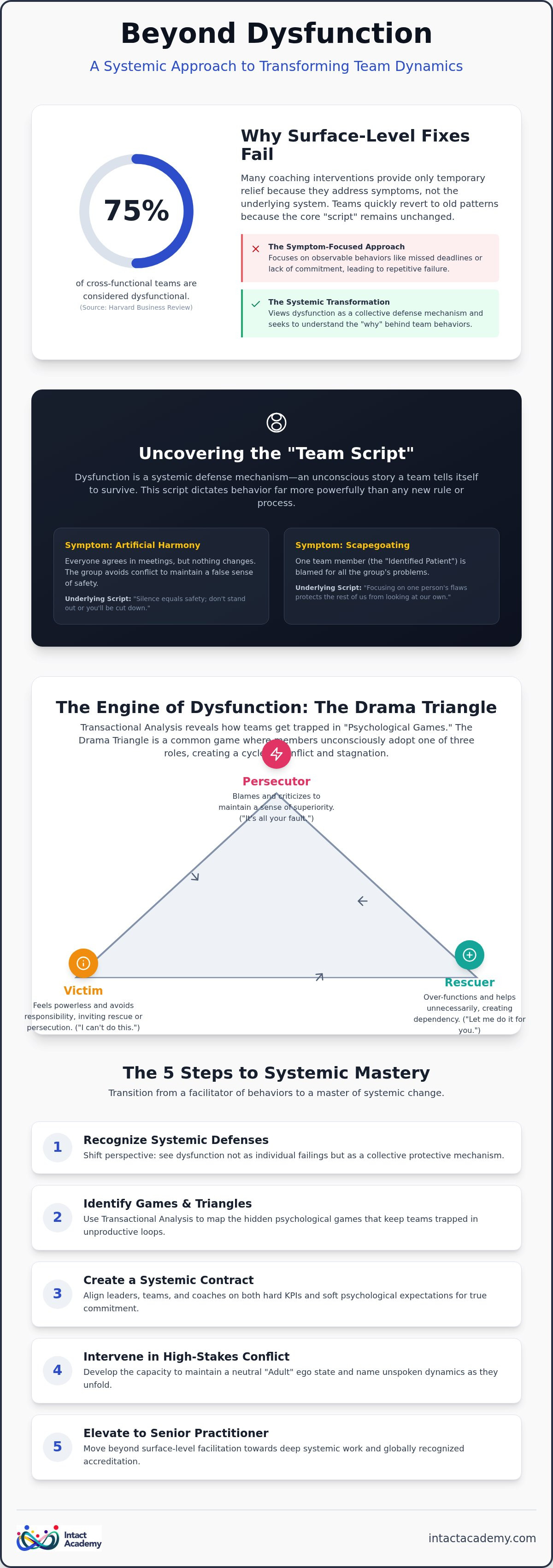
When we design team coaching interventions for dysfunction, we must look past the surface symptoms. Missed deadlines, circular arguments, and passive-aggressive silences are merely the visible ripples of an underlying "Team Script." This script is the unconscious story a group tells itself about what it takes to survive in this specific organization. For some, the script is "don't stand out, or you'll be cut down." For others, it's "success only comes through individual brilliance, never collective effort." Standard trust-building exercises often fail because they treat the symptom while the team's internal script remains untouched, keeping the group locked in a cycle of repetitive failure.
The Limitations of Behavioral Models
Attempting to fix a team by mandating new behaviors is like repainting a crumbling foundation. You might instruct members to "speak more in meetings," but if the underlying script dictates that silence equals safety, the new behavior won't stick. We often see "Artificial Harmony" used as a psychological shield. On the surface, everyone agrees and smiles, yet nothing actually changes once the meeting ends. True mastery involves moving from observing what is happening to questioning what is being avoided. We don't just want a better meeting; we want a fundamentally different way of being together.
Systemic Perspectives on Dysfunction
A team doesn't exist in a vacuum. Often, its internal struggles mirror the larger organizational culture or the anxieties of its leadership. We frequently encounter the "Identified Patient," a single team member who is blamed for all the group’s woes. This scapegoating is a systemic trap. By focusing on one person's flaws, the team avoids looking at how the entire system supports the dysfunction. Reframing these issues as failed attempts at self-regulation allows us to approach team coaching interventions for dysfunction with empathy rather than judgment. It’s about returning the system to wholeness and recognizing that every member plays a part in the collective dance.
Transactional Analysis in Teams: Unmasking Psychological Games
To understand why teams stall, we must look at the invisible architecture of their interactions. Transactional Analysis (TA) provides this lens. In a team context, what is transactional analysis? It's a social psychology framework that examines the "transactions," or exchanges, between individuals to uncover the underlying scripts and motivations. By analyzing these exchanges, we can see how teams inadvertently sabotage their own progress to maintain a familiar, if painful, status quo.
When team coaching interventions for dysfunction fail, it's often because the coach hasn't identified the "Psychological Games" being played. These are repetitive, unconscious patterns of communication that follow a predictable sequence and always end in a "payoff" of bad feelings. For instance, the "Yes, But" game allows a team to resist change while appearing to seek help. One person suggests a solution, and the group finds reasons why it won't work, leaving everyone feeling frustrated and stuck. These games aren't malicious; they're habitual ways of avoiding the vulnerability required for genuine transformation.
The Drama Triangle at Work
The engine of these games is often the Drama Triangle. In dysfunctional systems, members unconsciously rotate through three roles. The "Rescuer" leader over-functions, solving problems for others and inadvertently creating dependency. This creates a "Victim" employee who feels powerless, waiting for instructions and avoiding accountability. When things inevitably fail, the "Persecutor" emerges, using blame and rigidity to control others. Effective team coaching interventions for dysfunction aim to move the group toward the "Winner's Triangle." Here, Rescuing becomes Caring, Victimhood becomes Vulnerability, and Persecution becomes Assertiveness. This shift allows the team to return to a state of wholeness and shared responsibility.
Identifying Team Ego States
Communication is further shaped by "Ego States," which are consistent patterns of feeling and experience that translate into behavior. A team stuck in a "Critical Parent" culture relies on blame and strict rules to manage anxiety. Conversely, an "Adapted Child" culture is marked by compliance and a lack of genuine commitment. To achieve high performance, we facilitate "Adult-to-Adult" transactions. This state is objective, present-centered, and capable of solving complex problems without the emotional weight of old scripts. Mastering these shifts is a core component of systemic team coaching. It requires a calm, authoritative presence from the coach to name these states as they appear, inviting the team back to their shared Adult reality. Developing this level of insight is essential for anyone wishing to lead profound human transformation within organizations.
Systemic Contracting: The Foundation of Mastery
When designing team coaching interventions for dysfunction, the most critical step happens before the first session begins: the establishment of the systemic contract. In a systemic context, contracting isn't a mere administrative formality or a list of logistical details. It's a three-way psychological agreement between the coach, the leader, and the team members themselves. This alignment ensures that everyone is working toward the same outcome and, more importantly, that everyone has consented to the depth of the work required. Without this clarity, team coaching interventions for dysfunction risk becoming part of the very problem they were meant to solve.
We distinguish between the "Hard Contract" and the "Soft Contract." The Hard Contract covers the tangible KPIs, the schedule, and the business objectives. The Soft Contract, however, is where the true transformation lives. It addresses the psychological expectations: How will we handle conflict? What is the level of truth-telling we're committed to? Are we willing to look at our own contributions to the current state? A Mastery Level Contract is one that courageously addresses the hidden agendas, psychological needs, and systemic scripts of all stakeholders, ensuring that the work remains focused on genuine transformation rather than maintaining the status quo.
We must also remain vigilant against "Collusive Contracts." These occur when a coach unconsciously agrees to the team's dysfunctional script. For example, if a leader asks you to "fix" a difficult employee without addressing the leader's own role in the dynamic, and you agree, you've entered a collusive contract. You've become a tool for the system's defense mechanism. Recognizing these traps requires a high degree of self-awareness and professional support.
The Three-Way Contract
The coach often sits at the center of a tension between the sponsor's goals and the team's reality. It's common for a sponsor to hire a coach with the unspoken expectation that they will act as a benevolent "mechanic" who repairs others. To avoid being hired to fix people without their consent, the coach must ensure that the team is an active participant in the contracting process. This is where coaching supervision becomes invaluable. It provides a stable container for the coach to reflect on these systemic pressures, ensuring they maintain their "Adult" ego state and stay aligned with the primary task of transformation.
Spotting the Hidden Agenda
Teams often harbor a "Don't Change Me" contract. They may hire a coach specifically to prove that their situation is unique and unfixable, thereby validating their current dysfunction. You'll notice this when every suggestion is met with a "Yes, but." Uncovering what the team actually wants from you requires naming the unspoken dynamics as they arise. Re-contracting isn't a one-time event; it's a living process. When you sense the team is retreating into old scripts, you must stop and ask: "Is this still what we agreed to work on, or has our contract changed?"
High-Stakes Facilitation: Intervening in Real-Time Conflict
The true test of systemic mastery occurs when the room grows heavy with unspoken tension or erupts into overt conflict. Most coaches falter here because they focus on the content of the argument rather than the process of the interaction. Effective team coaching interventions for dysfunction require the coach to remain anchored in their "Adult" ego state, acting as a stable container for the group’s turbulence. By moving from what is being said to how it's being lived in the moment, you invite the team to witness their own patterns without the usual veil of defensiveness.
To navigate these high-stakes moments, we follow a methodical five-step intervention process:
- Step 1: Observe the pattern without judgment. Maintain an internal Adult ego state. Resist the urge to "fix" the discomfort or take sides.
- Step 2: Name the dynamic in the room. Use objective language to describe what you see. For example: "I notice that every time X speaks, Y looks away and the rest of the group falls silent."
- Step 3: Connect the behavior to the contract. Remind the team of their agreed-upon goals. "We agreed to move toward radical transparency; how does this silence serve that objective?"
- Step 4: Facilitate the team’s own inquiry. Ask the group to explore the function of the behavior. What are they protecting by avoiding this specific conversation?
- Step 5: Experiment with new Adult transactions. Invite a different way of communicating. Ask Y to share their thoughts directly with X, facilitating a clear, present-centered exchange.
The Power of Naming the Unspoken
We use a technique called "Immediacy" to bring the team's attention to the here and now. This requires the coach to stay grounded even when the team’s "Child" energy is high, manifesting as impulsivity or withdrawal. It's also vital to be aware of your own "Coach's Script." If your history inclines you to avoid conflict, you may unconsciously hesitate to name a difficult dynamic. Mastery involves recognizing these internal pulls and choosing to act in the service of the team’s growth anyway. If you're ready to refine these real-time skills, you can join our TA EMCC Senior Team Coach Academy to practice these interventions in a supervised environment.
Crossing the Game
In Transactional Analysis, "Crossing the Game" means interrupting a repetitive psychological pattern before it reaches its negative payoff. If the team is playing "Yes, But," you stop providing suggestions and instead name the game itself. This shifts the energy from blame to systemic responsibility. We also focus on providing "Strokes," or units of recognition, for authentic, Adult behavior. When a team member takes the risk to be vulnerable or assertive without being aggressive, that moment must be acknowledged. By reinforcing authenticity, we starve the dysfunction of the psychological fuel it needs to persist. This transition allows the team to move beyond their scripts and return to a state of genuine collaboration.
Advancing Your Practice: From Facilitator to Senior Team Coach
Transitioning from surface-level facilitation to systemic mastery requires a fundamental shift in how you view your role. While basic facilitation focuses on managing an agenda and ensuring everyone has a voice, systemic team coaching demands that you engage with the group’s collective unconscious. When you implement team coaching interventions for dysfunction at this advanced level, you aren't just a neutral moderator; you're a catalyst for deep human transformation. This evolution involves moving away from the need to "fix" a team and toward the capacity to hold a space where the team can rediscover its own inherent health.
Transactional Analysis offers a lifelong framework for this professional journey. It provides the language to describe complex human dynamics and the methodology to intervene with precision. As you grow in your practice, we invite you to reflect on a core question: Are you fixing symptoms, or are you facilitating wholeness? The former provides temporary relief, while the latter creates a permanent shift in the team’s ability to self-regulate and flourish. This distinction is what separates a skilled practitioner from a master of the craft.
The Path to EMCC Senior Practitioner
Reaching the level of a senior practitioner involves more than accumulating hours; it requires a commitment to deep psychological training and rigorous self-reflection. Pursuing an executive coaching certification or a senior team coach designation provides the global credibility necessary to work with high-stakes leadership teams. At the TA EMCC Senior Team Coach Academy, we focus on this integration of theory and practice. You'll join a global network of peers from over 14 countries, all dedicated to mastering the art of systemic transformation. This community serves as a mirror and a support system, helping you refine your "Adult" presence and expand your capacity to intervene in even the most challenging organizational scripts.
Conclusion: Returning to Wholeness
Resolving deep-seated dysfunction isn't about imposing new rules, but about peeling back the layers of defensive scripts to reveal the team’s true potential. A systemic approach recognizes that every behavior, no matter how disruptive, serves a purpose within the current system. By naming these patterns and re-contracting for authenticity, you provide the team with the tools to choose a different path. Your role as a coach is to be the stable container for this often-turbulent work, remaining grounded in empathy and authoritative insight.
Effective team coaching interventions for dysfunction don't just solve problems; they return individuals and teams to a state of completeness and genuineness. If you're ready to move beyond surface-level fixes and embrace the depth of systemic mastery, we invite you to join us. Explore our flagship programs at Intact Academy and take the next step in your professional evolution toward becoming a senior-level systemic coach.
Embrace the Depth of Systemic Mastery
True transformation begins when we stop treating symptoms and start addressing the systemic scripts that hold teams captive. By integrating Transactional Analysis and robust systemic contracting, your team coaching interventions for dysfunction become more than just temporary relief; they become a pathway back to collective health and genuineness. You now have the framework to name the unspoken, cross the games, and facilitate real-time Adult transactions that endure long after the session ends. This shift from fixing behaviors to facilitating wholeness marks the transition from a practitioner to a master of the craft.
If you're ready to refine this craft, we invite you to join a community dedicated to profound human growth. Our faculty, led by global expert Sari van Poelje, provides a stable container for your development within an EMCC Global Quality Award winning curriculum. You'll learn alongside professionals from over 14 nationalities, building a network that spans the globe. Apply for the TA EMCC Senior Team Coach Academy today to move beyond basic facilitation and step into your power as a senior level coach. The journey toward wholeness is both a professional milestone and a personal evolution. We look forward to walking that path with you.
Frequently Asked Questions
What is the difference between a dysfunctional team and a toxic team?
Dysfunctional teams generally struggle with performance and communication due to unconscious systemic scripts or a lack of alignment. These groups often want to improve but don't know how to break their repetitive patterns. A toxic team has moved into the realm of active harm, where psychological safety is destroyed by bullying, harassment, or malice. While dysfunction is often a failed attempt at self-regulation, toxicity requires more urgent, protective interventions to stop corrosive behavior.
How can Transactional Analysis help in identifying team dysfunction?
Transactional Analysis provides a precise map of the "transactions" or exchanges that define a group's reality. By identifying Ego States and Psychological Games, a coach can see the invisible architecture of the conflict. This allows for team coaching interventions for dysfunction that target the root script rather than just the surface behavior. It moves the conversation from vague feelings of unease to a structured understanding of how the team sabotages its own success.
What are the first steps a coach should take when entering a dysfunctional team?
The first step is always systemic contracting. A coach must establish a clear three-way agreement between themselves, the leader, and the team members to ensure consent and alignment on the primary task. Without this foundation, you risk being pulled into the team's defensive games or being hired to "fix" people without their permission. Observation and naming initial dynamics only follow once this stable container is securely in place.
Can one person be responsible for the dysfunction of an entire team?
No, dysfunction is almost always a systemic property rather than an individual flaw. While one person may be the "Identified Patient" who displays the most disruptive behavior, they're often acting out a role the system needs to maintain its current equilibrium. Blaming one individual is a common defense mechanism. It allows the rest of the group to avoid looking at their own contributions to the dysfunctional script and the collective culture.
How long does it typically take to resolve deep-seated team dysfunction?
Deep-seated transformation typically requires a commitment of six to twelve months. While surface-level shifts can occur in just a few sessions, rewriting a "Team Script" involves unlearning years of habitual patterns and building new psychological muscles. The pace of change depends on the team's willingness to stay in an "Adult" ego state and the leader's commitment to the new systemic contract. Sustainable change isn't a quick fix; it's an evolutionary process.
What is the role of the leader in team coaching interventions?
The leader acts as the primary holder of the systemic contract and a model for the desired transformation. Their role in team coaching interventions for dysfunction is to provide the psychological safety required for others to take risks and speak their truth. If a leader remains stuck in a "Critical Parent" or "Rescuer" role, the team's growth will likely be limited. The leader's own willingness to change is often the team's developmental ceiling.
How do I know if a team is 'uncoachable'?
A team is considered uncoachable when there is a fundamental lack of consent or a persistent refusal to enter an "Adult" ego state. If the group consistently uses the coaching space to play Psychological Games without any desire for genuine inquiry, the work cannot proceed. In these cases, the coach must name the dynamic and consider pausing the intervention. Sometimes, the system isn't yet ready for the vulnerability required for profound human transformation.
Is it safe to use psychological models like TA in a business setting?
Yes, provided the models are used with professional pragmatism and clear boundaries. Transactional Analysis is a powerful tool for organizational development, not a clinical treatment. When applied by an accredited professional, it offers a stable and structured methodology for understanding human behavior in a workplace context. It respects the maturity of the individuals involved while providing profound insights into the collective dynamics that drive organizational success and individual flourishing.


