

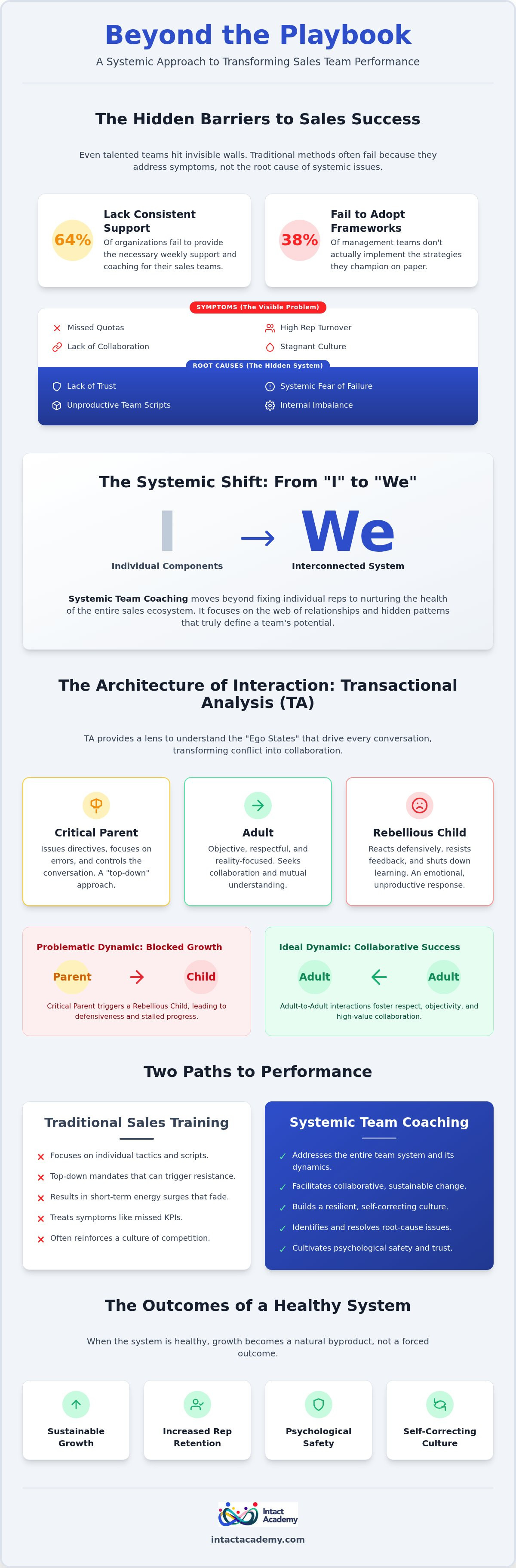
Why do your most talented sales professionals continue to encounter the same invisible barriers, even after mastering the latest tactical playbooks? You likely recognize the exhaustion of watching repetitive failure patterns emerge despite constant training. It's a frustrating reality when 64% of organizations fail to provide consistent weekly support, and only 38% of management teams actually adopt the frameworks they've put on paper. This gap between intent and execution often leaves departments struggling with high turnover and a lack of genuine collaboration in competitive environments.
By shifting toward systemic team coaching for sales teams, you can move beyond the transaction and address the psychological scripts that dictate how your people actually interact. This article promises a path toward sustainable revenue growth by leveraging Transactional Analysis to solve systemic performance issues at their root. We will explore how returning to a state of wholeness allows you to build a self-correcting culture, ensuring that psychological safety and rep retention become the natural byproducts of your professional evolution in 2026.
Key Takeaways
- Understand why tactical quick fixes fail and how to transition toward a systemic approach that addresses the root causes of recurring performance plateaus.
- Master the application of Transactional Analysis ego states to transform both internal collaboration and high-stakes negotiation dynamics.
- Implement a framework for team coaching for sales teams that prioritizes psychological safety and identifies the hidden systemic scripts holding your revenue back.
- Discover how to move from a culture of individual competition to a high-performing, self-correcting team that fosters long-term rep retention.
- Explore the professional path to mastery through the TA EMCC Senior Team Coach Academy, positioning yourself as a leader in deep organizational transformation.
Why Tactical Sales Coaching Fails to Solve Systemic Underperformance
In the high-stakes environment of 2026, the traditional sales manager often acts as a technician, focusing on the mechanics of the deal rather than the health of the machine. This transactional approach treats sales reps as isolated units whose performance can be tweaked through better scripts or more aggressive KPIs. However, as many leaders discover, adding more CRM tools or increasing the volume of leads rarely fixes a stagnant culture. When we focus only on the surface, we fall into the "symptom vs. cause" trap. High turnover and missed quotas are rarely just administrative failures; they're the external expressions of an internal systemic imbalance that tactical coaching simply cannot reach.
The Illusion of Progress in Traditional Sales Training
Short-term intensive training sessions often spark a brief surge in energy that quickly fades into the background of daily routines. This happens because "top-down" mandates frequently trigger psychological resistance within the team. Sales professionals might comply outwardly to satisfy a manager, yet they remain internally committed to old, unproductive scripts. To break this cycle, leaders must shift their perspective toward professional development for coaches. This mindset recognizes that sustainable change requires more than a new playbook; it requires a profound evolution in how the team perceives its own identity and collective potential.
Systemic Team Coaching Defined
Systemic team coaching is the art of coaching the "we" rather than the "I", moving the focus from individual components to the intricate web of relationships that define the group. Every sales department is a living system that naturally seeks equilibrium. Even when that equilibrium results in consistent underperformance, the system will resist change to maintain a sense of familiar stability. In this context, team coaching becomes a process of identifying these hidden patterns and bringing them into the light. The leader's role transforms from a director of actions into a facilitator of the system, creating a space where the team can begin to self-correct and return to a state of completeness.
Effective team coaching for sales teams acknowledges that a rep's repetitive failure to close a deal might actually be a reflection of a lack of trust within the department or a systemic fear of failure. By addressing these underlying psychological dynamics, organizations can finally move beyond the tactical and toward a state of genuine, high-performing wholeness. This shift ensures that revenue growth is not a forced outcome, but a natural result of a healthy, resilient system. It's about moving from fixing individual parts to nurturing a flourishing whole.
The Architecture of Sales Excellence: Applying Transactional Analysis to Team Dynamics
To understand why a sales team hits a performance ceiling, we must look beneath the surface of their daily activity and examine the invisible architecture of their interactions. This is what is transactional analysis (TA) offers: a profound framework for decoding the human exchanges that either fuel or frustrate progress. In the context of team coaching for sales teams, TA serves as a diagnostic lens. It allows us to identify the "Psychological Games" that team members play, often unconsciously, to avoid the vulnerability of real accountability or the pressure of sustained success.
Ego States in the Sales Room
Every interaction in a sales environment is driven by one of three ego states: Parent, Adult, or Child. When a manager operates as a "Critical Parent," issuing directives and focusing solely on errors, they often trigger a "Rebellious Child" response in their reps. In this dynamic, the rep becomes defensive, the learning ceases, and the opportunity for growth is lost. High-value B2B sales depend on Adult-to-Adult transactions. This state is characterized by objectivity, mutual respect, and a focus on reality rather than drama. Shifting a team toward this state during a high-stakes deal review transforms a critique into a collaborative strategy session.
Beyond these individual transactions, organizations often carry "Life Scripts", which are unconscious narratives that dictate what the team believes is possible. A team might operate under a script of being the eternal underdog, a narrative that subtly sabotages their ability to close market-leading deals. These scripts act as a self-imposed ceiling on revenue potential. Identifying these patterns is the first step toward reclaiming a sense of agency and returning to a state of collective completeness.
Breaking the "Sales Scripts" of Failure
Re-scripting a sales team requires the courage to challenge long-held beliefs about competition and worthiness. By utilizing TA to build a culture of "I’m OK, You’re OK," leaders can eliminate the toxic internal competition that prevents genuine collaboration. This shift isn't simply a soft-skill exercise; it's a systemic realignment. When a team moves from a script of scarcity to one of abundance, they begin to support one another's wins rather than protecting their own silos. Implementing team coaching for sales teams through this lens allows for a high-performing, self-correcting culture. For leaders ready to initiate this level of change, specialized Team Coaching provides the structured methodology required to sustain such a profound transformation.
Systemic Team Coaching vs. Traditional Sales Training: A Comparison
Traditional sales training often operates on the assumption that if you fix the individual rep, the department will flourish. This transactional model focuses on external skills like handling objections, closing techniques, and CRM hygiene. While these are necessary, they're insufficient for leading organizational change that lasts. Systemic team coaching for sales teams represents a fundamental shift in perspective. It moves from fixing the part to evolving the whole, recognizing that the team is a living entity with its own unique history and future.
A Comparison Framework for Sales Leaders
Understanding when to deploy each approach is vital for professional mastery. Transactional training is effective for onboarding or introducing specific new tools. However, when performance plateaus despite high skill levels, the issue is usually systemic. Use this framework to distinguish your needs:
- Transactional Training: Focuses on the "How." It delivers scripts and tactics to solve immediate, surface-level gaps. It's about the transaction.
- Systemic Coaching: Focuses on the "Who" and the "Why." It examines the team's identity and the unconscious patterns that dictate its collective limits. It's about transformation.
By investing in the system, organizations see a more resilient ROI. While tactical training provides a short-term spike, systemic interventions create a self-correcting culture that maintains high performance long after the coach has left the room. It turns a group of competitors into a unified system capable of sustainable revenue growth.
Contracting for Professional Mastery
A cornerstone of effective team coaching for sales teams is the concept of "Contracting." This isn't merely a legal agreement; it's a multi-layered alignment of goals. We establish clear professional contracts regarding revenue targets, but we also create psychological contracts regarding how the team will handle conflict and failure. Without this clarity, sales managers often fall into "rescuer" patterns. They try to save underperforming reps by doing the work for them, which inadvertently creates a culture of dependency. Clear boundaries and structured supervision ensure that transformation is grounded in reality, allowing the team to return to a state of genuine competence and autonomy.
Implementing a Systemic Coaching Framework: From Psychological Safety to Performance
Implementing a systemic framework for team coaching for sales teams requires a deliberate journey from surface-level metrics to the heart of the team's collective psyche. This process begins by assessing the current systemic script. We ask: what is the unspoken story this team tells itself about its value and its limits? Once we uncover this narrative, we can move through a structured methodology designed to return the team to its natural state of high performance and wholeness. This is not a quick fix; it's a process of becoming.
Building the Safe Container for Growth
Psychological safety is often misunderstood as a mandate for politeness. In a systemic context, it's actually the courage to be real. It involves the creation of a "safe container" where team members can surface unconscious patterns without the fear of blame or retribution. When a leader models vulnerability and maintains an Adult-state presence, they give the team permission to do the same. This transparency is essential. It allows for honest feedback that isn't filtered through the lens of corporate survival, turning every failed deal into a laboratory for collective learning rather than a source of shame.
Interrupting the Sales "Games"
Common sales games like "Yes, But" or "Look How Hard I Tried" are unconscious maneuvers used to avoid the weight of responsibility or the risk of genuine success. These interactions keep the team trapped in the "Drama Triangle," where individuals cycle through the roles of Victim, Rescuer, and Persecutor. To evolve, the team must move toward the "Winner’s Triangle." This shift involves replacing blame with problem-solving and replacing helplessness with autonomy. We measure progress not just by quota attainment, but by the frequency of these behavioral shifts. Effective team coaching for sales teams ensures these interruptions become a natural part of the daily rhythm.
Co-creating a new team narrative is the final stage of the initial transformation. This isn't a marketing slogan; it's a deeply felt commitment to collective excellence. Sustaining this change requires ongoing systemic supervision, ensuring that the team doesn't slide back into old, comfortable scripts when pressure increases. For organizations seeking to master these transitions, our Team Coaching services provide the depth and structure necessary for lasting impact. By honoring the maturity of your people, you create a system that doesn't just hit targets but flourishes as a whole entity.
Elevating Sales Leadership: Professional Mastery through the TA EMCC Senior Team Coach Academy
Sales leaders in 2026 recognize that tactical proficiency isn't enough. They are moving toward executive coaching certification because they understand that the most significant performance gains come from deep human transformation. This mastery distinguishes a standard manager from a transformational mentor. While a manager organizes tasks, a mentor evolves the system; while a manager seeks compliance, a mentor fosters autonomy. By engaging with team coaching for sales teams at this level, you aren't just addressing a pipeline problem; you're nurturing the human core of your organization.
The TA EMCC Senior Team Coach Academy offers a unique path for those who seek to master these depths. It provides the structured methodology required to move beyond surface-level interventions. You become part of a global community of practitioners who value integrity, depth, and the courage to change. This isn't merely about adding a credential to your profile. It's about developing the quiet power and presence necessary to guide a team through the often-turbulent work of professional change.
The Path to Senior Team Coach Accreditation
Choosing a team coaching course is a decision that involves more than just curriculum; it's about joining a lineage of practitioners. The TA EMCC Senior Team Coach Academy adheres to the rigorous standards of the EMCC. In the corporate landscape of 2026, these accreditations are the gold standard for quality and ethical practice. The journey moves you from merely "doing coaching" as a task to "being a coach" as a core identity. It requires a commitment to looking inward, allowing you to hold a stable space for your team even during turbulent market shifts.
Sustaining Mastery with Intact Academy
True mastery isn't a destination, but a continuous process of refinement. At Intact Academy, we emphasize the role of professional systemic supervision to maintain the integrity of your practice. Sari van Poelje brings decades of experience bridging complex psychological theory with the sharp reality of corporate environments. Participants from 14+ countries form a global community, sharing insights and fostering a culture of mutual growth. This community acts as a mirror, helping you see the blind spots that might otherwise hinder your team's success.
By mastering the depths of Transactional Analysis and systemic dynamics, you position yourself as a leader capable of profound impact. It's time to move beyond the quota and embrace a state of completeness. Transform your sales team from the inside out and lead them toward a future of sustainable, high-performing wholeness. This is the path to becoming a wise global mentor within your own organization.
Reclaiming the Human Core of Sales Excellence
The journey beyond the quota is a transition from managing transactions to nurturing a living system. We've explored how tactical interventions often fail because they ignore the underlying psychological scripts that dictate a group's limits. By embracing team coaching for sales teams, you move toward a state of completeness where high performance is the natural result of a healthy, self-correcting culture. This evolution requires the courage to move past surface-level fixes and look deeply at the ego states and games that define your daily interactions.
True professional mastery is within your reach. Our EMCC Global Quality Award-winning programs, led by world-renowned expert Sari van Poelje, provide the structured methodology needed for this profound change. Join a global community of practitioners from over 14 countries who are already redefining leadership. Master the art of systemic transformation at the TA EMCC Senior Team Coach Academy and lead your team toward sustainable, high-performing wholeness. The path to lasting organizational change begins with the decision to evolve your own coaching presence.
Frequently Asked Questions
What is the difference between sales training and team coaching for sales teams?
Sales training is typically a transactional process that focuses on the "how" of a sale, such as mastering scripts or learning new software. In contrast, team coaching for sales teams is a systemic approach that focuses on the "who" and the "why" of the collective group. It addresses the underlying psychological scripts and team dynamics that cause repetitive failure patterns. This facilitates a deep transformation that moves beyond surface-level tactical updates and toward organizational flourishing.
How can Transactional Analysis help a sales team close more deals?
Transactional Analysis (TA) helps teams identify the ego states Parent, Adult, and Child active in negotiations and internal meetings. By shifting from a Child state of fear or a Parent state of blame to an Adult state of objective problem-solving, reps build deeper trust with clients. This clarity allows the team to interrupt unconscious games that sabotage high-stakes deals. It leads to more authentic closures by returning the sales process to a state of genuineness.
Is systemic team coaching effective for remote or hybrid sales teams?
Systemic coaching is highly effective for remote and hybrid teams because it addresses the quality of the "systemic container" regardless of physical location. Remote environments often amplify feelings of isolation or lack of trust. Systemic coaching creates a safe space for these teams to surface hidden patterns and co-create a new narrative. This ensures that the team's culture remains resilient and unified despite geographical distances, allowing for a state of genuine, collective excellence.
How long does it take to see results from a systemic team coaching intervention?
Behavioral shifts often begin within the first few sessions, though deep systemic change typically requires a commitment of six to twelve months. While tactical improvements might appear quickly, returning a team to a state of wholeness is a methodical process. This timeline allows for the identification, interruption, and re-scripting of long-standing organizational patterns. It ensures that performance gains are sustainable rather than temporary spikes, providing a stable container for the often-turbulent work of professional change.
Why is psychological safety important in a competitive sales environment?
Psychological safety allows sales reps to take the risks necessary for growth without fear of being shamed for failure. In hyper-competitive environments, a lack of safety often leads to reps hiding mistakes or engaging in toxic internal games. When safety is established, the team can engage in honest self-correction and genuine collaboration. These elements are essential for long-term retention and collective revenue success, creating a space where complex systemic issues feel manageable through insight.
What are the benefits of an EMCC-accredited team coaching program for sales managers?
An EMCC-accredited program, such as the TA EMCC Senior Team Coach Academy, provides a rigorous framework for professional mastery. It ensures that managers aren't just "doing coaching" as a task but are "being coaches" with a deep understanding of ethical standards and systemic dynamics. This accreditation signals a commitment to quality and professional supervision, which is vital for facilitating sustainable organizational change in 2026. It effectively bridges individual growth with long-term organizational success.
How do you measure the ROI of team coaching for sales teams?
ROI is measured through a combination of hard metrics, such as increased quota attainment, and qualitative shifts in culture. Organizations providing weekly structured coaching are more than twice as likely to report 71% or higher quota attainment. By addressing systemic issues, team coaching for sales teams reduces the high costs associated with rep burnout and repetitive failure patterns. This approach delivers a long-term return on investment that far exceeds the impact of one-off tactical training sessions.
Can systemic coaching help reduce sales rep burnout and turnover?
Systemic coaching directly reduces burnout by addressing the underlying psychological pressures and Drama Triangle dynamics that exhaust sales professionals. It moves the team away from a culture of constant rescuing or persecuting toward one of autonomy and mutual support. By fostering a sense of belonging and psychological safety, systemic interventions help reps return to a state of completeness. This approach significantly improves retention and overall job satisfaction by honoring the maturity and intelligence of the reps.


