

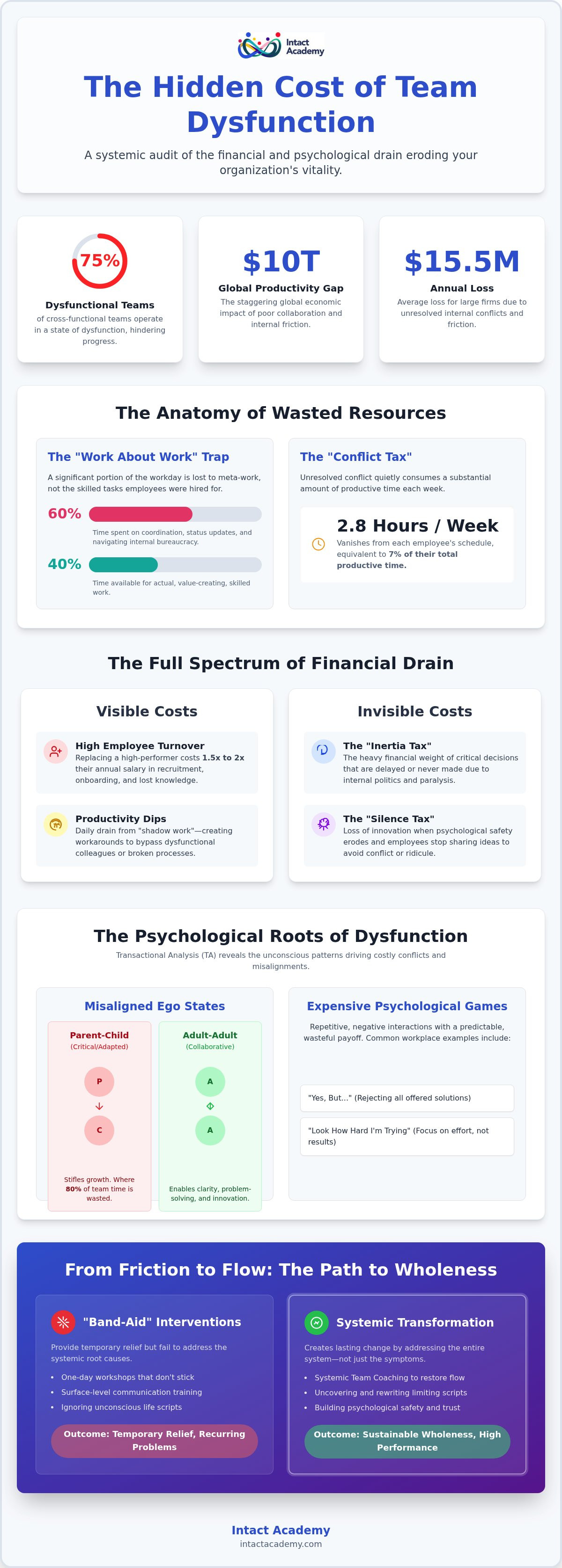
When 75% of cross-functional teams are operating in a state of dysfunction, the quiet erosion of your organization's vitality isn't just a cultural concern; it's a measurable financial hemorrhage. You've likely felt the weight of this yourself. Perhaps you've spent your afternoon mediating the same recurring conflict or watched a top performer walk out the door despite a generous salary. The true cost of a dysfunctional team extends far beyond the 3% of profit lost to poor decision making or the $10 trillion global productivity gap. It lives in the "work about work" that consumes 60% of your people's time, leaving little room for the actual skilled tasks you hired them to perform.
We understand the exhaustion of trying to fix these deep-seated issues with surface-level training that never seems to stick. You deserve a more profound approach. This article provides a systemic audit of the psychological scripts and structural gaps that drain your resources. You'll discover a clear framework to quantify these hidden losses and understand why traditional interventions often fail to reach the root cause. By moving beyond transactional fixes, we'll explore a path toward sustainable organizational wholeness where individual talent and systemic health finally align.
Key Takeaways
- Quantify the true cost of a dysfunctional team by examining the interplay between wasted salary, missed opportunities, and systemic friction.
- Uncover the unconscious "Life Scripts" that dictate leadership behavior and often limit the team’s ability to evolve beyond recurring conflicts.
- Audit your team’s internal dynamics by identifying the "Meeting Tax" and recognizing whether your collective interactions are stuck in Parent-Child or Adult-Adult Ego States.
- Evaluate the long-term ROI of systemic transformation compared to the temporary relief of "Band-Aid" workshops or one-day interventions.
- Explore how Systemic Team Coaching serves as a bridge to organizational wholeness, restoring the integrity and flow necessary for high-performance results.
The Quantifiable and Hidden Financial Impact of Team Dysfunction
The cost of a dysfunctional team is rarely captured in a single line item on a balance sheet. It's a composite of wasted salary, missed opportunity, and systemic friction that quietly drains the organization's life-force. Research from Harvard Business Review suggests that large firms lose an average of $15.5 million annually to internal friction. For mid-sized organizations, the impact is proportionally just as severe. When teams fail to collaborate, you aren't just losing time; you're losing the compounding interest of collective intelligence.
Quantifying the cost of a dysfunctional team requires looking beyond the obvious. One of the most insidious elements is the "Inertia Tax." This represents the financial weight of decisions that are never made or are delayed by months because of internal politics. While your competitors move with agility, your team remains paralyzed. This dysfunction creates a ripple effect, infecting the broader organizational culture and making understanding group dynamics a critical business necessity rather than a luxury.
The Visible Costs: Turnover and Productivity Dips
The most immediate financial impact is found in turnover. Replacing a high-performer typically costs between 1.5x to 2x their annual salary when you account for recruitment, onboarding, and the loss of institutional wisdom. Beyond departures, the daily drain is immense. The average employee spends 2.8 hours every week dealing with unresolved conflict. This equates to 7% of their productive time simply vanishing into thin air. Much of the remaining time is lost to "shadow work," where employees expend energy creating workarounds just to bypass a dysfunctional colleague or a broken communication loop.
The Invisible Costs: Erosion of Psychological Safety
The true damage often happens in the silence. When psychological safety erodes, employees stop sharing innovative ideas to avoid the risk of conflict or ridicule. This "silence tax" stunts your company's evolution and prevents the breakthrough thinking needed for growth. Your reputation in the global talent market also suffers; top performers talk, and a brand known for internal friction struggles to attract elite talent. These issues are often rooted in "unspoken contracts," the hidden, unconscious agreements that dictate behavior and prevent the team from achieving true agility and wholeness.
Beyond the Surface: The Psychological Roots of Team Friction
While the financial metrics discussed earlier provide a shadow of the problem, the true engine of dysfunction lies in the unconscious patterns of human interaction. Transactional Analysis (TA) offers both the art and science to decode these patterns. It moves us past the binary idea of "trust" into a nuanced understanding of how individuals relate. When a team operates from misaligned Ego States, such as a leader acting as a critical Parent and employees responding as adapted Children, the cost of a dysfunctional team manifests as a total collapse of Adult-to-Adult problem-solving. This misalignment isn't just a personality clash; it's a systemic failure that prevents the team from accessing its collective intelligence. In the Adult state, we find the clarity and objectivity needed for innovation, yet many teams spend 80% of their time trapped in Child-Parent dynamics that stifle growth.
Psychological Games in the Workplace
In TA, a "Game" is a repetitive sequence of interactions that ends in a predictable, negative payoff for everyone involved. You've likely seen the "Yes, But" game, where a team member asks for help only to reject every solution offered. Another common pattern is "Look How Hard I’m Trying," where the focus shifts from results to the performance of effort. These games aren't just annoying; they are expensive. They consume billable hours, delay project milestones, and drain emotional energy. To stop this cycle, leaders must learn to spot psychological games in the workplace and intervene before the pattern solidifies. Every minute spent in a psychological game is a minute stolen from the organization's strategic goals.
The Role of Unconscious Scripts
Every individual carries a "Life Script," an unconscious plan formed in early life that dictates their perception of success and failure. If a leader carries a "Don’t Succeed" or "Don’t Be Close" script, they may unconsciously sabotage their team just as they reach a breakthrough. This becomes particularly visible in mergers or rapid growth phases, where teams often re-enact past organizational traumas rather than responding to current realities. The cost of a dysfunctional team in these scenarios is the loss of organizational agility. Shifting from these scripted responses to an "Autonomous" presence requires a commitment to deep learning. For those ready to lead this change, the TA EMCC Senior Team Coach Academy provides the methodology to facilitate this profound human transformation. By mastering the art of "Contracting," leaders can align these unconscious scripts with the conscious goals of the business, returning the team to a state of completeness and genuine performance.
Calculating the ROI of Healthy Systems vs. The Price of Inertia
Viewing team development as a discretionary expense is a fundamental miscalculation of organizational value. In reality, the cost of a dysfunctional team is a continuous drain on capital, while systemic intervention acts as a long-term investment in the firm's infrastructure. When leaders choose inertia, they accept a compounding tax on every project, meeting, and strategic pivot. Conversely, investing in the structural health of a team allows for the reclamation of lost productivity and the acceleration of market response times. It's the difference between paying for a recurring repair and investing in a superior engine.
Intervention Comparison: Tactical vs. Systemic
Short-term workshops often act as a "Band-Aid," providing a temporary surge in morale without altering the underlying organizational script. These tactical fixes fail because they don't address the systemic roots of friction. In contrast, the methodology championed by the TA EMCC Senior Team Coach Academy focuses on profound transformation. By utilizing the "Contracting for Change" model, organizations move beyond vague aspirations toward measurable outcomes. This rigorous process ties coaching to specific, observable behavioral shifts, ensuring that the cost of a dysfunctional team is replaced by visible gains in decision-making velocity and reduced context-switching expenses.
The Value of Systemic Wholeness
True performance is found when a team achieves systemic wholeness. This is a state where the collective energy is no longer consumed by internal friction but is fully available for the task at hand. When the C-suite operates in this state, the multiplier effect is felt throughout every layer of the company. A high-performing executive team doesn't just work faster; they create a field of clarity that empowers everyone beneath them. This alignment eliminates the "shadow work" previously mentioned, allowing the organization to return to a state of genuine productivity and completeness.
Systemic Wholeness represents the ultimate competitive advantage in 2026, serving as the foundational state where an organization’s internal alignment becomes its most resilient shield against external market volatility.
A Leaders Guide to Auditing Team Dysfunction
Identifying the root of systemic friction requires more than a casual observation; it demands a structured audit of the invisible forces at play. To truly grasp the cost of a dysfunctional team, you must begin by quantifying the "Meeting Tax." This represents the collective hours lost to circular, non-productive debates where no clear decisions are reached. If your team meetings feel like a repetitive loop, you're likely witnessing a collision of misaligned Ego States. Are your people behaving as responsible Adults, or has the culture devolved into a Parent-Child dynamic where dependency replaces initiative? When you are the only one providing direction while the team waits for permission, you aren't leading; you're managing a structural bottleneck.
A comprehensive audit also examines the "Stroke Economy," which is the way recognition is exchanged within the system. In healthy teams, positive strokes for growth are the primary currency. In dysfunctional ones, negative attention or a total lack of recognition becomes the norm, driving disengagement. You should also review your turnover data through a systemic lens. Are you losing "Culture Fits" who simply mirrored the existing dysfunction, or "Culture Adds" who brought the very diversity of thought the system was too rigid to incorporate? Finally, assess the clarity of your "Contracting." If you ask five team members what they specifically agreed to achieve this month and receive five different answers, your organizational foundation is fractured.
Mapping the Transactional Patterns
To see these dynamics in action, observe a single high-stakes meeting without participating. Notice who speaks to whom and the tone they employ. Watch for "Discounting," a psychological mechanism where team members minimize a problem, its significance, or their own capacity to solve it. This subtle form of sabotage is a primary driver of the cost of a dysfunctional team, as it keeps the group stuck in a state of learned helplessness. You can use Sari van Poelje’s systemic change insights to map these transactional patterns and identify exactly where the flow of productivity is being blocked.
Evaluating the Organizational Script
Many teams suffer from "Pseudo-Agility," a state where they adopt the vocabulary of modern business but remain tethered to old, unconscious systemic loops. This happens when the team's internal script is focused on avoiding blame rather than achieving success. To break this cycle, you must implement a robust "Contracting" framework that makes the unspoken explicit. By resetting expectations and aligning individual goals with the systemic mission, you move the team back toward a state of wholeness. If you are ready to facilitate this level of transformation for your organization or your clients, the TA EMCC Senior Team Coach Academy offers the depth and methodology required to lead systemic change with authority.
Restoring Wholeness: The Path of Systemic Team Coaching
Restoring wholeness is not a cosmetic procedure; it's a fundamental structural realignment. While the cost of a dysfunctional team can be measured in lost profit and high turnover, the remedy requires a shift from transactional fixing to systemic evolution. Systemic Team Coaching serves as the essential bridge, moving the group from a collection of fragmented individuals to a unified, high-performing organism. This process honors the complexity of human behavior while demanding the professional pragmatism required for business success. It's about returning to a state of completeness where the team's energy is no longer divided by internal friction but is fully available for its primary task.
The Mastery of Systemic Intervention
A Senior Team Coach doesn't simply moderate discussions. They facilitate a sustainable transformation by identifying the unconscious scripts and patterns that govern the team's collective life. This level of work requires profound psychological depth and a commitment to the "Adult" ego state, especially during high-conflict sessions. Maintaining this presence is made possible through rigorous systemic supervision, which acts as a container for the coach's own development. It's why the TA EMCC Senior Team Coach Academy is considered the gold standard for those seeking this level of mastery. For individuals looking to expand their capacity to facilitate such change, exploring professional development for coaches is a vital step toward deepening organizational impact.
Next Steps for Organizational Leaders
The journey toward wholeness begins with a commitment to clarity. Initiating a formal systemic audit of your C-suite or key project teams allows you to finally stop paying the hidden cost of a dysfunctional team. When selecting a partner for this work, prioritize coaches with EMCC-accredited mastery and the "Senior Practitioner" level of experience. This ensures they possess the intellectual rigor and emotional maturity to handle complex organizational dynamics without becoming entangled in the team’s internal games. If you're an executive seeking to embody this level of insight within your own leadership, we invite you to explore our Executive Coaching Certification. This path offers the tools for systemic mastery, allowing you to lead with a presence that is both authoritative and deeply human.
Reclaiming the Vitality of Your Organization
The quiet erosion of your organization's potential isn't inevitable. By auditing the hidden "Meeting Tax" and recognizing the unconscious scripts that dictate team behavior, you begin the process of reclaiming lost capital. We've explored how the true cost of a dysfunctional team lives in the silence of missed innovation and the friction of misaligned ego states. True transformation requires moving beyond tactical fixes toward a state of systemic wholeness where every individual's growth serves the collective mission. This alignment ensures that energy is no longer wasted on internal conflict but is focused on your strategic evolution.
If you're ready to lead this evolution, we invite you to master the art of systemic transformation at our TA EMCC Senior Team Coach Academy. Led by world-renowned expert Sari van Poelje, our programs offer EMCC Senior Practitioner accreditation and connect you with a global community of professional coaches dedicated to profound human change. You have the power to transform friction into flow. The path to organizational health is open, and it begins with the courage to look beneath the surface.
Frequently Asked Questions
What is the most significant hidden cost of a dysfunctional team?
Beyond visible metrics like turnover, the most profound hidden cost of a dysfunctional team is the systemic erosion of collective intelligence. When energy is diverted into navigating internal friction, the capacity for breakthrough innovation vanishes. This "silence tax" prevents the C-suite from accessing the diverse perspectives needed for strategic pivots. Over time, this inertia creates a competitive disadvantage that no amount of individual talent can overcome.
How can I calculate the ROI of team coaching for my organization?
Calculating ROI requires a shift from viewing coaching as an expense to seeing it as a capital investment. You begin by quantifying the "Meeting Tax," which is the total salary hours lost to non-productive debates. Contrast this with the reduction in high-performer turnover and the increased velocity of decision-making. When a systemic intervention resolves underlying scripts, the recovered billable hours and improved project delivery often far exceed the initial investment.
Is team dysfunction always the fault of the leader?
Dysfunction is rarely the fault of a single individual; it is a systemic phenomenon. While a leader’s unconscious Life Script certainly influences the team’s ceiling, the system itself often carries its own historical trauma and unspoken contracts. Shifting the blame to the leader ignores the complex group dynamics and transactional patterns that sustain the friction. True transformation occurs when the entire system takes responsibility for returning to a state of wholeness and Adult accountability.
Can Transactional Analysis really be applied to corporate team dynamics?
Transactional Analysis (TA) provides a robust, evidence-based framework for understanding professional relationships. By mapping Ego States and identifying psychological games, TA allows leaders to decode the hidden patterns that dictate organizational behavior. It moves beyond surface-level personality assessments into the realm of profound human transformation. At Intact Academy, we use TA to help teams move from scripted, repetitive conflicts toward autonomous, Adult-to-Adult communication that drives sustainable performance.
How long does it typically take to see results from systemic team coaching?
The timeline for results depends on the depth of the intervention. While you may notice a shift in awareness and meeting dynamics within the first few sessions, a sustainable systemic transformation typically unfolds over six to twelve months. This period allows the team to dismantle long-standing unconscious scripts and establish new, healthy transactional patterns. It is a methodical process of deep learning that ensures the return to high performance is both genuine and lasting.
What is the difference between a team-building workshop and systemic coaching?
A team-building workshop is often a tactical "Band-Aid" designed to boost morale through shared experiences. While pleasant, these sessions rarely address the structural roots of friction. Systemic coaching, however, focuses on the organizational system’s underlying architecture. It involves a rigorous process of contracting for specific behavioral changes and addressing the psychological games that drain energy. This approach ensures that the transformation is structural rather than merely cosmetic, leading to a permanent shift.
How do I know if my team needs a "Senior Practitioner" level coach?
If your team is stuck in repetitive, high-conflict cycles or navigating a complex merger, a Senior Practitioner level coach is essential. These professionals, often trained through the TA EMCC Senior Team Coach Academy, possess the psychological depth to handle intense systemic pressure without becoming part of the dysfunction. They provide a stable container for the turbulent work of cultural change, ensuring that the intervention reaches the root cause rather than just managing the symptoms.
What happens if a dysfunctional team is left unaddressed for too long?
Leaving dysfunction unaddressed leads to a total erosion of the organizational culture. The cost of a dysfunctional team eventually manifests as chronic burnout, the loss of your most talented "Culture Adds," and a damaged brand reputation. The system becomes increasingly rigid, making it impossible to adapt to market shifts. Over time, the internal friction becomes so heavy that the organization loses its ability to function as a unified, purposeful entity.


