

What if the recurring resistance you encounter in a high-stakes executive session isn't a lack of will, but a silent, systemic script playing out in real time? You likely recognize the frustration of witnessing a breakthrough during a coaching session only to watch the leader revert to defensive patterns just days later. It's a common challenge for senior practitioners who feel their interventions lack the structural depth to anchor permanent growth. When you rely on surface-level tools, you're often treating symptoms while the underlying psychological games continue to dictate the team's culture. By integrating advanced transactional analysis techniques for coaching, you gain a rigorous framework to map the unconscious architecture of leadership and organizational dynamics.
We'll explore how mastering these psychological depths allows you to facilitate sustainable change and achieve higher-level accreditation with bodies like the EMCC or ICF. You'll learn to navigate complex power dynamics with a calm, authoritative presence that invites clients back to a state of wholeness and genuineness. This journey moves beyond transactional business advice into the realm of profound human transformation. We'll examine the specific methodologies that bridge the gap between individual ego states and systemic organizational success, providing you with the tools to guide executives through their most turbulent professional shifts with quiet power and clinical precision.
Key Takeaways
- Learn to move beyond surface-level behavioral coaching by creating a stable psychological container that supports sustainable organizational change.
- Master structural and functional ego state analysis to decode the historical patterns that influence a leader's current thoughts, feelings, and behaviors.
- Map the invisible architecture of team conflict by using transactional analysis techniques for coaching to dismantle repetitive psychological games and the Drama Triangle.
- Identify and rewrite the unconscious life scripts that create professional glass ceilings, helping executives return to a state of genuineness and completeness.
- Understand how integrating these systemic frameworks provides the rigorous foundation required for senior-level accreditation through the TA EMCC Senior Practitioner academy.
The Architecture of Depth: Why TA Techniques Elevate Professional Coaching
Professional coaching often hits a ceiling when it focuses solely on behavioral adjustments. While goal-setting and accountability are useful, they frequently fail to address the invisible currents that pull a leader back into old habits. Integrating transactional analysis techniques for coaching allows you to move beyond these surface-level interactions. It provides a stable container for the turbulence of organizational change, ensuring that transformations aren't just temporary shifts but permanent evolutions. This depth begins with the "I'm OK - You're OK" philosophy. This isn't a passive sentiment; it's a rigorous stance of mutual respect that enables radical professional candor. When both parties operate from this position, the "unspoken" in the room becomes accessible, allowing the coach to address the true drivers of behavior.
Understanding the foundational principles of Transactional Analysis helps you see that every interaction is a data point. You aren't just listening to words. You're observing the architecture of a person's psychological system.
The Systemic Advantage of Transactional Analysis
Traditional coaching often fails because it treats the individual in isolation, ignoring the underlying organizational "script." Every corporate culture is a collection of individual ego states interacting in predictable, often restrictive ways. If a leader attempts to change while the system remains anchored in a different script, the system usually wins. By using specific techniques, you help clients achieve professional wholeness. This isn't just about skill acquisition. It's about returning to a state of genuineness where their internal system aligns with their external leadership goals. This systemic lens is a core pillar of the TA EMCC Senior Practitioner academy, where we bridge the gap between individual growth and organizational success.
Contracting for Transformation
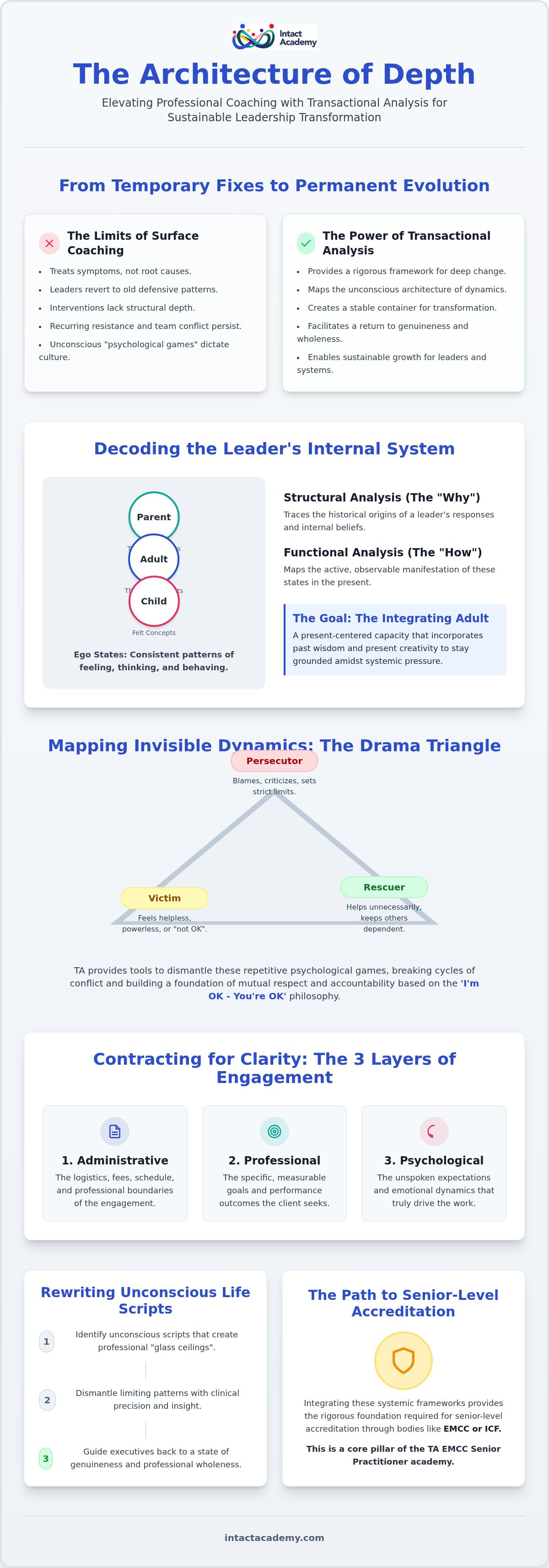
Within the framework of what is transactional analysis, the contract is the most vital tool for safety and clarity. Professional coaching requires a multi-layered approach to contracting to avoid the pitfalls of unconscious "games." We distinguish between three distinct layers:
- Administrative Contract: The logistics, fees, and boundaries of the engagement.
- Professional Contract: The specific goals and performance outcomes the client or organization seeks.
- Psychological Contract: The unspoken expectations and emotional dynamics that often dictate the success of the work.
Mastering these layers ensures that you and your client are working toward the same objective. It prevents the "three-cornered contract" between coach, client, and organization from becoming a source of conflict, instead making it a foundation for sustainable change.
Decoding the Internal System: Structural and Functional Ego State Analysis
To influence a system effectively, a coach must first understand the internal architecture of the leaders within it. Ego states are not mere metaphors; they are consistent patterns of feeling, thinking, and behaving that dictate how an executive interacts with their environment. Structural analysis allows us to explore the "why," tracing the historical origins of a leader's responses and the internal structures they've built over time. Functional analysis, however, maps the "how," revealing the active manifestation of these states in the boardroom. By mastering these transactional analysis techniques for coaching, you help leaders develop an "Integrating Adult." This state is more than just logical processing. It is a vibrant, present-centered capacity that incorporates the wisdom of the past and the creativity of the present to stay grounded amidst systemic pressure.
Functional Fluency in Leadership
Executive presence often hinges on the balance between the Parent and Child states. A leader operating from a "Controlling Parent" state may provide necessary structure, yet risks stifling autonomy if they become overly critical or micromanaging. Conversely, the "Nurturing Parent" fosters growth and psychological safety, but might struggle with hard accountability if boundaries aren't clearly defined. In the C-suite, we often see the "Adapted Child" manifest as sophisticated compliance or unproductive rebellion. These patterns stall decisive action and create bottlenecks in organizational flow. The ultimate goal is to liberate the "Natural Child," the wellspring of organizational creativity and innovation. When a leader can access this state safely, they invite their teams into a space of genuine possibility and authentic connection.
Recognizing Ego State Contaminations
Strategic failure often stems from "contamination," where Parent or Child beliefs masquerade as neutral Adult facts. Contamination is the intrusion of archaic patterns into current reality. For example, an executive might believe that "vulnerability is a sign of weakness," treating a Parent-derived prejudice as an objective business truth. This blurring of boundaries prevents the leader from responding to the actual needs of the organization. To "de-contaminate" the Adult state, a coach must help the client distinguish between historical echoes and current data. This process of clarification is essential for clear strategic thinking. If you are looking to deepen your mastery of these systemic shifts, exploring our professional development pathways can provide the rigorous framework needed for such profound work. By cleaning the "Adult lens," the leader can finally see the organization as it truly is, rather than through the filter of past scripts.
The Invisible Dynamics: Managing Games and the Drama Triangle in Team Coaching
In team environments, the complexity of coaching multiplies as individual ego states collide to form collective patterns. While the Parent-Adult-Child model clarifies internal dialogue, transactional analysis techniques for coaching are equally vital for exposing the unconscious scripts that dictate group behavior. We often see teams trapped in repetitive cycles where the same conflicts emerge regardless of the strategic topic. These are psychological games: unconscious, repetitive interactions that follow a predictable sequence and end in a "payoff" of bad feelings for everyone involved. To break these cycles, a coach must remain outside the system while simultaneously mapping its invisible architecture. This systemic perspective allows for the identification of patterns that are often invisible to those within the "game."
The Three-Cornered Contract in Action
Effective team coaching requires navigating the "Three-Cornered Contract." This systemic framework acknowledges that the relationship isn't just between the coach and the team; it involves the organization's hidden expectations, often represented by HR or the CEO. Transparency is paramount here. If the coach doesn't manage these multiple stakeholders, they risk being pulled into a professional game where the organization expects the coach to "fix" a team without addressing the systemic issues above them. Maintaining these boundaries is a specialty of Sari van Poelje, who emphasizes that a coach's neutrality is their greatest asset in maintaining psychological safety for all parties. It's about ensuring that the contract is explicit at every level, preventing the "unspoken" from sabotaging the work.
De-playing Games in High-Stakes Environments
In strategic planning sessions, the "Why Don't You... Yes But" game is a frequent culprit. One member presents a problem, others offer solutions, and the first person rejects every suggestion. The goal isn't to solve the problem; it's to maintain the status quo while proving others are unhelpful. Coaches can also fall into the "I'm Only Trying to Help" trap, where they become a Rescuer in the Karpman Drama Triangle. This triangle consists of three roles: the Persecutor who blames, the Victim who feels powerless, and the Rescuer who offers unsolicited help that keeps the Victim dependent.
To stop these games, you must use "crossed transactions." If a client speaks from a helpless Child state, don't respond as a Rescuing Parent. Instead, ask an Adult question that requires data or reflection. This shift moves the team toward the Winners Triangle. In this healthier model, the Victim becomes Vulnerable, the Persecutor becomes Assertive, and the Rescuer becomes Caring. By applying these transactional analysis techniques for coaching, you transform toxic team dynamics into a culture of mutual accountability and professional wholeness.
Rewriting the Narrative: Using Script Analysis for Executive Transformation
Beyond immediate transactions and team games lies the Life Script, an unconscious life plan decided in childhood and reinforced by early caregivers. This script acts as a silent architect for a leader's career, often determining the heights they reach and the "glass ceilings" they seemingly cannot break. When an executive finds themselves repeating the same professional failures or struggling with the same interpersonal conflicts across different organizations, they are likely following a script. Organizational systems themselves often inherit these psychological patterns from their founders, creating an "Organizational Script" that can either foster resilience or mandate perpetual crisis. By applying advanced transactional analysis techniques for coaching, you can help executives identify these scripts before they lead to burnout or systemic stagnation.
Identifying Injunctions and Drivers
In the high-pressure environment of the C-suite, we frequently observe the "5 Drivers" in action. These are behavioral styles that leaders adopt to maintain a sense of worthiness under stress. Drivers are the conditional rules we follow to feel "OK." The five primary drivers include:
- Be Perfect: Leads to micromanagement and a fear of failure.
- Please Others: Results in conflict avoidance and poor boundary setting.
- Hurry Up: Creates a frantic organizational pace and shallow decision-making.
- Try Hard: Values effort over results, often leading to perpetual "start-up" energy without closure.
- Be Strong: Masks vulnerability, preventing authentic connection and team trust.
While these drivers may have fueled early career success, they eventually become rigid cages that limit a leader's effectiveness and health.
The Process of Re-decision
Helping a leader move from a script toward autonomy requires a methodical process of re-decision. This path is a cornerstone of transactional analysis techniques for coaching, allowing for a return to completeness and genuineness. This isn't about changing the past, but about changing the influence the past has on the present. The journey follows four essential steps:
- Awareness: Identifying the recurring pattern or "dead end" in current professional reality.
- Connection: Linking this pattern to an early script decision made when the leader had fewer resources.
- Re-decision: Using the Adult state to make a new, conscious choice to act differently in the present.
- Strengthening: Anchoring the new behavior through consistent coaching support and systemic reinforcement.
This path toward "Script Cure" is what distinguishes deep developmental work from surface-level consulting. If you're ready to master these profound shifts, consider joining our TA EMCC Senior Practitioner academy to transform your practice into a vehicle for genuine human and organizational evolution.
Insight to Impact: TA in Professional Accreditation
The journey to professional mastery is rarely a straight line. It is a process of deepening one's capacity to hold the complex, often turbulent dynamics of human systems. Within the TA EMCC Senior Practitioner academy, we view the mastery of transactional analysis techniques for coaching as the essential bedrock for this evolution. These frameworks don't just provide tools; they provide a language for the core competencies required by the EMCC and ICF. When you map a client's ego states or identify a systemic script, you're demonstrating the high-level psychological literacy and self-awareness that define senior-level practice. Systemic supervision remains a vital part of this process, serving as a reflective mirror that ensures your own "Adult" state stays clear and uncontaminated by the very dynamics you're seeking to transform.
Consider a case where a top-down change initiative in a global firm stalled due to widespread "Adapted Child" resistance. While other consultants pushed for better communication, a TA-trained coach identified the underlying "Organizational Script" of perfectionism that made employees fear any shift in protocol. By addressing the "Parent" drivers at the executive level, the coach helped the leadership team move from a posture of control to one of invitation. This systemic shift didn't just save the project. It fundamentally altered the cultural architecture of the company, proving that deep psychological insight is the most pragmatic tool a coach can possess.
Achieving EMCC Senior Practitioner Status
Moving from tactical, goal-oriented coaching to systemic mastery requires a profound shift in how you hold the coaching space. It's a transition from doing coaching to being a coach who can navigate the "unspoken" with quiet authority. Intact Academy’s programs are specifically designed to bridge the gap between rigorous psychological theory and the demanding realities of the corporate world. For those ready to formalize this expertise and achieve international recognition, pursuing an executive coaching certification offers the structured methodology needed to facilitate sustainable, high-impact change at the highest levels of leadership.
The Path to Global Citizenship and Mastery
Mastering transactional analysis techniques for coaching invites you into an international community of practitioners who value depth, integrity, and the courage to change. There is an ethical imperative in our work: we cannot guide a client toward professional wholeness if we haven't first explored the architecture of our own internal systems. This commitment to one's own development is what distinguishes a leader in the field. If you feel called to expand your impact from individual leaders to entire organizational cultures, enrolling in the TA EMCC Senior Team Coach Academy represents the next logical step in your journey toward systemic excellence and professional completeness.
Advancing Toward Systemic Mastery and Professional Wholeness
True professional mastery resides at the intersection of psychological depth and systemic insight. We've explored how decoding ego states, de-playing unconscious games, and rewriting restrictive scripts can transform your coaching from tactical advice into a vehicle for profound human evolution. By integrating transactional analysis techniques for coaching, you gain the capacity to hold the complexity of organizational change with a calm, authoritative presence. This work isn't just about solving problems; it's about returning to a state of genuineness and completeness that anchors sustainable growth for both leaders and teams.
If you're ready to bridge the gap between theory and practice, we invite you to join our global community of practitioners across 14+ countries. Our programs are accredited by the EMCC and ICF, ensuring your development meets the most rigorous international standards. Under the mentorship of Sari van Poelje, TSTA-O, you will acquire the framework needed to facilitate transformation at the highest levels. Discover the TA EMCC Senior Practitioner academy at Intact Academy and begin your journey toward systemic excellence. Your commitment to depth is the catalyst for the flourishing of the organizations you serve.
Frequently Asked Questions
Is Transactional Analysis still relevant for modern executive coaching in 2026?
Transactional Analysis is highly relevant in 2026 as executive coaching moves away from surface-level behavioral models toward deep systemic understanding. Modern leaders face overwhelming complexity and distraction. Stabilizing their state using transactional analysis techniques for coaching allows for actionable progress. It provides a rigorous framework for navigating organizational systems and group dynamics, which are critical in the current global professional landscape where psychological literacy is increasingly demanded.
What is the difference between TA coaching and clinical psychotherapy?
The primary distinction lies in the objective and the contract. While clinical psychotherapy addresses deep-seated psychological issues and long-term therapeutic healing, TA-based coaching focuses on professional performance, organizational systems, and future-oriented change. We work with the Integrating Adult to facilitate sustainable organizational success. It's a developmental approach that respects the boundaries of the professional environment while utilizing psychological depth to unlock leadership potential without entering the clinical realm.
How long does it take to master Transactional Analysis techniques for coaching?
Mastering these techniques is a methodical process of deep learning. A foundational understanding can be acquired through intensive workshops, but systemic mastery typically requires a multi-year commitment. For instance, a comprehensive certification might span three to five years. Our TA EMCC Senior Practitioner academy provides a structured path for senior professionals to translate theory into core competencies over a dedicated academic cycle, supported by supervised practice and peer learning.
Can TA techniques be used effectively in a team coaching environment?
These techniques are exceptionally effective in team settings because they expose the unconscious scripts that dictate group behavior. By identifying repetitive games and the Drama Triangle roles within a team, you can facilitate more authentic communication. This systemic approach helps teams move from reactive patterns to a state of professional wholeness, ensuring that collective growth aligns with the organization's strategic goals and operational health through structured methodology.
What is the 'Three-Cornered Contract' and why is it vital for organizational coaches?
The Three-Cornered Contract is a systemic framework that manages the relationship between the coach, the individual client, and the sponsoring organization. It is vital because it addresses the hidden expectations of stakeholders like HR or the CEO. By making these administrative, professional, and psychological contracts explicit, you maintain transparency and boundary clarity. This prevents the coach from being pulled into unproductive organizational games or conflicting agendas that could sabotage the transformation.
How do TA 'Drivers' like 'Be Perfect' impact leadership performance?
Drivers like Be Perfect or Please Others are conditional rules leaders follow to feel OK under pressure. While they often fuel early career success, they eventually limit performance by creating rigid, defensive patterns. For example, a Be Perfect driver can lead to micromanagement and a fear of innovation. Recognizing these drivers through transactional analysis techniques for coaching allows executives to choose more flexible, autonomous responses that foster team trust and organizational resilience.
Do I need a psychology degree to use Transactional Analysis in my coaching practice?
You don't need a formal psychology degree to integrate Transactional Analysis into your practice. However, specialized training is essential to ensure the safe and ethical application of these concepts in a professional context. Our programs at Intact Academy are designed for coaches and consultants from diverse backgrounds who seek to deepen their impact. We provide the rigorous psychological framework and systemic methodology required to achieve senior-level accreditation through the EMCC or ICF.


