

What if the friction you encounter during a transition isn't a sign of failure, but a necessary dialogue between the system's past and its future? While many leaders view pushback as a barrier to be dismantled, it's often a vital manifestation of the organizational survival script. You've likely felt the exhaustion of a strategy that looks perfect on paper yet stalls in practice, making the task of overcoming resistance to organizational change feel like an uphill battle. It's painful to witness high turnover or a sense of cultural "stuckness" that persists despite your most sincere efforts to move forward.
This article invites you to shift your perspective. We'll explore how to decode the hidden psychological and systemic drivers that keep teams anchored to the status quo. By moving beyond surface-level tactics, you'll discover a framework to transform organizational friction into sustainable growth. We'll examine the "hidden" reasons for resistance and provide practical tools to facilitate a transformation that aligns individual growth with collective success. By understanding the deeper mechanics of human and systemic behavior, you can move from managing conflict to facilitating profound, lasting evolution.
Key Takeaways
- Recognize resistance as a systemic survival mechanism aimed at maintaining homeostasis, rather than a lack of cooperation or individual failure.
- Identify the "Invisible Script" of your organization to understand how past systemic traumas influence your current success in overcoming resistance to organizational change.
- Shift from transactional surface fixes to transformational leadership by prioritizing psychological safety and autonomy over top-down mandates.
- Apply the practical methodology of "Contracting" and "Stroking" to create clear agreements and provide the recognition needed for deep, lasting growth.
- Acknowledge that your own professional mastery and internal alignment are the most powerful levers for facilitating healthy organizational evolution.
Beyond the Surface: Why Resistance to Organizational Change is a Survival Mechanism
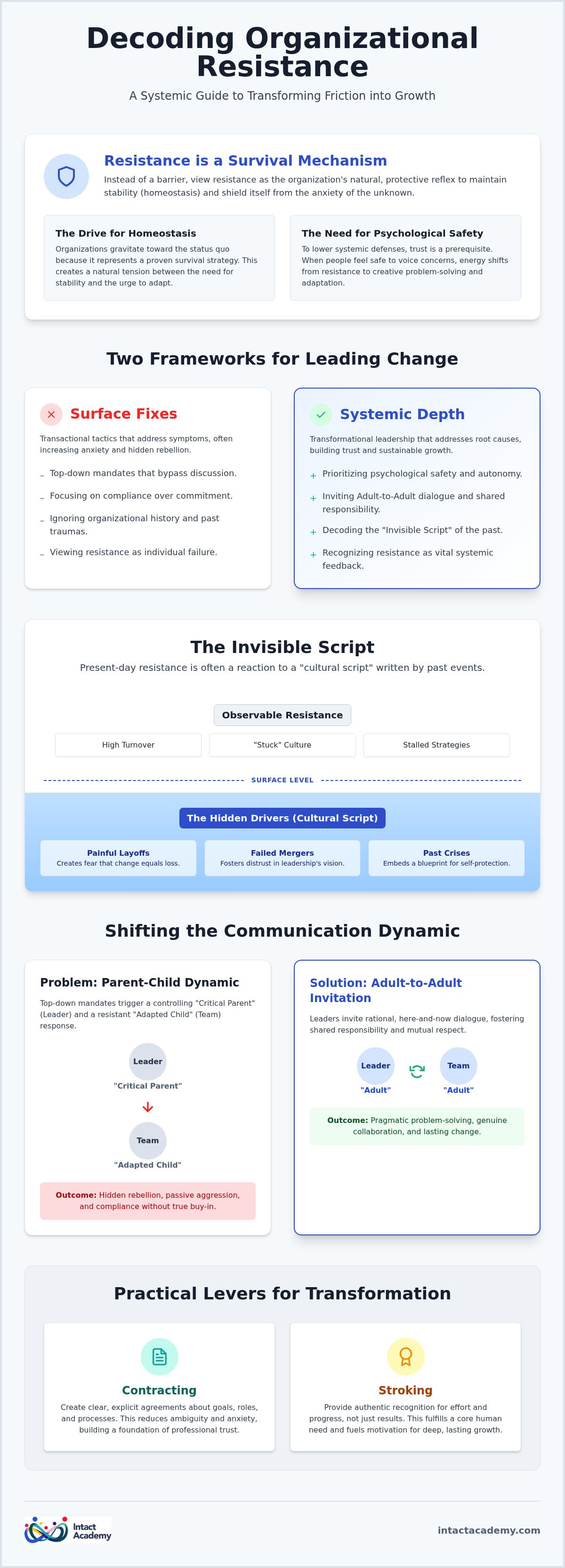
Resistance isn't a defect in the machinery of progress; it's a biological and systemic necessity. When we discuss overcoming resistance to organizational change, we must first recognize that every organization is a living organism seeking homeostasis. This state of equilibrium provides the stability necessary for daily operations and psychological comfort. When a new initiative disrupts this balance, the system reacts with a protective reflex, much like a body defending itself against a perceived pathogen. Systemic resistance is a protective function of the organizational culture, designed to shield the collective from the anxiety of the unknown.
To lower these systemic defenses, psychological safety must be established as a prerequisite. Without a foundation of trust, the brain's limbic system remains on high alert, processing organizational shifts as existential threats rather than opportunities for growth. When individuals feel safe to voice concerns without the risk of shame or retaliation, the energy tied up in resistance can be redirected toward creative problem-solving. This shift allows the organization to move from a state of rigid preservation to one of fluid adaptation.
The Role of Homeostasis in Human Systems
Organizations gravitate toward the status quo because it represents a proven survival strategy. There's an inherent tension between the evolutionary urge to adapt and the systemic need for stability. Healthy resistance acts as a vital filter, ensuring that the organization doesn't abandon core competencies for every passing trend. However, destructive stagnation occurs when the fear of transition outweighs the logic of survival. Leaders can utilize the formula for change to evaluate if the dissatisfaction with the present and the clarity of the future vision are strong enough to overcome these homeostatic forces.
Ego States and the Change Reaction
The human brain often processes organizational shifts through the lens of identity and power dynamics. In Transactional Analysis, we observe how change can trigger specific ego states that complicate overcoming resistance to organizational change. When a transition is imposed through top-down mandates, it frequently activates a "Critical Parent" response in leadership and an "Adapted Child" response in the workforce. This dynamic manifests in several ways:
- The Critical Parent: Leaders may become overly controlling or punitive when faced with delays, further increasing team anxiety.
- The Adapted Child: Employees might show outward compliance while engaging in hidden rebellion or passive-aggressive withdrawal.
- The Adult Invitation: True transformation occurs when leaders invite the "Adult" ego state, which processes data in the here-and-now, allowing for rational dialogue and shared responsibility.
By fostering Adult-to-Adult communication, you move the conversation away from emotional power struggles. This approach honors the maturity of your team and creates a space where the complexities of the transition can be managed with professional pragmatism and mutual respect.
The Invisible Script: How Organizational History Shapes Current Resistance
Every organization carries a memory that predates its current leadership. This memory isn't just stored in archives; it lives in the nervous system of the culture. In Transactional Analysis, we refer to this as a "Life Script," a pre-conscious plan for life that dictates how a system survives, succeeds, or fails. When you face challenges in overcoming resistance to organizational change, you're often wrestling with a script written years ago during a period of crisis, such as a painful layoff or a failed merger. These past traumas create a "cultural script" that acts as a blueprint for self-protection, signaling to the collective that change is synonymous with loss.
To truly grasp these dynamics, one must first recognize the importance of what is transactional analysis in unearthing these hidden drivers. It provides a lens to view the organization not as a collection of roles, but as a living system governed by historical patterns that influence every present interaction.
Mapping the Organizational Life Script
Uncovering a company's script begins with the "founding myth." Was the business born out of a desire for innovation, or as a reaction against a previous employer's rigidity? This origin story defines what is safe and what is forbidden. If the script dictates that "we only succeed through solo effort," a new initiative toward cross-functional collaboration will be met with profound resistance. You've likely noticed repetitive patterns in how conflict is handled; perhaps the organization always retreats into silence when a deadline is missed, or perhaps it erupts into blame. These aren't random behaviors. They are scripted responses designed to maintain the status quo. Recognizing these patterns is the first step toward overcoming resistance to organizational change at a systemic level.
Psychological Games in the Workplace
When resistance becomes entrenched, it often takes the form of "Psychological Games." The most common is "Yes, But," where a team member agrees with a proposal in theory but provides endless reasons why it won't work in practice. This keeps the organization in a stalemate. Many leaders inadvertently fuel this by entering the "Drama Triangle," a model that identifies three dysfunctional roles:
- The Victim: Feeling powerless and seeking a Rescuer to take responsibility for the change.
- The Rescuer: Stepping in to "save" the team, which inadvertently prevents them from taking ownership.
- The Persecutor: Using blame or rigid mandates to force compliance, which triggers further rebellion.
Breaking this cycle requires moving to authentic "Adult-Adult" transactions, where both parties engage with reality without the masks of the script. It's about fostering a space where individuals feel empowered to take genuine responsibility. For those seeking to facilitate this shift, our expertise in Organizational Change offers the systemic tools needed for deep transformation.
Surface Fixes vs. Systemic Depth: A New Framework for Change Leaders
Many leaders approach overcoming resistance to organizational change as if they're repairing a broken machine. They adjust the gears of incentives or rewrite the blueprints of mandates, expecting the system to hum along in a new direction. This transactional approach relies on external pressure, yet true evolution requires internal resonance. To move beyond the surface, we must distinguish between superficial compliance and the deep, transformational insight that honors both the individual and the collective. True leadership in this context isn't about exerting power over a system, but about facilitating the power within it.
A systemic framework recognizes that "contracts for change" must exist on two levels: the professional and the psychological. While a professional contract outlines the tangible deliverables and timelines, the psychological contract addresses the unstated needs for recognition, safety, and belonging. For a more expansive view of these dynamics, you can explore our guide on leading organizational change, which delves into the nuances of professional mastery in turbulent times.
The Failure of Transactional Mandates
Carrots and sticks produce short-term compliance but often erode the very engagement necessary for long-term success. When change is "enforced," the hidden cost is a slow accumulation of burnout and systemic disengagement. By ignoring employee autonomy, transactional leaders trigger defensive scripts that stall momentum. This top-down pressure fails in modern, agile environments where adaptability depends on the psychological buy-in of every team member. Without this buy-in, the system remains rigid, merely performing the motions of change while the undercurrents of friction remain untouched.
The Systemic Alternative: Facilitating Wholeness
A systemic alternative views the organization as an interconnected web of loyalties and aspirations. Instead of "fixing people," the focus shifts to "evolving the system." This involves integrating individual aspirations with organizational needs to create a state of wholeness where growth feels natural rather than forced. It's in this space that overcoming resistance to organizational change becomes a collaborative process of discovery rather than a battle of wills.
By utilizing Systemic Team Coaching, leaders can align the collective script with the organization's future goals. This alignment ensures that the movement forward isn't just a structural shift, but a profound evolution of the organizational soul. You're no longer pushing against the system; you're inviting it to become its most genuine and effective self.
Practical Steps to Transform Resistance into Creative Energy
Moving from theory to action requires a structured methodology that respects the human element. When overcoming resistance to organizational change, the goal isn't to suppress opposition but to harness the energy within it. Resistance is simply undirected power. By applying specific systemic tools, you can redirect this power toward the organization's future state. This process demands a shift from seeing people as obstacles to viewing them as partners in a shared evolution.
Contracting for Sustainable Change
Effective transformation begins with the art of "Contracting." This goes far beyond a standard administrative agreement. It requires a deep psychological contract between the leader and the team. In complex organizations, you must navigate "triangular contracts" where multiple stakeholders hold conflicting expectations. A clear contract ensures everyone understands what's being asked and what's being offered. Crucially, it provides a "clear exit" or "permission to fail," which reduces the existential anxiety that often fuels defensive behaviors. When the boundaries of the change are transparent, the system can relax into the process of growth.
The Power of Recognition (Strokes)
In Transactional Analysis, "Strokes" are units of recognition essential for human flourishing. During the "unfreezing" phase of change, individuals are asked to let go of familiar certainties, a process that's often psychologically taxing. Positive reinforcement is critical here. You must balance "conditional strokes," which recognize specific performance milestones, with "unconditional strokes," which validate the person’s inherent value to the team. This balance builds the systemic resilience needed for overcoming resistance to organizational change by ensuring people feel seen and valued even when their roles are in flux.
The third step is "Redefining." This involves consciously changing the narrative from a story of "loss" to one of "evolution." It’s a rhythmic process of acknowledging what's being left behind while highlighting what's being gained. Finally, change agents themselves require "Supervision." This provides a "stable container" for those leading the charge, allowing them to process the systemic pressures they absorb. Without this external support, leaders often risk burnout or inadvertently becoming part of the very resistance they seek to resolve. They need a space to reflect before they can effectively lead others through the turbulence of transition.
Master the art of these transitions through our specialized Organizational Change programs, designed for leaders who seek profound systemic impact and professional mastery.
Cultivating Mastery: Integrating Systemic Insights into Your Leadership Practice
The leader's internal landscape is the most potent lever for organizational change. If you remain unaware of your own survival scripts, you risk inadvertently fueling the very friction you wish to resolve. True mastery in overcoming resistance to organizational change begins with the courage to look inward before attempting to influence the outward system. It's about recognizing that your presence is never neutral; it's either an invitation to growth or a trigger for defense. When you align your internal state with your strategic goals, you create a resonance that ripples through the entire organization.
The Coach as a Systemic Instrument
In high-stakes environments, you function as a systemic instrument. Your ability to remain grounded and "Adult" in the face of collective anxiety can soothe the system's limbic response, allowing for rational transition. This "Self-as-Instrument" awareness enables you to detect the subtle undercurrents of the organization within your own reactions. To maintain this level of clarity, the importance of ongoing systemic supervision cannot be overstated. It provides a necessary mirror to your own processes, ensuring you don't lose your perspective in the turbulent currents of organizational life.
Pursuing professional development for coaches is a deliberate path toward this high-level mastery. It represents a commitment to the art and science of deep transformation. For those ready to deepen their impact, the TA EMCC Senior Team Coach Academy offers a rigorous environment to build these specialized skills, moving beyond surface-level coaching into the realm of systemic evolution and professional integrity.
Next Steps: From Insight to Impact
You can begin applying these Transactional Analysis concepts in your next leadership meeting. Observe the ego states in the room without judgment. Are you hearing the "Critical Parent" in a manager's tone, or the "Adapted Child" in a team's silence? Invite the "Adult" by asking reflective questions that prompt reality testing and shared responsibility. By shifting the quality of your contact, you begin overcoming resistance to organizational change one transaction at a time.
Building a "community of practice" within your organization allows these insights to take root and flourish. This collective learning creates a stable container for the often-turbulent work of transition. We invite you to explore our accredited programs at Intact Academy, where we bridge the gap between psychological depth and professional excellence. Transformation is not a checklist; it's a process of becoming. By integrating these systemic insights, you return the system to a state of genuineness, where sustainable growth becomes the natural outcome of your collective efforts.
Embracing the Art of Systemic Evolution
True transformation begins when we stop fighting the system and start listening to its wisdom. By recognizing resistance as a survival mechanism and unearthing the invisible scripts that govern behavior, you move from mere management to profound facilitation. You've discovered that sustainable growth requires more than surface-level mandates; it demands psychological safety, clear contracting, and a commitment to your own professional evolution. Integrating these systemic insights is the most effective path to overcoming resistance to organizational change while honoring the humanity of your team.
This journey from insight to impact is a continuous process of becoming. If you're ready to master the art and science of deep organizational change, we invite you to join a global community of senior practitioners. Deepen your impact with our TA EMCC Senior Team Coach Academy, led by global authority Sari van Poelje. Our EMCC and ICF accredited programs provide the structured methodology and psychological depth needed to lead with integrity in an increasingly complex world. You have the power to return your organization to a state of wholeness; the next step is simply a matter of choosing mastery.
Frequently Asked Questions
What is the most common reason for resistance to organizational change?
Mistrust in the organization is the primary driver of resistance, cited by 41% of employees in 2026 data. This lack of trust, often coupled with a 39% lack of awareness regarding the change's purpose, triggers a systemic survival reflex. When individuals don't feel secure, they retreat into familiar patterns to maintain homeostasis. Addressing these underlying fears is the first step in overcoming resistance to organizational change and restoring systemic alignment.
How does Transactional Analysis help in overcoming resistance?
Transactional Analysis provides a precise map for decoding the interpersonal and systemic dynamics that stall progress. By identifying whether a team is operating from a Child, Parent, or Adult ego state, leaders can adjust their communication to invite rational, "Adult" problem-solving. This methodology moves beyond surface-level management, allowing leaders to address the unconscious scripts and psychological games that act as the "hidden" drivers of resistance within the culture.
What is the difference between active and passive resistance?
Active resistance manifests as vocal opposition, direct sabotage, or organized dissent, making it visible and manageable through dialogue. Passive resistance is more elusive, often appearing as outward compliance while harboring internal disengagement or "Yes, But" behaviors. While active resistance can feel more disruptive, passive resistance is often more damaging because it erodes the initiative from within. Both forms are signals that the psychological contract between the individual and the system has been breached.
Can resistance to change ever be a positive thing for a company?
Resistance is often a vital feedback mechanism rather than a barrier to be destroyed. It can signal that a proposed strategy threatens a company's core competencies or ignores essential cultural values. When viewed through a systemic lens, resistance acts as a guardian of the organization's integrity. By listening to these concerns, leaders can refine their approach, ensuring that the evolution is grounded in reality rather than just top-down theory.
How can leaders build psychological safety during a major transition?
Leaders build psychological safety by establishing clear, multi-level contracts that define the boundaries of the transition. This includes providing "permission to fail" and acknowledging the emotional labor involved in letting go of old certainties. Consistent use of "Strokes," or units of recognition, validates the team's efforts during the "unfreezing" phase. When employees feel their inherent value is secure, they're more likely to engage in the creative work of overcoming resistance to organizational change.
What role does organizational "life script" play in failed initiatives?
An organizational "life script" is the unconscious blueprint formed during a company's early years or past crises. If a company's history includes failed mergers or traumatic layoffs, the script may dictate that "change equals danger." These repetitive patterns predict how the system will react to new initiatives. Initiatives fail when they ignore this script, as the collective memory will always prioritize psychological survival over a new, logically sound business strategy.
How do you contract for change with a resistant team?
Contracting with a resistant team requires moving beyond administrative tasks to address the psychological undercurrents of the work. You must establish a "triangular contract" that honors the needs of the individual, the team, and the organization. This involves being transparent about what is non-negotiable and where the team has genuine autonomy. By creating a stable container with clear agreements, you reduce the existential anxiety that fuels the team's defensive posture.
Why do top-down change mandates often trigger the "Rebellious Child" ego state?
Top-down mandates are often delivered from a "Critical Parent" ego state, which naturally invites a "Rebellious Child" response from the workforce. This dynamic is a regression to defensive patterns where employees feel their autonomy is being threatened. Instead of rational cooperation, the team engages in passive-aggressive withdrawal or active defiance. To break this cycle, leaders must shift their presence to an "Adult" state, inviting a mature, peer-to-peer dialogue about the transition's reality.


