

Why does a perfectly executed behavioral intervention often dissolve the moment your client returns to the boardroom? You've likely felt the quiet frustration of being a "toolbox coach," equipped with techniques that offer temporary relief but fail to shift the underlying systemic current. In the high-stakes debate of transactional analysis vs nlp, many professionals find themselves caught between the desire for rapid results and the need for psychological depth. It's a common crossroads in a global coaching market now exceeding 122,000 practitioners, where the pressure to deliver lasting ROI has never been higher. You're seeking more than just a new set of tactics; you're seeking a theoretical anchor that explains the intricate dance of human personality and organizational life.
This guide will help you move beyond surface-level patterns to understand the fundamental frameworks that drive human transformation. We'll examine how NLP optimizes the mechanics of the mind while Transactional Analysis rewrites the relational script. By the end, you'll have the clarity needed to choose a training path that leads to Senior Practitioner status and the confidence to map unconscious patterns within complex corporate cultures. We'll move from the "how" of behavior to the "why" of systemic change, ensuring your work as a leader or coach leaves a permanent mark on the organizations you serve.
Key Takeaways
- Move beyond the "toolbox coach" plateau by identifying why senior practitioners require a deep theoretical anchor to sustain long-term client results.
- Compare the core philosophies of transactional analysis vs nlp to see how systemic awareness differs from internal sensory modeling.
- Gain the ability to map unconscious scripts and psychological games that often hinder corporate culture and team performance.
- Identify the specific scenarios, from high-conflict leadership to rapid behavioral change, where one framework offers more intellectual rigor than the other.
- Evaluate the accreditation paths that support your journey toward Senior Practitioner status and profound human transformation.
Beyond Techniques: Why Coaches Face the TA vs NLP Dilemma
The coaching industry has matured far beyond the era of simple performance-based "hacks." Many practitioners begin their journey by collecting behavioral interventions, often finding initial success with the rapid, goal-oriented techniques found in Neuro-Linguistic Programming. However, as your practice evolves toward the executive suite or complex organizational systems, these tools can feel surprisingly thin. The dilemma of transactional analysis vs nlp isn't merely a choice between two different toolkits; it's a decision about the depth at which you're willing to work. It's about whether you're content with surface-level adjustments or if you're ready to address the foundational architecture of the human experience.
Senior practitioners often reach a plateau where purely behavioral models no longer suffice. When a leader understands what they should do but remains unable to do it, the problem is rarely a lack of technique. It's often a structural or relational issue rooted in decades of conditioning. Choosing a methodology dictates your client demographic. If you wish to work with leaders facing deep-seated cultural resistance or personal scripts that sabotage their success, you need a framework that honors the complexity of the human psyche. This requires a significant emotional and intellectual investment, moving you from a technician to a transformative partner.
The Search for Professional Depth
There's a profound difference between "doing" coaching and "being" a coach. NLP offers the allure of quick results through sensory modeling and internal representations, which is invaluable for specific behavioral shifts like overcoming a phobia or improving public speaking. Yet, for many, the search for professional stability leads toward the psychological grounding of what is transactional analysis. It provides a systemic guide that allows you to remain calm and authoritative when the "quick fix" fails. This investment requires more than just learning a script; it demands an intellectual and emotional commitment to understanding the roots of human interaction. It's the difference between helping someone perform better and helping them return to a state of completeness and genuineness.
The Systemic Turn in Modern Coaching
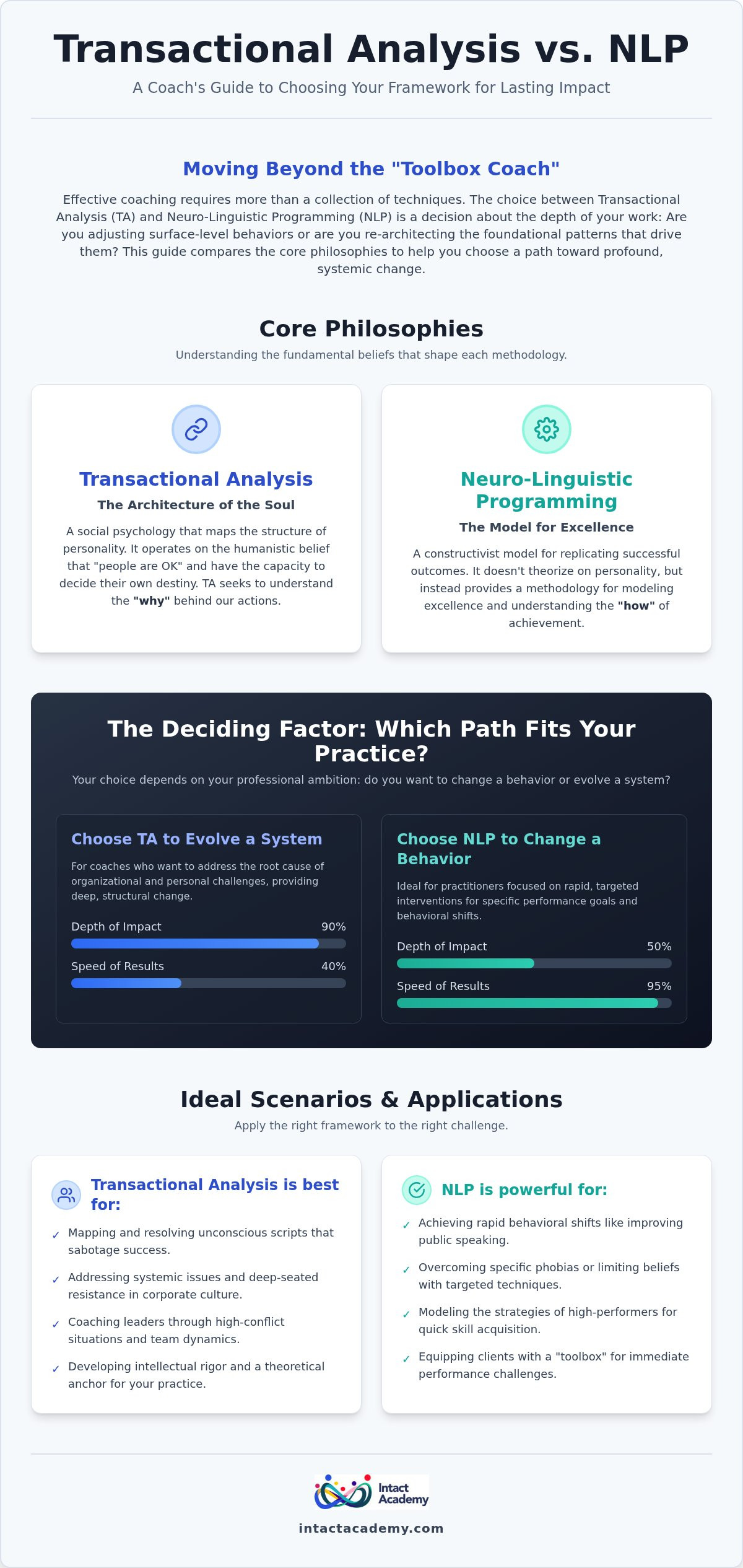
Modern organizations are no longer looking for isolated individual improvements. They're seeking systemic transformation that ripples through every layer of the business. The shift toward systemic team coaching and organizational change requires you to handle high-stakes interventions where the "programming" of one person is insufficient to change the collective culture. Transactional Analysis (TA) offers a map for these complex dynamics, allowing you to see the invisible threads that bind a team together. When comparing transactional analysis vs nlp, the deciding factor is often your ambition: do you want to change a behavior, or do you want to evolve a system? A systemic approach ensures that the growth achieved in a coaching session doesn't evaporate the moment the client returns to their high-pressure environment.
Decoding the Frameworks: Core Philosophies of TA and NLP
Understanding the debate of transactional analysis vs nlp requires looking past the techniques to the philosophical foundations that support them. Transactional Analysis is a social psychology that maps the structure of human personality. It's built on a humanistic bedrock, operating from the fundamental belief that "people are OK" and possess the innate capacity to think and decide their own destiny. In contrast, NLP is a constructivist model of excellence. It doesn't seek to explain why we are the way we are, but rather how we can replicate the specific internal processes of those who succeed. While TA provides a robust theory of personality, NLP offers a pragmatic methodology for behavioral modeling.
Transactional Analysis: The Architecture of the Soul
At its core, TA examines the internal architecture that dictates our external reality. While many are familiar with the Parent, Adult, and Child ego states, the true power of the framework lies in structural analysis. It reveals how we've introjected the voices of authority and how we replay childhood strategies in adult boardrooms. A critical differentiator is the concept of the Life Script. These are unconscious life plans, made in childhood and reinforced by parents, that govern current executive behavior. If you find a client repeatedly hitting a "glass ceiling" of their own making, you're likely observing a script in action. The ultimate goal here is Autonomy, which is the recovery of awareness, spontaneity, and intimacy. For those seeking to master these depths, the TA EMCC Senior Practitioner academy offers a structured path toward this level of psychological mastery.
NLP: The Software of the Mind
If TA is the architecture, NLP is the software. It operates on the premise that our experience of reality is filtered through sensory representations, including visual, auditory, and kinesthetic inputs. By adjusting these internal filters, an NLP practitioner can rapidly reprogram a client's behavioral response to specific triggers. This focus on "Modeling" allows for the swift replication of success, making it an excellent tool for skill acquisition and short-term performance gains. However, NLP often encounters limitations when faced with deep-seated, systemic relational patterns. It can change how a person feels about a conflict, but it may not address the underlying "Psychological Games" or the systemic script that keeps the conflict alive. It's a precise tool for individual excellence, yet it sometimes lacks the relational depth required for profound, sustainable organizational transformation.
Behavior vs. Structure: The Relational Depth of Transactional Analysis
When we examine the tension between transactional analysis vs nlp, we are essentially comparing the art of programming with the science of analysis. NLP often approaches the human mind as a sophisticated computer, where "programming" involves identifying and altering the sensory sequences that lead to specific behaviors. It's a mechanistic view that yields impressive results for individual performance. However, Transactional Analysis (TA) shifts the focus from the internal software to the relational structure. It functions as an analytic framework that deciphers the invisible contracts and psychological games that dictate how people interact within a system. In this context, the coach moves from being a programmer of individual minds to a systemic facilitator of human connection.
TA excels in high-conflict scenarios because it identifies the "Psychological Games" that frequently derail workplace productivity. These are repetitive, ulterior transactions that leave both parties feeling drained and misunderstood. While an NLP approach might try to change an individual's reaction to a conflict, TA analyzes the structural "why" behind the interaction. Transactional Analysis maps the unconscious patterns in corporate culture by identifying the repetitive, non-productive interactions that signal a deeper departmental script. It allows you to see the underlying drama before it manifests as a crisis, providing a stable container for genuine resolution rather than a temporary behavioral fix.
Uncovering the Invisible: TA and Organizational Culture
This focus on structural resolution is just as vital in personal development; for example, Tracy Kimberg helps parents understand how their own self-esteem impacts their teenager’s confidence, fostering a more resilient family system.
The true power of TA lies in its ability to diagnose the health of an entire system. Just as individuals have Life Scripts, departments and whole companies often operate under collective scripts that limit their potential. This systemic perspective is essential for leading organizational change effectively. By identifying these collective patterns, you can move beyond individual performance metrics to address the systemic health of the organization. You aren't just fixing a "broken" employee; you're evolving the environment in which they work, ensuring that transformation is both profound and sustainable.
The Relational Contract: A TA Differentiator
In executive coaching, the relationship isn't just between the coach and the client; it involves the organization, HR, and the client's direct reports. TA prioritizes "multi-party contracting," a process that ensures everyone's needs and boundaries are explicitly clear. This creates a safe container for transformation, preventing the "triangulation" that often sabotages coaching outcomes. This rigorous focus on relational clarity is why TA is the preferred tool for Sari van Poelje when working in complex agile environments. In these fast-moving systems, the ability to maintain integrity and wholeness while navigating shifting roles is the hallmark of a Senior Practitioner.
Integrating or Specializing: Which Methodology Fits Your Practice?
The temptation to become a "methodology collector" is a common trap for dedicated professionals. While it's natural to want a diverse toolkit, there is a significant risk of falling into the "Master of None" trap. In the debate of transactional analysis vs nlp, the most impactful coaches are those who choose a primary theoretical anchor rather than a shallow smattering of both. Depth in one methodology provides a stable internal compass, allowing you to stay present with a client's struggle without frantically searching for the next technique. Mastery isn't found in the number of tools you possess, but in the precision with which you apply a robust framework to complex human systems.
Your choice should align with the nature of your work and the needs of your clients. NLP is exceptionally effective for short-term performance coaching, phobia work, or simple behavioral changes where the goal is to shift a specific cognitive block. However, if your practice focuses on long-term leadership development, cultural transformation, or navigating the turbulent waters of team dynamics, Transactional Analysis offers a superior level of intellectual rigor. Evaluating the current standards for professional development for coaches in 2026 reveals a clear trend: the market is moving away from quick fixes toward sustainable, depth-oriented evolution.
The Path to Senior Accreditation
This shift toward sustainable growth is particularly crucial for independent practitioners who must balance clinical excellence with commercial viability. For therapists and counsellors, Martin Hogg Private Practice Success offers specialized business coaching and accredited CPD training to help bridge the gap between psychological depth and professional sustainability.
For those aiming for high-level recognition, the structural integrity of your training matters. TA training is uniquely aligned with EMCC Senior Practitioner requirements because it emphasizes the reflective practice and psychological depth necessary for senior roles. This systemic approach is a cornerstone of a truly rigorous executive coaching certification. Furthermore, the global recognition of TA bodies like the EATA and ITAA provides a unified professional identity that fragmented NLP associations often lack. This global citizenship ensures your credentials carry weight across borders and industries.
A Checklist for Your Professional Journey
As you reflect on your path, consider these inquiries to determine which methodology resonates with your professional soul:
- Do you prefer working with internal cognitive patterns or the nuances of relational dynamics?
- Are your clients looking for immediate behavioral shifts or a more profound, sustainable evolution?
- How much psychological depth are you prepared to explore within yourself to facilitate change in others?
- Does your current framework allow you to map the unconscious scripts of an entire organization?
If you find yourself drawn to the systemic and the profound, it may be time to commit to a path that honors that complexity. You can explore the TA EMCC Senior Practitioner academy to begin your journey toward a more integrated and impactful coaching presence.
From Transaction to Transformation: The Intact Academy Approach
At Intact Academy, we recognize that the choice between transactional analysis vs nlp often centers on the tension between efficiency and depth. We choose depth, not at the expense of pragmatism, but as the very foundation of it. Our approach bridges the gap between high-level psychological theory and the immediate, often turbulent demands of executive life. We don't just aim to improve performance; we invite you to return to a state of completeness and genuineness. This focus on wholeness serves as our thematic North Star, distinguishing our training from more transactional, surface-level providers.
The TA Foundation Year is designed as more than a standard training curriculum. It's a systemic journey that demands personal evolution before professional application. Under the guidance of a wise global mentor, you'll learn to see the invisible structures that govern human behavior. This allows you to lead with a quiet power that is both experienced and deeply human, ensuring that profound psychological concepts remain accessible and actionable without losing their intellectual rigor.
Joining a Global Community of Mastery
Our academies transcend geographical borders, bringing together participants from 14+ countries in a sophisticated blend of online and in-person learning environments. This global citizenship enriches the developmental process, offering a diverse perspective on systemic issues that feel manageable through our structured methodology. By enrolling in our EMCC-accredited academies, you ensure your practice reaches the highest levels of professional impact. We're currently accepting inquiries for our upcoming TA EMCC Senior Practitioner academy, a path specifically designed for those ready to anchor their coaching in systemic excellence.
The Intact Academy Difference
What distinguishes our approach is the seamless integration of Transactional Analysis with systemic team coaching and organizational redesign. We don't view the individual in isolation; instead, we provide the tools to map the entire organizational script and facilitate sustainable change. Supervision and ethical practice aren't merely requirements in our programs. They're the core pillars of mastery that provide a stable container for the challenging work of personal and professional transformation. We invite you to join a community that honors your intelligence and maturity, moving beyond behavioral "hacks" into the realm of profound human flourishing.
Advancing Toward Systemic Mastery
Choosing your path between transactional analysis vs nlp is a decision that defines the nature of your professional legacy. While NLP offers precise tools for behavioral shifts, Transactional Analysis provides the structural depth required to navigate complex organizational scripts and facilitate sustainable transformation. You now understand that moving from "doing" to "being" a coach requires a theoretical anchor that honors the intelligence and maturity of your clients.
The journey toward Senior Practitioner status is about more than credentials; it's about the courage to return to a state of completeness. Through our EMCC and ICF accredited programs, led by international expert Sari van Poelje, you can join a global community of senior practitioners dedicated to profound systemic change. This is your invitation to evolve beyond transactional techniques into the realm of genuine human flourishing. Deepen your impact—explore our TA EMCC Senior Practitioner Academy today. The path to mastery is deliberate, but the impact you'll create is enduring.
Frequently Asked Questions
Is Transactional Analysis more "scientific" than NLP?
Transactional Analysis is grounded in a social psychology that maps the structure of human personality through observable transactions. While NLP is a model of excellence based on sensory modeling, it's often viewed as a set of techniques rather than a unified scientific theory. TA's rigorous accreditation through bodies like the EATA and ITAA requires extensive theory, supervision, and research, providing a level of intellectual depth that many senior practitioners find more reliable in complex organizational settings.
Can I use Transactional Analysis and NLP together in coaching?
You can certainly integrate both, but it's vital to maintain a clear theoretical anchor. Using NLP for rapid behavioral shifts can complement the deeper structural work of TA. However, jumping between transactional analysis vs nlp without a primary framework can lead to a fragmented coaching presence. Most senior practitioners find that mastering one methodology first allows them to use the other as a secondary tool without diluting the impact of the core intervention.
How long does it take to become proficient in Transactional Analysis compared to NLP?
Proficiency in TA typically requires a multi-year commitment, often spanning three to five years for full certification. This process includes extensive theory, group training, and supervised practice. In contrast, NLP practitioner paths are often much shorter, sometimes completed in weeks or months. The difference lies in the depth of transformation; TA aims for a fundamental shift in personality and relational dynamics, which naturally requires a more deliberate and steady learning rhythm.
Does NLP have a place in systemic team coaching?
NLP has a place in team coaching when the goal is to align individual mental models or improve specific communication skills. However, it often struggles with the systemic scripts that govern a team's collective behavior. While NLP can reprogram a person's response, it rarely addresses the invisible threads of organizational culture. For true systemic change, coaches often prefer TA because it maps the ulterior transactions and psychological games that occur between people rather than just within them.
Why does Transactional Analysis focus so much on the past?
Transactional Analysis doesn't dwell on the past for its own sake; instead, it looks back to understand how early Life Scripts govern current behavior. These unconscious decisions, often made in childhood, act as a blueprint for adult interactions. By identifying these patterns, clients can move from being driven by the past to living with autonomy and spontaneity. It's about returning to a state of completeness by resolving the structural issues that hinder current professional flourishing.
What are the main criticisms of NLP in a professional business context?
The primary criticisms of NLP in business center on its perceived focus on manipulation and its lack of psychological depth. Critics argue that its quick fix approach can lead to temporary behavioral changes that don't survive high-pressure environments. Additionally, the fragmentation of NLP accreditation bodies can make it difficult for corporate clients to verify the rigor of a coach's training. This often leads senior leaders to favor the more stable, humanistic framework provided by Transactional Analysis.
Which framework is better for resolving workplace conflict?
Transactional Analysis is exceptionally effective for conflict resolution because it identifies the Psychological Games that keep disputes alive. While NLP might help a person change their internal representation of a conflict, TA reveals the ulterior transactions and roles, such as Victim or Persecutor, that create the cycle. This allows the coach to facilitate a relational contract where both parties return to an "I'm OK, You're OK" stance, leading to sustainable resolution rather than just a temporary truce.
How do I explain the value of TA to a corporate client who wants quick results?
You can explain that while quick results are appealing, they often dissolve because the underlying organizational script remains unchanged. TA offers a way to map these unconscious patterns, ensuring that the intervention addresses the root cause rather than just the symptom. By comparing transactional analysis vs nlp, you can show that TA provides a stable container for long-term ROI, preventing the repetitive revolving door of behavioral issues that often plague corporate teams.


