

What if the next stage of your professional evolution isn't about mastering another coaching technique, but about holding the space for the transformation of the profession itself? Many experienced practitioners reach a point where technical proficiency no longer feels like enough. You might sense a subtle stagnation in your growth or feel a quiet anxiety when navigating the tangled ethical and systemic webs that surface in high-stakes executive environments. It is a common crossroads where the desire for deeper impact meets the need for a more robust, reflective framework.
This guide offers a clear, systemic roadmap for how to become a certified coaching supervisor, moving beyond surface-level metrics into the realm of ethical maturity and psychological depth. You will discover the specific pathways toward EMCC or ICF accreditation, including the latest 2026 requirements for practice hours and specialized training. We will explore how to distinguish professional supervision from mentor coaching and how integrating frameworks like Transactional Analysis allows you to provide a truly safe, reflective container for other practitioners. By the end of this article, you'll understand how to bridge the gap between individual technical expertise and the quiet, transformative power of systemic presence.
Key Takeaways
- Understand the fundamental shift from technical coaching to systemic supervision, creating a reflective space that honors professional maturity and ethical complexity.
- Learn the precise requirements for 2026, including the specific steps on how to become a certified coaching supervisor through both EMCC and ICF accreditation pathways.
- Discover how Transactional Analysis serves as a powerful lens to decode psychological games and systemic patterns within the coaching relationship.
- Gain a clear, multi-step roadmap for auditing your professional history and selecting an academy that aligns with global standards like the ESQA.
- Elevate your practice from transactional skill-building to the art of human transformation, fostering a state of completeness for yourself and your supervisees.
The Evolution of Professional Mastery: What is Coaching Supervision?
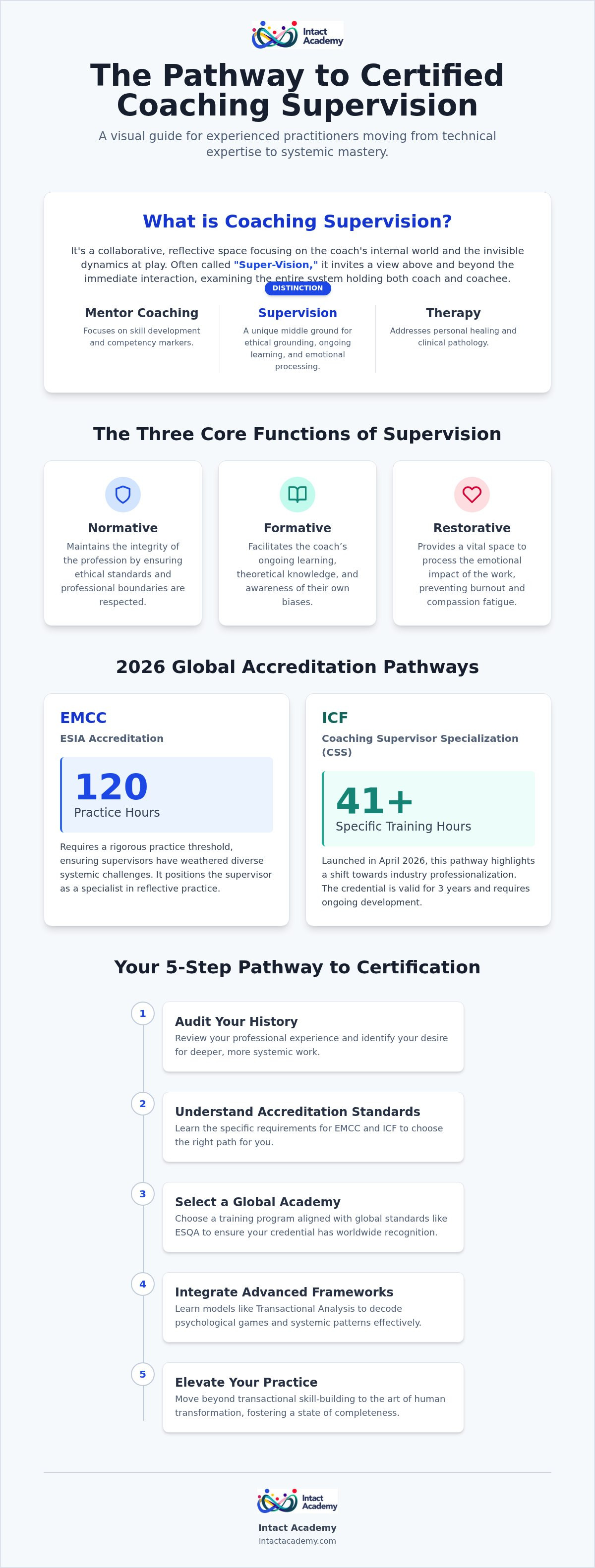
Coaching supervision is more than a quality check; it's a collaborative, reflective space where professional development meets deep psychological inquiry. While Coaching focuses on the client's progress, supervision focuses on the coach's internal world and the invisible dynamics at play. It's often called "Super-Vision" because it invites you to look above and beyond the immediate interaction. You aren't just looking at the coachee; you're looking at the system that holds both the coach and the coachee. It is a space where the technical meets the soulful, and the individual meets the organizational.
Many practitioners researching how to become a certified coaching supervisor initially confuse the role with mentor coaching or therapy. Mentor coaching is focused on skill development and competency markers. Therapy addresses personal healing and clinical pathology. Supervision, however, holds a unique middle ground. It operates through three core functions that ensure a coach remains effective and ethically grounded:
- Normative: Maintaining the integrity of the profession by ensuring ethical standards and professional boundaries are respected.
- Formative: Facilitating the coach’s ongoing learning, theoretical knowledge, and internal awareness of their own biases.
- Restorative: Providing a vital space to process the emotional impact of the work, preventing burnout and compassion fatigue.
Beyond Technical Skill: The Shift in Identity
The journey to becoming a supervisor involves a fundamental shift in identity. You move from being the expert who provides solutions to becoming a reflective partner for other professionals. This transition requires a high degree of psychological maturity. You must be able to handle parallel processes, which are situations where the dynamics between the coach and their client are mirrored in the relationship between you and the coach. Experienced coaches often reach a plateau where more techniques don't help. They need the reflective lens that only supervision provides to move from doing coaching to being a coach.
The Systemic Context of Professional Supervision
Understanding what is coaching supervision requires looking at the wider organizational system. Individual coaching can sometimes become a vacuum, ignoring the pressures of the corporate environment. Supervision pulls back the curtain to reveal how the client's organization, the coach's background, and global cultural trends intersect. This systemic awareness is vital for maintaining the integrity of the profession worldwide. If you're exploring how to become a certified coaching supervisor, you're committing to becoming a guardian of these complex, interconnected spaces, ensuring that every coaching intervention serves the whole system.
Accreditation Standards: EMCC and ICF Supervision Frameworks
The journey toward professional excellence often leads to a pivotal question: how to become a certified coaching supervisor in a way that honors both your experience and the complexity of the systems you serve? Accreditation provides the necessary scaffolding for this evolution. The two primary global bodies, the EMCC and the ICF, have significantly refined their standards as of 2026. Seeking EMCC Supervision Accreditation (ESIA) requires a rigorous 120-hour practice threshold, ensuring that supervisors have weathered a variety of systemic challenges before receiving their credentials. This level of rigor ensures that the supervisor is not just a senior coach, but a specialist in reflective practice.
The ICF has also moved toward formalization with its Coaching Supervisor Specialization (CSS), launched in April 2026. This pathway requires at least 41 hours of specific supervisor training, highlighting a shift toward professionalization across the industry. The CSS credential remains valid for three years, requiring ongoing professional development to maintain. Understanding these nuances is the first step in learning how to become a certified coaching supervisor who can operate with quiet power across borders. For a global practitioner, choosing a program that aligns with both frameworks offers the greatest flexibility, ensuring your mastery is recognized in any organizational context.
The 7-Eyed Model of Supervision Explained
Systemic supervision requires a lens that can zoom from the micro-details of a conversation to the macro-dynamics of an organization. Peter Hawkins’ 7-Eyed Model provides this diagnostic clarity. It moves from the coachee’s world (Eye 1) and the coach’s interventions (Eye 2) to the deeper relationship dynamics (Eye 3) and the supervisor’s own internal resonance (Eye 6). In a high-stakes corporate environment, this model allows you to see how a CEO's anxiety might be traveling through the coach and into the supervisory space. It transforms a simple case study into a map of organizational health, allowing the supervisor to intervene at the root of the systemic issue.
Ethical Maturity and the Professional Container
True supervision moves beyond a simple checklist of rules. It demands ethical maturity, a state where you don't just follow a code but embody a presence that can hold the "unthinkable" for a coach. This involves rigorous contract management, ensuring that the needs of the coach, the client, and the sponsoring organization are all held in balance. When you are navigating ethical dilemmas in coaching, the supervisor acts as the guardian of the professional container. This protective role ensures the work remains transformative rather than merely transactional. If you feel ready to deepen this container, exploring a systemic supervision program can provide the structured methodology needed for this transition.
The Transactional Analysis Edge in Coaching Supervision
While accreditation provides the necessary structure for your practice, the theoretical framework you adopt provides its psychological soul. Understanding how to become a certified coaching supervisor requires more than just meeting the 2026 hour requirements; it demands a deep lens to decode the invisible threads of human interaction. Transactional Analysis (TA) offers this precision. It allows supervisors to move beyond the literal narrative to identify the "Psychological Games" that often play out between a coach and their client. By identifying these repetitive, unconscious patterns, you help the coach reclaim their autonomy and effectiveness in the face of complex interpersonal dynamics.
A supervisor grounded in TA doesn't just listen to the case study. They observe the Ego States, Parent, Adult, and Child, that are active within the coaching narrative. This is particularly vital when analyzing the Parallel Process, a phenomenon where the coach unintentionally mirrors the coachee’s dynamics during the supervision session. While ICF Supervision Frameworks emphasize the importance of reflective practice, TA provides the specific language to map these shifts in real time. It ensures that the "Contracting" competency is handled with absolute clarity, accounting for the psychological, professional, and administrative layers of multi-party agreements in high-stakes environments.
Mapping Unconscious Patterns with TA
Every practitioner carries a "Life Script," a set of unconscious beliefs formed early in life that dictates how they respond to stress, success, and conflict. In the supervisory space, these scripts often manifest as professional blind spots. A coach might have an insatiable "Recognition Hunger," seeking "Strokes" or validation from their clients rather than facilitating growth. Transactional Analysis is a systemic framework that illuminates the internal scripts and interpersonal transactions that drive human behavior in professional settings. By bringing these patterns into the light, the supervisor creates a stable container for genuine, lasting change.
Systemic TA: From Individual to Organization
The mastery of supervision extends into the collective. Using models like the "Organizational Mountain," supervisors help coaches map the culture and power dynamics of the corporate systems they inhabit. This link between what is transactional analysis and sustainable change is what distinguishes a senior supervisor from a technical coach. It represents the pinnacle of professional development for coaches, moving them toward a state of completeness where they can hold the weight of an entire system without losing their grounding. This psychological depth is the essential "inner work" that ensures the coaching profession remains both deeply human and organizationaly impactful.
A Step-by-Step Pathway to Certification in 2026
Transitioning into the role of a supervisor requires a deliberate alignment with global standards that have become increasingly rigorous as of 2026. The journey is not merely about accumulating hours; it is about the documented evolution of your internal state and systemic awareness. Understanding how to become a certified coaching supervisor involves navigating a series of structured milestones that ensure you can hold the professional "container" with integrity and depth.
The first step is a thorough audit of your existing foundation. For those pursuing the ICF Coaching Supervisor Specialization (CSS), you must hold a PCC or MCC credential. If your path leads toward the EMCC, ensure your practitioner hours meet the current Senior level requirements before embarking on supervisor-specific training. Once your foundation is confirmed, you should select an accredited training program, ideally one carrying the European Supervision Quality Award (ESQA). This ensures the curriculum meets the highest global benchmarks for psychological and systemic rigor.
After completing your training, you enter the practice phase. You'll need to log significant hours as a "Supervisor-in-Training." For the EMCC Global Supervisor Individual Accreditation (ESIA), the mandatory threshold is 120 hours of practice. During this time, you must build a comprehensive supervision portfolio and reflective log. This isn't just a list of dates; it is a narrative of your growth, ethical decision-making, and systemic insights. Finally, you submit your application for individual accreditation, demonstrating that you've moved from technical proficiency to true mastery.
Evaluating Accredited Training Programs
When selecting a program, look beyond the curriculum. Faculty expertise is paramount. You want mentors who have seen the inner workings of diverse global systems. Peer-group diversity is equally vital; learning alongside practitioners from 14 or more countries provides a rich tapestry of cultural and systemic perspectives. Ensure the program offers "live" practice sessions and real-time feedback loops. In our digital age, the choice between online and in-person formats matters. Online programs often offer better access to a global systemic network, which is essential for modern executive work. If you are ready to begin this journey, the TA EMCC Senior Supervisor academy provides the depth and accreditation you need.
Building Your Supervision Portfolio
Your portfolio is the evidence of your reflective journey. It should document not just what happened in your sessions, but how you were impacted by the work and how you managed the parallel processes involved. A critical component is "Supervision of Supervision" (SoS). Just as coaches need supervisors, supervisors-in-training need their own mentors to process the complex dynamics of the supervisory relationship. This final assessment phase is your opportunity to demonstrate that you can maintain a safe, reflective space while navigating the most turbulent organizational systems.
The Intact Academy Approach: TA EMCC Senior Supervisor Academy
The path of the supervisor is ultimately a return to wholeness. At Intact Academy, we believe that learning how to become a certified coaching supervisor is not just a quest for another credential, but an invitation to master the art and science of human transformation. Our approach is grounded in the belief that systemic change requires both psychological depth and professional pragmatism. By integrating Transactional Analysis with advanced supervisory frameworks, we provide a stable container where the most complex organizational dynamics become manageable through insight and structured methodology.
Participants in our academy benefit from the direct guidance of Sari van Poelje, a global expert whose decades of experience in high-stakes executive environments bridge the gap between theory and practice. This isn't a solitary journey. You join a sophisticated network of professionals from over 14 countries, creating a global citizenship of practice that honors diverse perspectives and systemic nuances. This community acts as a mirror, reflecting your growth as you learn to hold space for others. Furthermore, our advanced supervision curriculum directly supports those seeking an executive coaching certification, providing the reflective depth necessary to sustain a high-impact practice in the modern corporate world.
Program Structure and EMCC Senior Accreditation
The TA EMCC Senior Supervisor academy is meticulously designed to meet the rigorous 2026 standards of the EMCC. Our modular format allows for deep learning that respects the maturity and professional commitments of our students. The curriculum weaves together the psychological precision of TA, the breadth of systemic work, and the core EMCC competencies. This unique structure allows practitioners to pursue their Senior Practitioner and Supervisor accreditations simultaneously, ensuring a seamless evolution of mastery. For the 2026 cohort, we have confirmed intensive sessions from October 7 to 10 in Poznan and October 14 to 17 in Zwolle. These live, synchronous environments provide the real-time feedback loops essential for developing a truly authoritative supervisory presence.
Your Invitation to Profound Transformation
We invite you to look inward before you take your next outward step. Our philosophy centers on the idea of returning to a state of completeness and genuineness, a thematic North Star that distinguishes our training from more transactional providers. If you feel called to move beyond the technical "doing" of coaching and into the transformational "being" of supervision, the time to transition is now. This is your opportunity to become a guardian of the profession, ensuring that the work of personal and professional change remains deeply human and ethically grounded. Take the first step toward your global accreditation and Explore the TA EMCC Senior Supervisor Academy today.
Stepping Into the Guardian Role of the Profession
The transition from senior coach to supervisor represents a profound evolution of your professional identity. It requires a fundamental shift from individual intervention to systemic oversight. In this new role, you hold the space for other practitioners to reflect, learn, and grow safely within an increasingly complex organizational landscape. By understanding the rigorous 2026 standards and the psychological depth of Transactional Analysis, you now have a clear view of how to become a certified coaching supervisor. This journey is as much about your internal state of completeness as it is about meeting the technical requirements for ESIA or ICF accreditation.
We invite you to join a global network of professionals committed to this higher level of mastery. Join the TA EMCC Senior Supervisor Academy at Intact Academy to learn from our international faculty led by Sari van Poelje. Our curriculum offers a unique integration of TA and systemic supervision, providing a direct path to EMCC Senior Practitioner and Supervisor accreditation. Your commitment to this path ensures the continued flourishing of the coaching profession globally. We look forward to supporting your transformation into a wise mentor and systemic guardian.
Frequently Asked Questions
What is the difference between mentor coaching and coaching supervision?
Mentor coaching focuses primarily on the development of specific coaching competencies and technical skills required for credentialing. Supervision is a broader, reflective practice that explores the coach's internal world and the systemic dynamics within their client relationships. It prioritizes ethical maturity and the psychological health of the practitioner over simple skill acquisition.
How many coaching hours do I need before I can become a supervisor?
To begin the process of how to become a certified coaching supervisor, you must first establish a deep foundation as an experienced practitioner. The ICF requires applicants to hold a PCC or MCC credential, while the EMCC expects you to be at the Senior Practitioner level. These benchmarks ensure you have the professional maturity to hold a safe and stable space for other coaches.
Is coaching supervision required for ICF credential renewal in 2026?
As of April 2026, the ICF recognizes coaching supervision as a vital component of professional development and a valid CCE opportunity. While it is not mandatory for all standard renewals, it is a strict requirement for those holding the Coaching Supervisor Specialization (CSS). These specialists must complete 10 hours of professional development every three years, with at least 5 of those hours being the receipt of supervision.
How long does it take to get a coaching supervision certification?
Most practitioners complete their certification within 9 to 12 months. This timeframe includes the formal training modules and the subsequent period required to log practice hours. For the EMCC ESIA, you must document a minimum of 120 hours of supervisory practice, a process that ensures you have encountered and managed a wide variety of systemic challenges.
What is the EMCC ESIA accreditation and why does it matter?
The ESIA stands for the EMCC Global Supervisor Individual Accreditation. It is a prestigious global marker of quality that demonstrates your ability to operate with systemic awareness and profound ethical depth. It matters because it provides a verified standard of excellence, giving organizations and individual coaches confidence in your ability to protect the integrity of the coaching profession.
Can I practice as a coaching supervisor without being certified?
You can technically practice without certification, but the professional landscape is shifting rapidly toward formalization. Major global organizations and coaching bodies now prioritize certified supervisors to mitigate systemic and ethical risks. Certification proves you have the psychological grounding to handle complex parallel processes that an untrained practitioner might overlook or mismanage.
What are the main models used in coaching supervision training?
The 7-Eyed Model developed by Peter Hawkins is the gold standard in the field, providing a comprehensive lens for analyzing the coachee, the coach, and the wider system. Other essential frameworks include the Three Functions of Supervision (normative, formative, and restorative) and the Full Spectrum Model, which helps supervisors navigate the diverse needs of their supervisees.
How does Transactional Analysis improve my supervision practice?
Transactional Analysis offers a precise psychological map for understanding the "unspoken" transactions in a coaching relationship. It helps you identify ego states and psychological games that can derail progress, making it a vital tool for those learning how to become a certified coaching supervisor. This depth allows you to facilitate genuine, lasting transformation by addressing the root causes of behavior.


