

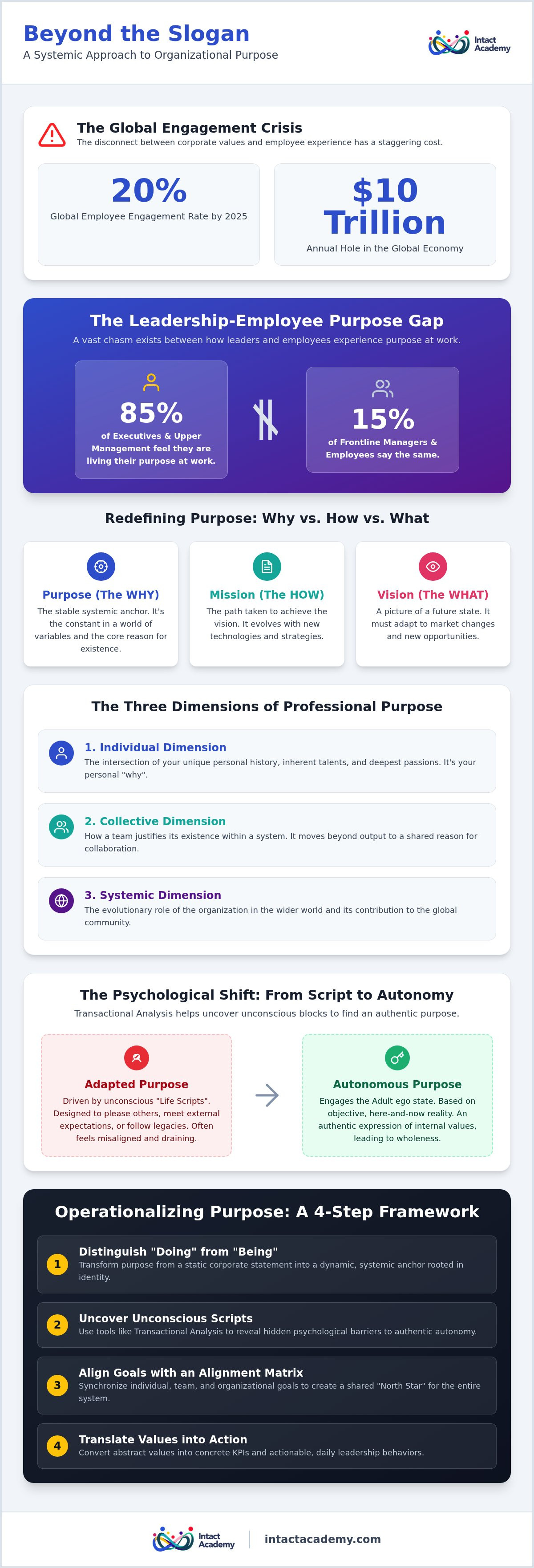
What if the purpose your organization proudly displays on its office walls is actually the primary source of your team's cynicism? It's a jarring thought, yet the data suggests a painful reality. By 2025, global employee engagement dropped to just 20 percent, leaving a staggering 10 trillion dollar hole in the global economy. You likely feel this friction every day. You've seen the glossy posters and the corporate values, but they often feel like thin veneers over a much deeper, unaddressed disconnection. It's exhausting to lead when the words don't match the internal experience of the system.
We believe that leadership should be an act of profound human transformation rather than a series of surface-level maneuvers. This article helps you move beyond generic slogans to find a psychologically deep, systemic anchor for your impact. We'll examine the specific tools needed to facilitate purpose-finding in teams and provide a framework to align your personal wholeness with your professional responsibilities. By looking inward before taking outward action, you can bridge the gap between stated values and lived reality.
Key Takeaways
- Learn to distinguish between "doing" tasks and "being" your identity, transforming your purpose from a static corporate statement into a dynamic systemic anchor.
- Discover how Transactional Analysis uncovers the unconscious "Life Scripts" that dictate professional choices. This clarity reveals the hidden psychological barriers to authentic autonomy.
- Master the Alignment Matrix to synchronize individual and organizational goals, creating a shared "North Star" for teams navigating complex transitions.
- Implement a structured four-step framework to translate abstract values into concrete KPIs and actionable daily leadership behaviors.
- Explore how bridging psychological depth with professional pragmatism fosters the wholeness required for sustainable mastery in coaching and leadership.
Beyond the Dictionary: What is Purpose in a Professional Context?
Dictionary definitions often fail us. They treat purpose as a static noun, a destination to be reached or a plaque to be hung, rather than the dynamic systemic anchor it truly is. In the context of organizational change, this concept is not a goal; it is a movement. It's the force that prevents a leader from drifting when market volatility rises or internal conflict threatens to derail progress. When we view it as an anchor, it becomes the primary driver of resilience. It allows leaders to hold a steady course, not through rigid control, but through a deep, internal alignment that survives even the most high-pressure environments.
There is a vital distinction between "doing" and "being" in this context. Most professionals spend their careers "doing" tasks they believe align with a corporate mission. However, profound transformation only occurs when we shift into "being." This is an identity-level integration where your professional role becomes an authentic expression of your internal values. Without this shift, work remains transactional. With it, work becomes a vessel for wholeness.
The urgency of this alignment is underscored by a staggering "Purpose Gap" identified in recent research. While 85 percent of executives and upper management report that they are living their core "why" at work, only 15 percent of frontline managers and employees say the same. This disconnect breeds deep organizational cynicism. When the majority of a workforce feels emotionally detached from the central reason for the company's existence, the system becomes fragile. Closing this gap isn't just a cultural initiative; it's a systemic necessity for survival.
The Three Dimensions of Professional Purpose
To understand how this anchor functions, we must look at it through three distinct lenses. First, the Individual Dimension involves the intersection of your unique personal history, your inherent talents, and your deepest passions. Second, the Collective Dimension examines how a team justifies its existence within a system, moving beyond mere output to a shared reason for collaboration. Finally, the Systemic Dimension considers the evolutionary role of the organization in the wider world, looking at how the entity contributes to the flourishing of the global community.
Purpose vs. Mission and Vision
We often see these terms used interchangeably, yet they serve different functions. Vision is the "what," a picture of a future state. Mission is the "how," the path we take to get there. In contrast, purpose is the "why." While a vision must adapt to market changes and a mission must evolve with new technologies, the "why" remains stable. It is the constant in a world of variables. Through the lens of Strategic Leadership, we see that the most effective leaders don't just manage tasks; they curate meaning. Purpose is the psychological contract between an individual and their work.
The Psychology of Purpose: Moving from Script to Autonomy
If we are to move beyond the surface of leadership, we must examine the psychological architecture that supports or subverts our intentions. Why do so many leaders feel a persistent disconnect between their stated goals and their daily lived experience? The answer often lies in the unconscious structures we carry. What is Transactional Analysis? It is a methodology that allows us to see these structures clearly, particularly the concept of the 'Life Script.' This script is an internal life plan, formed in our earliest years, that dictates how we believe we must behave to survive and succeed.
In a professional context, this script often creates an 'Adapted Purpose.' This is a version of purpose that is designed to please others, meet external expectations, or follow family legacies of success that may not align with our current reality. We might find ourselves trapped in a cycle of over-performance or conflict avoidance, mistakenly believing these behaviors are essential to our role. True 'Autonomous Purpose' only becomes possible when we engage the Adult ego state. This state allows us to process information objectively and make decisions based on the here-and-now, free from the dictates of past conditioning.
Uncovering the Unconscious Blocks to Purpose
Certain psychological 'Drivers' frequently masquerade as authentic ambition. The 'Be Perfect' driver can paralyze a team with unattainable standards; the 'Please Others' driver can lead to a leadership style that lacks the courage to set boundaries. These drivers are often played out through 'Psychological Games' in the workplace. These are repetitive, unconscious interactions that serve to reinforce old script beliefs while distracting from actual productivity. By identifying these patterns, leaders can stop the cycle of drama and refocus on their systemic impact. This level of insight is a cornerstone of the developmental work we facilitate at Intact Academy.
The Journey Toward Autonomy and Wholeness
The ultimate goal of this psychological work is autonomy, which Transactional Analysis defines through three specific capacities: Awareness, Spontaneity, and Intimacy. Awareness is the ability to see the world as it is, not as our script tells us it should be. Spontaneity is the capacity to react to the world with a full range of emotional and intellectual options. Intimacy is the courage to connect with others without the shield of psychological games. As we reclaim these capacities, we return to a state of wholeness. It is from this place of completeness that a genuine sense of direction emerges, allowing for more impactful Executive Coaching and leadership development.
Systemic Purpose: Aligning the Individual, Team, and Organization
Once we've addressed the internal scripts that dictate our behavior, we must turn our attention to the containers in which we work. The Alignment Matrix is a tool for understanding the friction that occurs when an individual's sense of purpose collides with the organization's trajectory. It isn't enough for a leader to be personally clear; they must also ensure that clarity ripples through every level of the system. Without this vertical alignment, even the most autonomous individual will eventually succumb to the gravity of a dysfunctional culture.
High-performing teams require a shared "North Star" to navigate the inherent complexity of modern business. When a team's direction is unclear, energy is wasted on internal politics and redundant efforts. Systemic Team Coaching serves as a vital intervention here, helping a group uncover its hidden reason for being. This process often reveals that a team's struggle isn't due to a lack of skill, but a lack of shared meaning. In one systemic intervention with a multinational firm, a structural deadlock between two competing departments was resolved only when they identified a shared goal: the preservation of long-term ecological integrity through their specific innovation. This shift moved them from a battle for resources to a collaborative effort for a greater legacy.
The 5 Levels of Systemic Alignment
To achieve true organizational health, we must look at alignment across five distinct layers:
- Personal Identity: Understanding who you are and what you stand for within the system.
- Role Clarity: Defining the specific purpose of your position beyond a mere list of tasks.
- Team Cohesion: Establishing what the "we" is trying to achieve together that no individual could do alone.
- Organizational Soul: Tapping into the core contribution the company makes to its industry.
- Global Impact: Recognizing how the entire system serves the wider environment and future generations.
Addressing the Conflict of Interests
There are moments when personal values and organizational directions no longer align. When this happens, the friction can lead to burnout or quiet withdrawal. The solution isn't always to leave, but to engage in a "Contracting" process. This involves a transparent renegotiation of the terms of engagement, looking for new ways the individual's growth can support the system's evolution. Mastering the art of Leading Organizational Change requires the courage to have these difficult conversations. It's about returning to a state of genuineness where both the person and the organization can flourish without compromising their integrity.
Operationalizing Purpose: A Framework for Coaches and Leaders
Theoretical clarity is merely the first step. To create lasting organizational impact, we must translate these psychological insights into concrete operational structures. This is a journey of strategic transformation where firms like Formatour Incorporated provide the advisory expertise needed to optimize operational performance and organizational resilience. This transition requires moving beyond the abstract and into the granular, ensuring that purpose is woven into the very fabric of daily operations. It is a process of moving from a state of reflection to a state of disciplined action, where every decision is filtered through a systemic lens of wholeness.
Step-by-Step Purpose Discovery
We utilize a four-step systemic inquiry to help leaders find their grounding. First, Step 1: Historical Inquiry involves uncovering the "Red Thread" of your life; those recurring themes, values, and strengths that have persisted through every professional and personal transition. Second, Step 2: Systemic Mapping requires identifying where you currently provide the most significant value within your specific organizational ecosystem. Third, Step 3: Script Analysis is the process of identifying and neutralizing the limiting beliefs or "drivers" that might distort your direction. Finally, Step 4: Integration involves crafting a statement that does not just describe a feeling, but prompts immediate, decisive action.
Once discovered, this direction must be translated into "Purposeful KPIs." These are not traditional metrics focused solely on volume or output; they are qualitative and quantitative indicators that measure alignment with your core "why." For instance, if your aim is to foster systemic innovation, your KPIs might include the diversity of perspectives included in new product development. Essential to this process is "Contracting for Change." This is the explicit agreement between a leader and their team on how daily behaviors will shift to support the new direction. Measuring the "Impact ROI" then becomes a matter of tracking the tangible benefits of this alignment. Research indicates that 73 percent of employees at purpose-driven companies report high engagement, compared to just 23 percent at traditional firms, representing a significant return on the investment of human potential.
Maintaining Alignment Over Time
The work of transformation is never truly finished; it requires ongoing vigilance and a commitment to professional mastery. Professional Supervision is a critical tool here, providing a safe, reflective container for leaders to examine their choices and ensure they haven't drifted back into old script patterns or unconscious "games." In a rapidly shifting global market, we also employ "Agile TA" to help leaders adapt their expression of impact without losing their core identity. In this sense, purpose serves as a compass, not a map. It provides a steady direction through uncharted territory, even when the specific terrain of the market changes. To deepen your own mastery of these frameworks and lead with systemic impact, we invite you to explore our TA EMCC Senior Practitioner academy.
Cultivating Purposeful Mastery: The Intact Academy Approach
Mastery is a process of becoming, not just a state of knowing. At Intact Academy, we understand that professional excellence requires more than a collection of techniques; it demands a profound commitment to one's own inner work. By bridging the gap between psychological depth and professional pragmatism, we create a space where complex systemic issues are resolved through insight rather than force. This approach, rooted in Sari van Poelje’s methodology, has transformed organizations across 14 countries by returning leaders to a state of completeness and genuineness.
The Executive Coaching Certification is designed for those who seek to lead with this level of depth. It moves beyond the transactional nature of typical training to foster a systemic anchor of purpose. When a leader operates from a place of wholeness, they stop reacting to the symptoms of organizational distress and begin addressing the underlying psychological causes. You can only lead a system as far as you have traveled within yourself.
The Path to EMCC Senior Practitioner Level
Our TA EMCC Senior Practitioner academy is specifically structured to prioritize impact over mere technique. While many programs offer surface-level fixes, we integrate Transactional Analysis and systemic models to deepen your coaching toolkit. This journey isn't just about gaining a credential; it's about joining a global community of practitioners dedicated to human flourishing. We focus on the practitioner's capacity to hold space for transformation, ensuring that your presence as a coach becomes the primary catalyst for change. It's a rigorous process that honors your maturity while challenging you to evolve.
Your Next Steps Toward Wholeness
As you reflect on the frameworks shared in this article, consider your current state of alignment. Are your daily actions an authentic expression of your purpose, or are they still dictated by old scripts? For those ready to begin this deep systemic journey, we invite you to explore the TA Foundation Year. This program provides the foundational psychological clarity needed to navigate the complexities of modern leadership with grace and authority.
Purpose is the gift you give to the systems you inhabit. It is the steady hand in the storm and the quiet power that invites others to return to their own state of wholeness. This principle of clear, purposeful direction is essential in any field requiring high-level coordination and trust, much like the professional training standards upheld by Alan's K9 Academy. By committing to this path of mastery, you ensure that your leadership is not just a role you play, but a contribution to a more conscious world.
Embracing the Journey Toward Systemic Mastery
Moving from the constraints of an unconscious life script toward a state of conscious autonomy is not a single event; it is a deliberate process of becoming. We've explored how systemic alignment requires you to look inward before you can effectively lead outward. By neutralizing the psychological drivers that masquerade as ambition, you create space for genuine impact that resonates through your team and the wider organization. This alignment of personal values with professional roles is the foundation of sustainable leadership.
True mastery in leadership and coaching requires a stable container for this profound transformation. Led by world-renowned Transactional Analysis expert Sari van Poelje, our programs provide the psychological rigor and systemic methodology needed for sustainable change. You'll join a global network of professionals from over 14 countries, supported by an academy accredited by both EMCC and ICF. Explore our TA EMCC Senior Practitioner Academy and find your professional purpose to begin your journey toward wholeness.
The path to professional excellence is open to those with the courage to change. Trust in your capacity to evolve and bring a state of completeness to every system you touch.
Frequently Asked Questions
What is the psychological definition of purpose?
Purpose is a stable, generalized intention to accomplish something that is both personally meaningful and of consequence to the world beyond the self. Unlike a passing interest, it acts as a central organizing principle for your life. It provides a sense of direction that persists through changing circumstances, helping you maintain a state of wholeness by aligning internal values with external actions.
How is purpose different from a personal mission statement?
A mission statement typically outlines the "how" and "what" of your current professional path, focusing on specific goals and strategies. In contrast, purpose is your fundamental "why," an enduring identity that remains constant even if your mission changes. While a mission is a roadmap for a specific season of work, your core direction serves as the compass that guides your long-term evolution.
Can an organization have a purpose if the employees don't feel it?
An organization can possess a formal statement of intent, but it doesn't truly inhabit its reason for being if the workforce is emotionally detached. When only 15 percent of frontline managers and employees feel they are living their values at work, a "Purpose Gap" emerges. Without lived experience, these values are merely marketing veneers that often fuel organizational cynicism rather than driving meaningful systemic change.
How do I find my purpose if I feel stuck in a corporate role?
Finding your direction while feeling stuck requires looking inward to identify the "Red Thread" of your life; those recurring themes and strengths that transcend your current job description. You must distinguish between your authentic desires and the "Adapted Purpose" formed by early script decisions. By engaging your Adult ego state, you can re-decide how to use your unique talents to serve the system genuinely.
What role does Transactional Analysis play in discovering purpose?
Transactional Analysis (TA) provides the tools to uncover the unconscious "Life Script" that often dictates our professional choices. It helps leaders identify "Drivers" like Be Perfect or Please Others that masquerade as authentic ambition. By neutralizing these patterns, TA allows you to move toward autonomy, creating a clear space where a psychologically deep and systemic anchor for action can finally emerge.
Is it possible for a team's purpose to conflict with the company's purpose?
Conflicts often arise when a team's local goals diverge from the organization's broader trajectory. This friction usually indicates a lack of systemic alignment or a breakdown in the contracting process. High-performing teams must renegotiate their "North Star" to ensure their collective contribution supports the organizational soul without losing their unique identity, turning potential conflict into a catalyst for evolution and growth.
How much does a purpose-driven culture actually impact the bottom line?
The impact is measurable and significant. Research shows that 73 percent of employees at purpose-driven companies report high engagement, compared to just 23 percent at traditional firms. This engagement directly correlates to productivity and innovation. Companies with high clarity of intent have been shown to achieve superior financial returns by bridging the gap between profit and the creation of value for all stakeholders.
What is the first step for a coach to help a client find their purpose?
The first step is a deep historical inquiry to uncover the recurring values and passions that have shaped the client's journey. A coach facilitates this by looking for the "Red Thread" that connects past successes with current aspirations. This process involves identifying the unconscious patterns that might be blocking their path, allowing the client to return to a state of completeness before they take outward action.


