

If you find yourself constantly reacting to the loudest voice in the room, have you ever stopped to ask which part of your internal script is actually holding the pen? Many leaders operate under the weight of chronic overwhelm, feeling a deep misalignment between their personal values and the daily urgencies that demand their attention. It's a common struggle to realize that the tools designed to help us manage our priorities often fail because they ignore the deep-seated behavioral patterns that drive our decision-making.
We believe that true leadership requires a return to a state of completeness, where your outward actions reflect your inner integrity. In this guide, you'll discover how Transactional Analysis and systemic thinking can help you distinguish between noisy distractions and the essential work that creates lasting impact. We'll examine the unconscious scripts that dictate your daily choices and provide strategies to lead your team through complex organizational shifts. By looking inward first, you can develop the quiet power needed to sustain focus in a world of competing demands.
Key Takeaways
- Reclaim your focus by understanding how the modern pluralization of priorities creates a psychological paradox that dilutes your leadership impact.
- Identify the five internal "Drivers" from Transactional Analysis that unconsciously dictate your daily choices and behavioral patterns.
- Recognize the "Shadow Culture" within your organization to ensure that systemic loyalties don't undermine your official strategic goals.
- Master the process of "Contracting for Change" to create a stable container for shifting personal and team focus toward genuine value.
- Transition from surface-level task management to the systemic mastery required for profound organizational transformation and professional growth.
Defining Priorities: From Linguistic Meaning to Psychological Reality
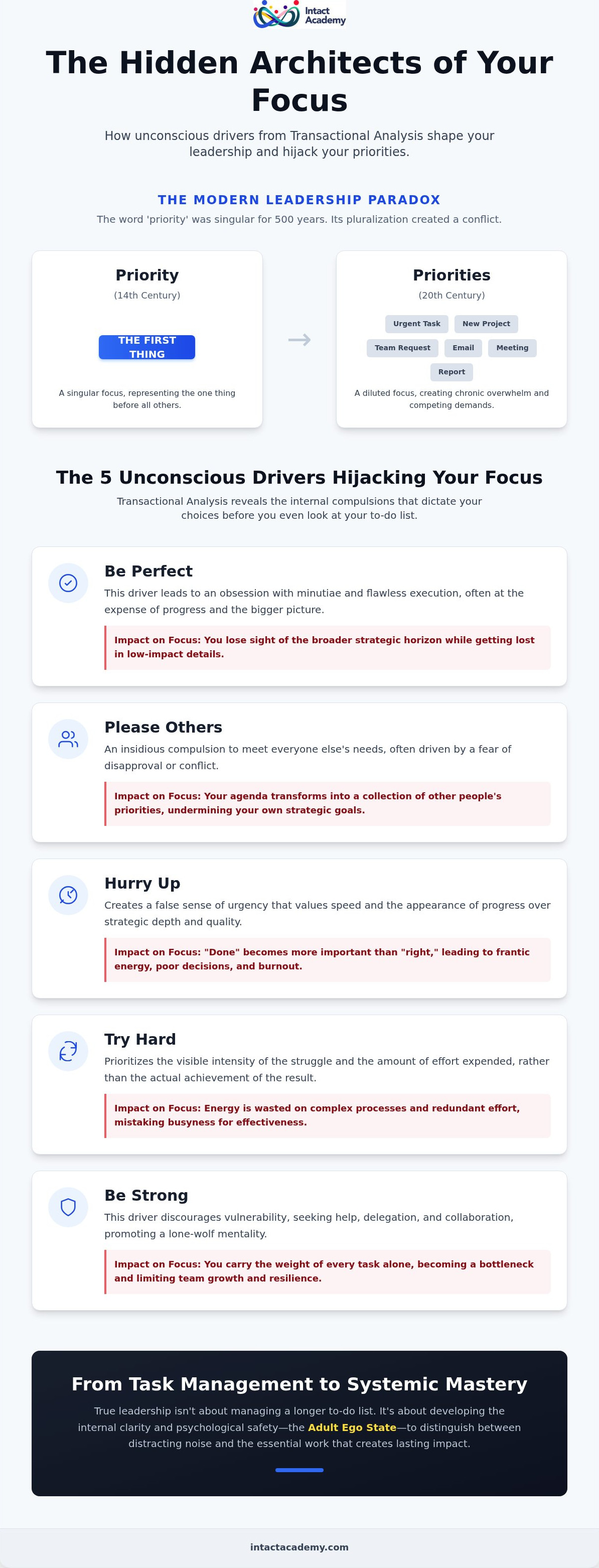
The word "priority" came into the English language in the 14th century, originating from the Latin prior, which simply means "first." For half a millennium, the word remained singular; it described the one thing that stood before all others in terms of time, rank, and importance. It was only during the industrial era that we began to speak of the term in the plural, attempting to bend the laws of logic by having multiple "first" things. This linguistic shift created a modern leadership paradox that many struggle to resolve today.
When we look beneath the surface of a calendar or a to-do list, we find that the way a leader manages priorities is a direct reflection of their internal psychological reality. It's a visible manifestation of their values, their boundaries, and their dominant ego states. From a Transactional Analysis perspective, our choices are often driven by unconscious scripts rather than objective necessity. We must learn to distinguish between functional tasks required for daily operation and existential purpose that represents the long-term health of the system. One keeps us busy; the other keeps us meaningful.
The Urgent vs. The Important: A Systemic Re-evaluation
While many are familiar with the Eisenhower Matrix, a sophisticated leader looks beyond simple grids toward systemic impact. In many organizations, "urgency" functions as a psychological defense mechanism. It provides a frantic energy that masks a lack of clear direction or a fear of engaging with high-stakes, complex problems. Identifying the "noise" that masquerades as an urgent demand requires a calm, reflective stance. We must ask if a task is truly vital for evolution or merely a distraction from the work of becoming. Effective prioritization involves stripping away these systemic distractions to reveal the core objectives that drive genuine growth.
Boundary Management and the Adult Ego State
Setting a strategic focus is, at its heart, an exercise in boundary management. To say "yes" to a singular goal, one must possess the psychological safety to say "no" to a dozen other demands. This is rarely a matter of time management; it's a matter of internal permission. Using the Adult ego state allows a leader to make objective decisions based on current reality rather than falling into "Please Others" or "Be Perfect" drivers. When organizational boundaries are weak, focus points bleed into one another, resulting in a state of chronic dilution where resources are scattered and impact is minimized. Strengthening these boundaries is the first step toward reclaiming clarity and integrity in your leadership practice.
The Hidden Architects: How Transactional Analysis Shapes Your Focus
While we might believe our priorities are the result of purely rational analysis, Transactional Analysis (TA) suggests otherwise. These choices are often the work of hidden architects: our internal drivers and life scripts. TA offers a profound methodology for professional mastery by revealing the unconscious patterns that dictate where we place our attention. It moves us beyond surface-level productivity into a space where we can understand why we choose certain tasks over others, even when those choices conflict with our stated goals.
In the framework of TA, we identify five specific "Drivers" that function as internal compulsions. These drivers often hijack our focus before we've even reached for our calendars. They include:
- Be Perfect: Leads to an obsession with minutiae, causing leaders to lose sight of the broader strategic horizon.
- Please Others: This driver is particularly insidious, as it transforms your agenda into a collection of other people's needs.
- Hurry Up: Creates a false sense of urgency that values speed over strategic depth.
- Try Hard: Prioritizes the intensity of the struggle rather than the achievement of the result.
- Be Strong: Discourages delegation and collaboration, forcing a leader to carry the weight of every task alone.
Drivers and the Trap of the 'Hurry Up' Priority
Speed is a seductive metric. It feels like progress. However, for a leader driven by the "Hurry Up" script, the rush to complete tasks often comes at the expense of quality and long-term alignment. This compulsion creates a frantic environment where "done" is valued more than "right." Similarly, the "Try Hard" driver can lead you to prioritize effort for the sake of effort. You might find yourself exhausted by a heavy workload that yields very little systemic value. To break these cycles, coaches must help clients identify these drivers in real-time. Learning to prioritize your time and energy requires the courage to slow down and evaluate the psychological "why" behind the rush.
Script Analysis: Are You Prioritizing Your Own Success?
Beyond daily drivers lies the "Life Script," an unconscious plan made in childhood that continues to influence adult behavior. Some leaders struggle with injunctions such as "Don't Succeed" or "Don't Be Important." These scripts create self-sabotaging priority lists where the most impactful work is perpetually pushed to the bottom. You might stay busy with trivialities to avoid the visibility that comes with true success. Understanding these patterns is essential for anyone seeking to return to a state of genuineness. You can explore these concepts further in our guide to Transactional Analysis. Recognizing these scripts is a vital step toward reclaiming your agency and ensuring your daily actions serve your true purpose.
Systemic Priorities: Navigating Organizational Culture and Change
In a healthy organization, priorities aren't merely top-down directives; they function as a collective agreement. While an executive might announce a new strategic direction, the true focus of a team is revealed by where its energy actually flows. From a systemic perspective, we see that organizations often possess a "Shadow Culture." These are the unwritten rules and unspoken loyalties that dictate behavior far more effectively than any official slide deck. If the formal strategy demands innovation but the shadow culture rewards silence and safety, the system will always choose safety. Understanding this misalignment is the first step toward genuine organizational health.
When leadership attempts to introduce change, they often encounter a invisible wall of resistance. This isn't usually due to a lack of competence or effort. Rather, it happens because new priorities frequently clash with old systemic loyalties. Employees may feel a deep, unconscious need to protect the "old way" out of respect for a founder or a previous era of success. In these moments of turbulence, the leader must act as a priority anchor. This means holding a steady, calm space where the team can acknowledge the past while firmly committing to the requirements of the future.
Uncovering Shadow Priorities in Teams
Surfacing hidden agendas is a critical skill for anyone leading organizational change. Teams often develop "default priorities" designed to preserve the status quo and avoid the discomfort of growth. You might notice a team that stays busy with low-stakes administrative tasks to avoid facing a difficult market reality. This is a form of systemic exclusion; the team chooses to ignore the most vital issues to maintain a false sense of harmony. By bringing these patterns into the light, you create the opportunity for the system to choose a different, more generative path.
Aligning Systemic Energy with Strategic Goals
To align a team's energy with its stated goals, we use the "Contracting" model. This involves creating clear, explicit agreements at every level of the organization about what is truly important. It's not enough to set a goal; you must map the flow of energy to see where the collective time is actually being spent. Are your resources following your words? If not, there's a breach in the contract. Systemic supervision provides the necessary stable container for this work, allowing leaders to reflect on these dynamics without getting lost in the daily noise. This process ensures that professional focus remains sharp, even when the environment is shifting rapidly.
Mastering the Art of Prioritization: Actionable Strategies for Coaches and Leaders
Mastering your priorities isn't a skill you acquire through a single workshop; it's a developmental journey toward professional mastery. It requires shifting from the frantic energy of reactive "firefighting" to the steady, quiet power of proactive systemic intervention. This transition demands more than a new app or a better calendar. It requires a profound re-negotiation of your internal and external agreements, a process we call "Contracting for Change." By integrating psychological insights into your daily decision-making, you move from being a victim of your schedule to being the architect of your impact.
The Systemic Priority Audit: A 5-Step Process
To reclaim your focus, you must first understand the energetic signature of your current commitments. This audit helps you peel back the layers of "busywork" to find the essential tasks that drive true evolution.
- Step 1: Inventory Commitments by Ego State. Look at your list. Which tasks come from the Parent (shoulds and obligations), the Child (wants and fears), or the Adult (objective reality)?
- Step 2: Identify the 'Driver'. Be honest about why you're doing a task. Is it to "Be Perfect" or "Please Others"? Recognizing the driver allows you to choose a different response.
- Step 3: Map Systemic Needs vs. Script Needs. Distinguish between what the organization actually requires for health and what your unconscious script requires to feel safe or important.
- Step 4: Practice 'Radical Contracting'. This involves re-negotiating the "yes" and "no" in your life. It's the courageous act of setting boundaries that honor your primary objectives.
- Step 5: Establish a Reflective Practice. True change takes root when you have a stable container for reflection. Explore our professional development for coaches to deepen this methodology.
Developing 'Executive Presence' Through Decisive Prioritization
There is a profound relationship between focus and what we call "wholeness." When a leader's priorities are aligned with their core professional mission, they radiate a sense of integrity and quiet power. This clarity builds trust within a team; people feel safe when they know exactly what the "anchor" is. Decisive prioritization isn't about being rigid. It's about being so grounded in your Adult ego state that you can adapt to change without losing your center. Using systemic supervision is vital here, as it provides the external perspective needed to stay aligned when the environment becomes turbulent. When you lead from a place of completeness, your choices become an invitation for others to do the same.
If you're ready to move beyond surface-level time management and master the psychological depths of leadership, consider joining our TA EMCC Senior Practitioner academy to transform your practice.
Elevating Your Practice: From Task Management to Systemic Mastery
The journey toward professional mastery isn't a linear climb; it's a process of deepening your capacity to hold complexity. While a junior practitioner might focus on the logistics of task management, a Senior Practitioner understands that priorities are the heartbeat of the organizational system. This level of mastery requires a fundamental shift in perspective. It's about developing the internal stability needed to guide others through the turbulent waters of change. Intact Academy provides the stable container for this transformation, offering a space where rigorous theory meets profound human insight.
Transitioning to this senior level means moving beyond the "what" of leadership and into the "how" of human systems. It involves recognizing that every choice made by a leader ripples through the entire organization, affecting psychological safety and collective performance. When you master systemic focus, you're no longer just managing a calendar; you're stewarding the energy of a living system. This work requires a return to a state of genuineness, where your professional actions are perfectly aligned with your internal values.
The TA EMCC Senior Practitioner Academy
Our academy is designed for those who seek to integrate Transactional Analysis, systemic coaching, and organizational change into a singular, powerful practice. This is not just another certification. It's an accredited, psychologically-grounded training recognized by the EMCC and ICF, reflecting our commitment to the highest global standards. By mastering the tools of TA, you gain the ability to see the hidden scripts and systemic drivers that others miss. You learn to help leaders and teams align their energy with their deepest purpose, turning competing priorities into a unified path forward. This is where you move beyond the surface and begin to work with the underlying structures of human behavior.
Commit to Your Evolution
True leadership is an inside-out process. The most effective leaders recognize they must prioritize their own developmental journey to remain relevant in a rapidly shifting professional landscape. As we've explored, human skills like empathy and systemic foresight are the ultimate competitive advantages in a world of increasing automation. By engaging with Sari van Poelje’s systemic insights, you aren't just learning a methodology; you're joining a global community of masters dedicated to human flourishing and organizational health.
The path to systemic mastery is open to those with the courage to change. Whether you're an executive coach, a team leader, or a change agent, your personal evolution is the key to your team's success. We invite you to step into this stable container and discover what's possible when you lead from a place of wholeness and integrity. Your next step in professional mastery begins with the decision to look deeper.
Reclaiming the Center of Your Leadership
Mastering your focus is a journey of returning to your most genuine self. It requires the courage to look beneath the surface of daily demands to find the internal drivers and systemic loyalties that truly hold the pen. When you move from reactive firefighting to a grounded, Adult state, you don't just manage your time; you steward the energy of your entire organization. This shift from practitioner to master is marked by the ability to align your priorities with both systemic health and personal integrity.
True transformation happens when you have a stable container for this deep learning. Our programs offer a unique blend of psychological depth and professional pragmatism, led by a global faculty of experts. With EMCC and ICF accredited curricula focused on Transactional Analysis and systemic change, we ensure your growth is recognized on an international stage. If you're ready to move beyond surface-level tools and redefine your impact, we invite you to join our community.
Deepen your systemic impact at the TA EMCC Senior Practitioner Academy.
Your evolution is the most important contract you'll ever sign. We look forward to supporting your flourishing.
Frequently Asked Questions
What is the psychological difference between a priority and a goal?
A goal is a specific destination or outcome you intend to reach in the future, while a priority is the value-based ranking of your choices in the present moment. Goals provide direction, but priorities reflect your integrity and boundaries in the "here and now." Understanding this distinction helps leaders move from chasing distant targets to making grounded, impactful decisions every day.
How do Transactional Analysis 'Drivers' interfere with effective prioritization?
Drivers like "Please Others" or "Be Perfect" function as unconscious compulsions that override rational decision-making. When these drivers are active, you might prioritize appeasing a colleague or obsessing over minor details instead of focusing on high-level strategy. Recognizing these internal pressures is the first step toward reclaiming your Adult ego state and making objective choices based on current reality.
Why do teams struggle to agree on priorities even with a clear strategy?
Teams often struggle because of the "Shadow Culture," where unwritten rules and systemic loyalties carry more weight than the official strategy. Even if a document states that innovation is the goal, the team might prioritize safety if the system historically punished failure. Aligning a team's priorities requires surfacing these hidden agendas and creating new, explicit agreements through the process of contracting.
Can systemic coaching help an individual improve their personal prioritization?
Systemic coaching is highly effective for personal focus because it treats the individual as an integral part of a larger organizational web. It helps you see how your personal choices are influenced by the expectations of the system and how your focus ripples outward. This broader perspective allows you to set boundaries that honor both your professional mission and the health of the collective.
What is 'Contracting' and how does it relate to setting priorities?
Contracting is the formal process of establishing clear, mutual agreements about expectations, roles, and outcomes. In the context of leadership, it ensures that everyone involved has a shared understanding of what truly comes first. By making these agreements explicit, you eliminate the ambiguity that often leads to conflicting focus and wasted systemic energy.
How does 'Life Script' influence my career priorities?
A Life Script is an unconscious plan formed early in life that can dictate which professional achievements you feel are "permissible." For instance, if your script includes an injunction like "Don't Be Important," you might unconsciously prioritize low-visibility tasks to avoid the pressure of the spotlight. Analyzing these scripts allows you to rewrite your career path with greater genuineness and purpose.
What is the benefit of coaching supervision for prioritization issues?
Supervision provides a stable container for reflection, allowing you to identify blind spots in your decision-making. It helps you see when your own psychological drivers or script issues are distorting your professional focus. Through this objective dialogue, you can stay aligned with your core mission and ensure your leadership remains grounded and effective.
How can I tell if my priorities are driven by my 'Adult' or 'Child' ego state?
Adult-driven choices are based on current data, objective needs, and a calm assessment of reality. If your focus is driven by the Child ego state, you'll often feel a sense of emotional urgency, a fear of disapproval, or a desire for immediate gratification. Learning to pause and check your internal state ensures that your actions serve the system's long-term health rather than a temporary emotional need.


