

What if the most significant shifts in your leadership team are the very things your current spreadsheets are designed to ignore? It's a common tension in the executive suite; you witness a profound psychological transformation in a leader or a systemic softening of conflict within a team, yet you struggle to translate that evolution into the language of the board. You aren't alone in feeling that traditional ROI metrics often fail to grasp the weight of human growth, leaving you with vanity data that barely scratches the surface of organizational health.
I'll show you how to move beyond these surface-level indicators to define and track results that capture the reality of human transformation and systemic maturity. By grounding your approach in a sophisticated framework for qualitative change, you'll gain the confidence to present the ROI of team coaching as a vital driver of business success. We'll examine how the way we measure change actually shapes the way people grow, ensuring your data serves as a mirror for the wholeness and genuineness your organization seeks to achieve.
Key Takeaways
- Reframe ROI as a vital bridge between your current organizational reality and a future state of systemic maturity and transformation.
- Understand the psychological "Observer Effect" to ensure your chosen metrics foster genuine growth rather than triggering defensive or regressive team behaviors.
- Apply Transactional Analysis frameworks to quantify shifts in team ego states, making the "invisible" dynamics of leadership clearly visible and actionable.
- Master the process of "Contracting for Change" to distinguish between lead indicators of behavior and the long-term lag indicators of cultural health.
- Discover how systemic supervision provides a stable container for auditing the deeper, qualitative layers of human and organizational flourishing.
What Are Metrics? Defining the Quantifiable in a Qualitative World
In the quiet space between an executive's current struggle and their eventual breakthrough, we find the need for a common language. Metrics are often misunderstood as mere accounting tools; in reality, they serve as the vital bridge between a leader's present reality and their desired transformation. While traditional business models view performance measurement through the lens of spreadsheets, we must look deeper. Raw data tells us what happened yesterday; these measurements tell us how we are evolving today. Actionable wisdom emerges only when we stop counting tasks and start measuring the movement of the human system itself.
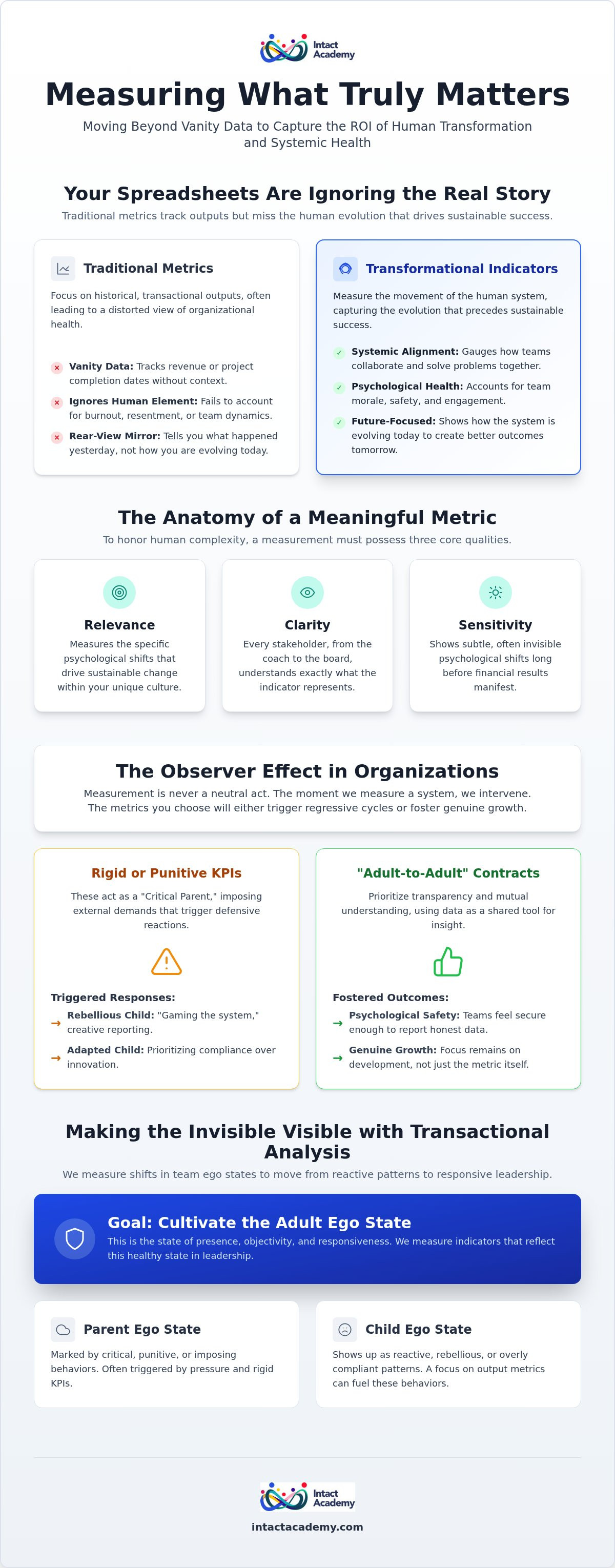
Traditional business indicators often falter because they ignore the human element. They track transactional outputs like revenue or project completion dates. While mastering these technical foundations is vital—and resources like IAB Academy provide the financial literacy and AI insights needed to navigate them—these numbers are necessary, yet they're insufficient for capturing the profound shifts of a team in flux. If a leadership team increases their output but does so through burnout and resentment, the measurement is lying. True indicators in coaching must account for the psychological health and systemic alignment that make sustainable success possible. We aren't simply looking for more work; we're looking for better ways of being.
The Anatomy of a Meaningful Metric
A measurement that honors human complexity must possess three core qualities. First, it requires relevance. It must measure the specific psychological shifts that drive sustainable change within your unique culture. Second, it needs clarity. Every stakeholder, from the coach to the board, should understand exactly what the indicator represents. Finally, sensitivity is paramount. A meaningful indicator is capable of showing the subtle, often invisible psychological shifts that occur long before a financial result manifests. It identifies the "becoming" before it's "become."
KPIs vs. Metrics: Navigating the Hierarchy of Impact
It's vital to distinguish between broad metrics and Key Performance Indicators (KPIs). While all KPIs are measurements elevated to a level of strategic importance, not every data point deserves that title. Organizations often fall into the trap of "vanity data," tracking indicators that look good on paper but offer no insight into systemic health. In our work, we focus on indicators that reflect the Adult ego state in leadership. This approach, rooted in Transactional Analysis, allows us to see beyond surface-level reactions. We look for measures of objectivity, presence, and responsiveness, rather than the reactive patterns of the Child or Parent ego states often seen in high-pressure environments.
The Psychology of Measurement: Why Metrics Shape Behavior
Measurement is never a neutral act. The moment we introduce a set of metrics into a leadership system, we are no longer merely observing; we are intervening. This is the organizational equivalent of the Observer Effect in physics. The act of being measured shifts the internal state of the individual and the collective. If a leader knows their performance is being distilled into a specific data point, their focus narrows. Their energy moves toward the measurement itself rather than the underlying growth the measurement was intended to track.
Within the framework of Transactional Analysis, rigid or punitive KPIs often function as a "Critical Parent" figure. They impose external demands that can inadvertently trigger a "Rebellious Child" response in even the most seasoned executives. We see this manifest as "gaming the system" or creative data reporting. Conversely, it might trigger an "Adapted Child" response, where leaders prioritize compliance over innovation. To avoid these regressive cycles, we must establish "Adult-to-Adult" contracts around measurement. These contracts prioritize transparency and mutual understanding, ensuring that data serves as a shared tool for insight rather than a weapon for judgment.
Measurement as a Transactional Event
Every data point recorded is a potential "stroke," a unit of recognition in the psychological sense. When an organization rewards only the metrics of output, it fuels "games" such as "Look How Hard I’m Working." Leaders may focus on visible, quantifiable tasks while neglecting the subtle work of cultural health. By transitioning to developmental feedback loops, we move the focus from punishment to potential. This shift requires a high degree of psychological safety, where leaders feel secure enough to report honest, even uncomfortable, data. If you are looking to deepen your understanding of these dynamics, our work in Systemic Supervision can help you audit the invisible forces at play in your team.
Metrics and the Life Script
Organizations, like individuals, operate under a "script"—a set of unconscious beliefs about how to survive and succeed. Often, these scripts dictate what is considered worth measuring. If a culture has a "Don’t Succeed" script, it may choose metrics that focus on failure or maintenance rather than growth. Empowering metrics break these patterns. They support a narrative of "becoming," focusing on the evolution of a leader's capacity. We move from measuring what they are "doing" to tracking the expansion of their "being." This approach honors the complexity of the human experience while maintaining professional rigor.
Measuring the Unmeasurable: Systemic and TA Metrics
While traditional scientific units focus on objective distance or universal constants, the metrics of human transformation require a more nuanced lens. We aren't simply measuring the speed of a process or the volume of an output. Instead, we are quantifying the quality of the "space between" people. To measure the systemic impact of coaching, we must look at how a leadership team functions as a single, living organism. This involves tracking the subtle shifts in team cohesion and the collective capacity to hold tension without fragmenting. These measurements allow us to move from subjective "feelings" of improvement to a structured understanding of systemic health.
Using Transactional Analysis, we can map the movement of ego states across an entire leadership team. Are the majority of interactions occurring in a reactive Parent-Child dynamic, or is there a measurable shift toward Adult-to-Adult functioning? By tracking these ego state distributions over time, we gain a clear picture of developmental progress. Similarly, psychological safety serves as a primary lead indicator for performance. When a team reports higher levels of safety, we can reliably predict future gains in innovation and speed. These aren't just "soft" concepts; they are the behavioral foundations upon which all financial ROI is built.
The Systemic Health Scorecard
A robust scorecard begins with the quality of "Contracting" within the team. We measure how clearly goals are defined and how effectively the team reaches consensus. We also track the frequency and intensity of "Psychological Games," those repetitive, unproductive patterns that drain organizational energy. As these games decrease, we see a measurable rise in "Autonomy." In the TA framework, autonomy is defined by awareness, spontaneity, and the capacity for intimacy. Tracking these three markers provides a profound look at the system's maturity and its readiness for complex challenges.
Evaluating the Depth of Transformation
It's crucial to distinguish between first-order and second-order change. First-order change is a surface adjustment, like a team member improving their time management. Second-order change is a fundamental shift in the system's rules and identity. Our metrics must be sensitive enough to capture these deeper evolutions. When you engage in systemic team coaching, the goal is often this higher level of transformation. We also look for the "Ripple Effect," measuring how the growth of a small executive group begins to influence the culture of the wider organization, creating a sustainable legacy of change.
Implementing a Metrics Framework for Professional Mastery
Building a robust framework for measurement requires more than a checklist; it demands a shift in how we perceive professional mastery. To implement effective metrics, we must first return to the foundation of any successful intervention: the contract. Without a clear, Adult agreement on what we are attempting to change, any data we collect will lack a systemic anchor. This process moves through four deliberate steps designed to ensure both clarity and psychological buy-in.
Step one is defining the contract. This involves identifying the primary goal of the intervention in a way that is observable and measurable. Step two requires us to distinguish between lead and lag indicators. Lead indicators are the early behavioral shifts, such as a leader’s increased capacity for active listening, while lag indicators are the eventual business outcomes, like reduced turnover. In step three, we co-create these indicators with the client. This ensures they aren't being "measured" by an external authority but are active participants in their own evolution. Finally, step four establishes a steady rhythm for reflection. We don't just collect data; we pause to understand what that data is telling us about the system's movement.
Tools for Qualitative Measurement
Qualitative measurement often feels elusive, yet tools like 360-degree feedback provide a systemic view of how a leader’s growth impacts those around them. When we use these tools, we aren't just looking for scores; we're looking for patterns of change. For those seeking to reach the EMCC Senior Practitioner level, self-assessment frameworks become essential for tracking internal mastery. Engaging in systemic supervision allows you to audit your own practice metrics, ensuring your presence as a coach remains a stable container for the client’s transformation. If you are ready to elevate your professional practice, explore our TA EMCC Senior Practitioner academy to deepen your systemic impact.
Avoiding the "Measurement Trap"
It's possible to become so enamored with the map that we forget the territory. We must recognize when measurement becomes a distraction from the work itself. If a leader starts performing for the numbers, the measurement has failed. True coaching requires a delicate balance between data and intuition. We must ensure that our tracking doesn't replace the deep presence required for human connection. Ethics also play a critical role here. In the confidential space of coaching, we must be clear about how data is used and who has access to it, protecting the psychological safety that makes profound change possible.
The Intact Academy Approach: Metrics as a Path to Wholeness
At Intact Academy, we believe that measurement should serve the process of becoming rather than just the act of doing. We integrate Transactional Analysis into the very fabric of how we evaluate success. This isn't about rigid compliance or the cold calculation of transactional output; it's about making the invisible visible. When a coach learns to read the "invisible metrics" of organizational culture, they're no longer just looking at surface-level performance. They're observing the flow of energy, the health of boundaries, and the presence of genuine autonomy within a system. This approach honors the intelligence of the system and the maturity of the individuals within it.
Professional mastery is inextricably linked to systemic ROI. A master coach doesn't just improve a single leader's performance; they catalyze a shift that resonates through the entire organizational structure. By training coaches to identify these subtle indicators, we empower them to guide leaders toward what truly matters: human flourishing and systemic health. We move from counting tasks to measuring the movement toward completeness and genuineness. This focus on wholeness serves as our thematic North Star, distinguishing our methodology from more transactional training providers.
Mastery through the TA EMCC Academies
Our academies are designed as stable containers for this deep work. We use specific benchmarks to track student progress, ensuring that theoretical knowledge translates into tangible systemic impact. With accreditation from the EMCC and ICF, our programs provide a globally recognized validation of your professional metrics. You aren't just gaining a certificate; you're joining a global community of practitioners across 14 countries who are committed to deep impact and sustainable transformation. Our curricula ensure that your evolution as a practitioner is both measurable and profound.
Your Next Step in Systemic Excellence
Your journey toward systemic excellence is a continuous process of learning and refinement. Whether you're leading organizational change or deepening your executive coaching practice, the metrics you use to measure impact will define the quality of your results. Sari van Poelje has applied these frameworks to global organizations for decades, demonstrating that profound psychological insight can coexist with professional pragmatism. We invite you to review our professional development for coaches to refine your own impact measurements and return to a state of professional wholeness.
Mastering the Language of Transformation
Measuring the profound shifts of human evolution requires a lens that honors both the individual and the system. We've explored how meaningful metrics move beyond surface data to capture the movement of ego states and the deepening of team cohesion. When you shift from punitive KPIs to Adult-to-Adult developmental contracts, you create a space where transformation is not only possible but sustainable. This approach ensures that your data reflects the true health of your organization, rather than just its transactional output.
If you're ready to bridge the gap between high-level theory and actionable systemic change, we invite you to elevate your impact through our accredited TA EMCC Academies. Led by global expert Sari van Poelje, our academy offers programs accredited by EMCC, ICF, and EATA. We're proud to support a diverse community of practitioners from over 14 countries who are dedicated to the process of professional becoming and systemic mastery.
True mastery lies in the ability to hold the tension between professional pragmatism and psychological depth. We're here to help you navigate that journey with clarity and purpose. Your commitment to measuring what truly matters is the first step toward a more genuine and flourishing organizational future.
Frequently Asked Questions
How do you measure the ROI of executive coaching?
ROI is measured by tracking the trajectory from behavioral lead indicators to organizational lag indicators. We look for shifts in leadership presence and decision-making quality that eventually manifest as increased retention or operational efficiency. By establishing a clear "Contract for Change" at the start, we ensure the measurement is grounded in the specific transformation the executive seeks. This method honors the complexity of human growth while providing the pragmatic data boards require.
What are the best metrics for tracking team performance?
The most effective measurements for teams focus on systemic health rather than just transactional output volume. We track the quality of collective contracting, the reduction of repetitive psychological games, and the team's capacity to handle tension without fragmenting. These indicators provide a more accurate picture of long-term performance than project counts alone. They reveal the underlying dynamics that either fuel or hinder a team's sustainable success.
Can you measure "soft" skills like empathy or leadership presence?
"Soft" skills become quantifiable when we observe their systemic impact through 360-degree feedback and behavioral observation. We measure leadership presence by tracking the shift in how others respond to a leader's interventions and the resulting clarity in team communication. By using structured self-assessment frameworks, leaders can also track their own internal movement toward a more integrated and Adult ego state. This makes the invisible process of becoming visible and actionable.
What is the difference between a metric and a KPI in coaching?
A metric is any measurement used to track a specific behavior or outcome, while a Key Performance Indicator (KPI) is a measurement elevated to reflect a core strategic goal. In a coaching context, many things are worth measuring to provide insight, but only a few should be designated as KPIs. This distinction prevents the system from becoming overwhelmed by vanity data. It ensures that leaders focus their energy on the shifts that drive the most profound transformation.
How often should organizational metrics be reviewed?
Organizational measurements should be reviewed in a rhythm that mirrors the process of deep learning itself. Quarterly reviews often provide enough distance to see systemic shifts without losing momentum. This regular cadence allows for the Adult adjustment of the coaching contract, ensuring the intervention remains relevant to the organization's evolving needs. It creates a stable container for reflection, allowing the team to integrate new insights before moving to the next stage of growth.
What happens if a metric shows that a coaching intervention is failing?
If an indicator suggests an intervention isn't meeting its goals, it serves as a vital diagnostic tool rather than a sign of failure. It prompts a deeper inquiry into the system's unconscious resistance or a potential misalignment in the original contract. We use these moments in systemic supervision to audit the coaching process and realign the intervention for better impact. This approach treats every data point as an opportunity for further insight and systemic correction.
How do you ensure metrics don’t damage psychological safety?
Psychological safety is protected when measurements are co-created with the participants rather than imposed from above. When leaders understand that metrics are tools for their own flourishing and development, they're more likely to engage honestly. We move away from punitive structures, ensuring the data serves as a stable container for growth rather than a source of judgment. This collaborative approach fosters the trust necessary for genuine systemic transformation and long-term health.
Are there specific metrics for Transactional Analysis practitioners?
Practitioners using Transactional Analysis often track the distribution of ego states within a team and the health of the "stroke economy." We look for a measurable increase in Adult-to-Adult transactions and a decrease in the frequency of psychological games that drain energy. These specialized metrics provide a deep, qualitative view of how a system is returning to a state of wholeness and autonomy. They allow us to quantify the profound reality of psychological growth.


