

What if the lines on your organizational chart are actually invisible barriers preventing your people from reaching a state of collective wholeness? You've likely spent hours perfecting reporting lines, yet communication silos persist and your most talented people are buckling under a heavy cognitive load. It's a common struggle; many leaders find that a "perfect" team structure on paper often fails to translate into the fluid, human excellence required in our current world of hybrid work and AI integration. You aren't alone in feeling that something deeper is missing from the traditional corporate blueprint.
This article promises a path forward, showing you how to move beyond static org charts and design a team structure that aligns psychological depth with operational excellence. We'll examine the systemic shifts needed to enable a fast flow of value while cultivating the psychological safety that prevents burnout. By looking inward at the human contracts within your organization, you'll learn to build a framework where roles are clear, conflict is minimized, and your team can finally move from mere survival into a process of true becoming.
Key Takeaways
- Understand why a modern team structure is more than an org chart; it's an intentional arrangement of roles and psychological boundaries designed for flow.
- Explore how ego states and the Group Imago create an invisible architecture that dictates how individuals interact within your organizational system.
- Learn to navigate systemic complexities by finding the equilibrium between hierarchical clarity and the autonomy of flat structures.
- Discover a practical five-step approach to mapping value streams and defining clear boundaries that empower teams to sense and respond to change.
- Realize why structural shifts require systemic team coaching to move beyond boxes and lines into a space of professional mastery and wholeness.
What Is Team Structure? Moving Beyond the Static Org Chart
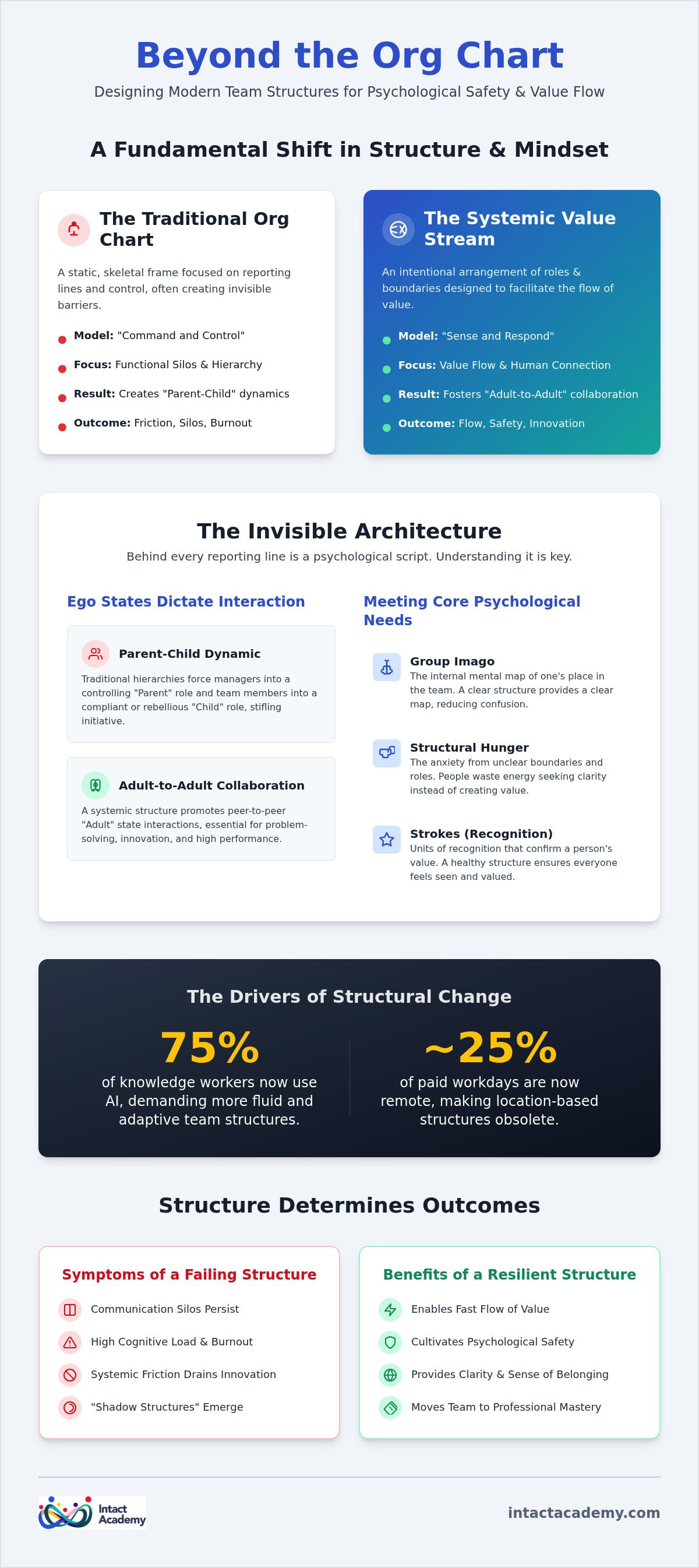
Many leaders view a team structure as a rigid skeletal frame, a static document of boxes and lines stored on a company drive. This perspective is dangerously limited. In reality, a truly optimized team structure is an intentional arrangement of roles, responsibilities, and psychological boundaries designed to facilitate the flow of value. It's the invisible architecture that dictates how energy moves through a system. As we move through 2026, the traditional "command and control" models are being replaced by "sense and respond" architectures. This shift is necessary because 75% of global knowledge workers now integrate AI into their daily workflows, requiring a structure that is as fluid as the technology it supports.
We must distinguish between the formal Organizational Structure Models displayed in HR manuals and the informal structures that live within the culture. The formal structure provides the skeleton, but the informal structure provides the nervous system. When these two are misaligned, the result is systemic friction that drains innovation and individual belonging. How often have you seen a perfect chart fail because the underlying human connections were neglected? The systemic impact of structure on a person's sense of belonging is profound; it defines whether they show up as a passenger or a co-creator of the organization’s future.
The Functional vs. The Systemic View
Traditional functional silos often inadvertently create "Parent-Child" dynamics in leadership. In these environments, leadership acts as the controlling or caretaking Parent, while team members adopt the compliant or rebellious Child ego state. This stifles the Adult-to-Adult collaboration essential for high performance. A systemic view, however, treats the team as a living organism. It recognizes that every part of the team structure affects the whole. When we design systemically, we focus on the "Group Imago," which is the mental map each member holds of their place within the team. Without this clarity, the cost is hidden friction and a significant loss in creative output.
Why Traditional Models Are Failing in a Hybrid World
Geographical divisional structures are crumbling in our digital age. With approximately one-quarter of paid workdays in the U.S. now performed from home, the old ways of organizing by office location no longer serve the work. When the formal chart remains too rigid, "shadow structures" emerge as people find workarounds to get things done. This lack of transparency leads to the erosion of psychological safety in the workplace. Without a clear, adaptive structure, team members feel adrift, leading to the burnout and communication silos that plague modern organizations.
The Invisible Architecture: Applying Transactional Analysis to Team Design
Behind every reporting line is a psychological script. While most leaders focus on the "what" of a team structure, the "how" is governed by the invisible architecture of human interaction. Transactional Analysis (TA) provides the lens to see this clearly. We aren't just moving boxes on a screen; we're managing ego states. When a structure is misaligned, energy leaks through unresolved conflicts and unspoken anxieties, draining the vitality of the entire system.
Every member of your organization carries a "Group Imago," a mental map of where they stand in relation to others. If the team structure is vague or shifting, this map becomes blurred. People experience "structural hunger," a profound anxiety that arises when boundaries are unclear. They spend their cognitive energy trying to find their footing rather than delivering value. A healthy structure provides "strokes," or units of recognition, ensuring every person feels seen and valued within the whole. For those who wish to guide organizations through these deep transformations, exploring a professional team coaching path can offer the systemic methodology required to heal these structural gaps.
Ego States and Reporting Lines
In a traditional hierarchy, the structure often pulls managers into a "Critical Parent" state. They feel the weight of responsibility and respond by over-controlling or judging. In turn, team members might retreat into an "Adapted Child" state, becoming overly compliant or quietly rebellious. This isn't a personality flaw; it's a structural byproduct. By contrast, flat or matrix models, when implemented with maturity, encourage "Adult-to-Adult" transactions. Here, information is shared without the weight of judgment. Decisions are made based on current reality rather than historical power dynamics, allowing for a more fluid and responsive organization.
The Role of Psychological Contracts
Beyond the formal offer letter lies the psychological contract. These are the unwritten rules and expectations that dictate how a team structure actually functions on a Tuesday afternoon when a deadline is looming. If the formal structure promises autonomy but the psychological contract demands constant check-ins, the system will eventually break. This misalignment creates a sense of betrayal that no org chart can fix. Contracting acts as the vital glue of team structure by explicitly aligning individual needs with organizational goals, ensuring that the living organism of the team moves with a single, coherent purpose.
Comparing Team Structure Models: A Systemic Analysis
Choosing a team structure isn't a neutral administrative task; it's a systemic intervention that dictates how much psychological weight each individual must carry. While traditional hierarchies offer clear containment and parental clarity, they often struggle with the speed required in 2026. Conversely, flat structures promise autonomy but can lead to "structural hunger" if the unwritten rules of engagement aren't mature. We must find an equilibrium that honors both the need for order and the necessity of flow.
Matrix structures are frequently used for cross-functional collaboration, yet they carry a hidden systemic risk: the double-bind. When an employee reports to two different leaders, they're often caught between competing "Parent" figures, leading to paralysis and anxiety. More resilient organizations are moving toward Network and Circular models. These designs foster high-trust, low-friction environments where the focus shifts from pleasing a supervisor to serving the collective purpose. Modern standards, such as Team Topologies, further refine this by organizing around "Stream-aligned" or "Platform" teams, ensuring that the architecture of the organization mirrors the flow of value itself.
Evaluating Models for Cognitive Load
A structure that exceeds a team’s cognitive limit inevitably leads to systemic burnout. When people are forced to navigate overly complex reporting lines or fragmented communication channels, their mental energy is diverted from deep work to mere survival. Understanding what is transactional analysis helps us see that cognitive load isn't just about task volume; it's about the emotional labor of managing ambiguous relationships. To protect your team's vitality, you must choose a structure that matches their psychological capacity for complexity.
Choosing the Right Model for Your Maturity Level
Your team structure must evolve as your organization matures. A startup needs the fluid, rapid-response nature of a network model, where the founder's presence provides the necessary containment. However, as an enterprise grows, it requires more formal boundaries to maintain psychological safety. The "Structure-Culture Fit" is vital. If you value radical transparency but maintain a rigid hierarchy, the resulting cognitive dissonance will erode trust. Use the table below to evaluate which model aligns with your current developmental stage.
| Model | Autonomy | Speed | Psychological Safety |
|---|---|---|---|
| Hierarchy | Low | Moderate | High (Clear Boundaries) |
| Flat | High | High | Variable (Needs Maturity) |
| Matrix | Moderate | Moderate | Low (Risk of Conflict) |
| Network | Very High | Very High | High (Trust-Based) |
| Team Topologies | High | Very High | High (Flow-Oriented) |
Designing for Flow: 5 Steps to Building a Resilient Team Structure
Transitioning from a rigid hierarchy to a responsive team structure is a process of systemic evolution rather than a simple reorganization. It requires a deliberate movement through five key stages to ensure the new architecture is both operationally sound and psychologically grounded. By following this methodical path, you can create an environment where energy flows toward value rather than getting trapped in bureaucratic friction.
- Step 1: Map the Value Stream. Look past the titles to see where work actually happens. Identify the path from initial thought to delivered value and organize around that flow.
- Step 2: Define Boundaries. Create clear containers for autonomy. Without boundaries, teams experience structural hunger; with them, they find the safety to innovate and take risks.
- Step 3: Contract for Interaction. Explicitly define how teams will collaborate. This step prevents the Parent-Child dynamics discussed earlier and fosters Adult-to-Adult transactions.
- Step 4: Align Incentives. Ensure rewards favor collective success. If you structure for collaboration but reward individual heroics, the system will eventually fracture.
- Step 5: Iterate Systemically. Use feedback loops to evolve. A structure is never finished; it's a living entity that must grow and adapt with your organization.
The Art of Systemic Contracting
Changing a team structure often triggers deep resistance. This isn't usually about the new chart itself, but rather the grief of losing established roles and psychological contracts. To manage this, facilitate "contracting" sessions where team members can voice their anxieties and negotiate their new places in the system. Your role is to create a "holding environment," a stable space where the emotional weight of change is acknowledged and held. Leaders who master this human dimension of change see significant results. According to research, companies that actively strengthen team collaboration see a 39% increase in productivity. This isn't just about efficiency; it's about the health of the whole system.
Reducing Dependencies and Handovers
Bottlenecks usually occur at the handovers between silos. By using the "Enabling Team" concept, you can build internal capability without creating new layers of bureaucracy. These teams don't take over the work; they provide the tools and knowledge for others to succeed. True team autonomy is a direct byproduct of structural simplicity, as fewer handovers allow for greater psychological ownership of the outcome. To master the art of designing these high-performance systems and lead your organization toward wholeness, consider joining the TA EMCC Senior Team Coach Academy, where we bridge the gap between systemic theory and practical leadership.
Mastering Systemic Team Coaching: Beyond the Boxes and Lines
Designing an optimized team structure is a significant achievement, yet even the most elegant architectural blueprint remains inert without a living, breathing culture to inhabit it. Structure alone is never enough to sustain high performance. While the chart provides the skeleton, systemic team coaching provides the spirit and the nervous system that allow the organization to move with grace. To truly transform a workplace, you must look beyond the boxes and lines and address the psychological field where your people actually reside.
This is where the integration of Transactional Analysis (TA) becomes indispensable for modern leadership. By understanding the ego states and group dynamics that run beneath the surface, you can ensure that your structural changes aren't just cosmetic. Sari van Poelje approaches organizational redesign as a process of returning to wholeness, where the structural design and the human experience are in perfect, healthy alignment. This systemic methodology ensures that the organization doesn't just function, but flourishes.
The Path to Professional Mastery
For those who feel called to lead these deep transformations, the journey requires more than just business acumen; it requires psychological depth. The TA EMCC Senior Team Coach Academy is designed for professionals who wish to master the art of systemic change. This isn't a typical training program. It's a developmental container where you learn to hold the complexity of organizational systems while fostering individual growth. In 2026, the need for professional development for coaches has never been more critical. As AI takes over routine tasks, the human ability to navigate structural complexity and psychological safety becomes the ultimate competitive advantage.
Your Next Steps in Systemic Leadership
Take a moment to reflect on your current team structure. Is it a container that serves the flourishing of your people, or are your people exhausting themselves to serve the demands of the structure? If you find that energy is leaking through silos or that your leaders are stuck in Parent-Child dynamics, it may be time to deepen your own mastery. We invite you to explore our advanced team coaching courses to find the path that aligns with your professional evolution. Join a global community of practitioners who are dedicated to the profound transformation of the workplace, moving beyond transactional management into a space of genuine systemic excellence.
From Structural Blueprint to Living Excellence
A high-performance team structure is never a static achievement. It's a continuous process of aligning operational necessity with human depth. By moving beyond the rigid lines of traditional org charts and embracing the psychological frameworks of Transactional Analysis, you create a space where innovation and well-being can coexist. You've seen that true flow depends on clear boundaries, systemic contracting, and the courage to iterate as your organization evolves toward its state of completeness; this commitment to flourishing is a lifelong journey, supported in schools and kindergartens by the work of Teacup Coach.
If you feel called to lead this level of transformation, the path to mastery is within reach. Under the guidance of world-renowned expert Sari van Poelje, you can gain the tools to navigate these complex human systems with precision and empathy. Master the art of systemic leadership at the TA EMCC Senior Team Coach Academy. Our programs are accredited by both the EMCC and ICF, ensuring that your professional development is grounded in global standards of excellence. Embrace the opportunity to move beyond transactional management and become a catalyst for profound psychological and systemic transformation. Your team's potential for flourishing is the ultimate reward for your commitment to this deep work.
Frequently Asked Questions
What is the most effective team structure for 2026?
The most effective team structure for 2026 is one that prioritizes "sense and respond" architectures over rigid command-and-control models. As 75% of knowledge workers now utilize AI, teams must be organized around value streams rather than geographical silos. Models like Team Topologies allow for a fast flow of value by reducing handovers and managing cognitive load effectively in hybrid environments.
How does team structure affect employee engagement and psychological safety?
Structure acts as the containment for human energy; when it's vague, it creates "structural hunger" and profound anxiety. Clear boundaries and well-defined roles foster psychological safety by reducing ambiguity. When a structure encourages Adult-to-Adult transactions rather than Parent-Child dynamics, employees feel more empowered to take risks and engage deeply with their work.
What is the difference between a matrix and a functional team structure?
A functional structure groups individuals by specialized expertise, while a matrix structure introduces dual reporting lines to facilitate cross-functional projects. While functional models provide deep expertise, they often create silos. Matrix models offer flexibility but carry the systemic risk of "double-binds," where employees feel caught between competing leadership demands.
How do I know if my current team structure is causing burnout?
Can Transactional Analysis really help in designing a business org chart?
Transactional Analysis is essential for mapping the invisible architecture that exists beneath any formal chart. It allows leaders to identify the ego states and scripts that dictate how people interact within their roles. By designing with TA in mind, you can create a team structure that actively promotes healthy, Adult-to-Adult collaboration and reduces systemic friction.
How often should an organization review its team structure?
Reviewing structure should be an iterative process rather than a sporadic, disruptive event. While major reorganizations should be rare to maintain stability, systemic feedback loops should be checked quarterly. This ensures the current arrangement still aligns with the evolving value stream and the psychological needs of the collective.
What is the role of a team coach in structural redesign?
A systemic team coach facilitates the "contracting" phase, ensuring that new roles and expectations are psychologically integrated. They provide a "holding environment" to manage the grief and resistance that naturally accompany structural shifts. Their presence allows the team to move through the transition without losing their sense of safety or professional mastery.
How do I manage resistance when changing my team’s structure?
Managing resistance requires acknowledging the emotional loss of established roles and unwritten rules. Instead of pushing through with force, use systemic contracting sessions to give team members a voice in the new design. This collaborative approach helps individuals find their place in the new Group Imago, turning resistance into a shared commitment to growth.


