

What if the unspoken rules in your office are actually more powerful than your official handbook? You've likely felt the tension when a meeting ends with surface-level agreement, only for hidden agendas to derail progress the moment the door closes. It's a common struggle in complex systemic structures where confusion over roles leads to friction rather than flow. Many leaders understand that a basic checklist isn't enough to sustain a high-performing team, especially when learning how to create a team charter that truly resonates.
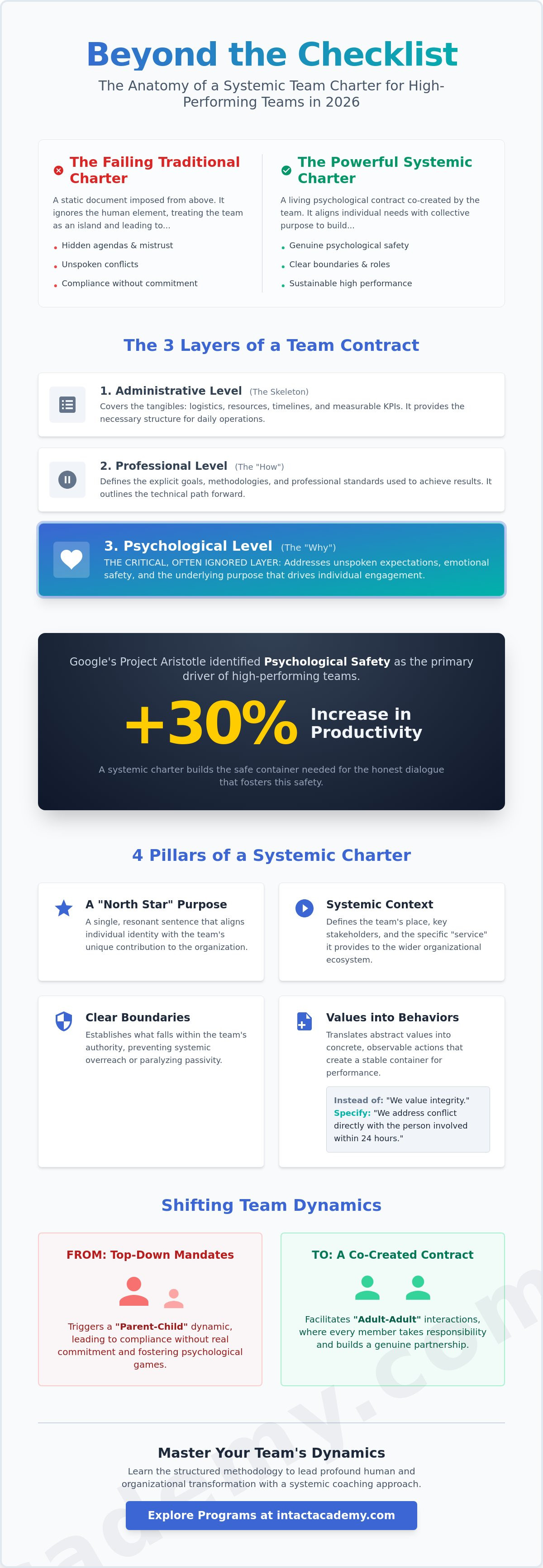
This article explores how to move beyond administrative formalities to align your team's unconscious dynamics with your organizational goals. By integrating insights from systemic supervision and team coaching, we'll examine how to establish clear boundaries and foster the psychological safety that Google's Project Aristotle identified as the primary driver of a 30% increase in productivity. We'll guide you through a methodical process to transform your collective energy into a sustainable, human-centric culture for 2026. You'll gain a deeper understanding of how a living psychological contract can reduce interpersonal conflict and ensure your team flourishes in an era of rapid transformation.
Key Takeaways
- Move beyond surface-level checklists by understanding the administrative, professional, and psychological layers of team contracting.
- Discover how to create a team charter that acts as a living systemic agreement, aligning individual ego states with collective organizational purpose.
- Establish a safe container for honest dialogue to uncover hidden agendas and foster genuine psychological safety within the group.
- Learn to recognize and address unconscious psychological games, such as the Drama Triangle, to maintain clear boundaries and professional norms.
- Explore how a systemic approach to team coaching provides a structured methodology for leading profound human and organizational transformation.
The Foundation: Why a Team Charter is a Psychological Contract
To understand how to create a team charter that endures, one must first look beneath the surface of organizational structure. While a traditional Project charter often serves as a functional roadmap for deliverables and deadlines, a systemic team charter acts as a profound psychological contract. It is the invisible thread that binds individual aspirations to the collective purpose. When we ignore this deeper layer, we invite the very dysfunction we seek to avoid. We don't just need rules; we need a shared understanding of our human architecture. This alignment isn't a one-time event but a continuous process of becoming a cohesive unit.
In the framework of Transactional Analysis, we view this alignment through three distinct layers of contracting. Most teams stop at the first two, leaving the most volatile elements of human interaction to chance. When a charter is imposed from above, it often triggers a "Parent-Child" dynamic. Team members might comply, but they rarely commit. A truly systemic approach facilitates "Adult-Adult" interactions. Here, every member takes full responsibility for their role in the group's success, moving beyond mere obedience toward genuine partnership. The process of learning how to create a team charter becomes an exercise in mutual respect and shared maturity.
The Three Levels of Team Contracting
- Administrative: This layer covers the tangible logistics, resources, and measurable KPIs. It's the skeleton of the team, providing the necessary support for daily operations.
- Professional: Here, we define the explicit goals and methodologies used to achieve results. It outlines the "how" of the work, ensuring everyone understands the technical path forward.
- Psychological: This is the most critical yet often overlooked layer. It addresses the unspoken expectations, emotional safety needs, and the underlying "why" that drives individual engagement.
Why Traditional Charters Fail in 2026
Traditional documents often fail because they lack systemic alignment with the wider organizational script. They treat the team as an island, ignoring the broader ecosystem that influences behavior. In 2026, a static document is no longer sufficient. If we ignore the unconscious needs of individuals within the group dynamic, we leave the door open for psychological games. A charter must be a living, evolving entity that adapts as the team grows. Without this fluidity, the document becomes a relic of compliance rather than a catalyst for transformation.
The Anatomy of a Systemic Team Charter
A systemic team charter is far more than a collection of bullet points on a shared drive. It is a structural blueprint that defines how a group of individuals becomes a coherent system. When considering how to create a team charter, we must look beyond internal mechanics to the team's place in the broader organizational ecosystem. This systemic context acknowledges that no team exists in a vacuum. It is influenced by, and in turn influences, the departments, stakeholders, and cultural scripts that surround it. By defining clear boundaries, we establish what falls within the team's authority. This prevents the common pitfalls of systemic overreach or paralyzing passivity.
Values often remain abstract and meaningless unless they are translated into observable behaviors. Instead of stating "we value integrity," a systemic charter might specify "we address conflict directly within 24 hours." This shift from the conceptual to the practical creates a stable container for performance. It allows the team to move from a state of "doing" to a state of "being" that is aligned with their highest potential. If you're looking to deepen your mastery of these dynamics, exploring team coaching can provide the structured methodology needed to facilitate these complex conversations.
Defining Purpose and Systemic Context
A team's purpose should act as a "North Star." It's a single, resonant sentence that aligns individual identity with collective mission. This goes beyond profit or output; it touches on the team's unique contribution to the organization. We must identify key stakeholders and the specific "service" the team provides to the wider system. This perspective is vital when leading organisational change, as it ensures the team's evolution supports the broader company trajectory. If the team doesn't understand its role in the larger story, it risks becoming a fragmented silo.
Roles, Responsibilities, and Authority
Clarity in roles is the antidote to interpersonal friction. We distinguish between functional roles, like a Project Manager, and psychological roles, such as the "challenger" who tests assumptions or the "nurturer" who maintains group cohesion. Both are essential for a healthy system. When teams define these explicitly, they reduce the likelihood of unconscious conflict. Establishing decision-making protocols is equally important. Who has the final say in high-stakes scenarios? Mapping these authority boundaries ensures that responsibility is shared rather than avoided. For those working in hybrid environments, a well-defined Team Communication Charter can bridge the gap between digital and physical presence, ensuring that norms remain robust across all platforms.
Step-by-Step: Facilitating the Chartering Process
Facilitating a team's evolution requires more than a structured agenda; it demands the creation of a holding space where the unspoken can finally be voiced. When we consider how to create a team charter, the process itself is as vital as the final document. It is a rhythmic movement from individual reflection to collective resonance. This journey ensures that the resulting agreement isn't just a list of rules, but a living commitment that every member can sign off on with genuine integrity. By following a deliberate facilitation arc, we move the team from divergent brainstorming toward a convergent, shared reality.
The success of this process rests on the facilitator's ability to maintain psychological safety throughout. This isn't about avoiding discomfort; it's about creating a container strong enough to hold honest dialogue and differing perspectives. When people feel safe to express their true thoughts, the hidden agendas that typically derail performance begin to dissolve. Understanding how to create a team charter in this way allows the group to transition from a collection of individuals into a high-performing system capable of sustainable organizational impact.
Phase 1: Discovery and Individual Alignment
Before the group gathers, the facilitator must engage in deep discovery. Individual pre-interviews are essential for uncovering hidden anxieties or aspirations that might not surface in a group setting. This is where we apply the lens of what is transactional analysis to understand individual life scripts within the team. These scripts are the unconscious patterns that dictate how we respond to authority, feedback, or conflict. By identifying these common themes early, we can anticipate potential areas of friction and prepare the ground for a more productive collective session.
Phase 2: The Collaborative Workshop
The workshop begins by opening the space with techniques for grounding and presence. We move the dialogue from the "What" of daily tasks to the deeper "Why" of the team's shared purpose. This phase focuses on drafting the Rules of Engagement. We ask the difficult questions: How will we handle disagreement? What does healthy feedback look like in our specific context? By defining these norms together, the team moves toward an Adult-Adult collaborative commitment, replacing old patterns of compliance with active partnership.
Phase 3: Integration and Review
A charter is only as robust as its ability to withstand real-world pressure. During the integration phase, we test the document against specific stress tests or hypothetical high-stakes scenarios. This ensures the norms are practical rather than just aspirational. We also establish a steady cadence for quarterly Systemic Health Checks. These sessions allow the team to reflect on their progress and adjust the charter as the organizational ecosystem evolves. Finally, communicating the charter to external stakeholders ensures that the team's internal alignment is mirrored in its outward professional relationships.
Beyond the Document: Addressing Resistance and Psychological Games
Even the most robust agreement can falter when the heat of systemic pressure rises. It is here, in the moments of tension, that we see the true value of understanding how to create a team charter as a living psychological contract. Without active maintenance, teams often slide into the Drama Triangle. This unconscious dance between the Victim, the Rescuer, and the Persecutor drains energy and obscures the path to collective goals. A Victim might claim they weren't informed of a deadline; a Rescuer might step in to finish the work, breeding resentment; and a Persecutor might blame individuals rather than the process. Recognizing these roles is the first step toward reclaiming an Adult-Adult collaborative space.
Passive-aggressive compliance is perhaps the most insidious form of resistance. It's the "yes" that means "no." When a team member agrees to a norm in the workshop but fails to act on it in the office, they're often playing a psychological game to maintain the status quo. The cost of this misalignment is high. A lack of psychological safety contributes to 44% of workplace burnout cases, according to CareerTrainer.ai (2026). The leader's role is to model the charter's values under pressure, remaining grounded and inviting others back to the agreed-upon norms.
Spotting Unconscious Patterns
Identifying red flags like sarcasm, withdrawal, or over-compliance requires a high degree of systemic awareness. These are often signals that the psychological contract has been breached. We use the technique of "immediacy" to name these dynamics in the room without shame. For example, a facilitator might say, "I notice that when we discuss the new budget, several of us stop making eye contact." This naming allows the team to look at the process rather than the person, refining the charter when it no longer serves the group's evolution.
The Charter as a Tool for Conflict Resolution
Conflict is not a sign of failure; it is a signal that the system is trying to grow. When debates become heated, we refer back to the agreed-upon norms as an objective third party. This transforms "Games" into "Intimacy" and genuine collaboration. It shifts the focus from winning an argument to solving a systemic problem. For those facilitating these deep shifts, seeking professional development for coaches can provide the advanced tools needed to handle deep systemic blocks and resistance. If you find your team repeatedly caught in these cycles, our Team Coaching services offer a deeper exploration into the systemic roots of these dynamics.
Mastering Team Dynamics with Intact Academy
Mastering the intricate dance of group dynamics requires more than a conceptual understanding of how to create a team charter. It demands a level of presence and systemic awareness that traditional management training rarely addresses. At Intact Academy, we believe that true organizational change begins with the individual's courage to look inward. Our TA EMCC Senior Team Coach Academy is designed for those who seek to move beyond surface-level fixes and enter the sphere of profound human transformation. By integrating Transactional Analysis with systemic principles, we provide a stable container for coaches and leaders to navigate the often-turbulent work of professional change. This methodology ensures that the profound psychological concepts we discuss remain both accessible and actionable for a sophisticated global audience.
When you guide a group through the process of how to create a team charter, you aren't just drafting a document; you're facilitating a shift in consciousness. This work requires the support of accredited supervision to ensure that the facilitator remains grounded and objective. Our programs, including the TA EMCC Senior Supervisor academy, offer the rigorous structure needed to sustain high performance over time. We invite you to join a global community of practitioners who value depth, integrity, and the courage to evolve alongside the systems they serve.
Systemic Team Coaching Certification
Choosing the right team coaching course is a pivotal decision for any practitioner aiming for systemic mastery. Our certification programs prepare you to facilitate profound organizational change by addressing the underlying psychological layers of group interaction. Whether you are starting in Rome on June 27, 2026, or Poznań in September, our curriculum is designed to deepen your impact and return your practice to a state of genuineness.
The Intact Academy Philosophy
Our philosophy is rooted in the belief that the coach's own inner work is the primary instrument of change. We don't offer quick fixes or generic templates. Instead, we provide a structured methodology that honors the complexity of human systems. This focus ensures that the changes you facilitate are sustainable and deeply human. To take the next step in your journey toward systemic mastery, we invite you to Explore our TA EMCC Senior Team Coach Academy today.
Cultivating Sustainable Team Excellence
The journey toward collective wholeness begins with a single, intentional step. By understanding how to create a team charter that functions as a living psychological contract, you move beyond administrative compliance into a space of genuine Adult-Adult partnership. This systemic approach allows you to dissolve the unconscious games that hinder innovation and replace them with clear boundaries and shared purpose. You've seen how integrating these psychological layers transforms a group into a high-performing system capable of navigating the complexities of 2026.
True mastery in this field requires a commitment to both professional methodology and personal growth. Our EMCC and ICF accredited programs, led by global expert Sari van Poelje, have empowered participants from over 14 countries to lead with depth and integrity. If you're ready to deepen your impact and facilitate profound organizational change, we invite you to take the next step in your professional evolution.
Master Systemic Team Coaching with Intact Academy
Your commitment to this work is the catalyst for a more human and effective workplace. We're here to support your growth and the flourishing of your teams every step of the way.
Frequently Asked Questions
How often should a team charter be updated?
A team charter should be reviewed every quarter or whenever a significant systemic shift occurs, such as a change in leadership or organizational goals. These reviews act as a systemic health check to ensure the psychological contract remains aligned with current realities. It's not a static document; it's an evolving agreement that reflects the team's growth and the changing demands of the organizational ecosystem.
What is the difference between a team charter and a mission statement?
While a mission statement defines the "what" and the "why" of a team's existence, a team charter details the "how" of their collective behavior and systemic interaction. The charter is a functional psychological contract that establishes norms, authority boundaries, and decision-making protocols. It moves beyond aspirational language to define observable behaviors and professional expectations that govern daily work.
Can a team charter be created for an existing team that is struggling?
Yes, learning how to create a team charter is often most transformative for established teams facing interpersonal friction or role confusion. In these cases, the process serves as a powerful intervention to surface hidden agendas and reset the team's "life script." By explicitly naming unspoken tensions, the charter provides a structured path back to an Adult-Adult collaborative state.
Who should lead the process of creating a team charter?
Ideally, an objective third party, such as a professional team coach or systemic supervisor, should facilitate the process to ensure a safe holding space for all members. If an internal leader takes the lead, they must be highly conscious of their own Parent-Child dynamics. The facilitator's role is to remain grounded while inviting every voice to participate in the discovery and alignment phases.
How do you ensure everyone actually follows the team charter?
Accountability is built through the Adult commitment made during the collaborative workshop rather than through top-down enforcement. When a norm is breached, any team member should feel empowered to use the charter as an objective reference point for feedback. This peer-to-peer accountability transforms the document from a set of rules into a living standard for professional integrity and mutual respect.
Is a team charter necessary for small teams or start-ups?
A charter is essential for small teams because the impact of a single person's unconscious behavior is magnified in a compact system. Start-ups benefit from early clarity on roles and authority to prevent the founder's trap or systemic overreach. Establishing these professional and psychological layers early creates a stable foundation for rapid scaling and long-term organizational health.
What should I do if a team member refuses to agree to the charter?
Resistance is often a signal of an underlying fear or a perceived threat to an individual's psychological safety. Instead of forcing compliance, use the discovery phase to explore the systemic roots of their hesitation. If a member remains in a Victim or Persecutor role, it may indicate a deeper misalignment that requires professional team coaching or a reassessment of their fit within the team.
How does a team charter improve psychological safety?
A team charter improves psychological safety by making the unspoken rules of the group explicit and predictable. When everyone understands the boundaries of their authority and the norms for handling conflict, collective anxiety levels drop significantly. This clarity allows team members to experiment and generate ideas more freely, which Google's Project Aristotle identified as a primary driver of high performance.


