

While global merger and acquisition deal value reached $3.1 trillion in 2025, up to 90% of these transactions fail to deliver their promised value. This isn't usually a failure of financial logic. It's a failure of human integration, evidenced by a staggering 47% employee turnover rate in the first year post-close. You likely recognize the tension that follows a deal: the quiet resistance, the erosion of trust, and the fragmentation of once-solid cultures. Understanding how to coach a team through a merger requires more than managing a checklist. It demands a deep dive into the psychological and systemic shifts that occur when two worlds collide.
This article provides the systemic frameworks and psychological insights you need to guide teams from fragmentation to wholeness. We'll explore how to navigate unconscious group dynamics, dismantle "merger scripts," and build a new, unified identity that preserves performance. You'll gain the tools to transform a period of profound disruption into an opportunity for genuine organizational evolution and a return to collective completeness.
Key Takeaways
- Discover how to coach a team through a merger by addressing the "merger script," which involves the past traumas and ego states that dictate a team's response to change.
- Apply Transactional Analysis to map the Group Imago, allowing you to visualize how team members perceive their place within a shifting organizational system.
- Identify the unwritten rules of the "Hidden Curriculum" to navigate cultural collisions and move the team from a preservation mindset to one of transformation.
- Master a five-step systemic coaching framework that begins with a deep diagnosis of the collective system rather than focusing solely on individual concerns.
- Understand the role of systemic supervision in managing parallel processes, ensuring your own psychological scripts remain a source of insight rather than a barrier to the team's growth.
The Psychological Landscape of a Merger: Beyond the Balance Sheet
While Mergers and acquisitions (M&A) are often viewed through the lens of financial synergy, the reality for the people involved is a profound systemic shock. This isn't just an administrative change; it's a disruption of the collective identity. When you look at how to coach a team through a merger, you must first acknowledge that every organization carries a "Merger Script." This is an unconscious narrative built from past organizational traumas, such as failed restructures or sudden leadership shifts. These scripts dictate how a team reacts to the current transition. If the past was marked by betrayal, the team will meet the new merger with deep suspicion, regardless of how positive the public messaging might be.
The entry state for most teams is one of survival. They move into a "survival" ego state, characterized by heightened anxiety and a sense of grief for what's being left behind. As a coach, your role is to facilitate a return to "intactness." This isn't about returning to the old ways; rather, it's about guiding the team toward a state of genuineness and completeness within the new structure. It's about repairing the systemic fractures so that performance can eventually resume from a place of wholeness. You're not just fixing a team; you're helping a system become whole again.
The Trauma of Identity Loss in Teams
A merger often feels like a death. Team members experience a corporate version of the "Grief Cycle," moving through denial, anger, and bargaining as they cling to their "Old Company" loyalty. This loyalty isn't just stubbornness; it's a psychological anchor. When that anchor is pulled up, the resulting identity loss acts as a systemic fracture that prevents the team from aligning with "New Company" goals. You can't bypass this grief with a pep talk. It must be witnessed and integrated before the team can move forward. True integration happens only when the team feels their past is honored while they build their future.
Recognizing the 'Us vs. Them' Dynamic
Tribalism is the natural psychological defense against the uncertainty of a merger. Newly merged departments often retreat into "Us vs. Them" dynamics to protect their sense of belonging. Leaders often inadvertently fuel this division by engaging in "Parent-Child" transactions, where they issue directives from a place of rigid authority, triggering a rebellious or compliant response from the team. Effective intervention requires leading organizational change by shifting these interactions into "Adult-Adult" dialogues. Only then can the team move past tribal defenses and toward a shared, integrated future. Understanding how to coach a team through a merger means breaking these cycles of dependency and resistance to foster a truly collaborative environment.
Mapping the Systemic Impact: Using Transactional Analysis (TA)
To understand the systemic disruption of a merger, we must look beneath the surface of professional behavior. Transactional Analysis (TA) provides the precise vocabulary and diagnostic tools needed to decode the complex human interactions that follow a deal. When you're exploring how to coach a team through a merger, you aren't just observing communication; you're analyzing the ego states that drive it. In high-stakes restructuring meetings, participants often shift between Parent, Adult, and Child states. A leader might adopt a "Critical Parent" stance to enforce new protocols, while a team, feeling disempowered, retreats into a "Rebellious Child" state. Recognizing these shifts allows a coach to mirror the team's dynamics back to them, moving the group toward "Adult-Adult" problem-solving where genuine integration can begin.
This work requires a solid foundation in systemic theory. To dive deeper into these mechanics, you can explore what is transactional analysis and how it serves as a guide for professional transformation. Beyond ego states, mergers often trigger "Psychological Games." These are repetitive, unconscious patterns that prevent real intimacy and progress. You might see the "Poor Me" game, where a department clings to its victim status to avoid the labor of change, or "Now I've Got You," where team members wait for leadership to make a mistake to justify their resistance. Effective coaching creates a contracted space, which is a clear agreement on goals and boundaries that makes these games visible and, ultimately, unnecessary.
The Group Imago and Systemic Belonging
Every individual carries a "Group Imago," an internal map of where they and others belong within the system. A merger shatters this map. When new members are added or roles are shifted, the team's sense of systemic health is compromised because the "internal map" no longer matches the external reality. Coaches can help teams visualize this shift by mapping out their current Imago. This process reveals who feels excluded, who feels overwhelmed, and where the new "systemic center" lies. It's a vital step in helping a team redraw their blueprint for belonging in a way that includes the new organizational reality. If you seek to master these high-level interventions, the TA EMCC Senior Team Coach Academy offers the depth required for such systemic excellence.
Breaking the Drama Triangle in Mergers
The uncertainty of a merger often pushes teams into the "Drama Triangle," a dysfunctional cycle of Persecutor, Rescuer, and Victim roles. The acquiring company is frequently cast as the Persecutor, while the acquired team takes on the Victim role, waiting for a "Rescuer" leader to save them from the transition. Breaking this cycle requires the establishment of psychological safety. It's the prerequisite for moving the team out of defensive roles and into a space of mutual accountability. By naming these roles as they appear, a coach invites the team to step out of the drama and into a more authentic, productive way of relating to one another.
Navigating the Cultural Collision: Comparison and Analysis
Cultural integration is rarely a linear process. It is a collision of values, a friction between the known past and an uncertain future. When you understand how to coach a team through a merger, you see that the struggle isn't about the new organizational chart; it's about the "Hidden Curriculum." These are the unwritten rules that dictate how power is handled, how conflict is resolved, and who is truly listened to. While the balance sheet shows a single entity, the team remains divided between a "Preservation" mindset, clinging to what worked before, and a "Transformation" mindset that seeks to erase the past for the sake of speed. The coach acts as a systemic boundary, holding a space where the old can be honored so the new can be built.
Success in this phase requires identifying "Cultural Anchors." These are specific practices or values from the original companies that can be preserved to reduce systemic anxiety. By intentionally carrying forward certain rituals or communication styles, the coach provides the team with a sense of continuity. This stability is essential for high-level performance. Without it, the team remains in a state of hyper-vigilance, unable to focus on the strategic goals of the new entity. The coach's presence ensures that the "human" element is not lost in the rush for operational efficiency.
Old Culture vs. New Culture Framework
To move forward, the team must audit their own cultural values. This framework helps members identify what they are willing to let go of and what they must keep. A vital part of this process is facilitating a "Funeral for the Old." This is a symbolic release that allows the team to mourn their previous identity openly. Without this closure, "Systemic Loyalty" often manifests as a quiet refusal to adopt new KPIs. Team members may feel that succeeding under the new regime is a betrayal of their former leaders. Recognizing this loyalty is key to how to coach a team through a merger effectively, as it shifts the focus from "performance issues" to "unresolved grief."
The Power of Narrative in Cultural Integration
Integration requires the creation of a "Third Story." This is a narrative that transcends the "Company A" versus "Company B" dichotomy. It is not a compromise but an evolution. Using metaphors, such as two distinct streams joining to form a deeper, more powerful river, helps the team visualize their growth. This narrative work provides a stable container for the often-turbulent work of professional change. The coach serves as the architect of a new collective memory, weaving the strengths of the past into the foundation of the future. By co-creating this story, the team moves from being victims of a merger to being the authors of their new reality.
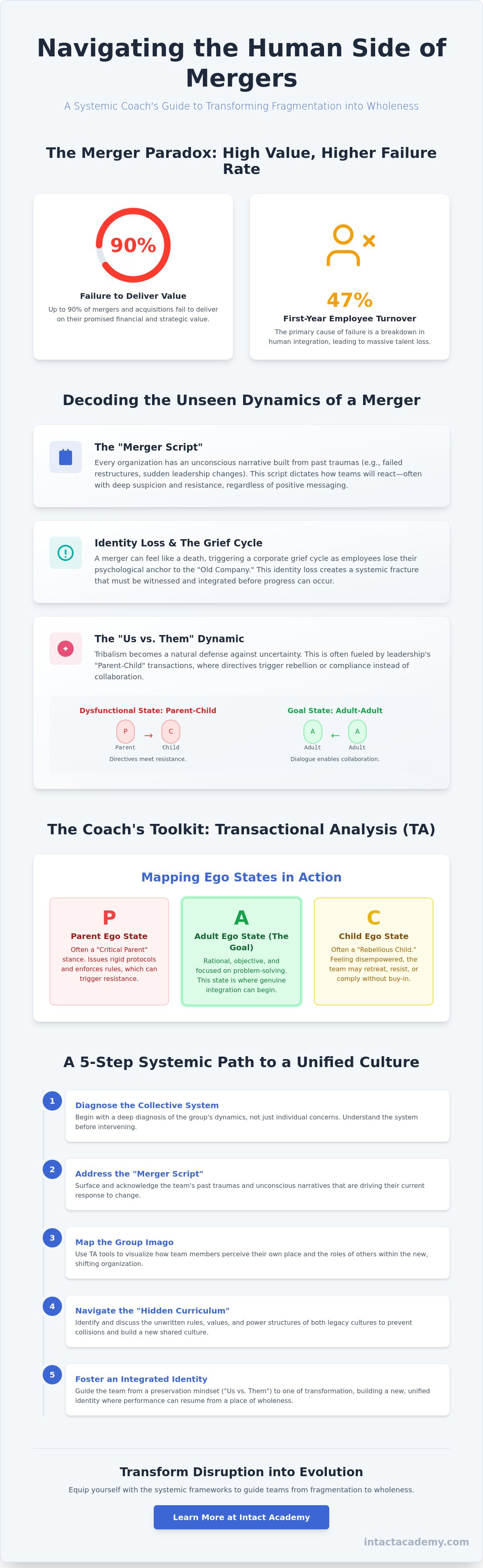
A 5-Step Systemic Team Coaching Framework for Mergers
Moving from psychological theory to organizational reality requires a disciplined, step-by-step methodology. When determining how to coach a team through a merger, the sequence of intervention is as critical as the intervention itself. A systemic approach ensures that we don't just treat individual symptoms of stress but instead address the underlying health of the collective. This framework is designed to move a team from the initial shock of fragmentation toward a state of integrated performance.
- Step 1: Systemic Diagnosis. This involves interviewing the "system" before the individuals. The coach observes team meetings and analyzes the organizational history to identify the "Merger Script" mentioned earlier.
- Step 2: Multi-Stakeholder Contracting. Alignment is established between the coach, the team leader, and the organizational sponsor to ensure everyone agrees on what "success" looks like.
- Step 3: The Integration Workshop. This is the space where the Group Imago is redrawn and the collective grief is processed. It's a symbolic and practical merging of identities.
- Step 4: Adult-Adult Strategy Building. Once the emotional landscape is stabilized, the team moves into an Adult ego state to define their new collective output and strategic goals.
- Step 5: Review and Embedding. The coach remains a systemic presence to ensure that new cultural norms are sustainable and that the team doesn't slide back into old, tribal behaviors.
If you're ready to master these advanced methodologies, the TA EMCC Senior Team Coach Academy provides the rigorous training needed to lead teams through such profound transformations.
Contracting for Success in M&A
In the volatility of a merger, a "hard" contract focusing on KPIs isn't enough. It must be paired with a "soft" psychological contract that addresses safety and confidentiality. Coaches must navigate the "Three-Cornered Contract" between themselves, the team leader, and HR. This prevents the coach from being used as a "tool" by management to enforce compliance. Essential questions include: "What is the unsaid expectation of my role?" and "How will we handle the inevitable resistance that arises during this transition?"
Facilitating High-Stakes Integration Sessions
Practical exercises in these sessions should focus on surfacing hidden resentments safely. Instead of focusing on individual performance, the dialogue shifts toward systemic impact. A powerful tool here is the TA concept of "Stroke Economy." By encouraging team members to provide genuine, positive recognition across the "old" company lines, the coach helps build new team morale. This intentional exchange of "strokes" acts as the glue for the new culture, replacing the "Us vs. Them" dynamic with a sense of mutual value and belonging. Understanding how to coach a team through a merger effectively means creating these small, rhythmic moments of connection that eventually lead to a whole system.
Sustaining Transformation: The Coach's Professional Mastery
Coaching through a merger isn't just about the team's evolution; it's about the coach's capacity to remain centered within a storm of systemic anxiety. When you're learning how to coach a team through a merger, you quickly discover that the system's turbulence often leaks into the coaching relationship itself. This phenomenon, known as a parallel process, occurs when the dynamics of the organization; its confusion, its grief, or its power struggles, are unconsciously replicated between the coach and the client. Without a high level of self-awareness, you risk becoming another fragmented part of the system rather than the catalyst for its wholeness.
True mastery requires moving beyond transactional toolkits. It demands a commitment to understanding your own "Script," the internal narrative that dictates how you respond to conflict or authority. If your own history includes unresolved organizational trauma, you may find yourself inadvertently taking sides or rescuing the team instead of challenging them to grow. This is where systemic supervision becomes non-negotiable. It provides the reflective space needed to disentangle your personal reactions from the team's needs, ensuring your intervention remains clean and impactful. You cannot lead a team to a place of integration if you haven't first integrated your own professional experience.
The Importance of Systemic Supervision
In the high-pressure environment of M&A, the coach needs a "stable container" to process the emotional weight of the transition. Systemic supervision allows you to identify parallel processes before they derail the intervention. It is a vital component of professional development for coaches, shifting the focus from what you do to who you are in the room. By examining these systemic mirrors, you turn the organization’s chaos into a diagnostic tool for their transformation. This reflective practice ensures that you remain an anchor of stability, even when the organizational ground is shifting.
Achieving Mastery in Team Coaching
The journey toward senior practitioner status is an invitation to bridge deep psychological theory with professional pragmatism. For those seeking a foundational shift, the TA Foundation Year offers a systemic path to professional mastery and wholeness. As you progress, obtaining an executive coaching certification provides the rigorous framework necessary to handle the complexities of the current corporate landscape. These pathways ensure that your practice is grounded in both intellectual rigor and human empathy.
Ultimately, mastering how to coach a team through a merger is a return to genuineness. It is the art of holding a system until it can hold itself. To deepen your capacity for this profound work and learn to navigate these complex human systems with authority, we invite you to join the TA EMCC Senior Team Coach Academy. Here, you'll join a global community of practitioners dedicated to the flourishing of the human spirit within the world of business.
Architecting Collective Wholeness
Guiding a team through the turbulence of a merger requires more than strategic alignment; it demands a profound understanding of the human system. By addressing the "Merger Script" and redrawing the Group Imago through Transactional Analysis, you move beyond surface-level management into the realm of genuine transformation. You've seen that success lies in honoring the past while co-creating a "Third Story" that invites every member into a state of belonging and performance. Mastering how to coach a team through a merger is ultimately an act of repairing systemic fractures to restore the team's innate capacity for growth.
If you're ready to deepen your impact and lead with systemic authority, we invite you to Master Systemic Team Coaching at Intact Academy. Our EMCC Accredited Senior Team Coach Academy, led by international expert Sari van Poelje, provides the rigorous framework and global community needed to handle complex organizational change. Step into a space where psychological depth meets professional mastery, and join a network of practitioners committed to human flourishing in the executive world. Your journey toward systemic excellence begins with the courage to look deeper.
Frequently Asked Questions
How do you handle 'us vs. them' mentality in a newly merged team?
You handle the 'us vs. them' mentality by facilitating a space where both original cultures are honored before a new collective identity is forged. This requires moving beyond surface-level communication into a systemic exploration of shared values and goals. By creating a 'Third Story' that transcends previous boundaries, you help the team recognize that their new combined strength is an evolution rather than a loss of their past. It's about shifting from tribal protection to systemic belonging.
What is the most common reason team coaching fails during a merger?
The most common reason team coaching fails during a merger is the neglect of the underlying psychological landscape, specifically collective grief and identity loss. When coaches focus strictly on KPIs and logistical alignment while ignoring the unconscious 'Merger Script,' the team remains stuck in a survival state. This fragmentation prevents genuine integration, as unaddressed anxiety continues to drive resistance and tribal behaviors. Without addressing the human system's need for closure, performance remains fragile.
How long does a systemic team coaching engagement typically last for M&A?
A systemic team coaching engagement for mergers typically lasts between six and eighteen months, depending on the complexity of the cultural collision. The initial phase focuses on stabilization and processing the 'Group Imago' shifts, while later stages emphasize embedding new norms and sustaining performance. This duration allows the coach to guide the team through the full cycle of transformation, ensuring the new organizational identity becomes a stable, high-performing reality rather than a temporary facade.
What is a 'Merger Script' in Transactional Analysis?
A 'Merger Script' is an unconscious organizational narrative, often rooted in past traumas or previous restructures, that dictates how a team responds to a current transition. In the context of how to coach a team through a merger, identifying this script is essential for breaking repetitive cycles of suspicion or compliance. Once the script is made conscious, the team can choose to write a new, more authentic story that supports their current reality and collective flourishing.
Can team coaching help reduce turnover after a merger?
Team coaching significantly reduces turnover by addressing the psychological factors that often lead to high attrition rates in the first year post-merger. By fostering psychological safety and clarifying the new systemic structure, coaching helps individuals find their place within the evolving system. When employees feel their professional identity is respected and their contributions are valued, their sense of belonging increases, mitigating the urge to seek stability in a different organization.
How do I contract with a team that is currently in a state of high anxiety?
You contract with a high-anxiety team by prioritizing a 'soft' psychological contract that emphasizes safety, confidentiality, and clear boundaries. In these scenarios, the coach must acknowledge the team's current survival state before pushing for strategic results. This creates a stable container where team members feel protected enough to voice their fears. Only after this emotional foundation is established can you move toward 'hard' contracts involving specific performance metrics and long-term strategic goals.
What is the role of the coach in cultural integration?
The coach's role in cultural integration is to act as a systemic boundary and an architect of the new collective narrative. They facilitate the 'Funeral for the Old' and help the team identify 'Cultural Anchors' that provide continuity during the transition. By mirroring the team's unconscious dynamics, the coach helps them navigate the 'Hidden Curriculum' of unwritten rules, ensuring that the integration is deep, genuine, and sustainable for the entire system.
Is external coaching better than internal coaching during a merger?
External coaching is often more effective during a merger because it provides a level of neutrality and systemic distance that internal coaches may lack. An external practitioner is less likely to be caught in the organization's own parallel processes or political scripts. This objectivity is crucial for determining how to coach a team through a merger, as it allows the coach to challenge the system with a calm authority that is unburdened by internal history.


