

What if the friction you feel in a new group isn't a sign of failure, but the labor pains of a system trying to be born? Most approaches to leadership focus on task delegation, yet the real work of understanding how to coach a newly formed team lies beneath the surface of daily operations. You've likely noticed how individual ego states can clash in a fresh environment, creating a sense of fragmentation that no amount of project management software can fix. It's a common struggle to move past the "storming" phase when team identity remains a collection of individuals rather than a cohesive whole.
I understand the weight of responsibility you feel when trying to turn a group of talented professionals into a unified force. In this guide, we'll move beyond superficial icebreakers to master the art of systemic transformation and Transactional Analysis. You'll learn to navigate the delicate process of establishing both professional and psychological contracts that ground your team in clarity. We'll examine the specific methodologies required to harmonize diverse personalities and build a foundation for sustainable, high-level performance that honors the intelligence and maturity of every member.
Key Takeaways
- Shift your perspective from coaching individuals to treating the team as a singular, living system with its own unique identity and boundaries.
- Apply Transactional Analysis to recognize when a new team falls into reactive ego states and guide them toward a more mature, Adult-to-Adult way of relating.
- Master how to coach a newly formed team by navigating the three-way contract to ensure administrative, professional, and psychological alignment between all stakeholders.
- Surface the unconscious scripts and hidden dynamics that often derail early team development to co-create a more authentic and resilient social contract.
- Transition from technical facilitation to senior-level mastery by integrating systemic supervision and cultivating a grounded, authoritative coaching presence.
The Systemic Birth: Understanding the Team as a Single Entity
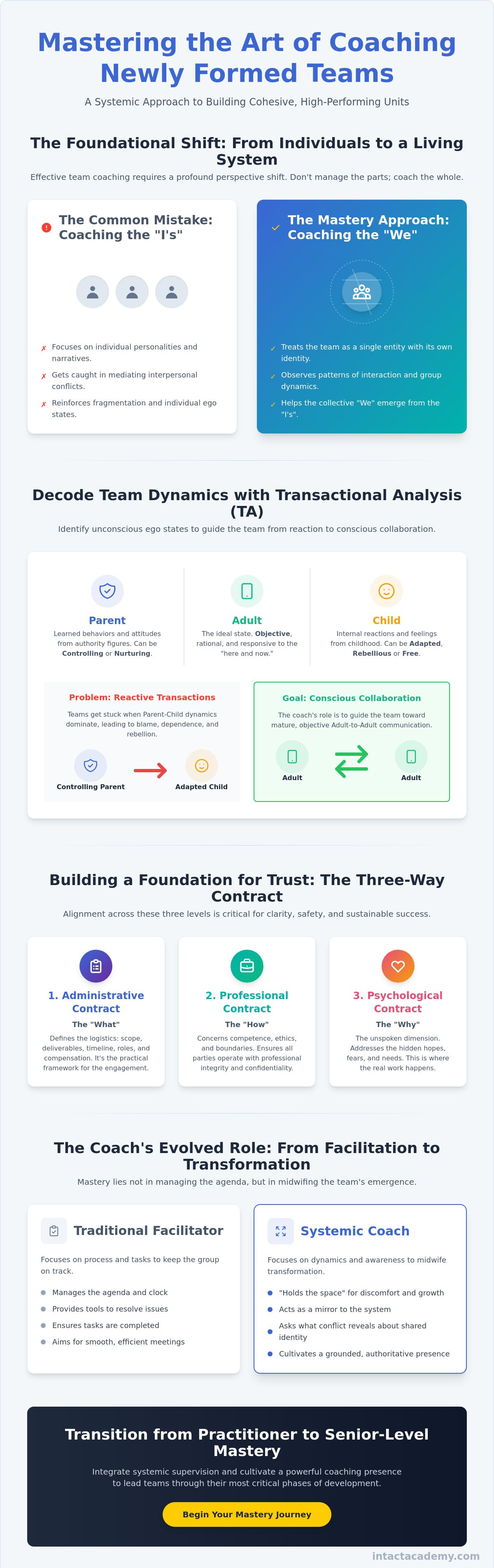
The birth of a team is not a logistical event; it's a profound psychological phenomenon. When you first explore how to coach a newly formed team, it's easy to get caught in the trap of managing individuals. You might find yourself mediating between two strong personalities or offering feedback to a single leader. However, a systemic approach requires you to view the team as a living, breathing entity with its own unique boundaries and identity. This entity has its own needs, fears, and evolutionary path, separate from the individuals who comprise it.
Beginners often make the mistake of coaching the "I's" within the room. This approach fails because it ignores the collective "We" that is struggling to emerge. To truly master how to coach a newly formed team, you must observe the patterns of interaction rather than the content of individual contributions. If two people are arguing, don't focus on the argument itself. Instead, look at what that conflict is doing for the system. Is it a way for the team to avoid a deeper, more frightening conversation about their purpose? By observing these systemic rhythms, you help the team move toward its psychological birth.
This process is often mapped through Tuckman's stages of group development, where the "forming" and "storming" phases represent the system's attempt to define its own space. Your role is to act as a mirror to this emerging system, reflecting back the dynamics that the members themselves cannot yet see. You are looking for the "we-ness" that exists in the space between people.
The Shift from Individual to Systemic Awareness
Your focus must shift from personal narratives to group dynamics. In the first sixty minutes of a new team's life, unspoken rules begin to crystallize. Who speaks first? Who remains silent? How is disagreement handled? These patterns form the early DNA of the system. As a coach, you stand outside the circle. You're a neutral observer, noticing the energy shifts and the silences that others might ignore. You aren't there to join their story; you're there to observe how they tell it together.
Why Traditional Facilitation is Not Enough
Traditional facilitation often stops at managing a process; it ensures the agenda is met and the clock is respected. Systemic coaching goes deeper. It's about "holding the space" for the team's initial anxiety without rushing to fix it. While facilitation might provide a tool to resolve a conflict, coaching asks the team what that conflict reveals about their shared identity. It is the difference between keeping a group on track and midwifing a transformation. It requires a presence that is both firm and empathetic, allowing the team to experience the discomfort necessary for growth.
Using Transactional Analysis to Map New Team Dynamics
While many frameworks focus on defining roles and responsibilities, they often overlook the psychological currents that drive how those roles are actually performed. To master how to coach a newly formed team, one must look toward Transactional Analysis (TA). This methodology provides a sophisticated map for understanding the "ego states" that members inhabit during their initial interactions. By observing the Parent, Adult, and Child states, a coach can diagnose why a group might feel stagnant or unnecessarily volatile despite having clear technical objectives.
In the early stages of building an effective team, members rarely interact from a grounded, objective place. Instead, they often default to "Adapted Child" states, seeking permission or approval, or "Controlling Parent" states, where they attempt to impose order through rigid criticism. These transactions are the invisible threads that weave the team's culture. If you can identify these shifts in real-time, you move the group from reactive patterns into a state of conscious collaboration. If you're new to these concepts, exploring what is transactional analysis can provide the foundational theory needed to apply these insights effectively.
Ego States in the Forming Stage
In new hierarchies, the "Rebellious Child" may emerge through subtle sarcasm or missed deadlines, while the "Compliant Child" over-adapts to please the leader, sacrificing their own expertise. Conversely, a leader acting as a "Nurturing Parent" might accidentally stifle team autonomy by being over-protective and preventing the group from experiencing necessary growing pains. The Adult ego state functions as the objective, data-driven engine of sustainable team performance. Your objective when learning how to coach a newly formed team is to invite members into this Adult state, where they can process information and solve problems without the emotional baggage of past scripts.
Identifying Early Psychological Games
Newly formed groups are fertile ground for "psychological games," which are repetitive, unconscious patterns that lead to a predictable "payoff" of negative emotion. You might spot the "Yes, But..." game during goal-setting sessions, where a member asks for help only to reject every suggestion offered. This effectively stalls progress while maintaining an illusion of participation. Similarly, the "Victim-Rescuer-Persecutor" triangle often emerges when one member feels overwhelmed, another rushes in to "save" them, and a third is blamed for the pressure. Recognizing these dynamics allows you to intervene before they become the team's permanent operating system. For those seeking to deepen their impact, our Team Coaching services offer a structured path to resolving these complex systemic entanglements.
The Three-Way Contract: Building a Foundation for Trust
Trust within a fresh group isn't a passive byproduct of time; it's the deliberate result of structural clarity. When you're determining how to coach a newly formed team, the first systemic challenge you'll face isn't within the team itself, but in the "Systemic Triangle" formed by the coach, the team, and the organizational sponsor. This three-way relationship creates a complex field of expectations. If the lines of communication between any of these three points are blurred, the coaching intervention will likely fail or, worse, become an unconscious tool for organizational politics.
A primary goal of this stage is to surface the "hidden agendas" that naturally accompany any new formation. Every member enters a new system with a set of unspoken needs. Some seek power; others seek safety or recognition. Without a robust contracting process, these unvoiced desires become the invisible drivers of team behavior. By making these agendas explicit, you create a container where the team feels safe enough to be honest. It's through this radical transparency that a collection of individuals begins to function as a unified system.
The Administrative vs. Psychological Contract
Effective contracting happens on three distinct levels: the administrative, the professional, and the psychological. The administrative contract covers the logistics of time and fees, while the professional contract defines tangible KPIs. However, it's the psychological contract that determines the team's success. This unwritten agreement establishes how the group will handle conflict, what confidentiality truly looks like, and how feedback loops will function. Negotiating this "contract for change" before the deep work begins ensures that everyone understands the emotional labor required to reach a state of high performance.
Aligning the Sponsor and the Team
A coach must never become a mere messenger for the sponsor. This role requires a sophisticated balance of empathy and authority. You must ensure the sponsor's strategic goals are aligned with the team's actual developmental capacity. If a sponsor demands high-speed innovation while the team is still struggling with basic psychological safety, the system will eventually fracture. We often look toward Sari van Poelje's approach to systemic alignment to bridge this gap. Her methodology emphasizes that systemic health depends on every part of the triangle acknowledging its role and responsibility in the collective transformation. This alignment prevents the coach from being triangulated and keeps the focus on the team's evolution.
Intervention Strategies for the 'Forming' and 'Storming' Phases
Moving beyond linear checklists is essential when learning how to coach a newly formed team. While traditional models suggest a simple progression from mission to goals, the reality is often a turbulent dance of human emotion and unstated expectations. Effective intervention requires a coach to move with the team's natural rhythm, facilitating the transition from a collection of individuals into a singular system. This process isn't about avoiding the friction of the 'storming' phase, but rather about utilizing that energy to forge a resilient collective identity.
To navigate this transition, we employ a structured yet fluid approach to systemic intervention:
- Co-creating the Social Contract: Move beyond the administrative agreement to define how the team will be together. This is a living document that governs their emotional and professional interactions.
- Surfacing Unconscious Scripts: Identify the hidden narratives that members bring from previous roles which may be limiting the current system's potential.
- Facilitating Healthy Conflict: Encourage the team to voice disagreements early. This prevents 'artificial harmony' and moves the group through the storming phase with integrity.
- Establishing Adult-Adult Norms: Use real-time feedback to invite members back into a grounded, objective state whenever reactive 'Child' or 'Parent' dynamics emerge.
- Systemic Check-ins: Conduct regular 'pulse' sessions to monitor the health of the system's boundaries and its alignment with the original psychological contract.
Surfacing the Team Script
Every team eventually writes a script, an unconscious story about its mission and its worth. As you explore how to coach a newly formed team, ask: 'What is the story this team is telling itself?' You might notice group 'drivers' appearing. A team might feel a collective pressure to 'Be Perfect,' leading to paralysis, or a need to 'Please Others,' resulting in a lack of clear boundaries with stakeholders. By surfacing these drivers, you empower the team to discard outdated narratives and write their own 'success script' based on their current reality and shared aspirations.
Navigating Conflict with Psychological Safety
In Transactional Analysis, we use the concept of 'Strokes'—units of recognition—to build a positive emotional bank account within the group. When a team feels recognized and valued, they can handle the weight of challenging feedback. Your role is to challenge the system's current way of functioning without triggering defensive 'Child' states in its members. This delicate balance requires a high level of self-awareness and presence. For those who wish to master these high-stakes interventions, our professional development for coaches provides the systemic supervision and theoretical depth necessary to hold space for profound change. If you're ready to elevate your practice, consider joining our TA EMCC Senior Team Coach Academy to refine your ability to navigate complex group dynamics.
Mastering Team Coaching: From Practitioner to Senior Level
To truly understand how to coach a newly formed team at a senior level, one must move beyond the mechanical application of tools and into the cultivation of a grounded presence. Foundations are essential, but mastery requires a shift in the coach's internal state. You're no longer just facilitating a meeting or managing an agenda; you're holding a complex systemic field. This evolution from practitioner to senior coach is marked by the ability to remain a stable container for the team's anxiety, allowing their collective identity to emerge without rushing the process or imposing a premature solution.
At this advanced stage, the integration of Transactional Analysis (TA) provides a unique edge in the global market. While generic coaching models might identify that a team is struggling, TA allows you to diagnose the exact transaction that's stalling progress. You begin to see the invisible architecture of the group. You notice the subtle shifts in ego states and the invitation into psychological games before they take root. This level of precision transforms the coaching engagement from a transactional service into a profound human intervention that facilitates lasting organizational change.
The Role of Supervision in Team Coaching
Systemic supervision is the cornerstone of professional evolution. You cannot coach a complex new system effectively without a "second pair of eyes" to help you navigate your own responses to the group. In the heat of a team's 'storming' phase, it's easy to get 'sucked into' the team's script. You might find yourself adopting a 'Nurturing Parent' role to soothe their conflict or feeling like a 'Victim' of their collective resistance. Supervision provides the reflective space needed to identify these patterns. In our guide on choosing the right team coaching course, we emphasize that long-term mastery is impossible without this dedicated space for systemic oversight.
Pathways to EMCC Senior Team Coach Accreditation
The journey toward senior-level accreditation is a path of both the heart and the mind. It requires a commitment to the 'art and science' of human systems. This journey involves moving from foundational skills to a place where you can comfortably navigate high-stakes conflict and deep systemic entanglements. At Intact Academy, we support this transition through a blend of rigorous theoretical study and practical, supervised experience. We invite you to Join our TA EMCC Senior Team Coach Academy to deepen your systemic impact and master the nuances of how to coach a newly formed team with authority and empathy. It's time to move beyond surface-level facilitation and step into your power as a catalyst for profound transformation.
Guiding the System Toward Maturity
Mastering how to coach a newly formed team requires a shift from surface-level facilitation to deep systemic awareness. You've seen that success lies in treating the group as a single entity and using Transactional Analysis to navigate the complex ego states that emerge during the forming and storming phases. By establishing robust three-way contracts and surfacing hidden scripts, you create a stable container for high performance and genuine human growth. It's about moving from managing tasks to midwifing a collective identity.
This journey from practitioner to senior coach is one of continuous evolution. If you're ready to move beyond basic tools and master the art of deep systemic transformation, we invite you to take the next step. Our programs are accredited by EMCC and EATA, led by international expert Sari van Poelje, and designed for those who seek professional excellence. Elevate your practice at the TA EMCC Senior Team Coach Academy and become a leader in the field of organizational change. The path to systemic mastery is open to you, and the impact you'll have on the teams you serve will be your greatest legacy.
Frequently Asked Questions
What is the biggest mistake coaches make with newly formed teams?
The most frequent error is focusing on individual behavior rather than the system as a whole. When learning how to coach a newly formed team, beginners often mediate personal disputes instead of reflecting the group's collective dynamics. This keeps the team stuck in a collection of "I's" rather than evolving into a unified "We" capable of self-correction and shared accountability.
How does Transactional Analysis help in coaching a new team?
Transactional Analysis offers a precise diagnostic tool for identifying ego states in real-time. By observing whether members are interacting from Parent, Adult, or Child states, the coach can surface the unconscious scripts that drive early friction. This awareness allows the team to consciously shift into a collaborative Adult state, which is the primary engine of sustainable performance and professional maturity.
How long should a team coaching engagement for a new team last?
A meaningful engagement typically spans six to twelve months. This duration provides the necessary space for the system to move through the turbulence of forming and storming into a state of high-performing maturity. Short-term interventions might solve immediate tasks, but deep systemic transformation requires a consistent, stable container over time to ensure new behavioral patterns become permanent.
What is the difference between team building and team coaching?
Team building is generally a discrete, event-based intervention aimed at improving social cohesion through shared experiences. In contrast, team coaching is a sustained developmental process focused on the system's ability to achieve its professional mission. While building creates rapport, coaching facilitates the psychological and professional shifts required for long-term excellence and structural alignment.
How do you handle a dominant personality in a newly formed team?
A dominant personality is often a systemic signal rather than just an individual trait. Instead of suppressing the person, a coach explores what the rest of the team is avoiding by remaining silent. By inviting the entire group into an Adult-Adult dialogue, you redistribute the systemic energy and encourage the silent majority to take up their rightful space within the group's hierarchy.
Why is contracting so critical for new teams?
Contracting is the foundation of psychological safety because it makes the unspoken rules explicit. It aligns the expectations of the coach, the team, and the sponsor before the work begins. Without a robust three-way contract, the process of learning how to coach a newly formed team becomes vulnerable to hidden agendas and unconscious resistance that can eventually fracture the group.
Can you coach a new team virtually as effectively as in person?
Virtual coaching is highly effective when approached with intentionality and structured methodology. Success in a digital environment depends on building trust through deliberate practices rather than physical proximity. While the medium changes, the systemic principles and TA frameworks remain identical, allowing for profound transformation regardless of the team's geographic distribution or hybrid work model.
What role does the team sponsor play in the coaching process?
The sponsor acts as a critical point in the systemic triangle, providing the mandate and strategic context for the coaching engagement. They must be aligned with the team's developmental capacity to prevent the coach from being triangulated into organizational politics. A healthy relationship with the sponsor ensures that the team's evolution remains anchored in the organization's broader goals and systemic realities.


