

What if the frantic energy of a scaling startup isn't a structural failure, but a systemic script waiting for a deeper level of intervention? Many seasoned professionals explore how to become an executive coach for startups only to discover that generic frameworks often fail when faced with the volatile reality of a Series B expansion. You likely feel that founders deserve more than mere tactical advice; they require a space where the intersection of human behavior and business strategy becomes clear and manageable.
It's common to feel ill-equipped for the "chaos" of rapid scaling when your current methodology lacks psychological rigor. This article promises a shift from transactional support to profound transformation by introducing you to the systemic tools and Transactional Analysis needed for mastery. You'll discover a clear roadmap toward EMCC or ICF accreditation and learn how to position yourself as a stable container for high-growth leadership. We'll examine the specific credentials and psychological depths that allow you to command high fees while fostering genuine, sustainable flourishing within the C-suite.
Key Takeaways
- Understand the unique "Founder to CEO" transition and why this shift represents the most critical systemic challenge in the high-growth startup ecosystem.
- Learn how to become an executive coach for startups by mastering Transactional Analysis; a framework that serves as a sophisticated operating system for decoding human dynamics.
- Transition from a traditional mentor role to a true transformation-facilitator who drives sustainable change rather than just offering surface-level advice.
- Follow a clear 2026 roadmap to EMCC or ICF accreditation, focusing on foundational systemic training and supervised coaching hours within the tech sector.
- Explore the TA EMCC Senior Practitioner Academy as a dedicated path for coaches who value psychological depth and professional pragmatism in their practice.
Understanding the Unique Ecosystem of Startup Executive Coaching
Startup executive coaching exists at the intersection of high-stakes business strategy and deep psychological inquiry. It's a specialized discipline designed for environments where growth is measured in multiples and time is the scarcest resource. Unlike traditional corporate structures, startups are volatile, often lacking the historical guardrails that stabilize legacy firms. When you explore how to become an executive coach for startups, you must first recognize that the organization is often an extension of the founder’s internal world. The boundaries between personal identity and professional output are frequently blurred, creating a unique systemic pressure.
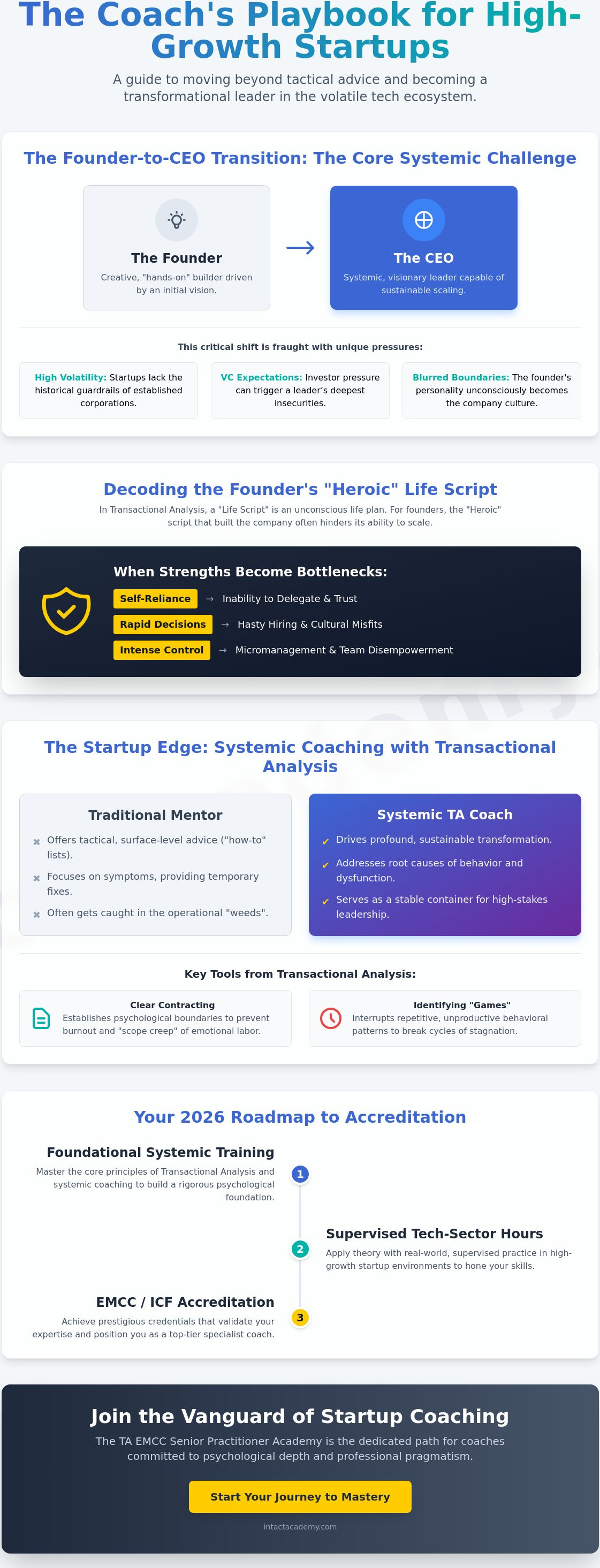
The most profound challenge in this ecosystem is the transition from Founder to CEO. It's a shift from the creative, "hands-on" energy of a builder to the systemic, visionary oversight of a leader. This evolution is rarely linear. It's often fraught with the psychological weight of venture capital expectations. Investors don't just provide capital; they introduce a specific brand of pressure that can trigger a leader’s deepest insecurities. In this high-pressure crucible, the founder’s personality doesn't just influence the culture; it becomes the culture. If the founder is prone to conflict avoidance or micromanagement, these traits will replicate throughout the entire hierarchy, manifesting as systemic blocks to progress.
The Founder’s Script and Scaling Pains
In Transactional Analysis, we speak of "Life Scripts," the unconscious plans we create in childhood to navigate the world. For many entrepreneurs, these scripts are built on a foundation of "Heroic Leadership." While this drive is what births a company, it often becomes a bottleneck during Series A and B funding rounds. The very traits that made the founder successful; self-reliance, rapid decision-making, and intense control; start to hinder the company’s ability to scale. Unconscious patterns manifest as organizational dysfunction, leading to rapid hiring mistakes and cultural fragmentation that can derail even the most promising tech innovations. A systemic coach identifies these scripts before they lead to burnout.
Why Startups Demand Systemic Depth
Startups don't need more tactical mentors; they have enough advisors giving them "how-to" lists. They need coaches who understand business and executive coaching as a vehicle for profound human transformation. Systemic coaching allows a professional to hold space for the immense uncertainty inherent in the tech sector. It requires a mastery of leading organizational change through a psychological lens. By addressing the root causes of behavior rather than just the symptoms, you help founders navigate pivots and scaling pains with a sense of wholeness and integrity. This is the path for those learning how to become an executive coach for startups who wish to move beyond the surface and into the realm of lasting impact.
The Core Competencies: Why Transactional Analysis is the Startup Edge
In the high-pressure environment of a tech startup, the primary source of friction is rarely the product; it's the invisible dynamics between the people building it. Transactional Analysis (TA) serves as a sophisticated operating system for these human dynamics. When you seek to understand how to become an executive coach for startups, you are essentially learning to read the code of human interaction. This framework allows you to move beyond surface-level observations and address the root causes of organizational inertia with professional pragmatism.
One of the most powerful tools in this system is the concept of "Contracting." In the frantic pace of a scaling company, boundaries are often the first casualty. Systemic coaches use clear, multi-level contracts to establish what is being worked on, who is responsible, and what the psychological boundaries of the engagement will be. This clarity prevents the "scope creep" of emotional labor that often burns out less experienced coaches. By identifying "Psychological Games", repetitive, unproductive patterns of behavior like the "Yes, But" game, you can help leadership teams break cycles of stagnation and return to a state of effective action.
Navigating Ego States in the C-Suite
The Parent-Adult-Child (PAC) model is indispensable for decoding high-stakes board meetings. In these settings, it's common for a founder to slip into an "Adapted Child" ego state when faced with the "Critical Parent" energy of a demanding investor. This shift effectively shuts down the founder's capacity for creative problem-solving. Your role as a coach is to recognize these shifts in real-time. For example, during a difficult pivot, you might help a founder move from a defensive child state into a grounded "Adult" state by asking reflective questions that invite data-driven reasoning rather than emotional reaction. This movement restores the leader’s agency and clarifies the path forward.
Psychological Safety and Cultural Architecture
While many professionals begin their journey with a foundational course like Georgetown's ICF-accredited coaching program, the specialized startup coach must go deeper into cultural architecture. You help founders understand that psychological safety isn't a "soft" benefit; it's a critical performance metric. By mapping unconscious patterns in corporate change, you allow the organization to evolve without losing its core identity. Systemic safety is the invisible foundation that supports every technical innovation. If you are ready to master these profound human frameworks, exploring the TA EMCC Senior Practitioner Academy can provide the rigorous training required for this level of work.
Startup Mentorship vs. Executive Coaching: Making the Transition
The journey of discovering how to become an executive coach for startups often begins with a fundamental misunderstanding of the role. Many seasoned professionals enter the field as mentors, acting as the "Advice-Giver" who provides solutions based on their own past successes. While mentorship has its place, executive coaching is a distinct discipline of "Transformation-Facilitation." It's the art of holding a mirror to the leader’s internal world, allowing them to see the systemic blocks they've unconsciously created. When a coach pushes solutions, they often inadvertently bypass the founder’s developmental process, leaving the leader dependent on external wisdom rather than internal mastery.
A common objection among aspiring coaches is the belief that one must be a former founder to coach one. This is a misconception that can actually hinder the coaching relationship. A coach who has lived the exact same experience may struggle to maintain neutrality, often falling into the trap of "solution-pushing" that fails to account for the unique systemic complexity of the current organization. Neutrality is a skill that requires ongoing professional development for coaches. It allows you to remain a stable container for the founder's uncertainty without feeling the need to "fix" the situation with your own anecdotes.
The Trap of the "Expert" Mindset
The "Expert" mindset often leads a coach into the role of the "Rescuer" within the Karpman Drama Triangle. When a founder presents a crisis, the impulse to save them is strong. However, rescuing reinforces a "Child" ego state in the founder, preventing them from stepping into their full "Adult" agency. To maintain professional distance while staying deeply empathetic, you must learn to distinguish between offering expertise and asking powerful questions. Expertise should be offered sparingly and only to provide a new framework for the founder to process, rather than a directive to follow. This balance ensures the leader remains the primary driver of their own evolution.
Building a Systemic Coaching Practice
As a startup scales, the focus of the work naturally shifts from individual coaching to team coaching. The dynamics between co-founders and the executive team become the new frontier of organizational health. To command trust at this level, obtaining a recognized executive coaching certification is essential. It provides the systemic frameworks and ethical grounding required for high-stakes C-suite engagements. Furthermore, engaging in Systemic Supervision is vital for managing your own "counter-transference." Supervision provides a safe space to explore the emotional weight you carry from your clients, ensuring that your own unconscious patterns don't interfere with the founder’s flourishing.
The Roadmap to Accreditation: Becoming a Certified Specialist in 2026
Understanding how to become an executive coach for startups requires more than a weekend seminar; it demands a rigorous, multi-stage commitment to professional excellence. In a market that is increasingly crowded with generic advisors, accreditation serves as the structural container that protects both the coach and the client. The roadmap to mastery begins with foundational training in a systemic framework like Transactional Analysis. This provides the intellectual rigor needed to decode the complex human scripts we discussed earlier. Without this foundation, a coach is merely reacting to symptoms rather than addressing root causes.
Once the theoretical groundwork is laid, the focus shifts to practice and specialization. You must accumulate supervised coaching hours specifically within the tech and startup sectors. This immersion allows you to internalize the unique language and stressors of venture-backed growth. From there, the path leads toward high-level recognition, such as the EMCC Senior Practitioner or the ICF Professional Certified Coach (PCC) levels. As your practice evolves, specializing in Team Coaching and Organizational Change becomes essential, as startup founders rarely operate in a vacuum. Finally, engaging in continuous Systemic Supervision ensures that your practice remains ethical and that your own unconscious patterns don't interfere with the founder’s flourishing.
Why EMCC Senior Practitioner Matters
The EMCC Senior Practitioner level is particularly suited for executive work because it prioritizes reflective practice over the mere accumulation of hours. While some models focus on quantity, the EMCC requires a deep, qualitative dive into the "how" and "why" of your interventions. This level of rigor is highly respected in international tech hubs like San Francisco, London, and Berlin, where leaders value evidence-based methodology. It signals to the C-suite that you possess the maturity to handle the volatility of their environment with a calm, authoritative presence.
Selecting a Mastery-Level Academy
Choosing a training program is a critical decision that defines the trajectory of your career. You should look for an academy that offers a blend of psychological depth and professional pragmatism, ensuring you aren't just learning theory in isolation. It's vital to select a program that integrates Sari van Poelje’s agile TA methodology, as this framework is specifically designed for rapid organizational evolution. Coaching mastery is the seamless integration of theory, self-awareness, and systemic impact. If you're ready to establish your credibility at the highest level, the TA EMCC Senior Practitioner Academy provides the comprehensive path required for this specialized field.
Join the Vanguard: The Intact Academy Path to Startup Mastery
Choosing a path toward mastery is an act of both professional ambition and personal integrity. The TA EMCC Senior Practitioner Academy stands as the premier destination for those dedicated to learning how to become an executive coach for startups with true psychological depth. This program doesn't offer surface-level hacks. Instead, it provides a rigorous integration of Transactional Analysis and Systemic Team Coaching, allowing you to address the intricate layers of founder dynamics and organizational health simultaneously. By joining this vanguard, you enter a space where professional pragmatism meets profound human transformation.
One of the most significant advantages of this path is the opportunity to learn within an international cohort. You'll find yourself among high-level professionals from global tech hubs, each bringing unique perspectives on scaling and systemic change. This diversity enriches the learning process, fostering a global citizenship that is essential for coaching in the interconnected tech sector. Intact Academy honors the wholeness of the coach. We recognize that your effectiveness depends on your own state of completeness and genuineness; our methodology ensures you evolve alongside your clients.
When you commit to this level of training, you aren't just gaining a credential; you're entering a community of practice that values integrity and depth. Our students often report that the process of learning how to become an executive coach for startups through a systemic lens fundamentally changes how they perceive leadership and growth. It's a journey that requires courage and a willingness to engage with the complexities of the human experience.
Deep Impact through Systemic Supervision
The intense pressures of the tech sector can easily lead to coach burnout or a sense of "enmeshment" with the founder’s crisis. To counter this, our Systemic Supervision provides a stable container for you to process the emotional and systemic weight of your engagements. It ensures you maintain the professional distance required for clarity while remaining deeply empathetic. For those looking to extend their influence beyond the C-suite, the TA EMCC Senior Team Coach Academy offers a specialized path for organizational-scale impact. It's an invitation to move beyond transactional interventions and into the realm of profound systemic transformation.
Next Steps for Your Coaching Evolution
As you conclude this guide, we invite you to take a reflective pause. Mastery-level work requires a readiness to look inward before taking outward action. If you feel called to this level of depth, check the upcoming academy intake dates for 2026. This is the moment to decide if you're ready to step into your full power as a systemic leader in the coaching field. Your evolution as a coach is the foundation for the evolution of the organizations you serve. Explore the TA EMCC Senior Practitioner Academy to begin your journey toward mastery.
Stepping Into Your Systemic Leadership
The transition from providing tactical advice to facilitating profound human transformation is the hallmark of a master coach. We've explored how Transactional Analysis provides a stable framework for decoding the "Founder Script" and how systemic safety acts as the bedrock for tech innovation. Mastering how to become an executive coach for startups isn't merely about learning a skill set; it's about evolving your own level of awareness to meet the complexity of the high-growth environment. By shifting from a mentor who gives answers to a coach who facilitates evolution, you create space for genuine organizational flourishing.
You don't have to navigate this evolution in isolation. Intact Academy offers a global sanctuary for this work, led by Sari van Poelje, an international expert in Transactional Analysis and Organizational Change. Our programs are accredited by the EMCC and recognized by the ICF, bringing together participants from over 14 countries to foster a truly global perspective on leadership. This diversity ensures that your training is as expansive as the tech sector itself.
If you're ready to move beyond the surface and commit to a path of professional integrity and depth, we invite you to take the next step. Begin your journey to Systemic Mastery at Intact Academy and join a vanguard of professionals dedicated to sustainable change. Your capacity for personal growth is the ultimate catalyst for the founders and teams you will lead toward their own completeness.
Frequently Asked Questions
Do I need a business degree to become an executive coach for startups?
A business degree isn't a professional requirement for this field. While understanding organizational mechanics is helpful, founders primarily seek coaches who can navigate the deep psychological and systemic complexities of rapid scaling. Your success depends more on your ability to hold a stable space for uncertainty and provide structural insight than on your knowledge of traditional academic business models.
What is the difference between ICF and EMCC accreditation for startup coaches?
ICF accreditation is globally recognized for its broad standards and hours-based tiers, while EMCC, particularly at the Senior Practitioner level, emphasizes reflective practice and systemic depth. Many startup coaches prefer the EMCC framework because it aligns with the need for psychological rigor in high-growth environments. Both bodies provide a clear path to credibility when working with sophisticated corporate clients.
How long does it take to become a certified executive coach?
The timeline typically spans six to twelve months for an initial certification program. However, achieving mastery and senior-level accreditation involves accumulating supervised coaching hours, which can take an additional one to two years of practice. It's a methodical process that mirrors the deep learning required to handle the volatile dynamics of a tech C-suite effectively.
Can Transactional Analysis really be applied to fast-paced tech environments?
Transactional Analysis is exceptionally well-suited for tech because it acts as a precise operating system for human dynamics. When learning how to become an executive coach for startups, TA helps you decode rapid-fire communication and board meeting tensions with clarity. It transforms complex emotional scripts into manageable data points for founders who value logic, structure, and actionable insight.
What is the typical salary or fee structure for a startup executive coach?
Industry data from 2026 shows that executive coaching rates in North America average around $297 per hour, with C-suite engagements often ranging between $300 and $800 per hour. Structured programs for senior leaders can range from $5,000 to $60,000 depending on the length and depth of the engagement. These rates reflect the high return on investment that systemic coaching provides.
How do I find my first startup coaching clients?
Finding your first clients involves positioning yourself within international tech hubs and demonstrating a specialized understanding of the "Founder to CEO" transition. You might start by offering systemic insights to mid-level directors or through networking in venture capital circles. Credibility in this sector is built by showing you can handle the specific "chaos" of scaling without losing professional neutrality.
What is coaching supervision and why is it mandatory for senior practitioners?
Coaching supervision is a formal process where a coach works with a supervisor to reflect on their client engagements and manage their own emotional responses. It's mandatory for senior practitioners because it ensures ethical integrity and prevents burnout in high-stakes sectors. Supervision provides the stable container necessary for the often-turbulent work of professional change, protecting both the coach and the founder.
Is team coaching more effective than individual coaching for startups?
Individual coaching is vital for personal growth, but team coaching is often more effective for addressing systemic misalignment within a scaling company. As a startup grows, the friction between co-founders or the executive team can become a primary bottleneck. Coaching the entire leadership team ensures that collective performance and cultural architecture evolve in harmony, which is essential for how to become an executive coach for startups with lasting impact.


