

What if professional accreditation wasn't a bureaucratic hurdle to clear, but a systemic invitation to deepen your impact as a human being? With the global coaching market reaching a record 122,974 practitioners in 2026, you might feel overwhelmed by administrative layers or uncertain about which level truly reflects your experience. Understanding how to become an EMCC accredited coach requires looking beyond the paperwork to see a maturation process that validates your psychological depth and professional pragmatism.
We agree that the path to mastery shouldn't feel like a frantic race. This guide offers a comprehensive roadmap to navigating the 2026 EMCC accreditation levels, competencies, and pathways. You'll gain a clear, step-by-step plan to secure your credential, ensuring your practice resonates with the international standards of excellence that today's sophisticated organizations demand. We'll examine everything from the specific supervision requirements for Senior Practitioners to the nuances of the five year renewal cycle, providing the structure you need to move from professional competence to systemic mastery.
Key Takeaways
- Recognize how the EMCC Global Individual Accreditation functions as a badge of professional integrity and systemic depth in a crowded global market.
- Transition from performing coaching tasks to embodying professional excellence through a deep dive into the eight core competencies of the EMCC framework.
- Determine the most effective path for how to become an EMCC accredited coach by comparing the fast-track EQA route with the traditional individual portfolio submission.
- Identify the structural requirements for your professional portfolio, including the vital role of quarterly systemic supervision in maintaining your accreditation.
- Learn how a mastery approach that blends Transactional Analysis with systemic methodology can elevate your practice from simple coaching to meaningful organizational change.
Navigating the EMCC Accreditation Landscape in 2026
Accreditation is often viewed as a finish line, yet for the reflective practitioner, it's a beginning. It serves as a public declaration of your commitment to professional integrity and psychological depth. As you explore how to become an EMCC accredited coach, you'll find that the European Mentoring and Coaching Council (EMCC) offers a framework that values the person as much as the process. In 2026, this landscape has evolved. There's a heightened focus on psychological safety and ethical vigilance, responding to a world where organizational complexity is the norm rather than the exception.
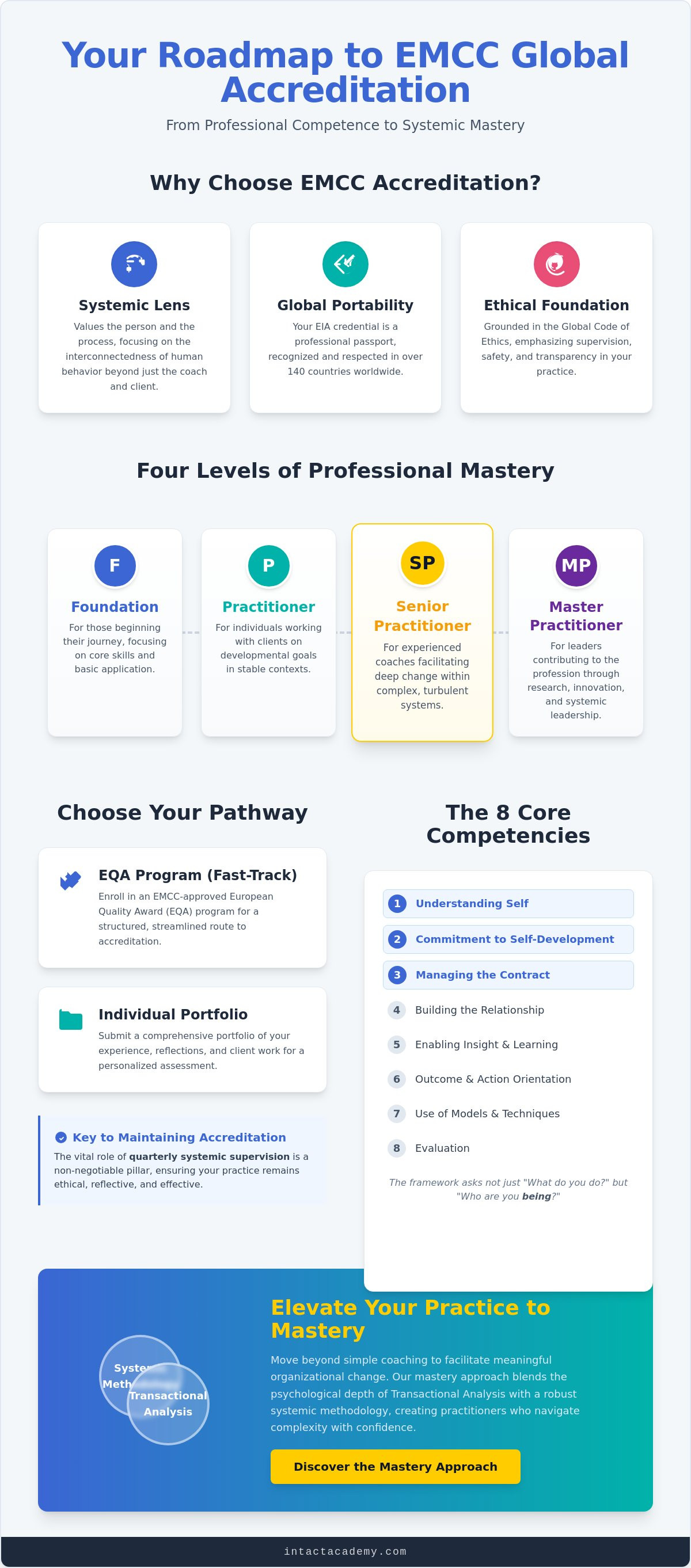
The EMCC Global Individual Accreditation (EIA) is structured across four distinct levels of mastery, each representing a stage in your professional evolution:
- Foundation: For those beginning their journey, focusing on core skills and basic application.
- Practitioner: For individuals working with clients on developmental goals within a stable context.
- Senior Practitioner: For experienced coaches who facilitate deep change within complex, often turbulent systems.
- Master Practitioner: For those contributing to the profession through research, innovation, and systemic leadership.
Why Choose EMCC Over Other Accrediting Bodies?
While other organizations might focus heavily on specific behavioral competencies, the EMCC distinguishes itself through its systemic lens. It doesn't just look at the coach and client in isolation. Instead, it prioritizes mentoring and supervision as non-negotiable pillars of practice. This alignment with the Global Code of Ethics ensures that your work remains grounded in safety and transparency. With global portability across 140+ countries, the EIA is a passport for the modern, borderless coach who seeks to understand the interconnectedness of human behavior.
Identifying Your Entry Level: From Practitioner to Senior Practitioner
Choosing the right level is a matter of honest self-reflection. You'll need to assess your coaching hours, but the quality of those hours matters just as much as the quantity. Are you working with individual life goals, or are you navigating the intricate power dynamics of executive coaching? For those leading organizational change, the Senior Practitioner level is often the most appropriate fit. It validates your ability to hold a space for transformation that impacts the entire organizational system, not just the person sitting across from you. Understanding how to become an EMCC accredited coach at this level requires a shift from simply performing a role to embodying a professional presence that can handle high-stakes systemic interventions.
Decoding the EMCC Global Core Competency Framework
True mastery in coaching isn't found in the rigid application of tools. It's found in the quiet space between the coach's presence and the client's emerging needs. If you're investigating how to become an EMCC accredited coach, you'll find that the framework demands more than technical proficiency; it requires a profound integration of your professional identity. The EMCC doesn't just ask what you do. It asks who you are being while you do it. This shift from performing to being is the hallmark of a systemic practitioner who understands that their own internal state is the most powerful tool in the room.
The EMCC Global Accreditation process centers on eight core competencies that act as a mirror for your practice. These standards challenge you to look inward. They prompt you to examine your ego states, your biases, and the subtle ways you might be influencing the systemic field. By linking a robust methodology like Transactional Analysis to these standards, you create a bridge between psychological theory and professional pragmatism. It's about ensuring that your self-belief is grounded in evidence and your empathy is balanced by professional distance.
The 8 Competencies Every EMCC Coach Must Master
At the heart of the framework lies "Understanding Self." This competency requires you to maintain an ongoing awareness of your internal processes and how they impact the coaching relationship. It's not enough to possess skills; you must demonstrate a "Commitment to Self-Development" through continuous learning and supervision. Another critical pillar is "Managing the Contract." Mastering coaching contracting ensures that every intervention is aligned with the client's needs and the organization's wider systemic goals. This clarity prevents the "drama triangle" and fosters a state of professional autonomy.
Evidencing Mastery in Your Application
When you prepare your application, the goal is to demonstrate the "Golden Thread." This is the consistent logic that connects your personal philosophy, your chosen methodology, and your actual client work. Your reflective logs shouldn't just list activities. They must reveal your internal dialogue and how you've navigated complex ethical dilemmas. Use client feedback not as a testimonial of success, but as evidence of systemic impact. For those ready to bridge this gap between theory and deep practice, our TA EMCC Senior Practitioner academy offers a structured environment to refine this internal alignment. You'll learn to translate your lived experience into the precise evidence required to show how to become an EMCC accredited coach at a senior level.
Choosing Your Pathway: EQA Programs vs. Individual Portfolio
Deciding on the right path is a moment of professional discernment. It's a choice between a structured, pre-validated journey and a retrospective mapping of your unique experience. When you consider how to become an EMCC accredited coach, you aren't just choosing a form to fill out; you're choosing a method of reflection. The EMCC offers two main avenues: the European Quality Award (EQA) route and the Individual Portfolio route. Each path respects the practitioner's maturity, yet they serve different developmental needs. One provides a future-focused container for growth, while the other offers a way to synthesize the wisdom you've already gathered.
The EQA Advantage: A Fast-Track to EIA
An EQA program acts as a pre-validated container for your professional evolution. When you graduate from an accredited academy, the EMCC has already audited the curriculum, the faculty, and the assessment methods. This pre-validation significantly reduces the administrative weight of your final application. You're learning within a cohort of systemic practitioners, which provides a social mirror for your own growth. Our TA EMCC Senior Practitioner academy and TA EMCC Senior Team Coach Academy are designed specifically to align with these EMCC Global Accreditation Standards, ensuring that your transition from student to accredited professional is a seamless evolution. It's a path for those who value a steady, methodical rhythm of learning and the safety of a structured peer group.
The Individual Portfolio: Honoring Your Unique Journey
Sometimes, your journey hasn't followed a linear track. You might be a highly experienced consultant with years of multi-disciplinary training that didn't carry an EQA badge at the time. The Individual Portfolio route honors this rich, often fragmented history. It requires a meticulous mapping of your prior learning against the EMCC competencies. While it demands more rigorous documentation and a deeper dive into past reflective logs, it allows you to weave together diverse threads of your career into a singular professional identity. Mapping your history through an individual portfolio is a rigorous way to show how to become an EMCC accredited coach while respecting your prior investments in learning. It's an ideal choice for the seasoned professional who seeks to formalize a lifetime of experience in organizational change and systemic leadership without repeating foundational training.
Ultimately, the choice between an EQA program and an Individual Portfolio is about where you are in your cycle of "becoming." If you're looking for a fresh, psychologically deep environment to refine your senior-level skills, the EQA route provides that space. If you're looking to validate a body of work that already exists, the Portfolio route offers the necessary rigor. Both lead to the same international recognition, validating your ability to facilitate profound human transformation within complex systems.
The Practical Journey: Building Your Professional Portfolio
Building a professional portfolio is a ritual of consolidation. It's the stage where you transform raw experience into professional evidence, moving from the intuitive to the articulated. If you're learning how to become an EMCC accredited coach, this phase requires a steady, methodical approach to documentation. It isn't merely about filing papers; it's about witnessing your own evolution. The portfolio serves as a stable container for your growth, ensuring that your practice is grounded in both psychological depth and professional pragmatism.
The journey involves five essential steps that lead toward international recognition:
- Step 1: Documenting coaching hours and client diversity. Record your sessions with a focus on breadth. The EMCC values your ability to navigate different organizational cultures and human challenges.
- Step 2: Engaging in professional supervision. This is the backbone of ethical practice. It's where you process the "parallel processes" that occur between you and your clients.
- Step 3: Crafting your coaching philosophy. Articulate your systemic framework. What is your North Star? How do you ensure your interventions lead to wholeness rather than just performance?
- Step 4: Compiling evidence of Continuing Professional Development (CPD). In 2026, this includes your adaptation to emerging technologies and deeper ethical training.
- Step 5: The final submission and interview. View the assessor interview as a dialogue between peers, a moment to demonstrate your professional presence.
The Critical Role of Coaching Supervision
Supervision isn't a sign of weakness; it's a mark of professional integrity. The EMCC requires a 1:35 supervision-to-coaching ratio, ensuring that for every 35 hours of client work, you spend one hour in deep reflection with a mentor. Finding a supervisor who understands systemic supervision is vital for those working in complex organizational settings. This space allows you to uncover blind spots and recognize the psychological games that can subtly derail a coaching relationship. It's a place of safety where you can look inward before taking outward action. If you're ready to deepen your reflective capacity, our Systemic Supervision provides the intellectual rigor and emotional support needed to maintain a state of professional completeness.
Writing Your Reflective Practice Logs
Your reflective logs are the heart of your application. They shouldn't just list what happened; they must explore what you learned about the system. By applying the principles of what is transactional analysis, you can analyze client dynamics through the lens of ego states and scripts. This level of insight shows the assessor that you aren't just performing a role, but are actively engaging with the human condition. Reflective practice is the bridge between experience and wisdom. When you write with this depth, you demonstrate how to become an EMCC accredited coach who is capable of facilitating profound transformation.
Elevating Your Practice: The Intact Academy Mastery Approach
Mastery is rarely a solitary achievement. It's a collaborative process of returning to a state of completeness, where your professional skills align perfectly with your internal genuineness. At Intact Academy, we believe that understanding how to become an EMCC accredited coach is only the first step. The true goal is to evolve into a practitioner who can hold the weight of complex organizational change. We achieve this by integrating the psychological precision of Transactional Analysis (TA) with the rigorous standards of the EMCC. This combination ensures that your practice remains both intellectually rigorous and deeply human.
Our approach moves beyond the transactional nature of typical coaching. We focus on the systemic field, looking at how individual growth and organizational success are inextricably linked. By learning from Sari van Poelje and our global team, you gain insights from decades of experience in the inner workings of diverse organizations. This mentorship helps you transition from a coach who performs a role to a senior practitioner who embodies a presence capable of facilitating profound human transformation.
The TA EMCC Senior Practitioner Academy
Our TA EMCC Senior Practitioner academy is a year-long immersion designed for those ready to move beyond individual interventions. We focus on an executive coaching certification that utilizes a systemic lens, allowing you to see the hidden scripts and power dynamics within an organization. We don't just teach theory. We provide the practical, step-by-step support needed to navigate the entire EIA application process. This ensures you have the reflective depth and documented evidence required to show how to become an EMCC accredited coach at a senior level, validating your ability to lead high-stakes organizational change.
Beyond Accreditation: Joining a Global Systemic Community
Accreditation is a significant milestone, yet the path to professional flourishing is lifelong. When you join our academy, you aren't just enrolling in a course; you're entering a global network of systemic practitioners spanning 14 countries. This community offers a stable container for your ongoing development, providing a space for peer learning that transcends traditional boundaries. It's an environment where complex issues feel manageable through shared insight and structured methodology. If you're ready to bridge the gap between technical skill and systemic wisdom, we invite you to Discover our TA EMCC Senior Practitioner Academy and begin your journey toward professional mastery.
Embodying the Path of Professional Flourishing
The transition from a skilled practitioner to an internationally recognized authority is a process of deep maturation. You've explored the structural requirements of the competency framework and the strategic choice between EQA and individual portfolio pathways. Understanding how to become an EMCC accredited coach is ultimately about integrating your personal philosophy with a rigorous systemic methodology. It's a commitment to transparency, ethical vigilance, and the steady rhythm of supervision that ensures your work remains grounded and impactful.
At Intact Academy, we provide the stable container needed for this transformation. Led by world-renowned expert Sari van Poelje, our EMCC and ICF accredited programs bring together participants from 14+ countries to foster a truly global perspective on organizational change. Whether you're seeking to refine your presence or lead complex systemic interventions, we're here to support your evolution. Elevate your coaching to the Senior Practitioner level with Intact Academy. The world requires coaches who possess the courage to look inward and the expertise to drive outward success. We invite you to step into your completeness and begin this next chapter of your professional story.
Frequently Asked Questions
What is the difference between EMCC Practitioner and Senior Practitioner levels?
The Practitioner level is designed for coaches who work with clients on developmental goals within relatively stable organizational contexts. In contrast, the Senior Practitioner level is for experienced professionals who facilitate deep, systemic change within complex and often turbulent environments. If your work involves navigating intricate power dynamics or leading high-stakes organizational change, the senior level validates your ability to hold a more sophisticated psychological space.
How many coaching hours do I need for EMCC EIA accreditation?
The specific practice hours required depend on the level of mastery you're seeking. Generally, the Practitioner level requires 100 hours of coaching practice, while the Senior Practitioner level requires a minimum of 250 hours. These hours must demonstrate a diversity of clients and contexts, proving that you can adapt your systemic approach to various human and organizational challenges.
Do I need a specific degree to become an EMCC accredited coach?
No specific academic degree is mandatory to start the journey of how to become an EMCC accredited coach. The EMCC prioritizes professional maturity, reflective capacity, and the integration of lived experience over formal titles. Your application is assessed on your ability to embody the eight core competencies and your commitment to ongoing psychological and professional growth.
Can I use my ICF hours toward an EMCC accreditation?
You can certainly use coaching hours previously logged for ICF credentials when applying for your EMCC Individual Accreditation. The EMCC recognizes valid practice hours regardless of which professional body you originally tracked them for. This flexibility is especially beneficial for those using the individual portfolio route to synthesize a broad, international body of work.
How much does the EMCC accreditation fee cost in 2026?
As of 2026, the Individual Accreditation (EIA) fees are set at €120 for Foundation, €205 for Practitioner, €245 for Senior Practitioner, and €450 for Master Practitioner. It's important to remember that VAT may be added at checkout. Additionally, you'll need to maintain an active membership, which currently costs €90 for a one year period in chapters like EMCC Cyprus.
What happens if my coaching training was not an EQA-accredited program?
You can still achieve your goals by following the Individual Portfolio route. This pathway allows you to map your prior non-accredited training and multi-disciplinary experience directly against the EMCC Global Professional Practice Framework. While it requires more rigorous documentation, it's an excellent way to honor a unique professional journey that doesn't follow a standard linear track.
How often do I need to renew my EMCC coach accreditation?
Your EMCC Individual Accreditation is valid for a period of five years. After this time, you'll go through a re-accreditation process to demonstrate your continued commitment to professional development and ethical practice. This ensures that all accredited coaches remain current with emerging trends, such as the integration of technology and systemic evolution in 2026.
Is coaching supervision mandatory for EMCC accreditation?
Supervision is a non-negotiable requirement for all EMCC accredited practitioners. As of March 2026, Senior Practitioners are required to engage in at least one supervision session per quarter to maintain their status. The EMCC recommends a ratio of one hour of supervision for every 35 hours of coaching practice to ensure you're effectively managing blind spots and systemic client dynamics.


