

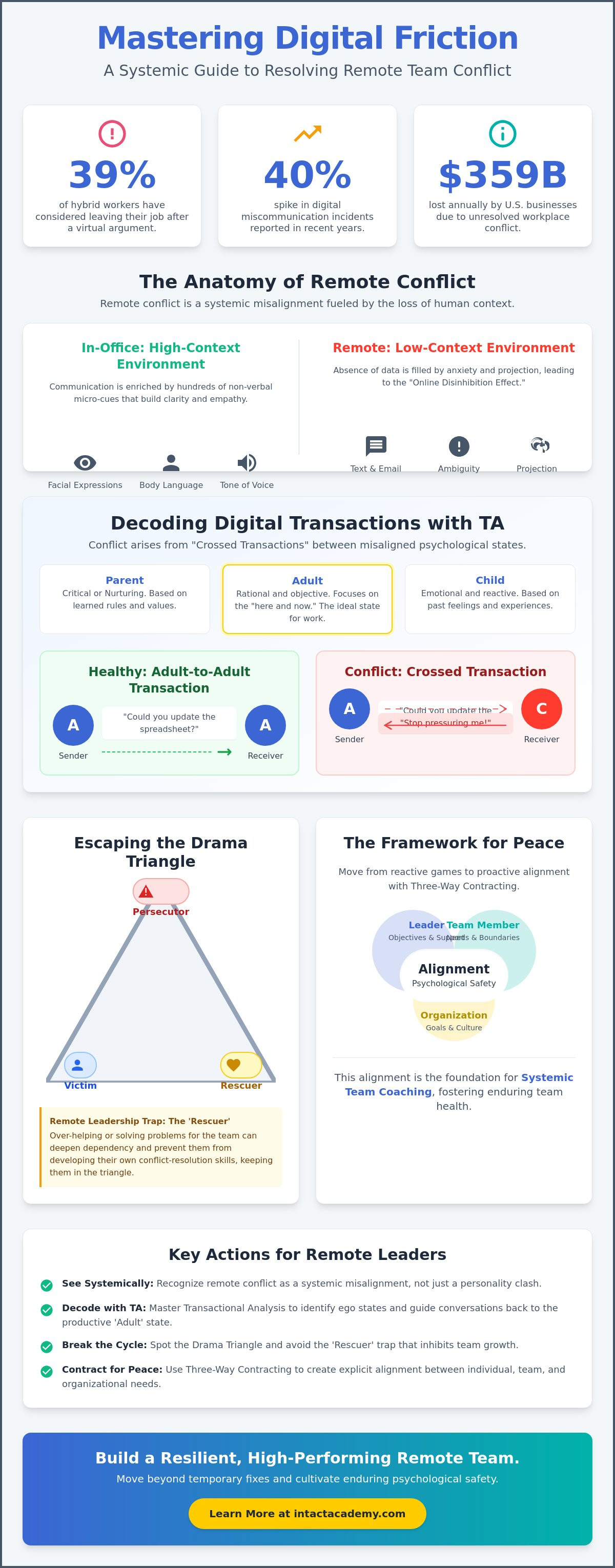
Did you know that 39% of hybrid workers have considered leaving their roles following a virtual argument? This startling figure highlights that handling conflict in remote teams is no longer a peripheral management skill; it's a requirement for organizational survival. When the physical office disappears, the subtle cues of human connection often vanish with it. This leaves a void where invisible tensions can quietly escalate into systemic fractures that threaten the core of your culture.
You've likely felt that sudden, sharp chill in a text thread or the heavy silence during a video call where something fundamental has shifted. It's exhausting to lead when you can sense the friction but cannot grasp its source. This article will help you master the art of resolving digital friction by understanding the hidden psychological and systemic patterns that drive remote dynamics. We'll explore a stable framework for digital mediation, focusing on how to restore psychological safety and ensure the long-term health of your organizational system.
Key Takeaways
- Recognize that remote conflict is a systemic misalignment rather than a simple personality clash, often fueled by the rapid escalation inherent in low-context digital spaces.
- Master the use of Transactional Analysis to decode digital ego states, transforming reactive text-based exchanges into productive, Adult-level dialogues.
- Break the cycle of the Drama Triangle by identifying how common remote leadership behaviors, like 'Rescuing,' can inadvertently deepen team dependency and friction.
- Implement a robust framework for handling conflict in remote teams through Three-Way Contracting, which secures alignment between individual needs and organizational objectives.
- Move beyond temporary fixes by embracing systemic team coaching, a methodology designed to foster enduring psychological safety and collective flourishing.
What is Remote Conflict? Moving Beyond the Digital Divide
Remote conflict is rarely a simple disagreement over a project deadline or a missed deliverable. It is a systemic misalignment occurring within a low-context environment. In a traditional office, humans rely on hundreds of micro-cues to navigate social interactions. A raised eyebrow, a heavy sigh, or a brief, reassuring smile provides the vital context needed to interpret a colleague's intent. Within a Virtual team, these sensory anchors disappear. We are left with low-context communication, where the absence of data is often filled by our own internal anxieties and psychological projections.
This environment creates a phenomenon known as Psychological Distance. When we do not share the same physical space, our brains struggle to maintain the same level of empathy that comes naturally during face-to-face interaction. We stop seeing a person; we start seeing a source of frustration. This shift explains why virtual friction often escalates with alarming speed. While traditional office disputes might simmer, digital miscommunication incidents have seen a reported 40% spike in recent years. This acceleration transforms task-based conflict, which can be productive, into relational friction that feels deeply personal and permanent.
The Invisible Escalation: Why Remote Teams Snap
Digital platforms often trigger the Online Disinhibition Effect. Professionals frequently say things in a Slack thread or an email that they would never utter in a physical boardroom. Without the immediate feedback of a colleague's facial expression, our internal social brakes can fail. Handling conflict in remote teams becomes significantly harder because the natural watercooler repairs are gone. In an office, a casual, five-second apology in the hallway can dissolve a morning's tension. In a remote setting, that tension sits. It festers. With U.S. businesses losing an estimated $359 billion annually in paid hours due to workplace conflict, the cost of this unresolved digital tension is a heavy burden on both team morale and organizational ROI.
Systemic Impact of Virtual Silos
Remote work can fragment the sense of Team Wholeness into isolated, individual silos. When team members feel disconnected from the collective, they often resort to sub-grouping as a defense mechanism against uncertainty. They form small, exclusive alliances to find the safety they no longer feel within the larger group. This fragmentation isn't just a communication hurdle; it's a systemic failure that threatens the stability of the entire culture. Effectively leading organizational change requires us to address these silos before they become entrenched. If we ignore the psychological patterns behind these divisions, we risk losing the collective intelligence that only a unified team can provide.
Decoding Digital Transactions: A TA Perspective on Remote Friction
While many leaders focus on the limitations of software, the true source of digital friction lies in the architecture of the human transaction. Transactional Analysis (TA) offers a profound framework for understanding these exchanges by identifying three distinct "Ego States": Parent, Adult, and Child. In a remote setting, every Slack message, email, and video call is a transaction where we offer a piece of ourselves and wait for a response. When we're handling conflict in remote teams, we're often untangling "Crossed Transactions." This happens when an objective request from the Adult state, such as "Could you update the project spreadsheet?", is met with a defensive response from the Adapted Child state, like "I'm doing my best, stop pressuring me!". These misalignments are the root of digital friction, turning simple task updates into emotional battlegrounds.
Asynchronous tools like email are particularly susceptible to these crossed transactions. Without the rhythm of real-time speech, we often project a "Parental" tone onto a neutral "Adult" message. Experts in Preventing and Managing Team Conflict emphasize that clarity in communication is paramount, yet TA teaches us that the psychological position we occupy matters as much as the words we choose. To foster a healthy team, we must learn to identify when we've slipped out of the Adult state and how to invite our colleagues back into a space of mutual respect and objective problem-solving.
Ego States in the Zoom Room
In the high-pressure environment of a video call, it's easy to slip into the Critical Parent state. This manifests as harsh, judgmental feedback or subtle micromanagement that stifles creativity. Conversely, remote workers feeling isolated might retreat into the Adapted Child, becoming overly compliant or passive-aggressive. The goal for any healthy organization is to return to Adult-to-Adult transactions. This state is characterized by curiosity, objectivity, and a focus on collective flourishing rather than individual blame. For those looking to deepen their mastery of these dynamics, exploring Team Coaching can provide the structural tools needed to facilitate these essential transitions.
Digital Strokes and Recognition Hunger
Humans have an innate need for "Strokes," or units of recognition. In a physical office, these are abundant. A nod in the hall, a shared laugh, or a quick "well done" while passing a desk provides the psychological nourishment we need to feel valued. Remote workers often suffer from intense "recognition hunger" because these informal strokes are absent. When positive recognition is scarce, individuals may unconsciously seek "Negative Strokes." They might initiate conflict or miss deadlines simply because negative attention is more tolerable than being invisible. Leaders can mitigate this by integrating authentic, specific recognition into virtual workflows, ensuring every team member feels "seen" within the system.
The Drama Triangle: Spotting Psychological Games in Remote Teams
Conflict in virtual spaces often follows a predictable, if unconscious, choreography. When we find ourselves handling conflict in remote teams, we aren't just managing schedules; we're often untangling the Drama Triangle. This model, developed by Stephen Karpman, identifies three shifting roles: the Persecutor, the Rescuer, and the Victim. In a remote context, these roles manifest through the screen. A Persecutor might use a "cc-all" email to publicly shame a colleague. A Victim may retreat into silence during meetings, feeling powerless against the digital void. Most dangerously, a manager often steps in as the Rescuer, attempting to "fix" every minor friction without addressing the underlying systemic cause.
The Rescuer manager creates a subtle but damaging dependency. By jumping into every Slack thread to resolve a dispute, they prevent team members from developing their own resolution muscles. This disempowerment eventually pushes subordinates into a permanent Victim stance, where they feel incapable of making decisions without intervention. As highlighted in professional insights regarding Resolving Conflicts in the Virtual Workplace, the lack of sensory feedback in these environments can cause these roles to harden. To move toward autonomy, the team must learn to recognize these roles and choose to step out of the triangle, favoring direct, Adult-to-Adult communication instead.
Common Remote 'Games' People Play
Psychological "games" are repetitive sequences of behavior with a hidden agenda. One frequent remote game is "Now I've Got You," where a team member meticulously archives every email to trap a colleague in a future contradiction. Another is "Yes, But," where an individual asks for help but rejects every solution offered, effectively stalling innovation. You can use transactional analysis to stop these games mid-flow. By naming the dynamic and refusing to play your assigned role, you collapse the game's structure and invite a more genuine interaction.
Breaking the Script of Remote Conflict
Every team operates under a "Team Script," an unconscious plan that dictates how the group handles success and failure. In remote settings, individual "Life Scripts" often play out without the social correction found in a physical office. If a team's script is "we are always overwhelmed," members will unconsciously create conflict to justify that feeling. Breaking this script requires a conscious effort to rewrite the team's narrative. A coach's role is to hold up a mirror to these patterns, helping the team move away from repetitive failures and toward a state of systemic wholeness and shared agency.
Contracting for Peace: Steps to Resolve Remote Conflict
True resolution begins with the Three-Way Contract. This systemic tool ensures that the individual's growth, the team's cohesion, and the organization's strategic goals are in perfect alignment. When handling conflict in remote teams, we often find that friction arises because one of these pillars has been neglected. By establishing an explicit Adult agreement on how to handle disagreements before they occur, you create a psychological safety net. This includes setting clear Boundaries of Engagement. When does a Slack message require an immediate response? When is it acceptable to remain offline? These are not just logistical questions; they are the boundaries that protect our mental energy and mutual respect.
Effective mediation also relies on the use of Clean Language. This technique involves asking questions that do not impose the mediator's own metaphors or biases onto the participants. Instead of asking, "Why are you angry?", a leader might ask, "And what kind of anger is that anger?" This allows the individual to define their experience without feeling judged or cornered. It moves the conversation away from blame and toward a shared understanding of the underlying systemic patterns. By honoring the unique internal landscape of each team member, you foster an environment where complex issues feel manageable through structured methodology.
The Remote Team Charter
A Remote Team Charter is a living document that defines "how we argue here." It's a collective agreement that moves beyond surface-level rules to address the psychological health of the group. Within this charter, teams set specific protocols for when to escalate a conversation. For instance, if a text-based thread reaches three exchanges without resolution, the protocol may dictate a mandatory switch to video. This prevents the "Online Disinhibition Effect" from taking hold. The ultimate goal is to ensure every team member feels "I'm OK, You're OK" even in the midst of a heated debate. This philosophical anchor transforms conflict from a threat into an opportunity for evolution.
Mediation Techniques for Virtual Leaders
When handling conflict in remote teams during a live video session, leaders can employ Systemic Circular Questioning. Instead of asking a person to explain their own behavior, you ask them how they think another team member perceives the situation. This encourages a shift in perspective and builds empathy across the digital divide. It's also vital to facilitate "Venting" safely. In a digital environment, this means providing a structured space where emotions can be expressed without causing systemic damage. For leaders seeking to master these mediation frameworks, our Team Coaching programs offer the depth required for true organizational transformation.
From Conflict to Mastery: The Role of Systemic Team Coaching
While immediate mediation restores a temporary equilibrium, it rarely addresses the underlying energetic shifts that allow friction to recur. Simple conflict resolution is often a reactive bandage applied to a systemic wound. Handling conflict in remote teams requires a shift in perspective, moving from the role of a crisis manager to that of a systemic architect. This transition involves looking beyond the individual actors and focusing on the invisible threads that connect them. When we stop asking "who is at fault" and start asking "what is this system trying to express," we open the door to profound human transformation.
The journey toward long-term team health necessitates a commitment to systemic team coaching. This approach doesn't just resolve an argument; it reconfigures the team's capacity for collective intelligence and psychological safety. By treating the team as a single organism, coaches can help members recognize their shared responsibility for the digital environment they inhabit. This creates a sustainable culture where friction is seen as a signal for growth rather than a threat to stability. It's about returning the team to a state of completeness and genuineness, where every voice contributes to the whole.
Developing the 'Internal Supervisor'
To lead effectively in high-stakes virtual environments, a leader must cultivate an "Internal Supervisor." This is the capacity for self-reflection that prevents you from being "hooked" into the team's drama. Without this internal grounding, it's easy to fall into parallel processes, where the leader unconsciously mirrors the stress and fragmentation of the team. Engaging in professional development for coaches in 2026 is no longer optional; it's a vital safeguard. Systemic supervision provides the necessary space to step back, gain clarity, and ensure that your interventions remain objective and impactful.
Join the TA EMCC Senior Team Coach Academy
Mastering the intricacies of human behavior within business systems requires a structured and rigorous methodology. The TA EMCC Senior Team Coach Academy offers a path for those who seek to move beyond transactional training and into the realm of systemic mastery. Our curriculum is built upon the intersection of Transactional Analysis and organizational systems, catering to a sophisticated global audience. By joining the academy, you gain access to:
- International Accreditation: Secure high-level recognition through EMCC and ICF standards, essential for the global remote market.
- Systemic Supervision: Learn to stay grounded and effective even during the most turbulent team crises.
- Profound Transformation: Move beyond surface-level coaching to facilitate deep, lasting change within organizations.
The complexity of handling conflict in remote teams demands a leader who is as comfortable with psychological depth as they are with professional pragmatism. If you're ready to evolve your practice and lead your team toward a state of flourishing, we invite you to take the next step. Discover our Team Coach Academy and begin your journey toward systemic mastery today.
Cultivating a Culture of Systemic Wholeness
The shift from managing isolated incidents to understanding the broader organizational system marks the transition from manager to systemic architect. By recognizing digital transactions and breaking the cycle of the Drama Triangle, you move beyond surface-level fixes. You've learned that handling conflict in remote teams isn't about eliminating tension; it's about using that tension as a catalyst for growth. Through robust contracting and a commitment to Adult-to-Adult communication, you create a container where psychological safety becomes a lived reality.
If you're ready to deepen this mastery, consider joining a community of practitioners dedicated to profound human transformation. Our EMCC and ICF Accredited Programs are led by Sari van Poelje, a global TA expert who has guided participants from 14+ countries toward professional excellence. Master Systemic Team Coaching at Intact Academy and lead your organization toward a state of genuine flourishing. The path to systemic health is a deliberate process, and you now possess the insights to begin this journey with confidence.
Frequently Asked Questions
How do I identify conflict in a remote team if no one is complaining?
Identify invisible conflict by monitoring shifts in the team's energetic output and communication rhythm. Silence is often more telling than complaints. Look for a sudden drop in voluntary recognition "strokes" or the emergence of silos where information is guarded. These are systemic indicators that the psychological contract has been breached and tension is being suppressed.
What is the fastest way to de-escalate an email argument?
The most effective way to de-escalate is to change the communication medium immediately. When handling conflict in remote teams, text often lacks the sensory data needed for empathy, which can lead to rapid escalation. Moving to a video call allows for the restoration of vital micro-cues. Once on the call, lead from an Adult ego state by focusing on objective facts rather than parental judgment.
Should I use a mediator for remote team conflicts?
Mediation is necessary when the team's internal resources for resolution have been exhausted and the same "Drama Triangle" roles are being played out repeatedly. If the manager is already "hooked" into the conflict as a Rescuer or Persecutor, they cannot remain objective. An external mediator or systemic supervisor provides the stable container needed for participants to move toward autonomy and genuine resolution.
How does Transactional Analysis help with remote leadership?
Transactional Analysis offers a precise language for decoding digital interactions that otherwise feel chaotic or unpredictable. It helps leaders identify when they are operating from a Critical Parent state or when a subordinate is retreating into an Adapted Child response. This awareness allows the leader to consciously invite Adult-to-Adult transactions, which are essential for effective problem-solving in a virtual workspace.
What are the signs of a 'Psychological Game' in a Zoom meeting?
Signs of a psychological game include a sense of "déjà vu" during interactions or an unexpected emotional "payoff" at the end of a meeting. If a team member consistently presents problems but rejects every solution, they're likely playing "Yes, But." Recognizing these repetitive patterns is the first step in collapsing the game's structure and returning to authentic engagement.
How often should remote teams review their communication contracts?
Review your communication contracts at least once every quarter or whenever there's a significant change in the team's composition. Remote dynamics are fluid; a contract that worked for a smaller group may fail as the system grows. Regular reviews ensure that boundaries of engagement remain relevant and that everyone feels "I'm OK, You're OK" within the digital structure.
Can remote conflict actually be productive for a team?
Conflict can be a powerful driver of evolution when it remains focused on tasks and systemic improvement. Productive friction challenges the status quo and prevents the stagnation of groupthink. However, this is only possible when handling conflict in remote teams occurs within a foundation of high psychological safety. Without that safety, task-based disagreements quickly degrade into damaging relational friction.
What is the role of a team coach in resolving remote friction?
A team coach moves the focus from surface-level symptoms to the underlying "Team Script" that dictates how the group handles stress. Their role isn't just to fix a single dispute but to facilitate a collective shift toward systemic maturity and wholeness. By employing systemic team coaching, they help the group rewrite their narrative of failure into one of shared agency and success.


