

Buy-in is not a communication outcome; it's the result of aligning the psychological contracts between individual ego states and the organizational system. When you're tasked with getting buy-in for organizational change, it's common to feel like you're pulling the entire weight of the transition by sheer force of will. You've likely experienced the frustration of seeing a well-planned initiative stall as employees drift into cynicism or quiet quitting, despite your clear explanations of the benefits. It's a heavy burden to lead when the system seems to resist its own evolution.
You aren't alone in this struggle. With 70% of change initiatives failing to meet their objectives, it's clear that traditional methods of persuasion are no longer enough. There is a more grounded path that honors the complexity of human behavior while delivering pragmatic results. We invite you to move beyond surface-level communication to secure a deep, sustainable commitment by understanding the psychological contracts and systemic dynamics that drive true organizational buy-in.
We'll provide a framework to identify the root causes of resistance and the tools needed to build a psychological contract for change that doesn't revert to old habits.
Key Takeaways
- Learn to distinguish between surface-level compliance and deep psychological commitment, shifting the organization toward a more mature Adult-to-Adult contract.
- Reframe resistance as a vital systemic message rather than a hurdle, allowing you to decode the Parent-Child dynamics that often stall progress.
- Implement a five-step systemic framework for getting buy-in for organizational change by diagnosing existing scripts and establishing transparent, mutual contracts.
- Discover how the internal state of a leader creates a parallel process, where your own presence and psychological ego state directly influence the quality of buy-in you receive.
- Understand why lasting transformation requires moving beyond one-off workshops into a continuous process of Systemic Supervision and structured methodology.
What is Buy-In for Organizational Change? Beyond Compliance
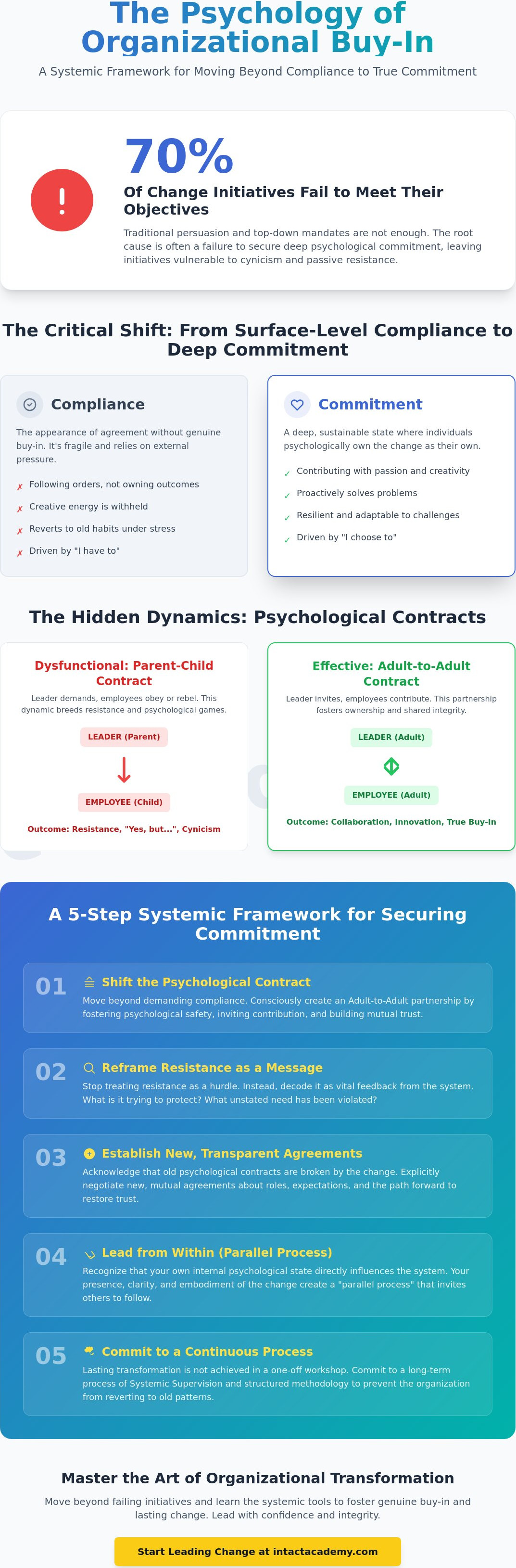
In many corporate settings, buy-in is mistakenly reduced to a checklist of signatures or a lack of vocal dissent. This surface-level agreement is merely compliance. It's the act of following orders while keeping one's heart and creative energy safely guarded. True commitment, however, is a deeper state where individuals own the outcome as if it were their own. Statistics reveal a stark reality: approximately 70% of organizational change initiatives fail to meet their objectives, often because leaders overlook the unconscious resistance bubbling beneath the surface of the corporate hierarchy.
To achieve a different result, we must view getting buy-in for organizational change as the creation of an Adult-to-Adult contract. In this psychological framework, the organization doesn't demand; it invites. The employee doesn't just obey; they contribute. This shift requires a robust container of psychological safety, where voices can be heard without fear of retribution. Without this safety, the system remains in a state of hyper-vigilance, making genuine transformation impossible to sustain.
The Difference Between Intellectual and Emotional Buy-In
Logic is a powerful tool, yet it's rarely the engine of behavioral change. You can present a perfectly rational business case for a merger or a new software rollout, but if the Child ego state within your team perceives a loss of autonomy or safety, resistance is inevitable. This part of our psyche doesn't care about quarterly projections. It cares about belonging and survival. While various change management models focus on the mechanics of the process, they often fail to address this emotional core. Moving from "I have to" to "I choose to" requires systemic alignment, where the change is seen as a path toward individual and collective flourishing rather than a threat to be endured.
Buy-In as a Psychological Contract
Every organization operates on a set of unwritten expectations known as the psychological contract. These are the unstated promises of loyalty, stability, and recognition that exist between leaders and their teams. When a major shift occurs, these old contracts are often violated without acknowledgment. To restore trust, new agreements must be explicitly negotiated. This isn't just about policy; it's about leading organizational change from a place of wholeness and genuineness. When leaders acknowledge what's being lost and clearly define the new boundaries, they find that getting buy-in for organizational change becomes a natural byproduct of shared integrity rather than a forced effort.
Decoding Resistance: Why People Don't 'Buy In'
Resistance is frequently viewed as a hurdle to be cleared or a fire to be extinguished. In reality, resistance is a message from the system. It signals that the current approach to getting buy-in for organizational change has touched a nerve in the collective psyche. When leaders operate from a Parent ego state, issuing directives without dialogue, they inadvertently trigger the Child ego state in their employees. This dynamic often results in psychological games like "Yes, But," where team members appear to agree in meetings while mentally listing every reason the plan will fail. These games aren't malicious; they're protective mechanisms within the organizational script, the repetitive patterns of behavior inherited from past failures.
While many frameworks focus on creating a vision for change, they often ignore the historical weight that makes a vision feel unattainable to a cynical workforce. To move forward, we must decode the specific type of resistance at play to understand what the system is trying to protect.
The Three Faces of Resistance
Resistance manifests in distinct ways depending on the individual's psychological response to perceived pressure. Active resistance is the most visible, characterized by the Rebellious Child who openly challenges new protocols or goals. More insidious is passive resistance, where the Adapted Child politely agrees to the new direction but never actually executes the required tasks. Finally, systemic resistance occurs when the organization's own structures, such as outdated KPIs or siloed departments, make it impossible for even the most willing employees to comply. Identifying these nuances is a core part of our methodology in Organizational Change, ensuring that interventions target the root cause rather than the symptoms.
The Role of Grief in Organizational Change
Every significant transition involves a loss. It might be a loss of status, a familiar routine, or the hard-earned sense of competence in an old system. If leaders rush past this ending phase, they leave the organization in a state of suspended mourning. These haunted initiatives are doomed to stall because the old script hasn't been properly closed. Using Transactional Analysis, we can facilitate a healthy mourning process, allowing the team to acknowledge what was valuable about the past before they're asked to commit to the future. Without this space for reflection, getting buy-in for organizational change remains an intellectual exercise that never reaches the heart of the system.
A 5-Step Systemic Framework for Securing Commitment
Moving from the diagnostic phase of decoding resistance into the active phase of transformation requires a structured methodology. To succeed in getting buy-in for organizational change, leaders must move beyond the frantic energy of "selling" a vision and instead focus on building a robust systemic container. This framework provides a steady path from identification to integration, ensuring that the shift is not merely a temporary adjustment but a profound evolution of the organization's character.
Step 1 & 2: Diagnosis and Contracting
The first movement in this framework is a systemic diagnosis. This involves mapping the "invisible" loyalties that often bind employees to the past. These loyalties might be to a retired founder's philosophy or a previous way of working that once provided safety. By making these hidden ties visible, we can address them with empathy rather than frustration. Once the landscape is understood, we move to multi-level contracting. This process operates on three distinct layers: the business layer (the "what"), the professional layer (the "how"), and the psychological layer (the "why"). Contracting is a tool for mutual accountability that transforms vague expectations into explicit, shared commitments. It ensures that every stakeholder knows not only what is expected of them but also what they can expect from the system in return.
Step 3 & 4: Communication and Autonomy
Effective communication in this framework avoids the "Parent" trap of over-explaining, which often triggers a "Child" rebellion. Instead, we employ Adult-to-Adult dialogue through reflective inquiry. By asking questions that prompt team members to look inward, such as "What resources do you need to remain effective during this transition?", we shift the energy from resistance to curiosity. This leads naturally into empowering autonomy. When employees have a genuine voice in how a change is implemented, they move from being subjects of change to being its architects. We encourage a creative risk-taking mindset, where it's safe to fail within the new system. This mirrors Sari van Poelje's approach to agile systemic change, where the focus remains on flexibility, speed, and psychological presence.
Step 5: Reinforcing New Patterns
The final step is the deliberate reinforcement of new patterns. Change is fragile in its early stages; it's easy for a system to snap back into old habits when under pressure. To prevent this, leaders must actively celebrate the wins that reflect the new organizational script. These aren't just technical milestones but behavioral ones, such as a team resolving a conflict through the new communication protocols. By highlighting these moments, you embed the change into the culture. This is the stage where getting buy-in for organizational change transforms into a lived reality, creating a state of completeness and genuineness that sustains the organization long after the initial initiative has concluded.
Leading the Change: The Leader's Internal State
Your internal state is the silent architecture of your leadership. It dictates the atmosphere of every meeting and the subtext of every email. When you're getting buy-in for organizational change, your team isn't just listening to your words; they're scanning your presence for alignment. If you're operating from a place of unacknowledged anxiety, the organization will mirror that tension through a phenomenon known as the parallel process. An anxious leader inevitably creates a resistant system. To break this cycle, you must move from a "Command and Control" mindset to one of facilitative leadership, where your primary role is to hold a steady, grounded space for others to navigate their own transitions.
Systemic presence requires you to remain anchored amidst the turbulence. It's the ability to witness the chaos of a restructuring or a digital transformation without being swept away by it. This grounding allows you to respond rather than react. When you're centered, you invite the rest of the organization to find their own stability, making the process of getting buy-in for organizational change a shared journey of growth rather than a top-down imposition of will.
Avoiding the 'Rescuer' Trap
In the face of employee distress, many empathetic leaders fall into the "Rescuer" trap. You might feel a deep urge to "save" your team from the discomfort of change by over-promising stability or softening the reality of the transition. While well-intentioned, this behavior is often patronizing. It treats employees as "Children" who cannot handle the truth, which naturally triggers a rebellious or dependent Child response in them. Staying in your Adult state means acknowledging the human cost of change without trying to fix it for everyone. You can maintain firm boundaries while remaining deeply empathetic. This balance ensures that your team feels respected as capable adults, which is the only state from which true commitment can emerge.
Developing Executive Presence Through TA
Executive presence isn't an innate gift; it's a skill developed through the alignment of your verbal and non-verbal communication. Admitting what you don't know about the future can be a powerful act of authenticity that builds more trust than a false sense of certainty ever could. Understanding what is transactional analysis provides the roadmap for this internal development. It allows you to analyze your transactions in real-time, ensuring that your leadership remains clear, direct, and focused on wholeness. By mastering your own internal ego states, you provide the stable container necessary for profound organizational evolution.
For leaders seeking to master this internal alignment and foster systemic health, our Executive Coaching offers a reflective space to bridge the gap between psychological depth and professional pragmatism.
Mastering the Art of Organizational Transformation
One-off workshops are often the corporate equivalent of applying a bandage to a systemic fracture. They offer temporary inspiration but rarely touch the underlying organizational script that dictates how people actually behave when the consultant leaves the room. True mastery in getting buy-in for organizational change requires shifting your identity. You must move from being a "Change Manager" focused on timelines and deliverables to becoming a "Systemic Architect" who understands the invisible structures of human interaction. This transition is not about learning more tools; it's about evolving your capacity to perceive the system as a whole.
Building change capability within an organization's DNA means that transformation becomes a continuous rhythm rather than a traumatic event. This level of maturity requires leaders and change agents to engage in Systemic Supervision. This practice provides a reflective space to examine how you are being influenced by the organization's dynamics. Without this external lens, it's easy to become entangled in the very resistance you're trying to resolve. Supervision ensures you remain a clear channel for growth, maintaining your authority and empathy even when the system is in flux.
The Role of Accredited Professional Training
Deep psychological training through bodies like the EMCC or ICF fundamentally changes your impact as a leader. It moves you beyond the surface level of "managing people" into the profound work of facilitating human transformation. When you join a peer group of senior practitioners, you gain more than just knowledge; you gain a community of practice that helps you navigate complex systemic interventions. These programs focus on impact rather than just tools. They challenge you to look at your own psychological presence, ensuring that your interventions are grounded in wholeness and integrity. This depth is what allows a leader to secure getting buy-in for organizational change that is both deep and sustainable.
In addition to specialized psychological frameworks, finding the right training partner is essential for broad-scale success. You can discover Trainetics Academy for comprehensive educational programs that empower individuals and organizations to reach their full potential through professional development.
Your Next Steps in Systemic Mastery
Take a moment to evaluate your current change initiative. Where is the psychological gap? Is the resistance you're facing a message about a violated contract or a lack of safety? Leading from a place of depth means having the courage to address these root causes rather than just the symptoms. It's an invitation to return to a state of genuineness in your leadership, where your internal state and external actions are in perfect alignment. If you're ready to move beyond the surface and master these systemic dynamics, we invite you to explore our TA EMCC Senior Team Coach Academy for deep systemic mastery. This is the path for those committed to the flourishing of both the individual and the organization.
Embarking on Your Journey of Systemic Mastery
True transformation begins when we stop treating resistance as a problem to be solved and start listening to it as a vital message from the system. By shifting from top-down directives to Adult-to-Adult contracting, you create a space where commitment becomes the natural choice for every stakeholder. You've seen how your own internal state serves as the anchor for the entire organization; when you lead with presence and psychological clarity, the system finds its own path toward wholeness. Getting buy-in for organizational change is ultimately an act of integrity that honors both the individual's need for safety and the organization's need for evolution.
If you're ready to transcend surface-level coaching and lead from a place of profound human insight, we invite you to deepen your impact with our TA EMCC Senior Team Coach Academy. Our EMCC and ICF accredited programs are led by Sari van Poelje, a global TA expert, and bring together participants from over 14 countries. This is your opportunity to join a global community dedicated to professional transformation and systemic health. You have the capacity to lead with depth; we provide the framework to make that vision a reality.
Frequently Asked Questions
How do I handle a key stakeholder who is actively sabotaging the change?
Treat the sabotage as a vital systemic message rather than a personal conflict. Invite the individual into an Adult-to-Adult dialogue to explore what aspect of the old organizational script they feel a loyalty to protect. By identifying the underlying fear of loss or perceived threat to their competence, you can renegotiate the psychological contract and move the interaction from a power struggle into a collaborative inquiry.
What is the 'Psychological Contract' and how do I rewrite it during a merger?
The Psychological Contract consists of the unwritten, often unconscious expectations between leaders and their teams. During a merger, this contract is frequently violated, leading to a sense of systemic betrayal. To rewrite it, you must explicitly negotiate new terms regarding trust, boundaries, and mutual rewards, ensuring that these new agreements are transparently documented and consistently modeled by leadership.
Can you get buy-in for a change that involves layoffs or restructuring?
Securing commitment during painful transitions is possible through radical transparency and honoring the collective mourning of the system. getting buy-in for organizational change that involves loss requires acknowledging the "ending" phase with empathy before asking for a "new beginning." This approach preserves the psychological safety of the remaining workforce and maintains the integrity of the organizational system during high turbulence.
How long does it typically take to achieve genuine buy-in for a major redesign?
Achieving deep commitment for a major redesign typically requires a sustained period that allows for the mourning of old habits and the integration of new patterns. The duration depends on the complexity of the existing organizational script and the consistency of the leader's systemic presence. It's a methodical process of becoming that cannot be rushed without risking a snap-back to old, familiar behaviors.
What are the most common psychological 'games' played during organizational change?
Common games include "Yes, But" and "Look How Hard I've Tried," where employees appear to comply intellectually while resisting behaviorally. These patterns allow individuals to maintain the status quo while avoiding direct conflict with leadership. Recognizing these games allows you to step out of the "Parent" role and invite your team back into a more productive Adult state where genuine ownership can flourish.
How does Transactional Analysis differ from traditional change management models like Kotter?
Traditional models like Kotter provide a linear roadmap for external processes and communication steps. Transactional Analysis offers a deeper look at the internal ego states and systemic dynamics that drive the human response to those steps. By focusing on the psychological contract, TA ensures that getting buy-in for organizational change is a result of profound human transformation rather than just surface-level process compliance.
Is it possible to get 100% buy-in, or should I aim for a critical mass?
Striving for 100% agreement is often counterproductive and can lead to a false sense of consensus that masks hidden resistance. Since employee resistance is a contributing factor in 72% of change failures, it's more effective to focus on reaching a critical mass of influential adopters. Once this core group begins to operate from the new script, the collective momentum naturally draws the rest of the system toward the new state.


