

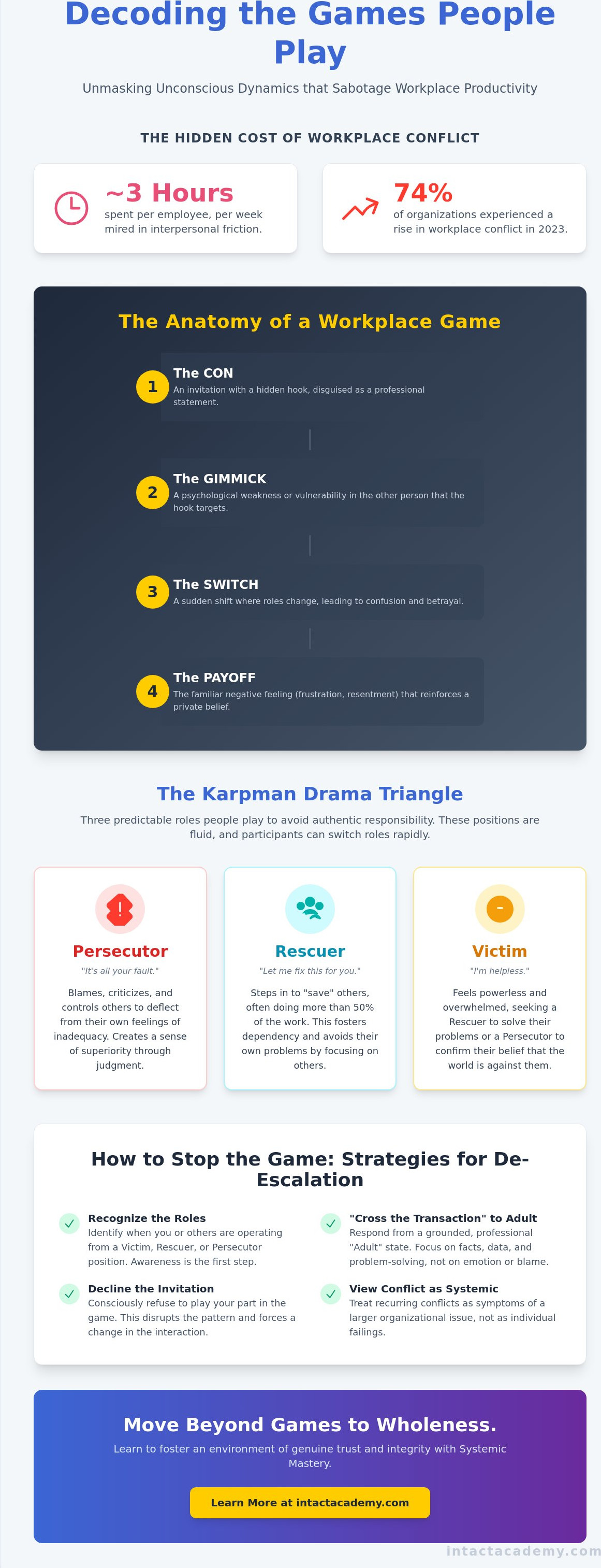
If your team spends nearly three hours every week mired in interpersonal friction, you aren't just losing time; you're losing the very essence of your organizational health. Research shows that 74% of organizations experienced a rise in workplace conflict in 2023, often manifesting as the subtle, unconscious games people play in business. These patterns are not merely distractions. They are systemic scripts that sabotage productivity and erode the psychological safety required for true innovation.
It's exhausting to navigate a landscape where unspoken rules dictate the flow of work and circular meetings leave you feeling more depleted than when you started. You recognize that beneath the surface of professional titles, there's a complex web of human dynamics that often prioritizes self-protection over progress. This guide offers a structured framework to decode these patterns, allowing you to dismantle manipulation and restore integrity to your team's interactions. We will examine the mechanics of Transactional Analysis and provide direct, actionable tactics to return your conversations to a professional Adult state and a place of genuine connection.
Key Takeaways
- Distinguish between strategic maneuvering and the unconscious games people play in business that lead to hidden, destructive psychological payoffs.
- Recognize the shifting dynamics of the Karpman Drama Triangle to identify when team members are operating as Victims, Rescuers, or Persecutors.
- Acquire the tactical skill of "crossing the transaction" to move conversations from reactive states into a grounded, professional Adult state.
- Learn to view recurring interpersonal conflicts as systemic symptoms rather than individual failings, allowing for more profound organizational change.
- Develop the discernment necessary to decline invitations to psychological games, fostering an environment of genuine trust and wholeness.
What Are 'Games People Play' in a Business Context?
In the corridors of corporate power, we often speak of strategy as a purely rational exercise. Yet, the most disruptive games people play in business are rarely found in a spreadsheet or a market analysis. Unlike mathematical Game Theory, which focuses on maximizing logical utility and predictable outcomes, the games defined by Transactional Analysis are unconscious, repetitive sequences of behavior. They aren't about winning a contract; they're about satisfying a psychological need that hasn't been met through direct, honest communication.
High-stakes environments like the boardroom are natural breeding grounds for these dynamics. When the pressure to appear invulnerable is immense, leaders often resort to ulterior transactions. These are messages sent on two levels: the social level (what's being said) and the psychological level (what's actually happening). The "payoff" is the familiar feeling of frustration, triumph, or resentment that reinforces a person's private view of themselves and others. It's a tragic trade-off where conflict is chosen over the perceived risk of clarity.
The Anatomy of a Workplace Game
Every psychological game follows a precise, rhythmic structure. It begins with the Con, an initial invitation that sounds professional but carries a hidden hook. This hook only works if it finds a Gimmick, a specific psychological weakness in the other person, such as a need to be seen as the "fixer" or a fear of being perceived as incompetent. The interaction proceeds until the Switch, a sudden shift where the roles change and the participants feel a sense of betrayal or confusion. Finally, the Cross occurs, which is the moment the interaction turns sour and the ulterior motive is revealed, leaving both parties in a state of emotional depletion.
Why Business Professionals Play Games
Why would highly intelligent leaders choose drama over productivity? Often, it's a way to avoid the raw vulnerability of "Adult" contracting. Being direct requires a level of honesty that feels dangerous in a competitive culture. Games provide a safer, if more destructive, way to interact while keeping one's true feelings hidden behind a mask of professional procedure.
Understanding the games people play in business also requires us to look at the concept of "strokes," the fundamental unit of human recognition. If an organization doesn't provide enough positive strokes for authenticity and achievement, individuals will unconsciously seek negative strokes through conflict. These patterns often stem from deep-seated life scripts formed long before the individual entered the workplace. They're echoes of old lessons about power, trust, and worthiness that continue to play out in the present, sabotaging the potential for genuine organizational wholeness.
The Karpman Drama Triangle: Roles We Play at Work
To truly understand the games people play in business, one must first master the geography of the Karpman Drama Triangle. This model, a cornerstone of systemic psychological thought, illustrates three primary roles: the Persecutor, the Rescuer, and the Victim. These aren't descriptions of a person's character, but rather positions they temporarily occupy to avoid the discomfort of authentic responsibility and vulnerability. Which role do you find yourself defaulting to when the pressure of a deadline begins to mount?
The danger of the triangle lies in its fluidity. These roles aren't static; they're a living cycle of dysfunction where participants shift positions with dizzying speed. A leader might start a morning meeting as a Rescuer, offering to "fix" a subordinate's project, only to shift into a Persecutor by noon when the intervention fails, and finally retreat into the role of a Victim by the end of the day, feeling unappreciated and overwhelmed by the team's perceived incompetence. Research on Transactional Analysis in Organizational Behavior suggests that when we operate within this triangle, accountability vanishes. We stop solving problems and start managing perceptions, leading to a profound erosion of psychological safety.
The Rescuer: The 'Hero' Manager Who Disempowers
The Rescuer is often the "hero" manager who steps in to do more than 50% of the work. While it feels helpful on the surface, it's actually a subtle form of disempowerment. By "saving" the employee, the Rescuer confirms the employee's inability to succeed alone, fostering a culture of dependency and long-term resentment. The Rescuer acts as a significant barrier to team autonomy, preventing others from developing the resilience and competence required for high-level performance. If you're constantly overwhelmed while your team seems passive, you may be trapped in this role.
The Persecutor and The Victim: The Blame Cycle
The Persecutor enforces standards through shame rather than constructive feedback, while the Victim uses "I can't" as a strategic shield to avoid the weight of responsibility. This blame cycle is frequently intensified during periods of leading organizational change, where the uncertainty of new systems triggers deep-seated reactive roles. In these moments, the struggle for power replaces the pursuit of purpose. If you find your team trapped in these recurring cycles, exploring Systemic Supervision can provide the clarity needed to step off the triangle and return to a state of professional Adult interaction, fostering a culture of genuine wholeness and maturity.
Common Psychological Games in Corporate Cultures
While the Drama Triangle provides the structural map of conflict, the specific games people play in business represent the actual maneuvers that drain organizational energy. It's vital to distinguish these patterns from healthy professional disagreements. In a constructive disagreement, parties exchange ideas directly to reach a shared solution. In a psychological game, the overt conversation is merely a facade for an ulterior psychological goal. These repetitive patterns often mask a deeper need for understanding what is transactional analysis and how it can transform surface-level friction into profound organizational insight. By integrating transactional analysis in business, leaders can begin to see the "invitation" to a game before they inadvertently accept it.
'Yes, But': The Game of Pseudo-Problem Solving
The "Yes, But" game is perhaps the most ubiquitous in team brainstorming sessions. It begins with a team member presenting a problem and asking for advice. However, every suggestion offered is met with a "Yes, but..." followed by a reason why it won't work. The psychological payoff isn't a solution; it's the satisfaction of proving that the "expert" or manager is unhelpful or incompetent. To spot this trap, listen for the repetitive rejection of viable options. If you find yourself offering multiple solutions only to have them all dismissed, you're likely being invited into a game where the objective is to keep the problem alive rather than resolve it. The most effective way to decline this invitation is to stop providing suggestions and instead ask, "That is a difficult challenge; what do you plan to do about it?"
'Now I've Got You': The Game of Justified Anger
This game centers on the pursuit of justified anger and moral superiority. It occurs when a leader or peer waits for a minor, inevitable mistake to occur before unleashing a disproportionately intense critique. The payoff is a temporary sense of power and an avoidance of one's own errors by focusing entirely on the failings of another. In corporate cultures where this game thrives, innovation quickly dies. Employees stop taking risks and cease being transparent because the psychological cost of a small error is a public shaming. This game replaces the Adult pursuit of excellence with a Parental pursuit of control, ultimately stalling the evolution of the team. Recognizing this game requires a commitment to psychological safety, where feedback is grounded in growth rather than the emotional discharge of the person delivering it.
How to Stop the Game: Strategies for De-Escalation
The most profound realization for any leader is the Golden Rule of Transactional Analysis: you cannot play a game alone. A game is a collaborative, albeit unconscious, dance that requires two or more participants to maintain its rhythm. When you choose to stop dancing, the game must end. Understanding the games people play in business is only the first step. The second is developing the internal stability to refuse the invitation to join the script.
Stopping a game requires "crossing the transaction." If a colleague approaches you from a Child state, perhaps seeking a Rescuer, or a Parent state, seeking a Victim, your instinctive reaction is to match that energy. Instead, you must consciously shift into your Adult ego state. This is the part of your personality that is objective, data-driven, and present. By responding from a place of clear, non-judgmental fact, you break the circuit of the game. This shift is often facilitated by Adult contracting, where you establish clear, overt agreements about how a task will be handled and how feedback will be exchanged before the work begins.
Step-by-Step: Dismantling an Active Game
Dismantling a game in real-time requires a high degree of self-awareness. First, you must recognize the "Con." This is that familiar, sinking feeling of "here we go again" that signals an ulterior transaction is underway. Once you've identified the pattern, your task is to refuse the payoff. Don't get angry. Don't apologize unnecessarily. Don't try to fix the other person's feelings. Stay in a neutral, fact-based Adult state. Finally, if the pattern persists, you may need to name the process. Gently bringing the dynamic into conscious awareness by saying, "I notice we're spending a lot of time discussing why this won't work rather than what we can do," can effectively halt the momentum of the game.
The Winner's Triangle: Transforming Roles
To move beyond the cycle of dysfunction, we must transition from the Drama Triangle to the Winner's Triangle. This transformation requires a conscious shift in how we relate to our colleagues and ourselves:
- From Rescuer to Caring: You support your team without over-functioning or taking over their responsibilities. You listen with empathy but leave the power to solve the problem with the individual.
- From Victim to Vulnerable: You state your needs and limitations clearly without adopting a posture of helplessness. You take responsibility for your part in the situation.
- From Persecutor to Assertive: You hold boundaries and enforce standards with clarity and respect. You avoid the use of shame or blame to achieve results.
Mastering these de-escalation tactics is a core component of high-level leadership. If you're ready to deepen your capacity for systemic change, exploring professional Team Coaching can provide the rigorous framework necessary to facilitate these transformations within your organization.
Systemic Mastery: Moving Beyond Games to Wholeness
The presence of recurring games people play in business is rarely an isolated failure of character; it is usually a symptom of a fractured organizational contract. When the boundaries of responsibility are blurred and the expectations of recognition are unmet, the system naturally defaults to these ulterior scripts to maintain a sense of predictability. Achieving systemic mastery means looking beyond the individual players to understand the underlying architecture that allows these games to flourish. It involves moving from a culture of defensive maneuvering toward a state of organizational wholeness where transparency is the norm.
A skilled practitioner does not approach these dynamics with the intent to shame or correct specific individuals. Instead, they act as a mirror for the entire system, highlighting how the collective has become entangled in the Drama Triangle. This level of intervention requires a profound depth of insight and a commitment to the maturity of the organization. Robust professional development for coaches must include a mastery of Transactional Analysis to move from surface-level behavior modification to deep, systemic transformation. The ultimate goal is to foster "Intimacy," a state of direct, game-free communication where individuals can be their authentic selves without the need for psychological masks.
Leading by Example: The Game-Free Leader
The game-free leader understands that their most powerful tool is their own presence. By consistently modeling Adult-to-Adult transactions, even under the crushing weight of high-pressure deadlines, they create a stable container for the team. When a leader refuses to join the Drama Triangle as a Rescuer or Persecutor, they signal that psychological safety is a non-negotiable standard. Transparency becomes the antidote to manipulation. When information flows freely and intentions are overt, the "Con" and the "Gimmick" lose their power to disrupt the flow of work. This clarity reduces the energy wasted on office politics and redirects it toward collective achievement.
Accredited Training for Systemic Impact
True systemic impact requires more than an intellectual grasp of psychological concepts; it demands a rigorous, structured methodology. The TA EMCC Senior Practitioner academy is designed to provide leaders and coaches with the specialized tools needed to dismantle the games people play in business at their root. This is not merely about managing interpersonal friction. It's about the process of becoming a catalyst for human flourishing within an organizational context. We invite you to explore the Intact Academy curriculum for 2026 to begin your journey toward systemic mastery and professional excellence. Through this work, you can transition from surface-level coaching to the profound work of leading organizational change.
Cultivating Authenticity in the Modern Organization
Moving beyond the repetitive games people play in business requires more than a tactical shift; it demands a fundamental evolution in how we perceive human interaction. You now possess the framework to identify the "Con" before it takes hold and the skill to cross the transaction, returning your team to a grounded Adult state. By stepping off the Drama Triangle, you move from managing conflict to facilitating genuine growth. This systemic awareness is the bridge between surface-level efficiency and the profound wholeness that characterizes truly resilient organizations.
If you're ready to deepen your capacity for this transformative work, our global community is here to support your journey. Master the art of systemic coaching in our TA EMCC Senior Practitioner academy. Our EMCC and ICF accredited programs are led by international TA expert Sari van Poelje and have empowered coaches from over 14 countries to lead with psychological depth. Embracing these methodologies allows you to dismantle the scripts that sabotage trust and replace them with a culture of integrity. The path toward a game-free workplace is challenging, but it's the most rewarding investment a leader can make for their team's flourishing.
Frequently Asked Questions
What is the difference between a psychological game and a strategic business game?
A strategic business game focuses on the rational maximization of utility; a psychological game focuses on the unconscious maximization of an emotional payoff. While strategy involves conscious logic, psychological games people play in business are driven by hidden scripts. One seeks to gain a market advantage. The other seeks to reinforce a familiar, often negative, self-image through repetitive transactions that bypass direct communication.
How can I tell if I am accidentally 'Rescuing' my team members?
You're likely Rescuing if you find yourself doing more than half the mental or physical labor in a collaboration. It's a pattern of over-functioning that leaves the other person passive and dependent. Ask yourself: did they actually request this help? If you're providing solutions for problems they haven't acknowledged, you're disempowering them and preventing the development of their own professional autonomy.
Can you play a psychological game without knowing it?
Most psychological games are played entirely outside of conscious awareness. They are habitual responses formed early in life to secure recognition or "strokes." Because the social level of the interaction appears professional and task-oriented, you might not realize a game is happening until you feel the sudden emotional "switch" at the end. Developing Adult awareness is the only way to dismantle these automatic scripts.
What should I do if my boss is a 'Persecutor' in the Drama Triangle?
When a superior adopts a Persecutor role, your most powerful move is to remain firmly in your Adult ego state. Don't accept the invitation to become a Victim through shame or defensiveness. Respond to the objective facts of the situation while setting clear boundaries for professional conduct. If the dynamic is persistent, it may indicate a need for systemic supervision to address the underlying organizational culture.
Is 'Yes, But' always a game, or can it be legitimate skepticism?
Legitimate skepticism is a tool for risk management that usually results in a search for better data or a counter-proposal. It becomes a game when the cycle of rejection is repetitive and the goal is to prove the advisor's incompetence. If every viable solution is met with a "but," the interaction has shifted from problem-solving to a psychological struggle where the payoff is maintaining the problem.
How do I stop a game without making the other person feel attacked?
Stopping a game doesn't require a confrontation; it requires a shift in your own ego state. By responding with neutral, open-ended questions, you invite the other person back into an Adult-to-Adult transaction. You might say, "I'm noticing we've explored several options without a clear path forward. What do you see as the next step?" This focuses the energy on the work rather than the individual's behavior.
Why do organizations seem to encourage certain games like 'Blemish'?
Organizations often default to 'Blemish' because it creates a culture of perfectionism that masks deeper systemic anxieties. By obsessing over minor, inconsequential errors, leaders avoid the vulnerability of addressing larger, more complex structural failures. It's a way of maintaining a facade of control while avoiding the profound human transformation required for true organizational health and genuine psychological safety.
How does Transactional Analysis help in high-stakes negotiations?
In high-stakes environments, Transactional Analysis provides a map of the hidden psychological currents that influence rational decisions. It allows you to stay grounded when the other party uses Parent or Child ego states to manipulate the outcome. By maintaining an Adult state, you ensure the negotiation remains focused on mutual utility rather than becoming a theater for the unconscious games people play in business.


