

The most impactful work you do in your first 100 days as a team coach isn't what you say in the room; it's the invisible silence you hold while the system reveals its true nature. You likely feel the heavy weight of expectation, the urgent pressure to prove your value while navigating a labyrinth of unspoken rules and unconscious resistance. It's natural to fear being perceived as an intruder, especially when a team's complexity feels like a fortress you're not yet invited to enter.
We understand this delicate threshold. This guide offers a systemic roadmap to move beyond surface interventions and into the realm of profound human transformation. You'll learn how to establish a resilient psychological contract and identify the deep-seated scripts that keep teams tethered to the past. By mastering these psychological nuances, you'll facilitate a visible shift in dynamics by day 100, replacing overwhelming complexity with a clear path toward wholeness. We'll explore how to measure your early impact through the lens of systemic evolution, ensuring your presence becomes a catalyst for sustainable change.
Key Takeaways
- Understand why the entry phase demands heightened systemic sensitivity, distinguishing your presence from a traditional managerial transition.
- Solidify the three levels of your contract, administrative, professional, and psychological, to build trust during the first 100 days as a team coach.
- Uncover the "team script," the unconscious life story the group follows, by identifying repetitive communication loops through Transactional Analysis.
- Shift the collective dynamic from symbiosis and dependency toward a state of genuine autonomy and sustainable interdependence.
- Integrate systemic supervision into your practice to ensure your interventions remain grounded in professional integrity and long-term mastery.
The Systemic Entry: Why the First 100 Days Define Team Coaching Success
The first 100 days as a team coach represent a liminal space where the future of the engagement is often decided before the first formal intervention occurs. This period is what we define as the Entry Phase, a time of heightened systemic sensitivity. During these initial weeks, the team system is at its most porous and its most defensive. It is a paradox of vulnerability and resistance. While a managerial transition focuses on assuming control and securing immediate tactical wins, your role as a coach is to witness the system's existing equilibrium without prematurely disturbing it.
Success requires you to inhabit the role of a temporary system member. You are invited into the team's inner sanctum, yet you must resist the gravitational pull of their internal dramas. If you become too integrated, you lose the objectivity required to facilitate change. If you remain too distant, you are dismissed as an irrelevant outsider. This delicate balance allows you to see the unspoken rules that members themselves have become blind to over time. These first three months are a unique window of opportunity for re-contracting and shifting cultural norms, as the system is naturally more reflective when a new presence is introduced.
As the team navigates the nuances of Tuckman's stages of group development, your presence acts as a catalyst for a new type of forming or storming. You aren't there to lead them through these stages, but to help them understand how they are moving through them. This distinction is vital. It is the difference between doing the work for the team and enabling the team to do the work for themselves. You are the architect of the process, not the owner of the outcome.
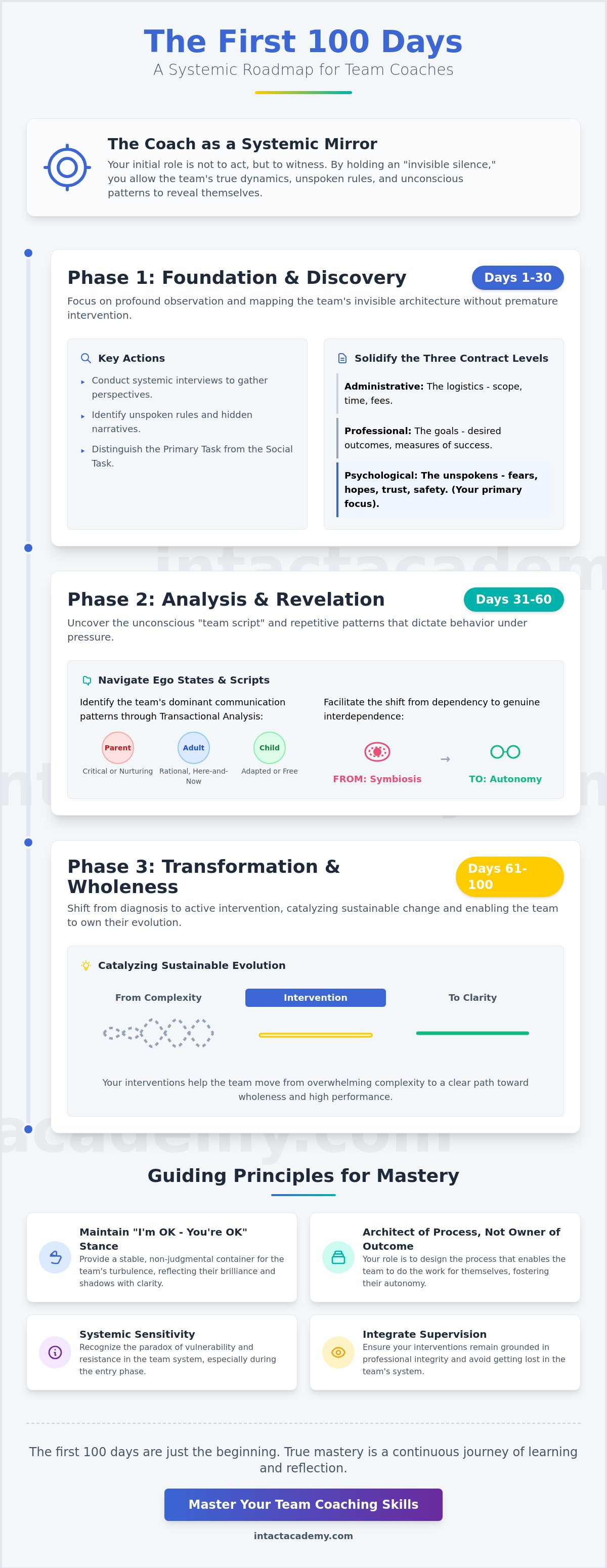
The Coach as a Systemic Mirror
Your presence alone begins to change the team dynamic from day one. This is the observer effect in a social context. To master this, you must develop an acute awareness of the parallel process. If you find yourself feeling uncharacteristically anxious or frustrated during a session, ask yourself whether this is your feeling or if you're holding the team's projected anxiety. By maintaining an I’m OK – You’re OK stance, you provide a stable container for the team’s turbulence. You offer them a mirror that reflects their brilliance and their shadows with equal, non-judgmental clarity.
Setting the Professional Standard
Establishing your identity as a professional team coach requires a blend of deep empathy and Senior Practitioner authority during your first 100 days as a team coach. You must hold the space with a quiet power that signals you can handle the team's complexity without being overwhelmed by it. This authority isn't about hierarchy; it's about the psychological safety that comes from demonstrated competence. We define the 100-day milestone as a critical boundary for initial assessment, marking the point where the diagnostic phase concludes and the deep work of systemic evolution begins.
Days 1-30: Mapping the Unconscious and Establishing the Psychological Contract
The first month of your engagement is a season of profound observation and quiet inquiry. While the team may expect immediate solutions, your primary responsibility is to map the invisible architecture of the group. This diagnostic phase focuses on uncovering the hidden narratives that dictate how the team functions under pressure. By conducting systemic interviews, you invite members to share their perspectives on the team's history, its unspoken rules, and its perceived future. These conversations often reveal a discrepancy between the Primary Task, the actual work the team is paid to do, and the Social Task, the unconscious effort to maintain harmony or avoid conflict at all costs.
During these early interactions, you'll begin to notice the team's preferred Ego States. A culture dominated by a Critical Parent, for instance, often produces a team that feels stifled, fearful of making mistakes, and overly reliant on permission. Identifying these patterns early in your first 100 days as a team coach allows you to mirror these dynamics back to the group before they become entrenched in your own relationship with them. This is the period where you gather the raw material for future transformation, ensuring that your later interventions are grounded in systemic reality rather than surface level symptoms.
The Art of Multi-Level Contracting
Effective coaching contracting requires a sophisticated understanding of three distinct layers. The Administrative Contract covers the logistics of fees, dates, and locations. The Professional Contract defines the measurable goals and outcomes the team hopes to achieve. However, it's the Psychological Contract that often determines success. This layer addresses the unspoken expectations: what members hope you'll fix for them, or what they're afraid you'll discover. Handling resistance during this phase isn't about pushing through it, but about making it a visible part of the contract itself. When resistance is named, it loses its power to sabotage the process.
Initial Diagnostic Observations
As you observe the team in its natural habitat, you're mapping the Group Imago, the internal map each member holds of their role and the roles of others. You might spot psychological games, such as the "Yes, But" loop, where the team asks for help only to reject every suggestion offered. These games are defensive maneuvers designed to maintain the status quo. By documenting these unspoken rules, you prepare the ground for deeper lessons in teamwork that will emerge later in the engagement. If you're looking to refine your ability to navigate these complex interpersonal scripts, our Senior Team Coach Academy offers the rigorous training needed to master these systemic nuances.
Days 31-60: Navigating Ego States and Team Scripts
As you move into the second month of your first 100 days as a team coach, the data gathered during your initial diagnostic phase begins to coalesce into a coherent narrative. You aren't just looking at behaviors now; you're looking for the Team Script. This is the unconscious life story the group has written for itself. It dictates how they respond to crisis, how they celebrate victory, and how they handle failure. Some teams are scripted for success, while others follow a "Near-Miss" pattern, where they consistently sabotage their own progress just as the finish line appears. Recognizing these patterns allows you to move beyond surface level symptoms and address the systemic heart of the team's struggle.
During this period, you'll likely observe the team trapped in the Drama Triangle. This is a common dynamic where members rotate between the roles of Victim, Rescuer, and Persecutor. A leader might play the Rescuer, constantly stepping in to fix problems that the team should solve, which inadvertently keeps the team in a Victim role. This cycle is often reinforced by "Discounting," a mechanism where the team ignores a problem, a resource, or their own capacity to act. By bringing these unconscious communication loops into the light of the Adult ego state, you create the possibility for a new, more functional way of relating.
Decoding the Team Script
Understanding whether a team is scripted for "Success," "Near-Miss," or "Failure" is essential for long term transformation. We look to experts like Sari van Poelje, who uses Transactional Analysis to decode organizational culture and reveal the hidden scripts that drive resistance. By exploring the team's history, you can often find the origin of current resistance patterns. A team that has experienced frequent leadership changes might have a script centered on "survival," leading them to discount the value of any new coach or initiative. Identifying these scripts isn't about assigning blame; it's about returning the team to a state of completeness by acknowledging what was previously hidden.
Analyzing Transactions
Effective communication relies on "Adult-to-Adult" transactions, where information is exchanged without the baggage of Parent or Child ego states. In high stakes environments, you'll often see "Crossed Transactions." This happens when one person speaks from an Adult perspective, but the other responds from a Critical Parent or Rebellious Child stance, leading to immediate breakdown. To shift this, you must also consider the role of "Strokes," or units of recognition. Teams starved of positive strokes will often resort to negative ones, creating conflict just to feel seen. By encouraging healthy recognition and Adult communication, you'll find that the team's energy and motivation begin to stabilize, providing the foundation for the deep work ahead in your first 100 days as a team coach.
Days 61-100: Intervening for Sustainable Transformation and Wholeness
The final phase of your first 100 days as a team coach is where the invisible insights of the previous months manifest as visible, structural change. At this stage, your interventions must move beyond surface behavioral corrections to address the systemic root causes of dysfunction. You're no longer merely a mirror; you're a catalyst for re-engineering the team’s internal architecture. This involves moving the group from a state of symbiosis, where they depend on you or their leader for direction, toward a state of genuine autonomy and interdependence. It's a delicate transition that requires you to hold the space while the team learns to stand on its own.
To support this evolution, you must provide the team with the Three Ps: Permission, Protection, and Potency. Permission allows the team to break their old, restrictive rules and experiment with new ways of being. Protection ensures they feel psychologically safe while navigating the vulnerability of change. Potency is the strength and professional authority you bring to the room, which serves as a grounding anchor when the team feels adrift. By measuring progress against the initial psychological contract, you demonstrate that transformation isn't a vague concept. It's a measurable shift in how the system breathes, communicates, and achieves its primary task.
Facilitating Team Autonomy
The transition from coach-led sessions to team-led accountability is the hallmark of a successful engagement. As you deliberately step back, you invite the team to step into their own power, ensuring the changes you've facilitated are sustainable long after your departure. A team redecision occurs when the group collectively chooses to abandon an old, limiting script in favor of a new, empowering narrative that aligns with their current reality. This redecision is the pivot point where the system moves from repeating past failures to creating a future of its own design. You're teaching them not just to solve a problem, but to evolve their entire way of relating to one another.
Reviewing the 100-Day Journey
Concluding this period requires a rigorous review with both the team and key stakeholders to validate the shifts in dynamics. This is a moment to honor the distance traveled and to recalibrate the contract for the next phase of leading organizational change. We celebrate wholeness not as a state of perfection, but as a return to genuine connection and authenticity within the system. If you're ready to master these systemic nuances and facilitate profound human transformation, our TA EMCC Senior Team Coach Academy provides the rigorous methodology needed to reach the next level of professional mastery.
Mastering the Art of Team Coaching: Beyond the 100-Day Milestone
While the first 100 days as a team coach provide a critical foundation, they represent only the beginning of a lifelong journey toward systemic excellence. The successful completion of this initial period doesn't mean the work is finished; rather, it indicates that you've earned the right to engage in the deeper, more complex layers of organizational transformation. True mastery requires a commitment to ongoing professional development that transcends mere technique, focusing instead on the coach’s own internal evolution and systemic presence. You're moving from a phase of intense observation into a rhythm of sustained influence.
To sustain this level of work without losing your own center, professional supervision is not optional; it's a fundamental requirement for senior team coaches. Supervision provides a safe container to explore the parallel processes and counter-transference that inevitably arise when working with high-pressure systems. It's the space where you examine your own blind spots, ensuring that your interventions remain grounded in integrity rather than your own unconscious needs. This disciplined reflection is what distinguishes a transactional coach from a systemic practitioner who facilitates profound human change.
Transitioning to a Senior Practitioner mindset means moving away from the urge to provide immediate answers. You become comfortable with the ambiguity of systemic change, trusting the process and the team’s innate capacity for wholeness. This journey is fueled by continuous learning in Transactional Analysis and systemic theory, allowing you to see the world not as a collection of individuals, but as a living tapestry of relationships and scripts. Your first 100 days as a team coach have taught you how to read the map; now, you must learn how to inhabit the landscape.
The Path to Senior Accreditation
The TA EMCC Senior Team Coach Academy is designed to support this long-term trajectory toward mastery. It offers a rigorous framework that moves beyond basic competencies into the realm of profound systemic influence. By joining an international network of systemic experts, you gain access to a collective wisdom that enriches your practice and expands your perspective. This community allows you to build a sustainable practice that facilitates deep, lasting organizational impact rather than fleeting behavioral shifts. It's about moving from doing coaching to being a coach.
A Call to Systemic Mastery
We invite you to reflect on your own coaching script. What ego states do you inhabit when the system pushes back? Are you playing the Rescuer, or can you hold the Potency of the Adult? Leading with depth and integrity requires the courage to look inward before you look outward. If you're ready to embrace the full complexity of human systems and return teams to their state of genuine connection, we invite you to Join the TA EMCC Senior Team Coach Academy and begin your transformation from practitioner to master.
Stepping into the Future of Systemic Excellence
The first 100 days as a team coach represent a sacred threshold. It is the space where you transition from a mere observer of dynamics to a deliberate catalyst for wholeness. By establishing a robust psychological contract and navigating the complex ego states within the room, you provide the protection necessary for a team to rewrite its own script. This journey moves beyond surface level fixes, inviting the system to step out of symbiotic dependency and into a state of genuine, sustainable autonomy.
True mastery is an ongoing process of becoming. Our EMCC and ICF accredited programs, led by international expert Sari van Poelje, provide the rigorous methodology and psychological depth needed for this professional evolution. With participants from more than 14 countries, you'll join a global community dedicated to deep organizational change and professional integrity. We invite you to Deepen your impact with the TA EMCC Senior Team Coach Academy. Trust in the systemic process and lead with the quiet power of your own authenticity. Your path toward profound human transformation is ready to unfold.
Frequently Asked Questions
What is the most important goal in the first 100 days as a team coach?
The most critical goal in your first 100 days as a team coach is establishing a secure psychological contract and mapping the system's unconscious scripts. Rather than seeking immediate tactical wins, you must focus on creating safety and clarity. This foundation ensures that future interventions are grounded in the team's actual needs rather than surface level symptoms. You're building the container that will hold the weight of profound transformation later in the engagement.
How do I handle a team that is resistant to coaching in the first month?
Resistance in the first month should be treated as vital systemic data rather than a personal hurdle. It often indicates that the team is protecting its current equilibrium. Instead of pushing against it, mirror the resistance back to the group non-judgmentally. By naming the unspoken fears or "Yes, But" loops, you help the team move from a defensive Child or Parent ego state into a reflective Adult stance.
What is a psychological contract in team coaching?
A psychological contract consists of the unspoken expectations, beliefs, and obligations that exist between you and the team. While the administrative contract covers logistics, this layer addresses the emotional and relational reality of the work. It involves clarifying what the team hopes you'll fix and what they fear you might uncover. Surfacing these hidden agendas early prevents future sabotage and aligns the group's unconscious energy with its formal goals.
How can Transactional Analysis help me understand team dynamics?
Transactional Analysis (TA) offers a precise language to decode communication loops and ego state preferences within a group. It allows you to identify whether a team is operating from a Critical Parent culture or a Rebellious Child stance. By analyzing transactions, you can help the team shift toward Adult-to-Adult communication. This framework makes complex systemic issues manageable, allowing for interventions that address root causes like Team Scripts or the Drama Triangle.
What should be included in a 100-day review for a team coaching engagement?
A 100-day review should evaluate progress against both the professional goals and the initial psychological contract. It's essential to include a reflection on shifts in team dynamics, such as decreased discounting or improved stroke exchange. You should also involve key stakeholders to validate these changes. This review serves as a formal boundary to conclude the diagnostic phase and adjust the contract for the next stage of organizational change.
Can I use these principles if I am an internal team leader, not an external coach?
Internal leaders can certainly apply these systemic principles, though they must navigate the dual role of being both a member and an observer. Using TA frameworks helps a leader identify when they are being pulled into a Rescuer role in the Drama Triangle. While an internal leader cannot be a temporary member in the same way an external coach is, they can still facilitate permission and protection to move the team toward autonomy.
How much time should I spend observing vs. intervening in the first 30 days?
During the first 30 days of your first 100 days as a team coach, you should spend roughly 80% of your time observing and 20% intervening. This period is dedicated to witnessing the system's natural patterns without prematurely disturbing them. Your interventions during this month should primarily be diagnostic inquiries that help the team see itself more clearly. Rushing into solutions before the system's script is understood often triggers unnecessary resistance.
What are the signs that a team coaching engagement is off track by day 60?
Signs that an engagement is off track by day 60 include the persistence of repetitive psychological games and a failure to move beyond surface level administrative logistics. If you find yourself feeling stuck in a symbiotic relationship where the team is overly dependent on your direction, the psychological contract may need urgent re-addressing. Another warning sign is the absence of Adult communication during high pressure meetings, indicating the system doesn't yet feel safe enough to change.


