

What if the ceiling of your professional growth is currently defined by the depth of the person sitting across from you in supervision? As you navigate the intricate dynamics of high-stakes leadership, the weight of professional isolation can become a silent burden that hinders your impact. You likely recognize that finding a qualified coaching supervisor is no longer just a checkbox for accreditation; it's a search for a secure base where your ethical reflections and systemic blind spots can be safely explored. With the International Coaching Federation's 2027 requirement for a Coaching Supervisor Specialization (CSS) fast approaching, the distinction between a surface-level mentor and a truly systemic partner has never been more critical.
You understand that your clients deserve more than just your skills; they deserve your psychological presence and your ability to hold their organizational complexity. This guide promises to help you identify a supervisor who offers the profound Transactional Analysis insights and systemic awareness needed to transform your practice. We'll explore the clear criteria for a long-term developmental partnership that ensures you never outgrow your support system. By the end of this article, you'll have a structured methodology to select a mentor who honors your maturity and fuels your evolution toward professional mastery.
Key Takeaways
- Shift your perspective from performance judgment to a collaborative inquiry that reveals the systemic blind spots inherent in high-level executive work.
- Identify how the normative, formative, and restorative pillars of supervision provide a secure base for both ethical integrity and emotional resilience.
- Master the criteria for finding a qualified coaching supervisor by distinguishing between tactical mentor coaching and deep, psychologically-informed systemic supervision.
- Use a step-by-step framework to evaluate a supervisor’s theoretical background, ensuring their expertise in Transactional Analysis or Gestalt aligns with your developmental path.
- Explore the path toward professional wholeness through specialized academies that integrate systemic organizational change with advanced supervisory mastery.
Beyond the Credentials: Why Finding a Qualified Coaching Supervisor is a Strategic Necessity
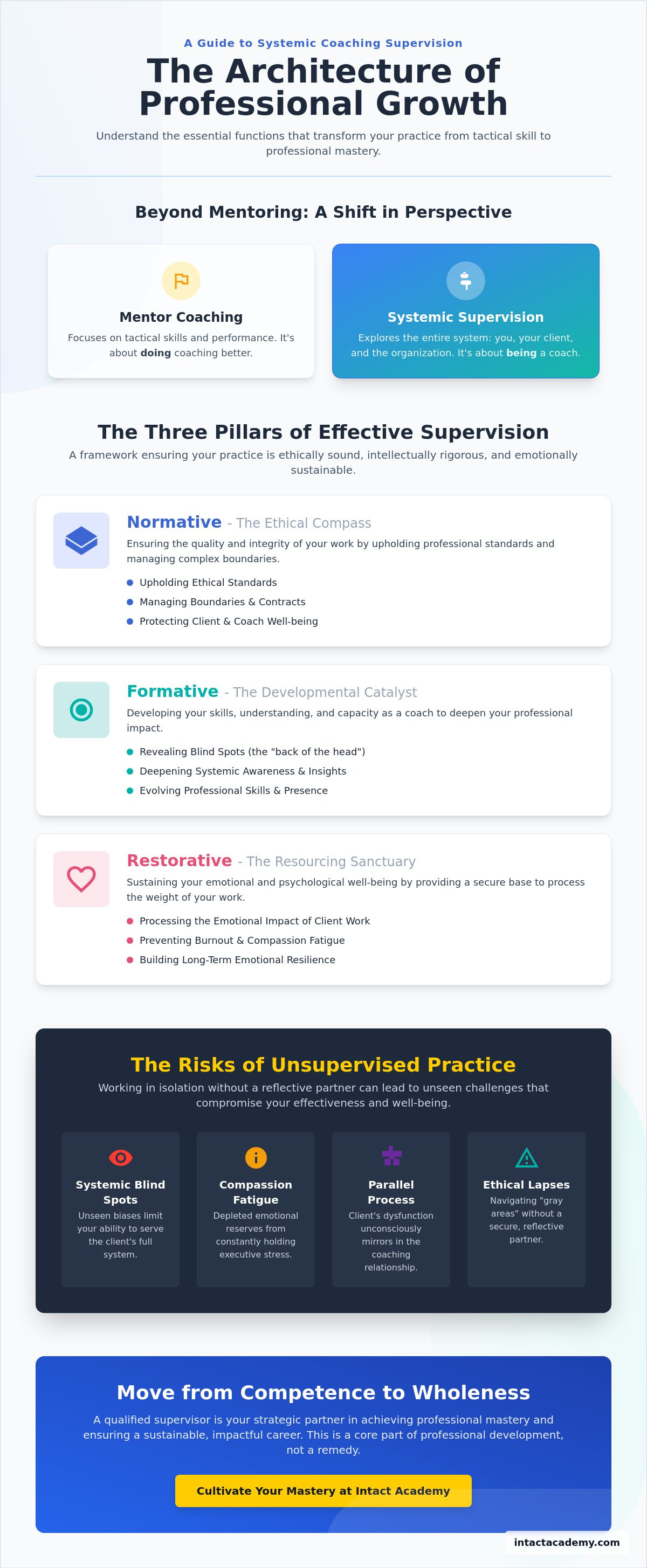
Coaching supervision is a collaborative learning practice designed to deepen your professional capacity. It’s not a performance review or a remedial session; it’s a shared exploration of the human dynamics at play in your work. When you're Coaching at a high level, you are often managing intense emotional and systemic pressures. Finding a qualified coaching supervisor provides you with a space to pause and reflect on these forces before they impact your efficacy. It's about moving from doing coaching to being a coach.
Consider the "back of the head" metaphor. No matter how much experience you gain, you cannot see your own nape without a mirror. In the same way, senior practitioners carry blind spots that only a trained supervisor can reflect back. As we move through 2026, the industry has shifted toward systemic organizational impact. With 57% of coaching now sponsored by organizations according to industry research, the complexity of these engagements requires a "stable container." Supervision acts as this container, holding the turbulence of professional change so you don't have to carry it alone.
The Evolution from Compliance to Mastery
The most impactful coaches don't seek supervision merely to satisfy accreditation requirements. They view it as a vital path toward mastery. This pursuit of professional development for coaches ensures that your practice remains sustainable over a decades-long career. A supervisor should embody the profile of a wise global mentor, someone who understands the intersection of individual psychology and corporate systems. Finding a qualified coaching supervisor who matches this depth allows you to move from technical competence to a state of professional wholeness.
The Risks of Unsupervised Practice
Working in isolation carries significant risks, particularly compassion fatigue. When you're constantly holding the weight of executive stress, your own emotional reserves can deplete. Without a restorative partner, you may fall prey to unconscious parallel processes, where the client’s organizational dysfunction begins to mirror itself within the coaching relationship. This isn't just a personal risk; it's an ethical one. A reflective partner helps you maintain the boundaries necessary to protect both your well-being and the integrity of your client’s growth. It ensures that you remain a clear mirror for those you lead.
The Three Pillars of Supervision: Normative, Formative, and Restorative Functions
Professional supervision is often misunderstood as a purely administrative task or a simple peer discussion. In reality, it operates through a triad of essential functions that provide the architecture for your professional growth. When you begin the process of finding a qualified coaching supervisor, you're looking for a partner who can fluidly move between these three pillars: the normative, the formative, and the restorative. This structure ensures that your practice remains ethically sound, intellectually rigorous, and emotionally sustainable. By utilizing Transactional Analysis (TA) ego states, a skilled supervisor can identify which of these pillars requires attention in any given session, ensuring that the support you receive is both precise and profound.
Navigating Ethics and Boundaries (Normative)
The normative function is the bedrock of professional integrity. It focuses on upholding ethical standards and managing the complex boundaries of organizational contracts. A supervisor helps you navigate the "gray areas" where professional codes meet messy human reality. For example, consider an executive sponsor who subtly pressures a coach to reveal confidential session details under the guise of "organizational alignment." Through supervision, the coach can explore this dilemma, reinforcing the boundary of confidentiality while managing the stakeholder relationship with maturity. This function aligns with the ICF's Definition of Coaching Supervision, which emphasizes the importance of ethical practice in a safe, reflective environment.
Deepening Your Psychological Lens (Formative)
The formative function is dedicated to your development as a practitioner. It moves beyond surface-level techniques to explore the underlying psychological dynamics of your work. Understanding what is transactional analysis provides a sophisticated framework for this process, allowing you to identify unconscious scripts and repetitive patterns that may be playing out in your coaching relationships. The formative function serves as the essential bridge between abstract psychological theory and your lived professional practice. It challenges you to look inward, fostering a level of self-awareness that transforms how you show up for your clients.
Finally, the restorative function addresses the emotional weight of the work. High-stakes coaching is often draining; it requires a space where you can process the "absorbed" stress of your clients. A supervisor provides the psychological containment necessary to prevent burnout and maintain your capacity for empathy. If you feel your practice is becoming heavy or stagnant, exploring systemic supervision can offer the restorative relief needed to return to a state of professional wholeness. Finding a qualified coaching supervisor who honors all three of these pillars is not just a choice for your career; it's a commitment to your own humanity and the flourishing of those you lead.
Credentials vs. Competency: Evaluating a Supervisor’s Psychological Depth and Systemic Awareness
When you're finding a qualified coaching supervisor, it's easy to get lost in a sea of certificates. While many hold credentials, few possess the systemic mastery required to handle the psychological complexity of modern leadership. As we move through 2026, the EMCC Senior Supervisor accreditation has emerged as the gold standard. It distinguishes those who have moved beyond the mechanics of coaching into the realm of deep, reflective practice. You must distinguish between a "mentor coach," who focuses on skill-based competencies for accreditation, and a "psychologically-informed supervisor," who explores the unconscious undercurrents of your client work.
Systemic awareness is no longer an optional luxury; it's a requirement for those working within organizational change. A qualified supervisor helps you spot "parallel processes," where the dysfunction of the client's organization begins to mirror itself in your coaching relationship. They also help you navigate "transference," ensuring you don't absorb the client's unresolved emotional patterns. This level of insight is what allows you to move from being a tactical resource to a truly transformational partner. Finding a qualified coaching supervisor who understands these dynamics ensures your practice remains a clear, stable mirror for your clients.
The 7-Eyed Model: A Framework for Systemic Depth
The 7-Eyed Model is a vital tool for evaluating a supervisor’s perspective. It requires the supervisor to look beyond the immediate coach-client dyad and into the wider organizational system. This model helps you map the intricate dynamics of leading organizational change, ensuring that your interventions are aligned with the client's broader context. As noted in the Harvard Business Review article The Leader as Coach, the shift toward inquiry-based leadership requires coaches to hold a much larger systemic view than ever before. A supervisor who uses this framework can help you identify how the organization’s culture is influencing the individual's behavior.
Transactional Analysis as a Supervisory Tool
Transactional Analysis (TA) offers a sophisticated language for seeing the "games" being played in a coaching relationship. A supervisor trained in TA can help you identify when you've been pulled into a "Parent" or "Child" ego state, helping you return to a clean "Adult-to-Adult" contract. This clarity is the foundation of psychological safety. It creates a space where you can be honest about your struggles without fear of judgment. When a supervisor works with TA, they don't just solve problems; they help you rewrite the internal scripts that may be limiting your professional growth. This focus on wholeness and genuineness is what distinguishes a deep supervisory match from a purely transactional one.
The Selection Process: A Framework for Interviewing and Contracting with Your Supervisor
The transition from understanding the theory of supervision to finding a qualified coaching supervisor requires a deliberate, structured approach. This isn't a search for a friend; it's a search for a developmental mirror. You must begin by defining your core needs. Are you seeking a partner primarily for accreditation hours, or are you looking for the profound psychological growth that sustains a lifelong career? Once your intention is clear, research the theoretical foundations of potential supervisors. A supervisor grounded in Transactional Analysis or Gestalt will offer a significantly different experience than one focused solely on behavioral outcomes.
The selection process follows five essential steps:
- Step 1: Define your developmental needs. Distinguish between a purely administrative requirement and the hunger for professional mastery.
- Step 2: Research theoretical backgrounds. Ensure their lens (TA, Systemic, or Psychodynamic) aligns with the complexity of your client work.
- Step 3: Conduct a Chemistry and Competency interview. Look for the intersection of personal resonance and professional challenge.
- Step 4: Engage in a Trial Session. Observe how the restorative function feels in real-time. Do you feel held or merely heard?
- Step 5: Establish multi-level contracting. Define the operational and psychological boundaries of the relationship.
Key Questions to Ask a Potential Supervisor
During your initial interview, move beyond logistical questions about rates and availability. Test for depth. Ask: "How do you handle parallel processes when they emerge in our work together?" This reveals their ability to see the systemic ripples between you, the client, and the organization. Inquire about the theoretical lens they use to understand organizational systems. You want to hear a coherent framework, not just a collection of anecdotes. Observe their voice. A "Wise Mentor" will challenge your assumptions rather than just validating your current perspective. If the conversation feels too comfortable, they may not be the partner who will push you toward your next level of evolution.
Contracting for Change: The TA Approach
In the realm of Transactional Analysis, contracting is an Adult-to-Adult agreement that ensures transparency and mutual respect. Clear "hard" contracting covers the logistical essentials: frequency, fees, and reporting requirements. However, "soft" contracting is where the transformational work begins. This involves defining the psychological goals of the relationship and the boundaries of confidentiality. A contract is a living document that evolves with your executive coaching certification journey. It should be revisited as your practice grows and your client challenges shift. For those ready to deepen their professional foundation, our Systemic Supervision offerings provide the structured methodology needed for this deep work.
Cultivating Mastery: How Intact Academy Supports the Supervised and the Supervisor
Professional evolution is rarely a linear path; it is a deepening of one’s capacity to hold the complex. While the initial journey of finding a qualified coaching supervisor focuses on your own development, the natural progression for many senior practitioners is to step into the role of supervisor themselves. The TA EMCC Senior Supervisor Academy at Intact Academy is designed for this exact transition. It offers a path to professional wholeness, where the technical skills of coaching meet the profound psychological insights required to guide other practitioners. This program isn't just about learning a new set of tools; it’s about evolving your identity to become a stable container for the coaching profession.
At the heart of this transformative experience is the expertise of Sari van Poelje, who has spent decades setting global standards for supervision. Her approach integrates Agile Transactional Analysis with systemic organizational change, providing a unique framework that addresses both the individual’s internal world and the external organizational pressures. By learning under her guidance, you gain access to a methodology that is as practical as it is profound, ensuring that your work as a supervisor carries the weight of lived experience and theoretical rigor.
Our Systemic Supervision Philosophy
The philosophy at Intact Academy centers on the idea of returning to a state of completeness and genuineness. We believe that finding a qualified coaching supervisor should lead to an integration of individual psychological depth with organizational pragmatism. Our supervision doesn't just look at what the coach is doing; it looks at who the coach is becoming. This focus on wholeness is why our graduates are recognized by the EMCC and ICF globally. They don't just leave with a certification; they leave with the ability to navigate the most turbulent systemic issues with a sense of quiet power and clarity.
Join the Global Community of Systemic Supervisors
Learning to supervise is not a solitary endeavor. It requires the mirror of a group and the shared wisdom of a global community. Our academy emphasizes the benefits of peer supervision and group dynamics, allowing you to experience the systemic ripples of coaching work in a safe, collaborative environment. As you prepare for the next stage of your career, consider joining our upcoming 2026 cohort. This is an invitation to move beyond transactional support and into a space of deep human transformation. It is a commitment to the flourishing of the coaching ecosystem as a whole.
If you are ready to elevate your practice and the practice of others, explore our TA EMCC Senior Supervisor Academy and discover how systemic mastery can redefine your professional impact.
Stepping into the Future of Professional Wholeness
The path to professional mastery requires more than just accumulating hours; it demands a profound deepening of your psychological presence. By understanding the three pillars of supervision and the necessity of a systemic lens, you've moved beyond mere compliance toward a true developmental partnership. Finding a qualified coaching supervisor is the first step in ensuring your practice remains a stable container for the organizational complexities of 2026. Your commitment to this reflective space honors the maturity of your clients and the integrity of the coaching profession.
If you're ready to transition from practitioner to a leader who shapes the next generation of coaches, we invite you to explore our advanced pathways. Our programs are led by global expert Sari van Poelje and feature a unique systemic TA focus for maximum organizational impact. These EMCC and ICF accredited programs provide the structured methodology needed to move from technical competence to professional wholeness. Deepen your impact: join our TA EMCC Senior Supervisor Academy.
Your journey toward becoming a wise global mentor begins with the courage to look inward. We look forward to supporting your continued flourishing and your evolution as a leader in this field.
Frequently Asked Questions
How do I know if a coaching supervisor is qualified?
A qualified supervisor should hold recognized credentials such as the EMCC Senior Supervisor accreditation or the new ICF Coaching Supervisor Specialization (CSS) introduced in April 2026. Beyond certifications, they must demonstrate at least 41 hours of specialized supervision training and a robust theoretical foundation. When you are finding a qualified coaching supervisor, look for someone who can articulate a systemic framework and has extensive experience navigating the psychological complexities of organizational life.
What is the difference between a mentor coach and a coaching supervisor?
Mentor coaching is primarily focused on the technical application of coaching competencies for credentialing purposes. In contrast, coaching supervision explores the broader psychological, systemic, and restorative dimensions of your practice. While a mentor helps you refine your skills, a supervisor provides a space to examine unconscious parallel processes and the emotional impact of your work. Supervision is about the evolution of the coach's self, not just the improvement of their technique.
Is coaching supervision a requirement for ICF or EMCC accreditation?
Yes, the industry standards have evolved significantly. Effective January 2027, ICF credential holders who complete supervision for professional development credit must work with a supervisor holding the CSS or an equivalent accreditation. The EMCC has long held supervision as a core requirement for professional mastery. Finding a qualified coaching supervisor is no longer a luxury but a strategic necessity for maintaining global standards and ethical integrity in your practice.
How much does coaching supervision typically cost in 2026?
Current industry data for 2026 shows that a one-to-one casual supervision session for one hour typically costs $75. Many practitioners prefer on-demand packages, such as four sessions used over twelve months for approximately $260. Group supervision options are also available, with casual 90-minute sessions costing around $60, or a series of three ongoing group sessions for $160. These rates allow coaches to build a sustainable support system at various stages of their career.
Can I have more than one coaching supervisor?
It is entirely possible and often beneficial to work with more than one supervisor to gain diverse systemic perspectives. You might engage one supervisor for individual reflection and participate in a group supervision academy for broader organizational insights. This approach prevents professional isolation and exposes you to different theoretical lenses, such as Transactional Analysis or Gestalt. Just ensure that each relationship has a clear contract to maintain the integrity of your developmental path.
What happens during a typical coaching supervision session?
A typical session is a reflective inquiry that begins with a check-in to identify a core struggle or systemic theme. You might bring a specific client case to explore blind spots using the 7-Eyed Model or examine how your own ego states are impacting a high-stakes engagement. The supervisor acts as a "secure base," helping you process the emotional weight of your work while upholding ethical standards. The session concludes with actionable insights that deepen your psychological presence.
How often should I meet with my coaching supervisor?
The frequency of meetings should align with the intensity of your coaching load and your developmental needs. Most senior practitioners find that meeting once every four to six weeks provides a steady rhythm for deep learning and restorative support. If you're managing complex organizational change or high-stakes executive clients, you may require more frequent sessions. The goal is to ensure that your "back of the head" blind spots are regularly illuminated before they impact your clients.
What should I do if my supervisor and I lack "chemistry"?
If you feel a lack of resonance, the first step is to bring this into the supervision space as an Adult-to-Adult conversation. This tension may be a parallel process mirroring a dynamic in your client work, providing a rich opportunity for learning. However, if the psychological safety remains compromised, it's appropriate to ethically conclude the contract. A supervisory relationship must be a stable container where you feel both challenged and supported to truly flourish.


