

If 84.5% of strategic projects fail to reach completion, why do we continue to treat the planning process as a mere exercise in logic and spreadsheets? You've likely sat in rooms where the loudest voices drown out the quiet brilliance of the team, or watched as participants slowly check out, their cynicism masked by polite nods. Facilitating strategic planning sessions requires more than a structured agenda; it demands an understanding of the invisible human undercurrents that either propel an organization forward or anchor it in place.
You know that a strategy is only as strong as the emotional buy-in of the people tasked with its execution. This article promises to help you move beyond transactional workshops into a space of profound systemic alignment. You'll learn to master a facilitation framework that handles conflict constructively and transforms hidden agendas into actionable roadmaps. We'll explore how addressing the psychological depth of your leadership team creates the stability needed for true organizational change and the genuine commitment that drives long-term success.
Key Takeaways
- Learn to create a "stable container" for collective visioning, moving beyond the myth of the rational actor to understand why smart teams often make poor strategic choices.
- Discover the power of systemic contracting in facilitating strategic planning sessions, ensuring alignment across administrative, professional, and psychological levels before the work begins.
- Design session agendas that mirror the natural "Contact Cycle," guiding your leadership team fluidly from initial awareness to mobilization and decisive action.
- Identify and navigate "Psychological Games" and systemic resistance, transforming potential derailleurs into vital signals that inform a more resilient strategy.
- Bridge the implementation gap by fostering the systemic alignment and emotional buy-in necessary to turn a static document into a living organizational transformation.
The Psychological Architecture of Facilitating Strategic Planning Sessions
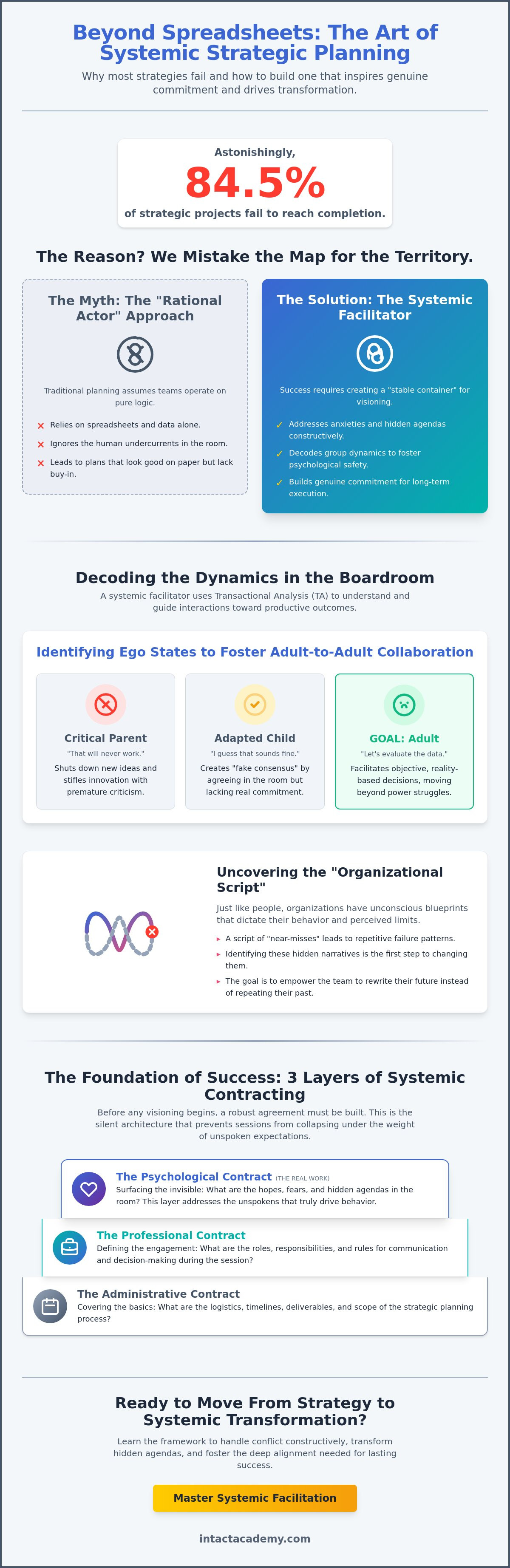
Facilitating strategic planning sessions is far more than managing a timeline or checking off a list of goals. It's the art of creating a "stable container" where collective visioning can occur without the interference of unexamined anxieties. Many traditional approaches assume the strategic planning process is purely rational. However, smart teams frequently make poor choices because they're driven by unconscious dynamics rather than objective data. This "Rational Actor" myth often leads to plans that look perfect on paper but fail to gain traction in the real world.
As a facilitator, your primary task is to act as a neutral, systemic observer. You aren't just looking at the charts; you're watching the patterns of interaction. When you notice a sudden shift in the room's energy or a recurring tension, you're seeing the system's psychological architecture at work. By remaining grounded and empathetic, you allow complex issues to feel manageable. Transactional Analysis (TA) serves as your diagnostic tool here, providing a way to decode these interactions in real time to keep the session on track.
Ego States in the Boardroom
In the high-pressure environment of the boardroom, participants often shift between different ego states. A "Critical Parent" dynamic might emerge when a senior leader shuts down a junior's creative suggestion, effectively killing innovation before it can breathe. Conversely, "Adapted Child" compliance often manifests as "fake consensus." This is where everyone agrees in the room but quietly sabotages the plan later because they don't feel heard. Your role is to invoke the "Adult" ego state in every participant. This state facilitates objective, data-driven decision making, allowing the team to focus on reality rather than internal power struggles. For entrepreneurs who want to master these dynamics in a high-level peer setting, you can learn more about The Boardroom Mastermind.
The Organizational Script: Why Some Strategies are Pre-Destined to Fail
Just as individuals have life scripts, organizations possess an "Organizational Script." This script acts as an unconscious blueprint for the company's identity and its perceived limits. If an organization has a script rooted in "near-misses" or "struggle," you'll likely see repetitive failure patterns emerge during the historical review phase of your session. Identifying these patterns is crucial for long-term success. Understanding what is transactional analysis helps facilitators uncover these hidden scripts, empowering the leadership team to rewrite their future instead of merely repeating their past mistakes.
Systemic Contracting: 5 Steps to Prepare the Field for Strategic Clarity
Contracting is the most overlooked phase of professional facilitation, yet it's the silent architecture that supports the entire weight of a session. When we engage in facilitating strategic planning sessions, the temptation is to jump immediately into visioning or data analysis. However, the real work starts by preparing the field. This involves establishing a clear mandate and surfacing the "hidden agendas" that might otherwise derail the most well-intended plans. Without a robust contract, the facilitator is often left navigating a minefield of unspoken expectations and unaddressed anxieties.
To ensure a productive environment, many successful practitioners employ an asset-based facilitation approach, focusing on the inherent strengths of the system to build future clarity. This methodology requires a deep alignment between the facilitator and the leadership team long before the first whiteboard is touched. It's during this phase that you establish the "Rules of Engagement," creating a space where psychological safety isn't just a buzzword but a functional reality. Those seeking to deepen their mastery of these complex dynamics often find that systemic team coaching provides the necessary tools for navigating such intricate human systems.
The Administrative vs. The Psychological Contract
There are three layers to every successful facilitation agreement. The administrative contract sets clear boundaries on time, scope, and deliverables. It's the "what" and "when." The professional contract defines the methodology and the facilitator's role. But the most critical is the psychological contract. This addresses the unspoken goals: what must happen for participants to feel the session was a success? It's here that you identify and handle "triangulation," such as when a CEO quietly asks you to "fix" a specific difficult team member during the session. Surfacing these requests early allows you to maintain your integrity and focus on the system as a whole.
The Three-Cornered Contract in Facilitation
Navigating the relationship between the Facilitator, the Sponsor (usually the CEO), and the Group requires a "three-cornered" approach to contracting. Each party has different needs and fears. Your task is to maintain multi-partiality, which means being on everyone's side without taking sides. This balance ensures you have the mandate to challenge the CEO in the room when necessary, preventing them from dominating the discourse. Think of the contract as a living document; it's something you can refer back to when the session drifts, allowing you to re-steer the group toward their stated objectives without appearing arbitrary or biased.
- Surface the Unspoken: Use pre-session interviews to identify hidden fears and conflicting priorities.
- Define the Mandate: Secure explicit permission to call out group dynamics and power plays in real time.
- Establish Boundaries: Clearly distinguish between what can be solved in a strategy session and what requires ongoing leadership development.
Facilitating the Session: Balancing Data with Group Dynamics
Once the systemic contract is established, the actual work of facilitating strategic planning sessions begins. This phase requires the facilitator to hold a delicate tension between hard data and soft human undercurrents. An effective agenda is never just a list of topics; it's a narrative arc that mirrors the psychological "Contact Cycle." This cycle moves the group through stages of awareness, mobilization, action, and finally, closure. By honoring this rhythm, you ensure the team doesn't rush into premature decisions before they've fully processed the systemic reality of their environment.
Throughout the session, regular "Check-ins" serve as a vital barometer for the system's emotional state. These aren't mere formalities. They're diagnostic moments that reveal whether the group is truly present or merely performing compliance. If the energy feels stagnant, the group may be trapped in divergent thinking, overwhelmed by the sheer volume of possibilities. Your role is to guide them toward convergent thinking, helping them narrow their focus without stifling the creativity necessary for growth. For those seeking a structured methodology for these transitions, this guide to facilitating strategic planning provides a robust framework for maintaining this balance.
The Agenda as a Narrative Arc
The session must open by validating the current reality, reinforcing the "Stable Container" required for honest dialogue. As the group moves into the middle phase, they inevitably enter the "Groan Zone." This is the uncomfortable space where complex problems feel unsolvable and frustration peaks. A skilled facilitator doesn't rush to "fix" this discomfort; instead, they hold the space, allowing the group to sit with the complexity until a new, collective insight emerges. The session must conclude with Adult-to-Adult agreements. These are clear, concrete commitments that avoid the vague, aspirational language that often leads to the 84.5% failure rate of strategic projects.
Creative Methods for Deep Participation
To bypass the verbal dominance of extroverted leaders, we must move beyond traditional bullet points. Visual mapping and metaphors allow the team to access systemic intuition, revealing connections that logical discourse might overlook. Using "Liberating Structures" ensures that every voice is heard, preventing the "loudest voice" from steering the ship while maintaining a steady pace. By integrating specific team coaching techniques, you can shift the dialogue from a collection of individual opinions toward a unified, collective wisdom. This transformation is essential because, while companies with written plans grow 30% faster, that growth is only possible when the strategy is understood and owned by the entire system.
Navigating Resistance and Power Plays During Strategic Planning
Resistance isn't a wall to be broken down; it's a vital signal indicating what the system is afraid of losing. When we're facilitating strategic planning sessions, we often encounter pushback that feels like an obstacle. In reality, this resistance highlights the underlying anxieties about change, loss of status, or perceived incompetence. By greeting resistance with empathy rather than frustration, you transform it into "creative tension." This tension becomes the fuel for a more robust strategic plan because it forces the team to account for reality rather than just optimistic projections.
Addressing power imbalances requires a delicate touch. Shaming a dominant leader only creates more defensiveness and drives their influence underground. Instead, you must name the dynamic as a systemic observation. By doing so, you allow the leader to step back and the rest of the team to step forward. This creates a more balanced field where collective wisdom can emerge. It's about moving from a culture of individual dominance to one of systemic flourishing.
Recognizing and Neutralizing Psychological Games
Strategic debates often mask deeper, unconscious "Psychological Games" that drain the group's energy. You might see the "Drama Triangle" in action, where participants rotate through the roles of Persecutor, Rescuer, and Victim. For instance, a leader might play "Yes, But," appearing to ask for advice only to reject every suggestion provided. A facilitator spots a Game by identifying a repetitive, predictable sequence of transactions that leaves everyone feeling vaguely frustrated or stuck.
To bring the group back to an "Adult" state, you must use "crossing transactions." This involves responding to a "Child" or "Parent" invitation with a calm, data-driven Adult observation. It breaks the cycle of the game and forces a return to the objective task at hand. This technique is essential for maintaining the integrity of the process. If you want to deepen your ability to manage these complex interactions, our Team Coaching academy offers the advanced training required for systemic mastery.
Facilitating the 'Elephant in the Room'
Every organization has its taboos, the unnameable issues that everyone knows but no one mentions. These "elephants" often hinder strategy more than any market competitor. To surface these safely, you can use systemic constellations or floor-mapping to visualize power dynamics and relationships within the room. This physical representation makes abstract tensions visible and manageable. It allows the team to "see" their own system from the outside.
During this process, pay close attention to your own "counter-transference." This refers to the emotions you feel that actually belong to the team. If you suddenly feel helpless, angry, or bored, it's likely you're picking up on the team's internal drama. Staying aware of this prevents you from getting sucked into the system's patterns. You remain a stable container for their transformation, ensuring the session leads to a genuine roadmap rather than a repeat of historical failures.
- Name the Pattern: Gently point out when the group is stuck in a repetitive loop.
- Stay in Adult: Refuse to play the role of the Rescuer or Persecutor.
- Use the Space: Move participants physically to break up stagnant power clusters.
From Strategy to Systemic Transformation: The Facilitator’s Role in Execution
The conclusion of a workshop is often where the real challenge begins. While many believe the work is done once the document is printed, research suggests that 84.5% of strategic projects fail to reach completion. This staggering failure rate isn't due to poor logic or lack of data; it's the result of a lack of systemic alignment during the handover. When facilitating strategic planning sessions, the facilitator's role must evolve from a guide in the room to a coach for the implementation phase. Execution is not a separate event; it's a continuation of the systemic change initiated during the planning process.
Measuring the success of these sessions requires looking beyond the immediate satisfaction of the participants. While 71.8% of facilitators measure success by engagement levels, a systemic approach focuses on long-term impact. We look for shifts in communication patterns, the reduction of psychological games, and the sustained alignment of ego states. By building internal capacity for leading organizational change, the facilitator ensures that the strategy becomes a living part of the company's culture rather than a forgotten file in a drawer.
The Role of Supervision in High-Stakes Facilitation
Senior facilitators often carry the systemic "weight" of the organizations they serve. They absorb the unexpressed anxieties, the power struggles, and the historical scripts of the leadership team. This is why systemic supervision is essential. It provides a safe space for the facilitator to process these dynamics, preventing burnout and ensuring ethical, multi-partial practice. Integrating insights from Sari van Poelje on mastering systemic change allows practitioners to remain agile, using Transactional Analysis to navigate the complex undercurrents of global executive environments.
Pathways to Mastery: Training for Strategic Facilitators
Moving from basic facilitation to true systemic mastery requires a commitment to deep learning and professional transformation. It's the difference between managing a conversation and transforming a system. Professional credibility in this field is often anchored in accredited training that honors both psychological depth and pragmatic business needs. If you're ready to move beyond surface-level workshops and drive profound organizational flourishing, we invite you to explore the TA EMCC Senior Team Coach Academy to deepen your facilitation impact and master the art of systemic change.
- Focus on Alignment: Ensure the handover process includes clear psychological contracts for implementation.
- Monitor Communication: Track whether the "Adult" ego state remains the primary mode of strategic dialogue.
- Seek Supervision: Protect your own professional wellbeing by processing the systemic pressures of high-stakes environments.
Mastering the Systemic Field of Strategy
True organizational transformation requires moving beyond the logical constraints of a spreadsheet to address the human undercurrents that drive actual results. By mastering the art of facilitating strategic planning sessions through a systemic lens, you move past the high failure rates of traditional projects and into a space of genuine alignment. You've learned that success is found in the "Adult" ego state, the clarity of the psychological contract, and the courage to name the "elephant in the room."
This path of professional mastery is both rigorous and rewarding. If you feel called to lead organizations toward their fullest potential, our EMCC and ICF accredited programs offer the structured depth you need. We invite you to deepen your facilitation impact at the TA EMCC Senior Team Coach Academy. Led by international expert Sari van Poelje, our Transactional Analysis based methodology provides the diagnostic tools to handle complex group dynamics with calm authority. The work of creating a flourishing organization is a profound human endeavor, and you don't have to navigate it alone. Step into your role as a catalyst for wholeness and watch your leadership team truly evolve.
Frequently Asked Questions
What is the ideal group size for a strategic planning session?
The ideal group size for an effective leadership session is typically between 8 and 12 participants. This range provides enough diversity of thought to challenge the status quo while maintaining the intimacy required for deep psychological safety. When a group exceeds 15 people, individual accountability often diminishes, and the system risks falling into "fake consensus" as quieter voices retreat.
How do I handle a CEO who dominates the conversation during the session?
You handle a dominant leader by naming the dynamic as a systemic observation rather than a personal critique. Use your "Adult" ego state to point out that the group's collective intelligence is currently being narrowed. It's essential to secure a mandate during the initial contracting phase that explicitly gives you permission to intervene when any single voice begins to overshadow the system's broader input.
Should strategic planning be done in-person or can it be virtual?
In-person environments are generally superior for facilitating strategic planning sessions because they allow the facilitator to detect subtle non-verbal cues and systemic energy shifts. While virtual sessions are a viable alternative for global teams, they require more frequent breaks and shorter segments to maintain the "stable container." Physical presence often accelerates the process of building genuine emotional buy-in.
How long should a typical strategic planning session last?
A typical strategic planning session lasts between two and three days. This duration is necessary to move the group beyond surface-level pleasantries and through the "Groan Zone" of complex problem-solving. Rushing the process into a single day often leads to superficial plans that lack the deep systemic alignment required for long-term execution and organizational flourishing.
What is the difference between a facilitator and a strategy consultant?
A strategy consultant typically focuses on the "what," providing industry data and expert recommendations for the business roadmap. A facilitator focuses on the "how," managing the human and systemic dynamics that determine whether any plan will actually succeed. While consultants offer external answers, facilitators help the system find its own internal truth and commitment to change.
How do I ensure that the strategic plan is actually implemented?
Implementation is secured by building concrete "Adult-to-Adult" agreements and ensuring the psychological contract for the handover is explicit. Since 84.5% of strategic projects fail to reach completion, the facilitator's role must extend into the execution phase. This often involves follow-up team coaching to monitor alignment and address the unconscious resistance that inevitably emerges when a system begins to change.
How do I handle emotional outbursts or high conflict during facilitation?
You handle high conflict by remaining a calm, neutral observer and decoding the underlying "Psychological Games" at play. Conflict is rarely about the data; it's usually a signal of unexpressed fear or systemic imbalance. By staying grounded and empathetic, you help the group cross their transactions and return to an objective state, transforming destructive friction into creative tension for the strategy.
What pre-work is essential before the strategic planning session begins?
Essential pre-work for facilitating strategic planning sessions involves systemic contracting and individual interviews to surface hidden agendas. While gathering market data is useful, the facilitator must prioritize understanding the "psychological contract"—the unspoken fears and expectations of each leader. This diagnostic phase ensures you enter the room with a clear map of the invisible power dynamics you'll need to navigate.


