

What if the isolation you feel in your new role isn't a reflection of your capability, but a natural consequence of a system that has stopped offering you the truth? The transition to the top seat is a profound systemic rite of passage that requires you to rewrite your internal leadership script rather than simply refining your management tools. You've likely noticed that honest feedback has become a rare commodity, replaced by a filtered diplomacy that leaves you making high-stakes decisions in a vacuum. This jarring shift from the tangible satisfaction of operational doing to the complex work of strategic being often triggers a quiet, persistent imposter syndrome. Engaging a specialized executive coach for first-time CEOs is a vital step in navigating this evolution, a reality reflected by the fact that 80% of CEOs now utilize professional coaching to anchor their leadership.
You deserve a reflective space where your leadership can move beyond reactive patterns and toward a state of genuine completeness. This article explores how systemic coaching and Transactional Analysis empower you to transcend professional isolation and lead with profound psychological depth. We'll preview how mastering your internal dynamics allows you to build an unbiased sounding board, ensuring your organizational impact is both sustainable and deeply human.
Key Takeaways
- Learn to bridge the gap between technical expertise and the psychological demands of the top seat by shifting from traditional mentorship to transformational coaching.
- Decode complex boardroom interactions using Transactional Analysis, ensuring you lead from a place of adult awareness rather than reactive ego states.
- Adopt a systemic lens to view your leadership as a crucial node within an interconnected organizational web, moving beyond isolated decision making toward holistic impact.
- Partner with a specialized executive coach for first-time CEOs to conduct a systemic audit and identify the personal scripts that often trigger during high-stakes transitions.
- Discover a structured five-step roadmap designed to help you transcend operational doing and master the art of strategic being for sustainable organizational health.
The First-Time CEO Paradox: Why Traditional Mentorship Often Fails
Stepping into the CEO role often feels like entering a vacuum where the echoes of your own voice are the only sounds you hear. This isn't a social failing; it's a systemic boundary issue. You've crossed a threshold where your relationships are now defined by power dynamics that inevitably filter the truth. Traditional mentorship, while well-intentioned, often relies on an "advice-giving" model that assumes your organizational system is identical to the mentor's past experiences. This approach frequently fails because it imposes someone else's script onto your unique reality. In contrast, Executive Coaching focuses on building your internal capacity to perceive and act within your specific context. It's the difference between being handed a map and learning to navigate by the stars.
Beyond the Sycophant Problem
The CEO role naturally distorts the feedback loops you rely on for survival. Direct reports, consciously or not, often engage in what leadership studies call "unjustified affirmation," providing filtered data to maintain safety or gain favor. This creates a dangerous isolation where your decisions are based on a curated reality. An external executive coach for first-time CEOs acts as the only truly "clean" mirror available to you. By existing outside your organizational hierarchy, they provide a space where you can dismantle these distortions and see the system as it truly is, rather than how your team wants you to see it.
The Shift from Operational to Systemic Leadership
Most leaders reach the top through a mastery of "doing," yet the CEO role demands a mastery of "being." You've likely spent years fixing problems, but your new mandate is to "hold the space" for the organization to function. Many first-time leaders fall into the "broken issue" escalation trap, where they continue to solve tactical problems that should be handled three levels down. This operational gravity pulls you away from strategic vision and toward executive burnout. When selecting a partner for this transition, the presence of a rigorous executive coaching certification in a coach’s background is vital. It ensures they possess the structured methodology required to help you shift from a tactical mindset to a systemic one.
True leadership isn't found in the relentless pursuit of more; it's found in the return to wholeness. Burnout is rarely the result of long hours alone. It's the exhaustion that comes from the friction of playing a role that feels disconnected from your genuine self. By working with an executive coach for first-time CEOs, you begin the profound work of reconciling your personal identity with your systemic responsibilities. This alignment is the only sustainable way to lead with psychological depth and lasting impact.
Transactional Analysis: A Framework for CEO Psychological Mastery
While traditional leadership training often focuses on the "what" of executive behavior, Transactional Analysis (TA) offers a profound exploration of the "who." It's a methodology that allows you to map the internal architecture of your interactions, moving beyond surface-level tactics into the realm of psychological mastery. For a new leader, The Importance of Executive Coaching for CEOs lies in its ability to reveal how these internal dynamics shape organizational reality. By understanding the ego states and scripts that drive your decision making, you can lead with a level of clarity that few ever achieve. To truly grasp the potential of this work, it's helpful to first understand what is transactional analysis and how it serves as a systemic guide for professional transformation.
Managing the C-Suite Ego States
In the high-pressure environment of the boardroom, it's common for leaders to inadvertently slip into "Critical Parent" or "Adapted Child" ego states. You might find yourself lecturing a direct report or, conversely, feeling an irrational need for approval from the board. An executive coach for first-time CEOs helps you cultivate the "Integrating Adult." This state isn't about suppressing emotion; it's about processing the here-and-now reality with objectivity and empathy. When you operate from your Adult state, you facilitate more productive meetings and foster a culture where others feel safe enough to offer their best insights.
Rewriting Your Leadership Script
Every leader carries a "Life Script," an unconscious plan formed early in life that dictates how they respond to high-stakes pressure. These scripts often contain "drivers" like "Be Strong" or "Be Perfect." While these traits might have propelled you to the VP level, they can become toxic in the CEO chair, leading to isolation or micromanagement. A script that values operational perfection often fails when the role requires strategic holding and systemic vision. Through systemic inquiry, a coach helps you identify these blind spots, allowing you to rewrite a script that honors your current responsibilities without sacrificing your wholeness. Identifying these patterns is the first step toward a more sustainable and impactful leadership style.
If you find that your current leadership patterns no longer serve the scale of your new role, exploring these scripts through Executive Coaching can provide the breakthrough you need to lead with renewed purpose and psychological depth. It's a process of returning to your genuine self while meeting the rigorous demands of your organization.
Systemic Coaching vs. Traditional Executive Mentoring
Most leadership development models treat the CEO as an isolated actor; a hero standing apart from the machinery of the firm. Systemic coaching rejects this vacuum. It views the leader as a critical node within an interconnected web of relationships, where every action and every silence creates a ripple effect throughout the culture. While the "Tactical Advice" model offers a prescribed map based on someone else's journey, the "Systemic Insight" model teaches you to read the terrain in real-time. For a first-time CEO, the challenge is learning to perceive organizational "constellations," the invisible lines of authority, hidden loyalties, and historical patterns that dictate how a team actually functions. To navigate these complexities, the quality of your guide is paramount. This is why professional development for coaches focuses so heavily on systemic mastery and the ability to hold space for organizational complexity.
The CEO as a Systemic Anchor
Your personal anxiety isn't a private burden; it's an organizational signal that propagates through every level of the company. If you're stuck in a reactive pattern, the entire culture often mirrors that instability. By using Transactional Analysis to map organizational culture, an executive coach for first-time CEOs helps you identify systemic "games." These are repetitive, unproductive patterns of interaction that drain energy and stall progress. Shifting your focus from individual performance to systemic health allows you to stabilize the anchor, ensuring that your presence fosters a culture of completeness rather than one of frantic reactivity.
Why Former CEOs Aren’t Always the Best Coaches
There's a common belief that only a former CEO can coach a current one. While former leaders offer valuable experience, they often provide mentoring rather than coaching. Mentoring tells you how it was done; coaching enables you to discover what needs to be done now. The risk of "script contamination" is high when a mentor inadvertently imposes their own historical solutions onto your unique systemic context. An executive coach for first-time CEOs with deep psychological training understands that your path must be your own. They provide the tools to handle C-suite emotional complexity without the bias of their own past successes, ensuring your leadership remains genuine and grounded in the present moment.
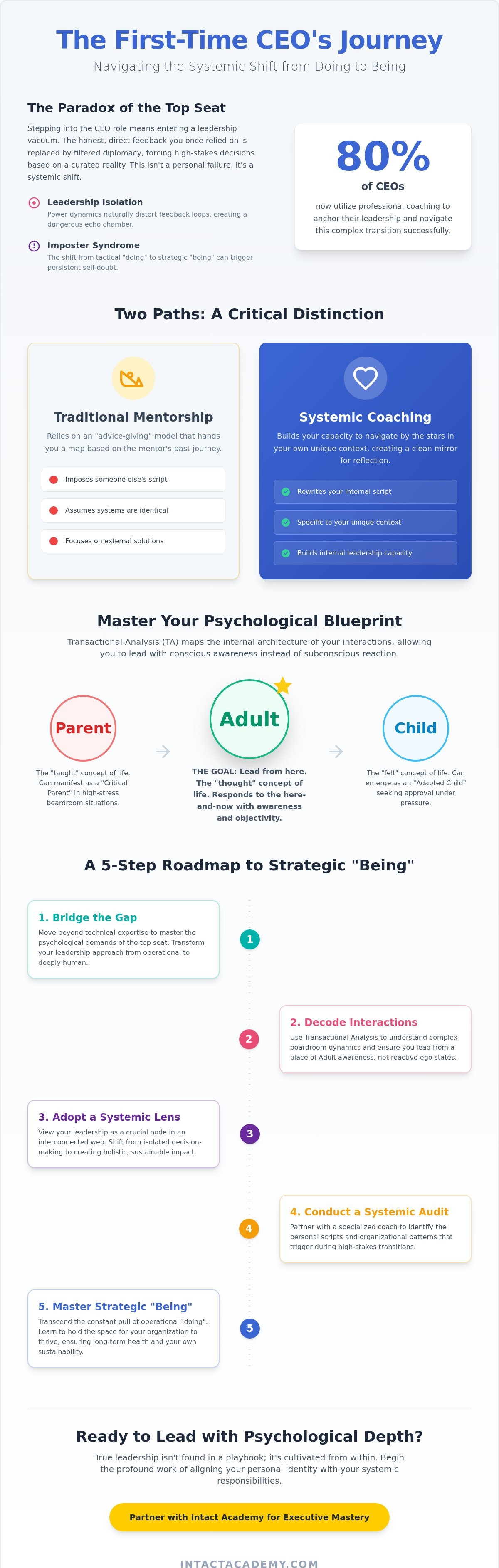
A 5-Step Roadmap for the First-Time CEO Transition
Transitioning from a senior vice presidency to the CEO chair is a systemic shift that requires more than a new set of responsibilities. It demands a structural overhaul of your psychological framework. An executive coach for first-time CEOs provides the scaffolding for this metamorphosis through a deliberate, five-step process designed to anchor your leadership in depth and clarity. This roadmap isn't a generic checklist; it's a journey of returning to wholeness while navigating the unique pressures of the top seat.
- Step 1: Systemic Audit. We begin by mapping the invisible architecture of your organization. You must identify not just the formal stakeholders, but the hidden loyalties and legacy patterns that influence current behavior.
- Step 2: Script Awareness. This phase involves identifying the personal narratives triggered by high-stakes pressure. Recognizing these patterns allows you to choose your response rather than reacting from unconscious habit.
- Step 3: Contracting for Success. Here, we establish clear, Adult-to-Adult boundaries with your Board. It's about moving beyond a dynamic of pleasing or rebelling and toward mutual accountability.
- Step 4: Shadow Work. You must confront the blind spots cultivated by the "sycophant problem." This step requires the courage to invite the truths that your team might be too hesitant to share.
- Step 5: Sustainable Integration. The final phase focuses on balancing your executive presence with personal wholeness, ensuring your leadership is a source of energy rather than a drain.
Contracting with the Board and the Self
In the specialized work of an executive coach for first-time CEOs, multi-party contracting is essential. This process aligns the goals of the leader, the coach, and the Board, ensuring that expectations move beyond mere financial KPIs to include the cultural health of the entire system. Contracting for Change is a core competency in 2026 that defines the psychological boundaries and shared outcomes of the developmental journey. By setting these parameters early, you create a stable container for the often-turbulent work of personal and professional transformation.
Developing Executive Presence through TA
Authentic executive presence isn't a performance; it's a reflection of your internal state. Using the "OK-OK" communication matrix from Transactional Analysis, you can build trust across every level of the organization by assuming that both you and your interlocutors are capable and valuable. This framework helps you move away from "Psychological Games" in the boardroom, those repetitive, indirect interactions that mask true intent and stall progress. Ultimately, leading organizational change starts with the CEO’s internal state, as your psychological maturity becomes the blueprint for the entire company’s evolution.
If you're ready to anchor your transition in systemic depth, our Executive Coaching services provide the structured methodology to guide your evolution toward a state of completeness and genuine power.
Partnering with Intact Academy for Executive Mastery
Partnering with Intact Academy means entering a space where business acumen meets psychological rigor. Sari van Poelje’s systemic approach doesn't just address the symptoms of leadership strain; it recalibrates the very foundation of your presence. For a leader in transition, an executive coach for first-time CEOs from our academy acts as a wise mentor who has seen the inner workings of countless global organizations. The unique value of Transactional Analysis in an international executive context lies in its universal language of human behavior. It allows you to bridge cultural divides and manage complex global systems with a sense of quiet power and clarity. Our engagements move beyond surface-level tactics, facilitating a sustainable transformation that honors your maturity and professional ambition.
The Intact Academy Methodology
Our methodology is a refined integration of Transactional Analysis, Systemic Constellations, and Agile leadership principles. This multi-layered approach ensures that we don't just solve problems; we evolve the system. We focus on the "Senior Practitioner" level of coaching mastery, with programs accredited by the EMCC to ensure the highest standards of professional excellence. Whether you're seeking support online or in person, our reach extends to leaders in over 14 countries. This global citizenship provides a stable container for the profound work of personal and professional change, ensuring you have the support you need regardless of your geographic context.
Your Journey to Wholeness
The ultimate goal of our engagement is not merely to create a more efficient executive. It's to facilitate your evolution into a more integrated, genuine human being. When your leadership is anchored in your true self, you don't just lead; you flourish. This process of returning to a state of completeness is the thematic North Star of our work. Your journey begins with an initial systemic consultation and discovery session, where we map your current challenges and identify the personal and organizational scripts that require rewriting. This initial step ensures that our work together is grounded in your specific reality from day one.
If you're ready to transcend the paradoxes of your new role and lead with psychological depth, Explore our Executive Coaching services at Intact Academy. We're committed to your flourishing and the sustainable impact of your leadership on the global stage.
Step Into Your Systemic Power
The transition to the CEO chair isn't merely a promotion; it's a profound evolution of your relationship with the entire organizational system. By mastering the ego states and script patterns that define your interactions, you move from reactive management to a state of strategic being. This shift allows you to break through the isolation of the sycophant problem and lead with a depth that is both intentional and sustainable. Engaging a specialized executive coach for first-time CEOs provides the essential mirror required to dismantle distortions and reclaim your genuine leadership voice.
Intact Academy, led by world-renowned TA expert Sari van Poelje, offers EMCC and ICF accredited programs that are currently trusted by leaders in over 14 countries. Our methodology ensures that your professional growth is anchored in psychological rigor and professional pragmatism. Begin your systemic transformation with Intact Academy and discover how a return to wholeness can redefine your organizational impact. Your path to mastery is a journey toward your most complete and genuine self.
Frequently Asked Questions
What is the difference between an executive coach and a business mentor for a CEO?
A business mentor typically operates from a model of "advice-giving" based on their own historical successes and personal scripts. In contrast, an executive coach focuses on enabling your internal capacity to navigate your unique systemic context. While a mentor tells you how they did it, a coach facilitates a transformational process that allows you to discover how you will do it, ensuring your leadership remains genuine and grounded in the present moment.
How long does a typical executive coaching engagement for a first-time CEO last?
For a leader navigating a systemic transition, a typical engagement with an executive coach for first-time CEOs lasts between six and twelve months. While some specialized programs conclude in four to six months, the profound work of rewriting leadership scripts and stabilizing organizational impact often requires a year-long stable container. This duration allows for the steady, methodical integration of new psychological states into your daily executive presence.
Can Transactional Analysis really help with business strategy and ROI?
Transactional Analysis directly impacts ROI by clarifying the internal architecture of decision making and reducing the friction of unproductive boardroom dynamics. Research indicates that companies often see an average return of seven times their initial investment in executive coaching. By cultivating an "Integrating Adult" state, you ensure that strategy is born from objective reality rather than reactive ego states, leading to more precise execution and sustainable growth.
How do I know if I am "coachable" as a first-time CEO?
Coachability is defined by your willingness to look inward and your courage to dismantle the personal patterns that no longer serve your new role. If you feel a persistent gap between your technical expertise and your psychological readiness for the top seat, you possess the necessary openness for growth. It's a commitment to returning to a state of completeness, moving beyond the need for "unjustified affirmation" toward a state of genuine professional mastery.
What should I look for in an executive coach’s credentials (ICF vs. EMCC)?
Both the International Coaching Federation (ICF) and the European Mentoring and Coaching Council (EMCC) set high global standards, but they emphasize different developmental paths. As of 2026, the EMCC is particularly recognized for its focus on competency-based learning and systemic supervision. You should look for a coach at the "Senior Practitioner" or "Master" level to ensure they possess the intellectual rigor required to handle C-suite emotional complexity.
How does systemic coaching help with the sycophant problem?
Systemic coaching addresses the sycophant problem by providing a "clean" mirror that exists entirely outside your organizational hierarchy. An executive coach for first-time CEOs helps you identify the "Psychological Games" and filtered feedback loops that naturally form around the top seat. This external perspective allows you to see the organizational constellations as they truly are, rather than the curated version presented by direct reports seeking safety or favor.
Is executive coaching confidential when the Board of Directors is paying for it?
Confidentiality is a cornerstone of the coaching relationship, even when funded by the Board. This is established through "multi-party contracting," a process that defines clear Adult-to-Adult boundaries between the leader, the coach, and the organization. While the Board may receive high-level updates on systemic health or cultural progress, the specific psychological work remains a private, safe space for your personal evolution.
How often should a first-time CEO meet with their coach?
The rhythm of coaching is typically bi-weekly or monthly, allowing sufficient time for the insights from each session to resonate and be tested in real-world scenarios. This deliberate pacing mirrors the process of deep learning itself, ensuring that change is not rushed but integrated. Many leaders also maintain ad-hoc access to their coach for high-stakes decision making, providing a reliable sounding board during periods of intense systemic shift.


