

What if the persistent tension you feel during a high-stakes engagement isn't a sign of personal failure, but a vital signal from the organizational system itself? Many practitioners find themselves caught in the middle of conflicting loyalties between a C-suite sponsor and the individual coachee, leading to a quiet sense of professional burnout. These ethical dilemmas in executive coaching often arise when the boundaries between performance development and deeper psychological intervention become blurred. You aren't alone in feeling the weight of these multi-cornered contracts; it's a natural response to the complex pressures of leadership environments in a market projected to reach $174.53 billion by 2031.
We recognize that maintaining your integrity while adhering to the 2025 ICF Code of Ethics requires more than just a checklist of rules. This article provides the tools to master the complexities of psychological boundaries using a systemic Transactional Analysis approach. You'll gain a clear decision-making framework to handle systemic traps and the grounded confidence to hold firm boundaries with even your most powerful clients. We'll begin by deconstructing the traps inherent in corporate systems and then move toward a model of professional wholeness and genuine connection.
Key Takeaways
- Move beyond static codes of conduct to recognize ethical friction as a systemic signal requiring sophisticated organizational insight.
- Resolve ethical dilemmas in executive coaching by implementing robust multi-cornered contracts that define clear loyalties between the organization and the individual.
- Master the "Stop, Breathe, Reflect" framework to navigate the informant trap and other high-pressure C-suite scenarios with Adult clarity.
- Utilize the "3 Ps" model of Protection, Permission, and Potency to evaluate psychological boundaries and maintain professional integrity in every session.
- Embrace systemic supervision as a vital tool for revealing hidden blind spots and fostering the emotional resilience needed for deep organizational transformation.
Beyond the Code of Conduct: Why Executive Ethics are Systemic
Ethical dilemmas in executive coaching are rarely as simple as choosing between right and wrong. They typically manifest as a collision between two competing "rights" or two equally valid loyalties. In the high-pressure environment of the C-suite, these dilemmas are amplified by the sheer velocity of decision-making and the weight of organizational power. When a coach enters this space, they aren't just working with an individual. They are engaging with a complex system where profit, speed, and reputation create a unique gravitational pull on professional integrity. To navigate this effectively, we must move beyond a linear understanding of Coaching ethics and standards and embrace a systemic perspective.
Traditional ethics often focus on the individual's moral compass, yet this approach can be insufficient when the organizational system itself is under stress. Systemic ethics recognize that the coach is part of a larger field. In this field, the "right" choice for the coachee might be the "wrong" choice for the shareholders or the team. This complexity often triggers the coach’s own "Life Script," a term from Transactional Analysis describing the unconscious life plan we develop in childhood. If a coach has a script that prioritizes pleasing authority, they may develop ethical blind spots when a powerful CEO pushes for confidential information. Recognizing these internal patterns is the first step toward maintaining a state of completeness and genuine presence.
The Illusion of the Two-Person Relationship
One of the most dangerous traps for a practitioner is the belief that coaching is a private, two-person relationship. In reality, there is always an "Invisible Client" in the room: the organization’s culture, its board, and its strategic goals. Traditional models that ignore this hierarchy often fail because they don't account for the psychological weight of the coach acting as a change agent for the entire system. You aren't just holding space for a leader; you're holding the tension of the system's evolution. This requires a shift in perspective that honors both the individual's growth and the organization's collective success.
Transactional Analysis as an Ethical Compass
Understanding what is transactional analysis provides a precise map for navigating these high-stakes demands. By utilizing the "Adult" ego state, a coach can remain objective and grounded even when caught in the crossfire of corporate politics. Without this clarity, it's easy to slip into a "Parent" role, perhaps by becoming overly protective of the coachee, or a "Child" role, where one feels intimidated by C-suite authority figures. TA offers a structured methodology to identify these shifts in real-time, allowing the coach to return to a position of potency and ethical clarity. This systemic awareness ensures that ethical dilemmas in executive coaching become opportunities for profound transformation rather than sources of professional burnout.
The Multi-Cornered Contract: Preventing Ethical Friction
The most profound ethical dilemmas in executive coaching often root themselves in a single, unanswered question: Who is the client? In the corporate world, the answer is rarely simple. While the individual sitting across from you is the recipient of your presence, the organization is the one providing the financial investment. This duality creates a natural tension. Because there is a notable lack of regulation in the coaching industry, the burden of defining these boundaries falls entirely on your shoulders. A robust multi-cornered contract acts as the skeletal structure that supports the weight of these competing interests, ensuring that integrity isn't sacrificed for the sake of a simple agreement.
Establishing this framework requires a step-by-step alignment before the first session even begins. You must bring the sponsor, the coachee, and often HR into a shared space to define success. This process uncovers "stealth" contracts; those unwritten, whispered expectations from a CEO or Director that never made it into the formal paperwork. Perhaps they want a "fixer" for a difficult personality or an informant on cultural morale. By naming these unspoken agendas early, you protect both your professional standing and the coachee’s psychological safety. It's about moving from a place of ambiguity to a place of shared clarity and mutual respect.
Managing the Sponsor-Coach-Coachee Triangle
In this triangle, we must distinguish between the Administrative Contract and the Psychological Contract. The Administrative Contract handles the logistics, fees, and reporting schedules. The Psychological Contract, however, is where the real work happens. It defines the level of depth, the degree of challenge, and the absolute boundaries of confidentiality. To align organizational ROI with individual growth, we use transparency agreements. These documents explicitly state what will be shared with the sponsor and what remains sacred within the coaching room, preventing ethical dilemmas in executive coaching from surfacing as betrayal later in the engagement.
Re-contracting as an Ethical Safeguard
Organizational goals are rarely static. When a company undergoes a merger or a leadership shift, the original coaching contract may no longer fit the new reality. Identifying "scope creep" is essential; it's that moment when the work begins to drift into areas you didn't agree to cover. When this happens, you must have the courage to pause the engagement and bring all parties back to the table. Re-contracting is the primary tool for maintaining systemic integrity when the landscape shifts. For those seeking to master these high-level boundary negotiations, our TA EMCC Senior Practitioner academy offers a deep immersion into the mechanics of professional safety and systemic clarity.
3 Common Ethical Dilemmas in the C-Suite and How to Resolve Them
While theoretical frameworks provide a necessary foundation, the true test of professional integrity occurs in the heat of a high-stakes engagement. In the C-suite, the pressure to perform often creates a gravitational pull that can distort even the most robust contracts. These ethical dilemmas in executive coaching are not merely hurdles to be cleared; they are systemic signals that require a coach to maintain a state of high awareness and potency. By examining specific scenarios, we can see how the multi-cornered contract discussed previously is put into practice when loyalties collide.
- The 'Informant' Trap: This occurs when a sponsor or HR director asks for "off-the-record" feedback about a coachee's potential or personality. It's a subtle invitation to breach the psychological contract under the guise of organizational alignment.
- The 'Boundary of Competence': You may find a leader beginning to "unpack" deep-seated trauma or clinical-level anxiety. While coaching can be therapeutic, we must remain clear that we do not offer clinical psychotherapy; knowing when the work has shifted beyond the coaching remit is vital for the safety of both parties.
- The 'Conflict of Interest': Coaching two rivals within the same leadership team can lead to a "split" in the coach's own psyche. Without a clear framework, you may inadvertently become a pawn in a power struggle, compromising your objectivity and the trust of both clients.
Navigating Confidentiality vs. Transparency
When a sponsor pushes for "insider" information, they are often unconsciously playing a Transactional Analysis game known as "Let’s You and Him Fight." They invite the coach to join them in a Parent ego state to judge the coachee. To resolve this, use a "Public vs. Private" framework. Public information includes progress toward agreed-upon goals and attendance; private information includes the psychological process and personal disclosures. A practical script for a powerful CEO might be: "I value our partnership in [Name]’s development. To protect the potency of this work, I'll share the themes of our progress during our scheduled three-way review, rather than in an informal setting."
The Coaching-Therapy Boundary in Executive Settings
Identifying "red flags" is a core skill for any senior practitioner. If a coachee exhibits persistent signs of clinical depression, active trauma responses, or personality disorders that impede their reality testing, a referral to a clinical professional is the only ethical path. Maintaining a professional stance means staying in the "here and now" of organizational performance while acknowledging the emotional weight the leader carries. Engaging in continuous professional development for coaches ensures you have the diagnostic clarity to see these boundaries before they are crossed. It allows you to remain a stable container for the coachee’s growth without stepping into a role that is outside your professional remit.
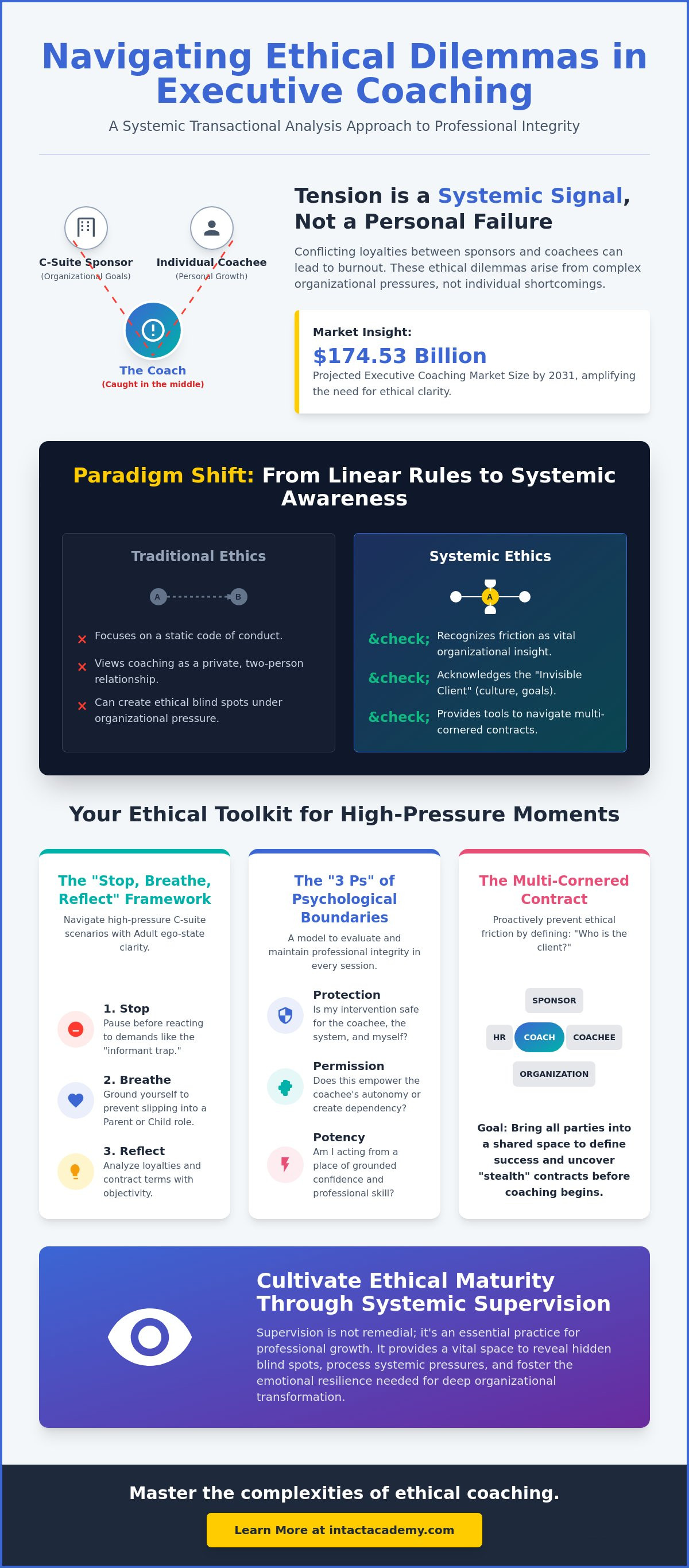
An Ethical Decision-Making Model for High-Pressure Moments
High-stakes leadership environments rarely offer the luxury of lengthy deliberation. Decisions often happen mid-sentence, under the gaze of a powerful executive or in the wake of a sudden organizational crisis. In these moments, ethical dilemmas in executive coaching can feel overwhelming, triggering a reactive "Child" ego state characterized by a desire to please or a fear of conflict. To remain effective, you need a model that functions at the speed of business while maintaining the depth of psychological practice. The "Stop, Breathe, Reflect" method allows you to pause the immediate pressure and return to "Adult" clarity, ensuring your response is grounded in reality rather than reactivity.
Beyond the immediate pause, we must evaluate our choices through the lens of the systemic "Script." Organizations, like individuals, often repeat unconscious patterns of behavior. If you find yourself tempted to bypass a protocol or keep a secret for a leader, ask yourself: Is this choice repeating a dysfunctional organizational pattern? The "Front Page" test provides an additional layer of clarity. If your decision were made public to the board or the entire leadership team, would you be able to stand by it with professional pride? This alignment between internal values and external transparency is the hallmark of ethical maturity.
The 3 Ps of TA Ethics
In Transactional Analysis, we use the "3 Ps" framework to evaluate the integrity of our interventions. These three pillars ensure that the coach remains a stable container for change:
- Protection: Does this choice ensure the physical and psychological safety of the coachee, the coach, and the broader organizational system?
- Permission: Have all parties truly consented to this course of action? This goes back to the multi-cornered contract we established earlier, ensuring no "stealth" agendas are at play.
- Potency: Do you have the internal authority and presence to hold the boundary? Potency is the ability to stay impactful and grounded even when the system exerts pressure on you to conform.
Internal vs. External Consultation
While an internal moral compass is vital, it can be compromised by the very systemic pressures you are trying to navigate. This is where peer-to-peer accountability becomes indispensable. Engaging with a community of experienced practitioners allows you to see the blind spots your own "Life Script" might be hiding. Creating a personal "Ethical Manifesto" also serves as a grounding document, a set of non-negotiable principles you bring into every C-suite engagement. This combination of internal reflection and external counsel transforms ethical challenges from sources of anxiety into catalysts for professional evolution. Elevate your ability to hold these complex spaces by joining our TA EMCC Senior Supervisor academy, where we explore the intersection of systemic integrity and leadership transformation.
Cultivating Ethical Maturity Through Systemic Supervision
Navigating the labyrinth of modern leadership requires more than just a set of tools; it requires a mirror that can reflect the parts of our practice we cannot see alone. Even the most seasoned practitioners are susceptible to the gravitational pull of the systems they serve. Because we are human, we inevitably carry a portion of the organizational shadow into our work. Systemic supervision provides this necessary mirror, acting as a stable container for the turbulence that leaks from the corporate suite into the coaching room. It is here that ethical dilemmas in executive coaching are transformed from heavy burdens into profound insights about the system's underlying health.
Unlike traditional mentoring, which often focuses on the "how-to" of specific techniques, systemic supervision explores the "who" of the coach within the organizational field. It moves the conversation from a transactional exchange of advice to a transformational exploration of relational dynamics. This depth of reflection is a cornerstone for those preparing for executive coaching certification, where ethical maturity is weighed as heavily as technical skill. True mastery involves the courage to look inward and acknowledge where our own history might be clouding our professional judgment.
The 7-Eyed Model in Executive Supervision
In our supervisory practice, we often utilize the 7-Eyed Model to look at the coach, the client, and the wider system simultaneously. This multi-dimensional view allows us to uncover "Parallel Processes," where the coach unconsciously begins to act like the client's boss or mirrors the organizational culture’s rigidity. By naming these dynamics in a safe, non-judgmental space, we move from "shame-based" ethics, where we fear making a mistake, to "learning-based" maturity. In this state, every ethical friction point becomes a data point for the system's evolution, allowing the coach to return to a state of completeness and potency.
Join a Community of Master Practitioners
The journey toward ethical maturity is rarely a solo endeavor. It thrives within a community of peers who value integrity, depth, and the courage to change. Engaging in accredited training, such as the TA EMCC Senior Practitioner academy, provides the rigorous framework needed to hold the complexities of the C-suite with grace. At Intact Academy, we are committed to supporting global coaches as they transition from practitioners to leaders in the field, eventually reaching the level of Senior Supervisor. This path is not just about professional advancement; it is about becoming a guardian of human flourishing within the world of business. To take the next step in your professional evolution, explore our TA EMCC Senior Supervisor Academy and discover how systemic supervision can anchor your practice in lasting integrity.
Embracing the Path of Systemic Integrity
The journey toward ethical maturity is an ongoing process of returning to a state of completeness and genuineness. We've explored how moving beyond static codes allows you to see the organizational field as a living system rather than a set of rules to be followed. By mastering multi-cornered contracts and utilizing the 3 Ps framework, you transform potential betrayals into shared developmental goals. These ethical dilemmas in executive coaching are not obstacles to be avoided; they are the very ground upon which professional potency is built. When you hold these boundaries with clarity, you create a safe container for profound human transformation.
To anchor your practice in this level of depth, you must engage with a community that values both psychological rigor and practical impact. Our EMCC and ICF accredited programs are led by Sari van Poelje, a global TA expert, and draw participants from over 14 countries. This global perspective ensures your learning remains as diverse and sophisticated as the leadership systems you serve. Deepen your ethical mastery at the TA EMCC Senior Practitioner Academy and step into your full professional authority. You possess the capacity to hold the complex tensions of the C-suite with grace and clarity. We look forward to supporting your evolution as you lead the way toward more human, ethical organizations.
Frequently Asked Questions
What is the most common ethical dilemma in executive coaching?
The most frequent ethical dilemmas in executive coaching involve navigating the tension between the individual coachee's growth and the organization's strategic objectives. This often manifests as a conflict of loyalty when a sponsor expects specific performance outcomes that don't align with the coachee's personal developmental needs. Recognizing this systemic pressure early allows the coach to remain a neutral, potent force for change rather than becoming a pawn in corporate politics.
How do I handle a sponsor who demands a report on a coachee's progress?
You handle such demands by returning to the transparency agreement established during the initial contracting phase. Instead of providing "off-the-record" feedback, invite the sponsor and coachee to a structured three-way review where progress is discussed collectively. This approach honors the coachee's psychological safety while ensuring the organization receives the necessary data on ROI. It shifts the dynamic from a secretive exchange to an open, Adult-to-Adult dialogue about systemic evolution.
When should an executive coach refer a client to a therapist?
A referral is necessary when the client’s struggles shift from professional development into the realm of clinical pathology or unaddressed trauma. If you observe persistent signs of clinical depression, active anxiety disorders, or a significant break from reality testing, the ethical path is to pause the coaching. While we don't offer clinical psychotherapy, we remain supportive by helping the leader transition to a qualified mental health professional who can provide the appropriate level of care.
What is the 'three-cornered contract' in coaching ethics?
The three-cornered contract is a systemic framework that defines the roles, expectations, and boundaries between the coach, the coachee, and the sponsoring organization. It ensures that every party understands who the client is and how information will flow through the system. By explicitly naming the goals of both the individual and the business, you prevent the ethical friction that arises from unspoken "stealth" contracts and conflicting agendas.
Is it ethical to coach two competing executives in the same company?
It's ethically permissible but requires a high degree of professional maturity and explicit boundaries regarding confidentiality. You must disclose the potential conflict of interest to all parties and establish clear rules about what information can be shared across the leadership team. If the rivalry is so intense that your objectivity is compromised, the most ethical choice is to refer one executive to a trusted colleague to maintain the system's integrity.
How often should an executive coach attend professional supervision?
Many senior practitioners attend supervision once every four to six weeks or after every twenty to thirty hours of client work to maintain their ethical edge. This frequency ensures you have a stable container to process the emotional weight of high-stakes engagements. Systemic supervision acts as a vital safeguard, helping you identify parallel processes and unconscious blind spots before they impact your professional integrity or lead to burnout.
What are the legal implications of confidentiality in executive coaching?
In most jurisdictions, executive coaching remains self-regulated; however, confidentiality is governed by the specific terms of your contract and overarching legal principles like the "duty to warn." If a coachee discloses illegal activity or a threat of harm, your legal and ethical obligation to report this may override your confidentiality agreement. It's essential to consult local regulations and clearly outline these legal exceptions in your written agreements with every corporate client.
How does Transactional Analysis help in resolving ethical conflicts?
Transactional Analysis offers a sophisticated map for identifying the psychological "games" and "scripts" that often fuel ethical dilemmas in executive coaching. By recognizing when a sponsor is inviting you into a Parent ego state to judge a coachee, you can consciously choose an Adult response that maintains professional boundaries. This methodology allows you to stay grounded and potent, ensuring that your interventions lead to a state of completeness rather than repeating dysfunctional organizational patterns.


