

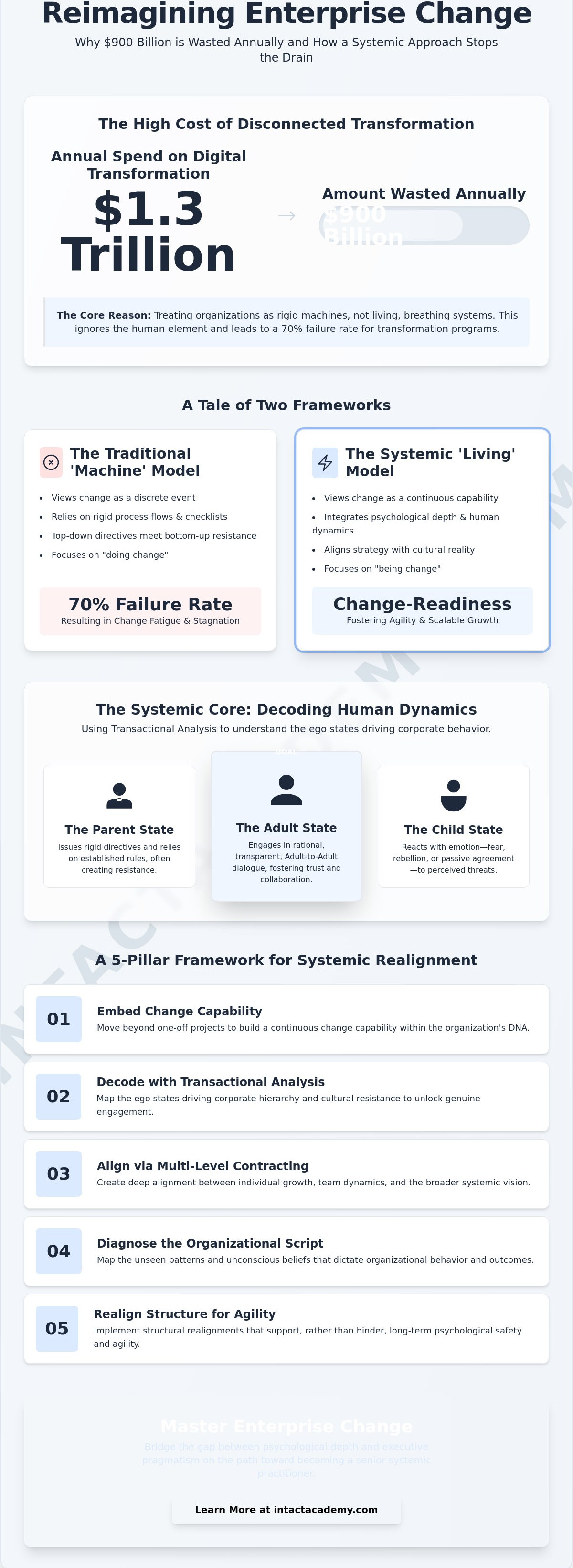
Nearly $900 billion of the $1.3 trillion spent annually on digital transformation is wasted because we often treat organizations as rigid machines rather than living, breathing systems. To stop this drain, leaders need a sophisticated enterprise change management framework that bridges the gap between executive strategy and cultural reality. You've likely felt the quiet friction of change fatigue settling into your teams, or watched expensive consulting interventions fail to address the human heart of the business.
Success in this era requires aligning psychological depth with organizational agility. We're moving beyond surface-level process flows to explore a systemic methodology that fosters genuine adoption and scalable growth. This guide provides a roadmap for 2026, offering the professional mastery needed to navigate complex shifts with empathy and precision. You'll learn how to transform your approach into a continuous process of becoming, ensuring your organization's wholeness remains intact through every evolution.
Key Takeaways
- Understand why modern transformation requires moving beyond rigid process flows toward a holistic structure that embeds change capability into your organization’s DNA.
- Explore how an enterprise change management framework rooted in Transactional Analysis can decode the ego states driving corporate hierarchy and cultural resistance.
- Learn to utilize multi-level contracting to create deep alignment between individual growth, team dynamics, and the broader systemic vision.
- Apply a five-pillar approach to systemic diagnosis, allowing you to map the organizational script and ensure structural realignment that supports long-term agility.
- Discover how to bridge the gap between psychological depth and executive pragmatism on the path toward becoming a senior systemic practitioner.
What is an Enterprise Change Management Framework?
In the quiet corridors of modern industry, we're witnessing a profound shift in how organizations survive. We're moving away from the era where change was a discrete event; a project with a start and a finish. Today, an enterprise change management framework must be viewed as a living, systemic capability that resides within the very DNA of the organization. It's the difference between a tree that bends in the wind and one that integrates the wind into its growth. This framework is not a manual on a shelf. It's the collective capacity to remain whole while constantly evolving.
The year 2026 presents a unique challenge where technological speed, driven by AI and rapid automation, often outpaces human adaptability. Research indicates that $900 billion of the $1.3 trillion spent annually on digital transformation is wasted, largely because the human element is treated as an afterthought. A robust framework balances this technical momentum with psychological safety. It ensures that as workflows accelerate, the people within the system don't fracture. The core objective is to move beyond mere resilience to a state of "change-readiness," where the organization thrives on evolution rather than fearing the next disruption.
Defining ECM in a Volatile Global Landscape
Modern enterprise boundaries have dissolved. With global citizenship and remote work now standard, a static model of change is no longer sufficient. We must move toward dynamic, systemic frameworks that acknowledge the interconnectedness of every individual, team, and department. While foundational change management principles provide the initial scaffolding, true mastery involves cultivating a change-adept system. This means shifting our focus from managing a specific transition to nurturing a culture that is inherently designed to transform. It's a move from doing change to being change.
Why Traditional Change Management Often Stalls at Scale
Traditional approaches often fall into the "process trap." We've seen countless leaders attempt to solve human resistance with more complex flowcharts and rigid checklists. However, flowcharts don't feel, and they don't hope. Approximately 70% of transformation programs fail because they ignore the disconnect between executive strategy and the underlying psychological scripts of the workforce. When a top-down directive meets a bottom-up culture of fatigue, the process stalls regardless of the budget. Systemic impact is achieved only when the internal psychological readiness of the people mirrors the external strategic requirements of the business.
The Systemic Framework: Mapping the Psychological Architecture of Enterprise Change
To build a truly resilient organization, we must look beneath the surface of flowcharts and spreadsheets. While many Organizational change management frameworks offer excellent structural guidance, they often fail to account for the invisible psychological undercurrents that dictate how people actually behave during a transition. A systemic enterprise change management framework recognizes that an organization is not just a collection of assets, but a complex web of human relationships and unconscious patterns.
At the heart of this approach lies Transactional Analysis (TA). By understanding what is transactional analysis in a professional context, leaders can decode the "ego states" that manifest during times of stress. In corporate hierarchies, we often see the "Parent" state issuing rigid directives, the "Child" state reacting with fear or rebellion, and the "Adult" state struggling to find a voice. When a transformation begins, these states often clash, creating friction that no project plan can resolve. Moving toward authentic engagement means inviting every stakeholder into an Adult-to-Adult dialogue, where transparency replaces posturing.
Transactional Analysis as the Foundation for Enterprise Agility
Agility isn't just about speed; it's about the quality of the transactions between people. In large-scale initiatives, "Psychological Games" often emerge as a defense mechanism against the unknown. You might recognize the "Yes, But" game, where employees agree to a change in public but undermine it in private. A systemic framework allows us to spot these patterns early. By shifting the internal contract from one of compliance to one of mutual accountability, we create a container where real transformation can occur without the drag of hidden agendas.
Uncovering Organizational Scripts and Cultural Patterns
Every enterprise operates according to an "Organizational Script." This is an unconscious narrative, often inherited from the founders or early leaders, that dictates how the company responds to crisis or opportunity. If the script is one of "perpetual struggle" or "don't trust outsiders," even the most advanced technical solution will be rejected by the system. Mapping this history allows us to predict where resistance will appear before it stalls the project. It requires a level of depth that many find uncomfortable, yet it's the only way to ensure the change is permanent. To maintain the health of this delicate process, engaging in systemic supervision provides the necessary external perspective to keep the framework aligned with the organization's highest potential.
Essential Components of a Robust Enterprise Change Management Framework
Building a sustainable system for transformation requires more than just a sequence of tasks; it demands a stable container where people feel safe to evolve. The most effective components of an enterprise change management framework are those that address the unseen architecture of human commitment. We must look beyond adoption rates, which often measure only surface-level compliance, and instead focus on the systemic health of the organization. This health is found in the quality of relationships, the clarity of purpose, and the strength of the internal agreements that hold the system together during periods of volatility.
To bridge the gap between executive strategy and daily execution, organizations often need to move beyond individual coaching toward systemic team coaching. This approach ensures that teams aren't just high-performing in a vacuum but are aligned with the broader enterprise goals. It addresses the silos that naturally form when departments prioritize their own survival over the collective flourishing of the company. By measuring systemic health, we track how information flows across these boundaries and whether the organizational script is shifting from one of resistance to one of active, conscious participation.
Contracting: The Multi-Level Agreement for Sustainable Change
Every successful transformation begins with a clear, multi-layered agreement. In a sophisticated enterprise change management framework, we utilize three distinct levels of contracting to ensure total alignment. First, the administrative contract handles the logistics of time, budget, and resources. Second, the professional contract defines the specific skills and outcomes required for success. Finally, the psychological contract addresses the unspoken expectations and fears that often derail progress. Clear contracting acts as a boundary that contains the transformation, ensuring that unspoken cultural anxieties don't derail the agreed-upon professional objectives. It creates a space of transparency where everyone knows not just what is changing, but why it matters to them personally.
Beyond Process: Building Systemic Resilience and Psychological Safety
Leadership serves as the "secure base" for an organization. When leaders provide this stability, employees feel empowered to take the risks necessary for growth. This sense of safety is the primary antidote to change fatigue, which research identifies as a significant threat to modern transformation success. By fostering systemic resilience, we ensure that the organization can absorb the shocks of a continuous stream of initiatives without burning out its most valuable assets. For a deeper exploration of how leaders can cultivate this environment, consider the principles of leading organizational change from a systemic perspective. This approach moves the focus from managing tasks to nurturing the human spirit within the corporate machine, allowing for a state of completeness even amidst constant movement.
Implementing the Framework: A 5-Pillar Approach to Large-Scale Realignment
Moving from a theoretical understanding to a lived reality requires a disciplined yet flexible approach. An enterprise change management framework is only as strong as its implementation. This process is not a linear march toward a finish line; instead, it's a rhythmic realignment of the entire organizational system. We utilize five pillars to ensure that the transition is deep, sustainable, and respectful of the human element. Each pillar serves as a structural anchor, preventing the system from reverting to old, unproductive scripts when the pressure of transformation intensifies.
- Pillar 1: Systemic Diagnosis. We begin by mapping the organizational script. This involves identifying the current ego states dominant within the hierarchy and uncovering the unconscious narratives that drive resistance.
- Pillar 2: Multi-Level Contracting. Alignment is secured through administrative, professional, and psychological agreements. This ensures every stakeholder understands the "why" behind the change at both a functional and emotional level.
- Pillar 3: Leadership Mastery. Executives are trained in systemic coaching and TA principles. This empowers them to lead from an "Adult" state, fostering an environment of transparency and mutual respect.
- Pillar 4: Cultural Integration. We realign the organization's rituals, communication channels, and reward systems. This ensures that the new way of being is reinforced by the environment itself.
- Pillar 5: Continuous Supervision. A feedback loop for systemic health is established. Regular supervision allows the organization to identify and resolve "Psychological Games" before they undermine the transformation.
The Role of the Change Management Office (CMO) through a Systemic Lens
In many organizations, the Change Management Office acts as a "process police," enforcing compliance through rigid checklists. To achieve true systemic impact, the CMO must evolve into a systemic facilitator. This shift requires internal change teams to be trained in Transactional Analysis, allowing them to sense the emotional temperature of the organization. By integrating systemic thinking into existing PMO structures, the CMO becomes a bridge between strategic intent and the psychological reality of the workforce. It stops being about enforcing a plan and starts being about nurturing a system's capacity to evolve.
Training and Certification: Upskilling for Continuous Evolution
The complexity of 2026 demands a new set of competencies for those leading the charge. Traditional project management skills are no longer enough to navigate the turbulent waters of cultural realignment. Investing in professional development for coaches and leaders is essential for building internal change capability. EMCC-accredited training provides the intellectual rigor and practical methodology needed to guide large-scale systems through profound transformation. By creating a sustainable pipeline of systemic change agents, your organization ensures that agility becomes a permanent trait rather than a temporary initiative. To begin your journey toward this level of expertise, explore the TA EMCC Senior Practitioner Academy and master the art of systemic impact.
Mastering Enterprise Change: The Intact Academy Path to Systemic Impact
True transformation within an organization is never merely the result of a well-executed plan; it's the reflection of the leader's internal state. While a technical enterprise change management framework provides the necessary structure, it's the practitioner’s presence and psychological depth that breathe life into the system. At Intact Academy, we bridge the gap between profound psychological theory and executive pragmatism. We understand that for change to be sustainable, it must be led by individuals who have moved beyond simply "doing" change management to "being" systemic change leaders. This shift represents a journey toward professional wholeness, where the leader becomes a stable container for the organization's evolution.
Our methodology focuses on the intersection of individual growth and organizational success. By participating in the TA EMCC Senior Practitioner Academy, professionals embark on a rigorous path toward deep organizational mastery. This isn't a standardized, high-volume certification. It's a developmental process that honors the complexity of human systems and the maturity of the leader. You'll learn to navigate the turbulent waters of cultural realignment with a sense of quiet power, ensuring that every intervention serves the health of the entire enterprise system.
Integrating TA Mastery into Your Change Management Strategy
The unique value of our approach lies in the integration of Transactional Analysis with systemic team coaching. This combination allows leaders to address the structural silos of an enterprise while simultaneously decoding the psychological scripts that keep those silos in place. We've seen systemic interventions transform stagnant corporate cultures into agile, change-ready environments by addressing the root causes of resistance rather than just the symptoms. We invite you to look beyond the surface of your organizational challenges and recognize the systemic scripts that have held your culture in place for years. When you change the script, you change the future of the enterprise.
Your Journey to Professional Certification and Organizational Wholeness
The path to becoming a senior systemic practitioner is one of both outward action and inward reflection. Through the TA EMCC Senior Team Coach Academy, you'll gain the tools to align diverse teams with a singular strategic vision, fostering a culture of Adult-to-Adult engagement. This journey connects you with a global network of experts dedicated to the flourishing of human-centric enterprises. It's an invitation to step into a space where your professional expertise and personal integrity meet to create lasting global impact. To begin your transformation and master the complexities of a modern enterprise change management framework, we invite you to explore our accredited programs and certification pathways.
Embodying the Future of Systemic Leadership
True agility in 2026 isn't found in the speed of your technology, but in the depth of your human connections. We've explored how a systemic enterprise change management framework moves beyond surface-level adoption to address the unconscious scripts that govern organizational behavior. By integrating the five pillars of implementation and utilizing Transactional Analysis, you can transform resistance into a catalyst for growth. This is the path toward becoming a leader who doesn't just manage change but embodies it, fostering a culture where wholeness and agility coexist.
To reach this level of professional mastery, you must step into a space of deep learning and global insight. Led by global TA expert Sari van Poelje, Intact Academy provides EMCC and ICF accredited programs that have empowered participants from 14+ countries. It's time to move toward organizational wholeness and systemic impact. Deepen your impact with our TA EMCC Senior Practitioner Academy and begin your journey toward a more genuine, complete state of leadership. Your courage to change is the first step toward a flourishing future for yourself and your entire enterprise.
Frequently Asked Questions
What is the difference between Change Management and Enterprise Change Management?
Traditional change management focuses on individual projects or specific transitions with a clear start and finish. Enterprise change management is a strategic capability that embeds the ability to evolve into the organization's permanent structure. It doesn't just manage a single event; it cultivates a continuous systemic readiness. This ensures that the entire enterprise remains resilient and adaptable regardless of the specific initiative being implemented.
How does Transactional Analysis (TA) apply to an enterprise change framework?
Transactional Analysis acts as the psychological architecture for an enterprise change management framework. It allows leaders to identify the ego states, such as Parent, Adult, or Child, that drive interactions during periods of stress. By recognizing these patterns, organizations can move from reactive games to authentic Adult-to-Adult engagement. This depth ensures that the cultural realignment is as rigorous as the technical implementation, addressing the human script beneath the process.
Why do most enterprise change initiatives fail despite having a structured framework?
Failure often occurs because frameworks are treated as rigid checklists rather than living systems. When a model focuses solely on administrative milestones, it ignores the underlying psychological resistance and change fatigue of the workforce. If the organizational script isn't addressed, the system will eventually revert to its previous state to maintain equilibrium. True success requires aligning the internal psychological readiness with the external strategic goals of the transformation.
What are the key roles needed in a systemic enterprise change management office?
A systemic office requires more than project managers; it needs systemic facilitators and internal practitioners trained in Transactional Analysis. These roles act as the nervous system of the change, sensing cultural friction and facilitating Adult-to-Adult dialogue across departments. Additionally, systemic supervisors play a vital role in maintaining the health of the change agents themselves. This ensures the team remains objective and avoids being pulled into the organization's unconscious scripts.
How long does it take to implement a systemic enterprise change management framework?
Implementing a systemic enterprise change management framework is not a race to a finish line but a process of becoming. While technical changes may occur quickly, the deep cultural and psychological realignment typically requires eighteen to thirty-six months to become self-sustaining. This duration allows for the mapping of scripts, the establishment of new rituals, and the consistent reinforcement of Adult-to-Adult professional contracts across the entire global system.
Can an enterprise change framework be integrated with Agile or Lean methodologies?
A systemic framework provides the psychological container that Agile and Lean methodologies often lack. While those methods focus on the efficiency of flow and iterative delivery, a human-centric approach ensures the people within those cycles don't lose the emotional capacity to sustain them. By aligning the psychological contract with the iterative nature of Agile, organizations create a rhythm that honors both operational speed and human stability.
Is professional certification necessary for leading enterprise-wide change?
While anyone can follow a checklist, leading large-scale systemic change requires a high level of expertise and intellectual rigor. Professional certification, such as through the TA EMCC Senior Practitioner Academy, ensures that leaders possess the depth to navigate complex psychological dynamics. It provides a structured methodology for addressing organizational scripts and managing systemic health. This level of mastery is what distinguishes a transactional manager from a truly transformative leader.
How do you measure the ROI of a human-centric change framework?
Measuring the return on investment involves looking at both quantitative outcomes and systemic health indicators. Beyond traditional adoption rates, we evaluate the reduction in change fatigue, the quality of information flow across silos, and the retention of key talent during transitions. When an organization maintains its wholeness and performance levels through a period of intense volatility, the ROI is found in its long-term viability and competitive agility.


