

What if the most significant barrier to your team’s success isn't a lack of strategy, but a hidden script that no one has the language to name? You likely feel the weight of this invisible architecture every time you step into a high-stakes organizational intervention. It's common to feel overwhelmed by the administrative weight of high-level portfolios or to struggle when articulating the "why" behind a complex systemic intervention. You understand that moving a group toward true wholeness requires more than just a toolkit; it requires a profound shift in your own professional identity.
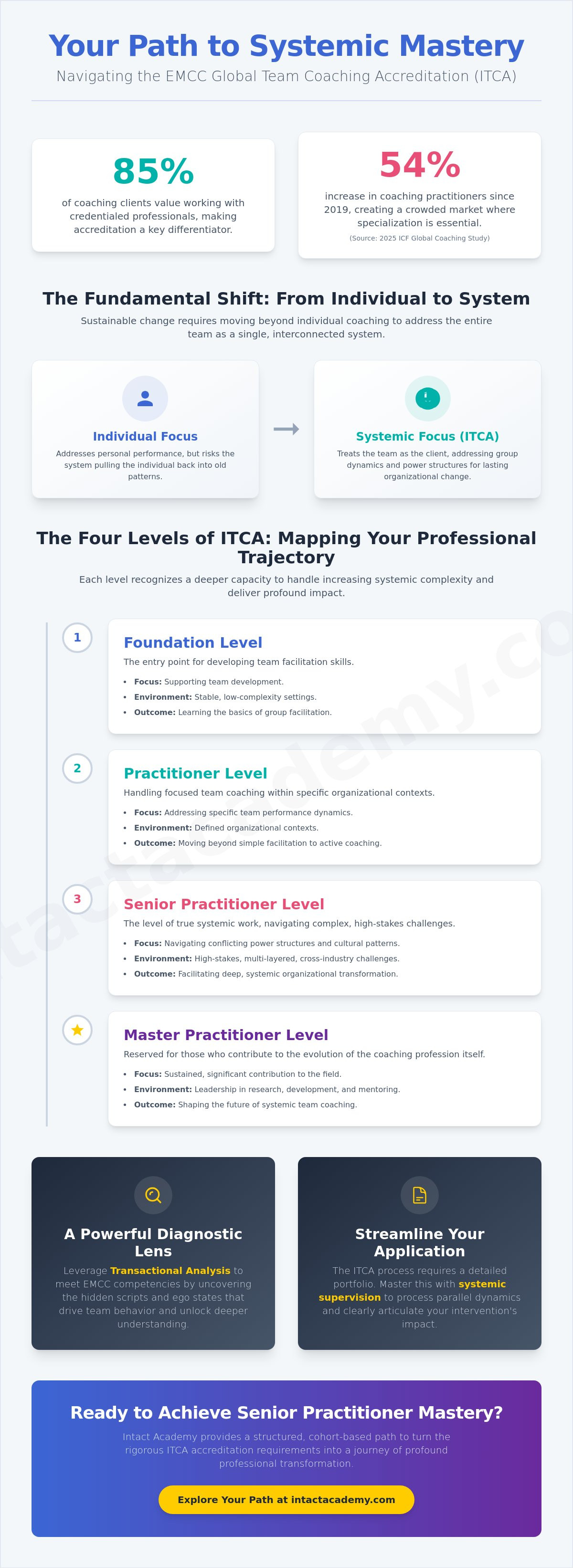
Recent data shows that 85% of coaching clients value working with credentialed professionals, making the EMCC global team coaching individual accreditation (ITCA) the essential benchmark for those seeking to lead at a Senior Practitioner level. This article provides a clear roadmap to achieving this prestigious recognition. You'll discover how integrating Transactional Analysis allows you to handle unconscious team scripts with precision and grace. We will explore the specific competencies required for systemic mastery, the practical steps of the application process, and how this accreditation opens doors to significant organizational contracts that demand the highest standards of professional integrity.
Key Takeaways
- Recognize how the shift from individual coaching to systemic team interventions addresses the complex, interconnected challenges of the modern workplace.
- Map your professional trajectory through the four levels of the EMCC global team coaching individual accreditation to ensure your credentials match your actual depth of practice.
- Leverage Transactional Analysis as a diagnostic lens to meet EMCC competencies by uncovering the hidden scripts and ego states that drive team behavior.
- Streamline your portfolio development by understanding the role of systemic supervision in processing parallel processes and articulating intervention impact.
- Explore how a cohort-based academy provides a structured path to mastery, turning the accreditation requirement into a space for professional transformation.
Why the EMCC Global Team Coaching Individual Accreditation (ITCA) Matters in 2026
The landscape of professional development has undergone a quiet but profound transformation. By 2026, the coaching market has expanded to over 122,000 practitioners globally, a 54% increase since 2019 according to the 2025 ICF Global Coaching Study. In this crowded environment, generalist skills are no longer enough to command the attention of sophisticated organizational clients. The EMCC global team coaching individual accreditation represents more than a certificate; it's a rigorous validation of your ability to facilitate collective growth within high-pressure systems. While the European Individual Accreditation (EIA) focuses on the developmental journey of a single person, the ITCA requires you to step into the complexity of group dynamics, power structures, and the invisible threads that bind a team together. Organizations now recognize that cultural transformation cannot happen in isolation. They demand specialists who can navigate the friction of systemic change with a steady, accredited hand.
The Shift from Individual to Systemic Impact
Coaching individuals in isolation often fails to produce sustainable change because the system eventually pulls the person back into old patterns. When you pursue the EMCC global team coaching individual accreditation, you're signaling a shift in your primary focus. The team itself becomes the client. This shift requires a different kind of contract, one that moves away from individual performance and toward the health of the entire organism. It's the missing link in many professional portfolios. By addressing the collective rather than the parts, you ensure that the growth you facilitate isn't just a temporary peak, but a permanent evolution in how the organization functions.
Professional Standing and Global Recognition
The European Mentoring and Coaching Council (EMCC) carries significant weight in international corporate procurement. In an era where 85% of coaching clients value working with credentialed professionals, having a specialized ITCA designation provides an undeniable return on investment. It aligns your practice with a Global Code of Ethics specifically tailored for the complexities of team environments, where confidentiality and boundaries are often tested. Achieving this level of accreditation isn't just about professional vanity; it's about joining a global community of practitioners committed to the highest standards of integrity and psychological depth. This recognition opens doors to high-level contracts that are simply inaccessible to those without a verified systemic framework.
The Four Levels of ITCA: Mapping Your Professional Trajectory
The journey toward mastery is rarely linear. It's a deliberate deepening of your capacity to hold space for others while navigating the invisible currents of a group. The EMCC Global Individual Team Coaching Accreditation (ITCA) recognizes this evolution by offering four distinct levels. Each stage reflects a specific depth of practice and a different level of systemic complexity. Whether you're just starting or you've spent decades in the boardroom, finding your place on this map is the first step toward professional wholeness.
- Foundation Level: This is the entry point for those beginning their journey into team facilitation. You're learning to support team development within relatively stable, low-complexity environments.
- Practitioner Level: At this stage, you're handling team coaching in focused organizational contexts. You've moved beyond simple facilitation and are beginning to address the specific dynamics that drive team performance.
- Senior Practitioner Level: This is where the work becomes truly systemic. You're navigating high-stakes, multi-layered challenges across various industries, often dealing with conflicting power structures and deep-seated cultural patterns.
- Master Practitioner Level: Reserved for those who contribute to the profession through sustained international impact. You aren't just practicing; you're innovating and shaping the future of the coaching industry itself.
Senior Practitioner: The Sweet Spot for Executive Team Coaches
For most consultants working at the executive level, the Senior Practitioner designation is the most sought-after. It's the point where your EMCC global team coaching individual accreditation signals to the market that you can handle the "parallel processes" that occur when leadership teams face extreme pressure. Reaching this level requires a significant portfolio of practice and a profound commitment to reflective learning. It's about more than just hours; it's about the quality of your presence. Many professionals find that joining the TA EMCC Senior Team Coach Academy provides the psychological framework needed to bridge the gap between individual coaching and systemic mastery.
Criteria for Progression and Level Matching
How do you assess where you currently stand? You'll need to look at your history through the lens of the EMCC competency framework. This involves evaluating the number of teams you've worked with and the diversity of the organizational challenges you've faced. If you have years of experience but lack formal certification, the Recognition of Prior Learning (RPL) process can help you enter at a level that matches your actual expertise. The transition from Practitioner to Senior isn't just a matter of volume. It's a qualitative shift. You stop trying to "fix" the team and instead become a stable container for their transformation. If you're ready to deepen your impact, consider how systemic supervision can illuminate the path forward.
Deepening Team Mastery: Using Transactional Analysis to Meet ITCA Competencies
The EMCC framework provides the necessary standards of professional conduct, but it's the underlying psychological methodology that provides the "how" of impactful coaching. For those pursuing the EMCC global team coaching individual accreditation, Transactional Analysis (TA) offers a robust intellectual engine to navigate the turbulent waters of group dynamics. TA isn't just a set of tools; it's a systemic lens that allows you to map the ego states of a team and understand the transactions that drive their performance. By applying the TA contracting model, you can manage the multi-layered agreements required in complex organizational settings, ensuring that the goals of the individual, the team, and the wider system remain in alignment. This level of psychological rigor is precisely what distinguishes a Senior Practitioner from a generalist.
Uncovering Team Scripts and Psychological Games
Teams often find themselves trapped in dysfunctional cycles that feel impossible to break. These are often "psychological games"—unconscious patterns of behavior that serve a hidden purpose while sabotaging the team’s actual objectives. In corporate culture, TA scripts manifest as the invisible, repetitive patterns of interaction that dictate how a team handles conflict, success, and the inevitable pressures of organizational change. As a coach, your role is to move the team from these restrictive "survival" scripts toward "growth" scripts. This involves identifying the roles individuals play within the system and facilitating a shift toward more authentic, productive ways of relating. By illuminating these hidden architectures, you provide the team with the autonomy they need to rewrite their own future.
The Coach’s Internal State: Autonomy and Presence
Your ability to facilitate deep systemic change depends largely on your own internal state. In high-conflict sessions, it's easy for a coach to be pulled into the team's drama, losing their professional neutrality. TA emphasizes the importance of the coach's "Adult" ego state, which is a place of autonomy, awareness, and intimacy. Maintaining this presence allows you to observe the system without becoming part of its dysfunction. It's about being a stable container for the team's transformation. The Sari van Poelje approach to agile Transactional Analysis is particularly effective here. It blends systemic depth with the speed required in modern business, helping you maintain a calm, authoritative presence even when the organizational system is in flux. This mastery of self is a core requirement for the EMCC global team coaching individual accreditation, as it ensures your interventions are grounded in insight rather than reactive impulse.
Navigating the ITCA Application: Practice, Supervision, and Portfolio
The administrative journey toward the EMCC global team coaching individual accreditation often feels daunting, yet it's designed to be a mirror of your professional evolution. It isn't merely a checklist of hours; it's a structured invitation to prove you can hold the complexity of a living system. The application process transforms your raw experience into a coherent narrative of mastery. By the time you reach the final submission, you won't just have a credential. You'll have a profound understanding of your own systemic impact and the unique value you bring to organizational change.
- Step 1: Documenting Practice: Curate your log of team coaching hours, ensuring you demonstrate diversity across different industries and organizational structures.
- Step 2: Systemic Supervision: Engage in regular sessions to process the "parallel processes" that occur between you and the teams you coach.
- Step 3: Reflective Writing: Develop logs that move beyond a simple record of events to show how you've integrated the EMCC competencies into your presence.
- Step 4: Portfolio Assembly: Weave your evidence into a story that highlights your ability to facilitate deep, sustainable transformation.
- Step 5: Final Assessment: Submit your portfolio for a rigorous review by EMCC assessors who look for evidence of both technical skill and psychological maturity.
The Critical Role of Systemic Supervision
Team coaching involves a level of emotional and systemic pressure that individual work rarely touches. This is why supervision is a non-negotiable pillar of the EMCC global team coaching individual accreditation. A skilled supervisor helps you identify when you've been "inducted" into a team's dysfunction, allowing you to regain your Adult ego state and professional neutrality. Your supervision hours aren't just a requirement to be checked off. They are the space where your most significant professional growth occurs. If you're looking to deepen this part of your practice, engaging in systemic supervision provides the necessary container to process complex group dynamics safely and effectively.
Evidence of Reflective Learning
The assessors aren't just looking for what happened in a session; they want to know what you learned about the system and yourself. Effective reflective writing requires you to look inward. Use the EMCC competency framework as a lens to examine your interventions. Why did you choose that specific moment to challenge the team? How did your own internal state influence the outcome? When you organize your portfolio, focus on clarity and depth. Use specific examples to illustrate how you've met each competency, making it easy for the assessor to see the "Senior Practitioner" within your writing. This level of self-awareness is what ultimately secures your standing in the global coaching community.
The Intact Academy Path: Achieving Senior Practitioner Mastery
The pursuit of the EMCC global team coaching individual accreditation is a journey that requires more than just clinical precision; it demands a transformation of the coach themselves. At Intact Academy, we believe that you cannot lead a team to a place you haven't explored within yourself. Our TA EMCC Senior Team Coach Academy is designed to bridge the gap between administrative requirements and profound systemic mastery. By integrating the accreditation process into a deep learning environment, we ensure that your portfolio isn't just a collection of documents, but a testament to your professional evolution. You'll move through this process within a cohort of global peers, creating a shared space where complex organizational issues feel manageable through collective insight and structured methodology.
Mentorship is the cornerstone of this experience. You aren't learning from theorists, but from global experts who have navigated the inner workings of high-stakes organizational systems for decades. This guidance allows you to move beyond surface-level interventions. It invites you to return to a state of completeness and genuineness, where your presence as a coach becomes the most powerful tool in the room. This alignment between individual growth and organizational success is what distinguishes our graduates in the global marketplace.
Beyond the Credential: A Journey to Wholeness
We focus on the person of the coach as much as the competencies they demonstrate. While the EMCC global team coaching individual accreditation validates your skills, true mastery comes from the seamless integration of Transactional Analysis, systemic work, and the pragmatics of organizational change. This holistic approach allows you to join a global community of practitioners who are committed to sustainable transformation rather than transactional fixes. It's a space where integrity and depth are valued above all else, ensuring that you remain a stable container for the turbulent work of professional change.
Next Steps for Your Professional Development
Assessing your readiness for the Senior Team Coach Academy is a reflective act. It requires looking at your current practice and asking if you're ready to step into the complexity of high-level organizational contracts. Once you've achieved your ITCA, you'll find it naturally complements other high-level credentials, such as an executive coaching certification, allowing you to offer a truly comprehensive systemic service to your clients. If you feel called to deepen your impact and achieve professional recognition that reflects your true depth, we invite you to take the next step. Schedule a discovery call with us today to map your unique path to ITCA mastery and begin your journey toward systemic wholeness.
Your Evolution Toward Systemic Mastery
Mastery in team coaching isn't merely about accumulating practice hours; it's about refining your internal presence to meet the complexities of living systems. We've explored how Transactional Analysis provides the diagnostic depth required for Senior Practitioner standing and how a structured portfolio reflects your professional evolution. The EMCC global team coaching individual accreditation is the external signature of this internal transformation. It signals to the global market that you possess the psychological rigor to navigate high-stakes organizational change with empathy and precision.
As an EMCC Global Accredited Provider with participants from over 14 countries, Intact Academy offers TA training recognized by EATA and ICF. We provide the stable container you need to bridge the gap between individual coaching and profound systemic impact. You don't have to navigate the administrative or psychological complexities of this journey alone. Join the TA EMCC Senior Team Coach Academy and secure your ITCA accreditation to elevate your practice to its highest potential. The organizational systems you serve are waiting for the clarity and genuineness that only a master practitioner can provide. Your path to professional wholeness is ready for the first step.
Frequently Asked Questions
What is the difference between EIA and ITCA in EMCC Global?
The European Individual Accreditation (EIA) focuses on your ability to coach individuals toward personal or leadership growth, whereas the ITCA is specifically designed for team coaching. While the EIA assesses your one-to-one presence, the ITCA requires you to demonstrate mastery over systemic group dynamics and the complex multi-stakeholder contracts inherent in organizational systems.
How many hours of team coaching do I need for the Senior Practitioner ITCA?
Reaching the Senior Practitioner level requires a significant portfolio of practice that demonstrates your ability to handle high-stakes, multi-layered systemic challenges. While specific hour requirements are evaluated as part of the total evidence within your application, you must show a sustained history of working with diverse teams in complex environments to meet this professional benchmark.
Can I apply for ITCA if I don't have a prior coaching accreditation?
You don't need a prior individual coaching accreditation to begin your journey toward the EMCC global team coaching individual accreditation. The EMCC provides a direct pathway for experienced practitioners who can demonstrate their expertise through a combination of professional training, a robust portfolio of team coaching hours, and evidence of systemic supervision.
What qualifies as 'supervision' for the ITCA application?
Supervision for the ITCA must be systemic, focusing on the intricate relationships between the coach, the team, and the wider organization. It involves working with a qualified supervisor who can help you process the "parallel processes" and unconscious scripts that emerge during your interventions, ensuring you maintain professional neutrality and an Adult ego state.
How long does the EMCC Global ITCA accreditation process usually take?
The duration of the process depends on your chosen route and current level of experience. If you're enrolled in an accredited training program, the path is often streamlined; however, coaches building an individual portfolio should expect the process of documentation, reflection, and assessment to take several months of deliberate effort.
What is a Team Coaching Quality Award (TCQA) and how does it relate to me?
A Team Coaching Quality Award (TCQA) is an accreditation given to training programs that meet the rigorous standards set by EMCC Global. Choosing a TCQA-accredited provider simplifies your path to EMCC global team coaching individual accreditation, as the training hours and competency assessments are pre-validated by the accrediting body.
Is Transactional Analysis a recognized methodology for EMCC accreditation?
Transactional Analysis is a deeply respected methodology that aligns perfectly with EMCC standards due to its psychological depth and systemic focus. It provides the intellectual rigor required to diagnose team scripts and ego states, offering a clear framework for coaches to demonstrate the advanced competencies expected at the Senior Practitioner level.
How do I renew my ITCA accreditation once I have achieved it?
Your ITCA accreditation remains valid for five years. To renew it, you'll need to provide evidence of your continued professional development, a record of ongoing team coaching practice, and proof of regular engagement in systemic supervision to ensure your practice remains grounded in the latest professional standards.


