

What if the rigorous standards of accreditation were not a series of hurdles to clear, but the vital scaffolding required to support your deepest systemic impact? It's natural to feel a quiet frustration when interpreting the 2025 Revised Supervision Framework or attempting to quantify the subtle, rhythmic work of reflective practice. You seek a path that honors your existing expertise while providing the structure necessary for global recognition.
This guide offers a definitive roadmap to mastering the EMCC coaching supervision requirements for 2026, ensuring you move beyond simple compliance toward true professional mastery. We'll explore the specific prerequisites for ESIA accreditation, including the necessary 120 hours of supervision practice and the essential ratios for Master Practitioners. You'll discover how to document your journey with precision and select a training environment that fosters human transformation rather than just technical proficiency.
Key Takeaways
- Learn how to transition from monitoring individual performance to nurturing the systemic health of entire coaching ecosystems.
- Gain clarity on the specific EMCC coaching supervision requirements, including the mandatory 120-hour practice threshold and Senior Practitioner prerequisite.
- Discover how Transactional Analysis serves as a diagnostic lens to uncover unconscious biases and relational scripts within the supervisor-client triad.
- Evaluate the most effective route to ESIA accreditation by contrasting self-guided submissions with the structured support of an ESQA-accredited program.
- Explore how the TA EMCC Senior Supervisor academy integrates profound psychological theory with live, expert-led supervision practice.
Beyond Compliance: The Essence of EMCC Coaching Supervision
Supervision is frequently misunderstood as a purely administrative hurdle or a box to be checked for accreditation. In reality, it's a sacred, reflective space where the practitioner's wellbeing and the client's growth intersect. The European Mentoring and Coaching Council (EMCC) defines this practice as a collaborative process that ensures the coach remains "fit for purpose." However, the true essence of supervision lies in a fundamental shift from monitoring individual performance to nurturing the systemic health of the entire coaching ecosystem. When you engage deeply with EMCC coaching supervision requirements, you aren't just following rules; you're building a bridge between personal evolution and organizational success.
The EMCC Global Supervisor Individual Accreditation (ESIA) represents the gold standard in this field. It signals a move beyond tactical coaching into the realm of systemic mastery. While not strictly mandatory for every practitioner, working with an ESIA-accredited supervisor is the preferred path for professionals who value depth. It simplifies the verification process for coaches seeking their own accreditation and ensures a high level of psychological safety and professional rigor. This partnership allows you to look inward before taking outward action, ensuring that your practice remains grounded and genuine.
The 2025 Revised Supervision Framework
The updated 2025 framework introduces a universal language designed for a complex, globalized world. It reflects our modern, AI-integrated era where technology often mediates human connection. These revisions demand higher competency in managing digital interfaces while remaining rooted in the principles of global citizenship. The framework asks us to consider how cultural nuances and systemic biases ripple through a conversation. It's no longer enough to be a skilled listener. You must become a conscious observer of the invisible forces at play in every organizational system.
The Three-Fold Purpose of Supervision
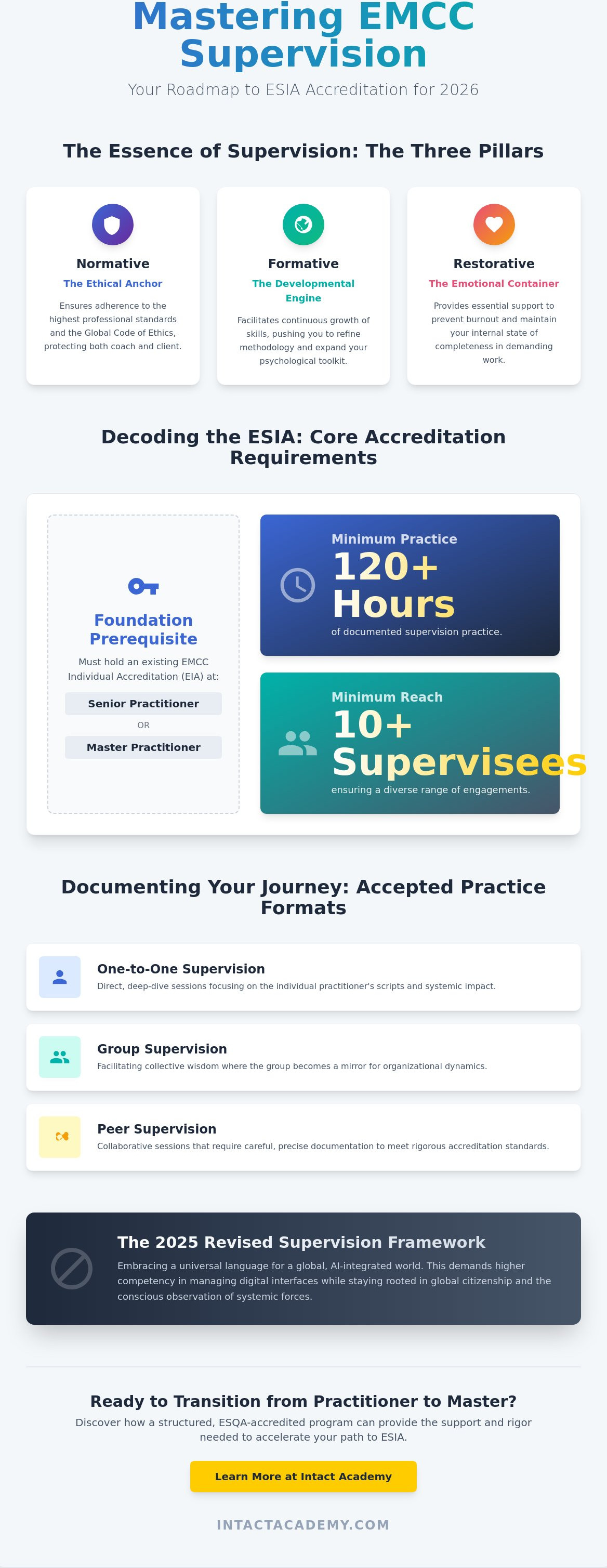
To fully grasp the EMCC coaching supervision requirements, one must look at the three pillars that sustain a healthy practice:
- Normative: This is the ethical anchor. It ensures you maintain the highest professional standards and adhere to the Global Code of Ethics, protecting both the coach and the client.
- Formative: This is the developmental engine. It facilitates the continuous growth of your skills, pushing you to refine your methodology and expand your psychological toolkit.
- Restorative: This is the emotional container. Coaching is demanding, often turbulent work. This pillar provides the support necessary to prevent burnout and maintain your own internal state of completeness.
Decoding the ESIA: Core EMCC Supervision Accreditation Requirements
Transitioning from a practitioner to a supervisor is a profound act of professional maturation. It requires you to shift your gaze from the client's immediate needs to the coach's internal landscape. To ensure this transition is grounded in stability, the EMCC coaching supervision requirements mandate a solid foundation. You've mastered the craft; now you must master the container. This begins with holding an Individual Accreditation (EIA) at the Senior Practitioner or Master level. This prerequisite ensures you possess the psychological depth and professional pragmatism necessary to hold space for other practitioners as they navigate their own turbulent growth.
Experience and Practice Hours
The journey to the ESIA award is paved with documented experience. You're required to demonstrate a minimum of 120 hours of supervision practice, working with at least 10 different supervisees. This isn't merely about clocking time. It's about the quality of the reflective dialogue you facilitate. Your log should reflect a diverse range of engagements:
- One-to-One Supervision: Direct, deep-dive sessions focusing on the individual practitioner's scripts and systemic impact.
- Group Supervision: Facilitating collective wisdom where the group becomes a mirror for organizational dynamics.
- Peer Supervision: Collaborative sessions that require careful documentation to ensure they meet the rigorous standards for accreditation.
Validation is key. Every hour must be tracked with precision, noting the duration, the systemic themes explored, and the insights gained. Your own supervisor plays a critical role here, acting as a witness to your evolution and signing off on your competency and adherence to the Global Code of Ethics.
The Prerequisite EIA Level
Why does the EMCC insist on the Senior Practitioner level before you can pursue supervisor status? It's because you can't mentor what you haven't fully integrated. This requirement aligns your existing coaching mastery with the broader scope of professional development for coaches. It ensures that when you step into the supervisor role, you do so from a place of completeness. If you're an experienced coach holding credentials from other bodies, you may explore "Recognition of Prior Learning" pathways to bridge the gap. For those ready to deepen their systemic impact through a structured, psychologically rich environment, the TA EMCC Senior Supervisor academy provides a stable container for this transformation. Your commitment to ongoing CPD and ethical integrity isn't just a requirement; it's a promise to the profession and the clients we serve.
The Systemic Edge: Integrating Transactional Analysis into EMCC Standards
While the EMCC coaching supervision requirements provide the skeletal structure for accreditation, Transactional Analysis (TA) provides the vital breath that brings the practice to life. It transforms a standard review into a diagnostic exploration of the supervisor-supervisee-client triad. By viewing this relationship through a systemic lens, we can identify the subtle, often unconscious scripts that dictate how a coach interacts with their client. This move beyond tactical advice allows us to uncover the deep-seated patterns that influence entire organizational cultures. When you understand the psychological architecture of the coaching relationship, you can offer a level of insight that goes far beyond simple performance metrics.
Systemic supervision recognizes that no individual exists in a vacuum. Every session is an intersection of personal histories, organizational pressures, and societal expectations. Mapping 'Life Scripts' within the supervision room allows us to uncover unconscious biases that might otherwise remain hidden. This approach ensures that the supervisor isn't just a monitor of ethics, but a facilitator of profound human transformation. By identifying these scripts, we help coaches return to a state of genuineness, which in turn allows their clients to do the same.
Moving from Linear to Systemic Supervision
Linear supervision often stops at the individual's performance. Systemic supervision, however, asks us to look at the "wholeness" of the interaction. By understanding what is transactional analysis, supervisors can map the relational dynamics that emerge during a session. Contracting for change becomes essential here. It ensures that the multi-party agreement between the coach, the supervisor, and the sponsoring organization is transparent and aligned. When we achieve this state of systemic wholeness, coaching outcomes improve and client retention naturally follows because the work is rooted in reality rather than just theory.
Managing the Parallel Process
One of the most profound phenomena in supervision is the 'Parallel Process.' This occurs when the dynamics of the client-coach relationship are unconsciously mirrored in the supervisor-supervisee space. If a client feels paralyzed by their organization, the coach might arrive at supervision feeling equally stuck. A master supervisor recognizes this mirroring as a diagnostic goldmine. By identifying these patterns, you help the coach remain grounded while facilitating transformation. Reflective inquiries prompt the practitioner to look inward, identifying where they've lost their sense of completeness before they attempt to guide the client back to theirs. Adhering to EMCC coaching supervision requirements means more than just tracking hours; it means developing the sensitivity to catch these systemic echoes before they become obstacles.
Your Roadmap to ESIA: Preparing a Successful Application
Preparing your ESIA application is less about administrative compliance and more about a ritual of professional integrity. It is the moment where your lived experience as a practitioner crystallizes into a formal body of evidence. To meet the EMCC coaching supervision requirements in the 2026 cycle, you must first decide on your entry path. While the self-guided route offers flexibility for those with established portfolios, an ESQA-accredited training program provides a pre-vetted structure that significantly streamlines the process. This choice reflects your personal learning style. Do you prefer the solitude of independent assembly or the collaborative depth of a structured cohort?
The heart of a successful application lies in the recommendation and feedback report from your own supervisor. This individual must be able to speak to your evolution, your systemic awareness, and your adherence to ethical boundaries. It is a testament to your commitment to the work that you, too, remain under the supportive gaze of another professional. This relationship ensures that your practice doesn't become a closed loop, but remains open to growth and external insight.
Documenting Your 120 Hours
Your log is the physical manifestation of your practice. To satisfy the 2026 evidence requirements, your documentation must move beyond simple dates and durations. Categorize your hours clearly into Executive, Team, and Group sessions. Each entry should be validated by a signature or contact detail from the supervisee. This level of precision creates a sense of reliability and trust with the assessors. It demonstrates that you treat your practice with the same rigor you expect from your supervisees. Validation is the anchor of professional trust.
Reflection and the Global Code of Ethics
Deep reflexivity is the differentiator between a practitioner and a master. When drafting your reflective log, avoid the trap of mere description. Instead of detailing what happened, explore how the encounter changed your internal state or shifted your systemic perspective. Your ethical stance should be articulated with clarity. You might state: "I align my practice with the Global Code of Ethics by ensuring that the multi-party contract remains the primary anchor for all systemic interventions." This demonstrates that your philosophy isn't just a theory; it's a lived commitment to the profession's core values. For those who seek a guided path through this complex process, the TA EMCC Senior Supervisor academy offers the necessary ESQA-accredited framework to ensure your application reflects true systemic mastery.
Cultivating Mastery: The TA EMCC Senior Supervisor Academy
The path to systemic mastery is rarely a solitary one. While individual study provides the foundation, true transformation occurs within a stable, reflective container. The TA EMCC Senior Supervisor academy is designed as an immersive journey that bridges the gap between technical knowledge and profound human presence. By choosing an ESQA-accredited route, you simplify the complexities of the EMCC coaching supervision requirements, as the curriculum is already pre-aligned with the highest global standards. This allows you to focus less on the mechanics of the application and more on the evolution of your own internal state. You aren't just earning a certificate; you're stepping into a new way of being.
Our academy moves beyond the transactional nature of typical business coaching. It invites you to explore the psychological architecture of organizational systems while maintaining a grounded, professional pragmatism. You'll engage in live supervision practice, receiving expert feedback that challenges your unconscious scripts and expands your capacity to hold space for others. This methodical approach ensures that when you eventually mentor your own supervisees, you do so with a sense of quiet power and global citizenship.
A Curriculum for Deep Transformation
The curriculum integrates the proprietary frameworks developed by Sari van Poelje, offering a unique blend of Agile Transactional Analysis and systemic change methodology. We explore how to move from "doing" supervision as a task toward "being" a supervisor as a professional identity. This involves a deep dive into the "wholeness" of the practitioner, ensuring that the work of personal change remains a thematic North Star. You'll learn to use TA as a diagnostic tool, identifying the subtle relational dynamics that influence team performance and organizational health. This focus on depth ensures that your practice remains resilient in the face of the turbulent shifts within the modern corporate landscape.
Joining a Global Community of Wise Mentors
One of the most enduring benefits of the academy is the opportunity to learn alongside a diverse cohort of professionals from over 14 different countries. This global perspective is essential for meeting the EMCC coaching supervision requirements regarding cultural awareness and global citizenship. Peer learning becomes a mirror, reflecting different systemic realities and enriching your own professional worldview. Even after the program concludes, you remain part of a global community dedicated to flourishing and integrity. This network provides ongoing support and consultancy opportunities, ensuring you never have to navigate the complexities of systemic change alone. If you're ready to deepen your impact and master the standards of your profession, we invite you to discover the TA EMCC Senior Supervisor Academy and begin your journey toward systemic wholeness.
Embracing the Path to Systemic Excellence
True mastery in supervision involves a transition from managing tasks to holding a transformative space for others. We've explored the structural scaffolding of the 120-hour practice requirement and the prerequisite EIA levels, yet the heart of the journey lies in your commitment to deep reflexivity. Navigating the EMCC coaching supervision requirements for 2026 is an invitation to refine your ability to perceive the invisible threads that bind organizations and individuals together. It's an act of professional integrity that ensures your practice remains grounded, ethical, and profoundly human.
This evolution is most effectively nurtured within a community that values both psychological depth and professional pragmatism. Our ESQA-accredited training path, guided by international TA expert Sari van Poelje, provides the structure you need to move from compliance to systemic mastery alongside a global network of practitioners from 14+ countries. You don't have to navigate these complexities alone. Step into Systemic Mastery: Join the Senior Supervisor Academy and begin the work of returning to a state of professional completeness. Your future supervisees are waiting for the depth only you can provide.
Frequently Asked Questions
What is the difference between EIA and ESIA accreditation?
The EIA (Individual Accreditation) validates your standing as a coach or mentor across four levels, while the ESIA (Supervision Individual Accreditation) is the specialized "gold standard" for those supervising other practitioners. To satisfy the EMCC coaching supervision requirements for the ESIA, you must already hold an EIA at the Senior Practitioner or Master Practitioner level. While the EIA focuses on your developmental impact on clients, the ESIA confirms your ability to hold a safe, systemic space for other professionals.
Can I apply for ESIA if my training was not ESQA-accredited?
Yes, you can apply through the "Individual Route" if your training program did not hold an EMCC Global Quality Award (ESQA). This pathway requires you to provide more extensive evidence of your competencies, including detailed case studies and a comprehensive reflective log. Choosing an ESQA-accredited program simplifies this process because the training is already pre-validated against EMCC standards, ensuring your methodology is recognized as rigorous and complete.
How many hours of supervision must I receive myself to qualify for ESIA?
You must demonstrate ongoing engagement with your own supervisor, typically maintaining at least one session per quarter to remain in good standing. For those at the Master Practitioner level, EMCC standards require a ratio of one hour of supervision for every 35 hours of coaching practice. This ensures you remain grounded and supported while you facilitate the growth and wellbeing of your own supervisees, reflecting a commitment to your own internal state of completeness.
What are the 2026 updates to the EMCC Supervision Competence Framework?
The 2026 framework places a heightened emphasis on digital transformation and global citizenship within the supervision room. It asks supervisors to navigate the complexities of AI-integrated coaching and the systemic ripples of cultural differences across more than 140 countries. These updates ensure that the EMCC coaching supervision requirements remain relevant in an increasingly interconnected and technologically mediated professional landscape, moving beyond performance to address global systemic health.
How do I document reflective practice for my EMCC application?
Documenting reflective practice requires a log that moves beyond a simple description of events to a deep analysis of your internal state and systemic impact. You should record the themes of each session, the ethical dilemmas encountered, and how the dialogue shifted your perspective or practice. This evidence demonstrates your commitment to the reflective space that EMCC considers essential for professional mastery, ensuring your growth is both stable and methodical.
Does group supervision count toward the 120-hour requirement?
Yes, group supervision practice is a valid component of the 120-hour experience requirement for the ESIA award. However, your log should reflect a diverse portfolio that includes work with at least 10 different supervisees to demonstrate a broad range of experience. This diversity ensures you can manage the unique dynamics of both intimate one-to-one sessions and the complex parallel processes present in group environments, where organizational dynamics are frequently mirrored.
What happens if I don't meet the Senior Practitioner level requirement yet?
You must first achieve the EIA Senior Practitioner level before you are eligible to apply for the supervisor accreditation. This prerequisite ensures you have integrated the necessary psychological depth and professional pragmatism required to support other coaches. If you're currently at the Foundation or Practitioner level, your focus should be on accumulating the required practice hours and reflective evidence to bridge the gap to Senior Practitioner status before pursuing supervision mastery.
How long does the EMCC ESIA application process typically take?
The timeline for accreditation usually spans several months, as it involves a rigorous review of your practice hours, supervisor recommendations, and reflective evidence. This pacing is deliberate, allowing assessors to resonate with your journey and verify your systemic impact. While individual applications may vary, those following an ESQA-accredited training route often find the administrative phase more streamlined due to the pre-assessment of their core competencies during their training journey.


