

What if the EMCC accreditation renewal process wasn't a bureaucratic hurdle to clear, but a profound invitation to witness your own systemic evolution? For many Senior and Master Practitioners, the five-year mark brings a familiar tension between the desire for professional excellence and the weight of administrative evidence. You've spent years facilitating human transformation, yet translating that depth into a formal submission can feel disconnected from the heartbeat of your practice.
It's common to feel a sense of pressure when articulating the reflexivity required for higher-level renewals or reconciling your hours with the 2025 Global Code of Ethics. This guide will help you navigate your submission with clarity, transforming a mandatory requirement into a meaningful milestone of professional mastery. We'll examine the updated standards, the shift toward streamlined reflection, and how to integrate your professional journey into a cohesive narrative of systemic growth.
Key Takeaways
- Reframe the five-year cycle as a dynamic inquiry into your professional evolution, shifting from a mindset of compliance to one of systemic ownership.
- Navigate the EMCC accreditation renewal process with a clear roadmap for documenting your practice hours and the psychological safety provided by ongoing supervision.
- Discover how Transactional Analysis frameworks can bridge the gap between your daily coaching sessions and the deep reflexivity required for higher-level accreditation.
- Identify the "Golden" case studies within your records that best illustrate your maturity and readiness for the next stage of your practitioner journey.
- Adopt a methodical approach to maintaining your professional logs, ensuring your next renewal is a seamless reflection of your continuous commitment to excellence.
Understanding the EMCC Accreditation Renewal Cycle
The five-year cycle established by the European Mentoring and Coaching Council acts as a rhythmic heartbeat for professional growth. It isn't a static deadline. Instead, it represents a living commitment to excellence that ensures your practice evolves alongside the shifting complexities of human systems. This period allows for a deep, longitudinal view of your impact, moving beyond the immediate gratification of a single successful session toward a sustained pattern of mastery.
Central to the EMCC accreditation renewal process are the principles of self-regulation and ownership. The EMCC operates on the belief that as an accredited professional, you hold the primary responsibility for your ethical standing and developmental trajectory. This isn't a top-down audit. It's a professional invitation to curate your own evidence of growth across various designations, including the European Individual Accreditation (EIA), the European Supervision Individual Accreditation (ESIA), and the Individual Team Coach Accreditation (ITCA). By framing the renewal as a dynamic inquiry, the process moves from a passive record-keeping exercise to an active, systemic interrogation of your professional identity.
The Philosophy of the Reflective Practitioner
Reflexivity is the cornerstone of this evolution. While reflection looks back at what happened, reflexivity examines the "self" that was present in the room. It's a deeper form of critical self-awareness where you analyze your internal reactions and systemic biases. Since the update to Version 4 of the Global Code of Ethics in December 2025, this internal alignment has become even more vital. The renewal asks you to demonstrate how you've moved from merely "doing" coaching to "being" a systemic presence. This shift signifies a psychological maturity where your presence itself becomes the intervention.
Key Deadlines and the Principle of Equivalence
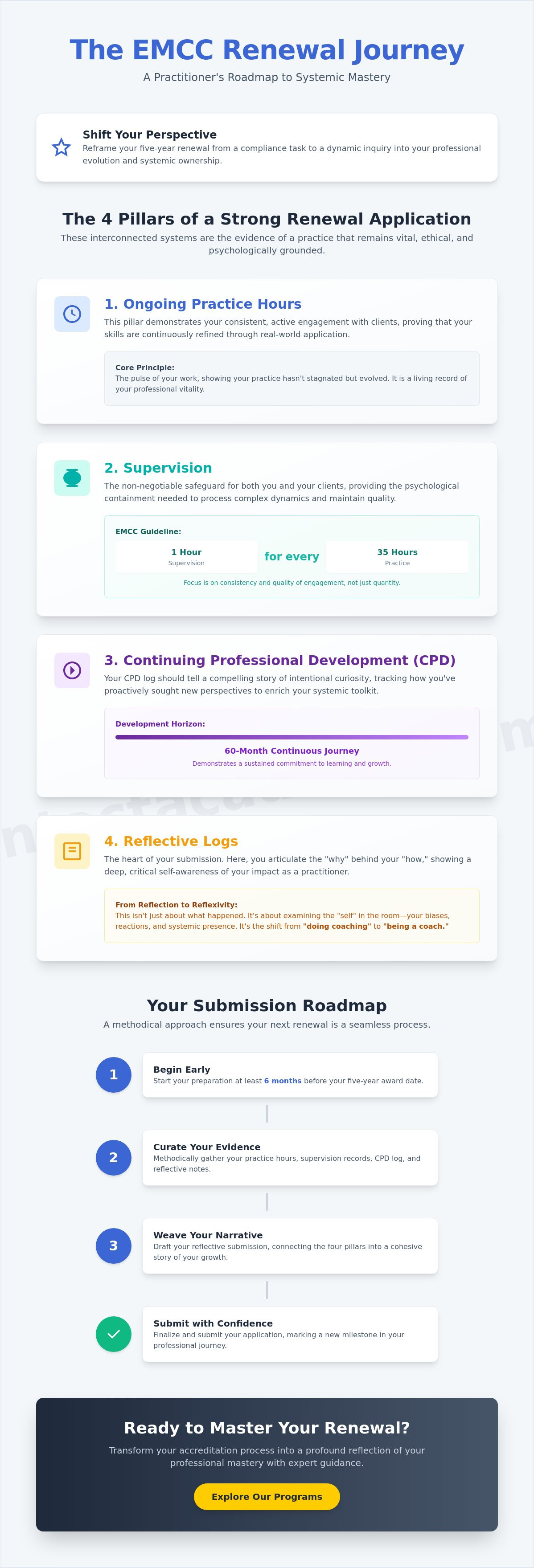
Preparation should ideally begin at least six months before your five-year award date. The EMCC usually sends a reminder during this window, but the burden of awareness remains with you. If life's unpredictability causes you to miss a deadline, specific grace periods exist, though they often require a clear explanation and a commitment to immediate rectification. A key strength of the EMCC accreditation renewal process is the principle of equivalence. This framework acknowledges that professional journeys are diverse. It allows for varied types of practice and CPD to be recognized, provided they align with the core competencies and ethical standards of the council.
The Four Pillars of the EMCC Renewal Application
The structural integrity of your professional standing rests upon four foundational pillars. These aren't merely checkboxes on a form; they're the evidence of a practice that remains vital, ethical, and psychologically grounded. In the EMCC accreditation renewal process, your application serves as a mirror, reflecting how you've integrated five years of experience into a coherent professional identity. By treating these pillars as interconnected systems, the administrative task transforms into a restorative review of your journey.
- Ongoing Practice Hours: This pillar demonstrates your consistent engagement with clients. It's the pulse of your work, proving that your skills haven't stagnated but have been refined through real-world application.
- Supervision: This is the non-negotiable safeguard for both you and your clients. It provides the psychological containment necessary to process complex dynamics and maintain the highest standards of quality control.
- Continuing Professional Development (CPD): Over a 60-month horizon, your CPD log should tell a story of intentional curiosity. It tracks how you've proactively sought new perspectives to enrich your systemic toolkit.
- Reflective Logs: Here, theory meets the messy reality of practice. These logs are the heart of your submission, where you articulate the "why" behind your "how," showing the EMCC that you're a practitioner who thinks deeply about their impact.
Supervision Requirements: Quality over Quantity
For those holding or seeking Senior Practitioner status, the EMCC emphasizes the depth of the supervisory relationship. While the traditional guideline suggests a ratio of one hour of supervision for every 35 hours of practice, the focus has shifted toward the consistency and quality of the engagement. Engaging in systemic supervision allows you to identify parallel processes and blind spots that individual reflection might miss. Your supervisor must be well-versed in the EMCC Global Supervision guidance to ensure your practice remains aligned with the latest ethical evolutions. If you're looking to deepen this area of your practice, exploring a specialized supervisor academy can provide the rigorous framework needed for Master-level mastery.
Documenting CPD with Systemic Intent
Effective CPD isn't about collecting certificates; it's about curated growth. The EMCC accreditation renewal process rewards practitioners who balance formal training with informal learning and contributions to the wider profession. You might categorize a high-level masterclass alongside self-study or peer-mentoring. Using Transactional Analysis as a lens for your CPD allows you to link disparate workshops into a unified narrative of ego-state awareness and contractual clarity. This systemic intent shows the EMCC that your learning isn't accidental but a deliberate pursuit of professional wholeness.
Using Transactional Analysis to Deepen Your Reflective Inquiry
How does the internal architecture of your psyche influence the professional space you hold for others? When you approach the EMCC accreditation renewal process, you're invited to move beyond a simple list of hours and enter a space of deep, psychological reflexivity. Understanding what is transactional analysis provides more than just a theoretical framework; it offers a precise roadmap for your renewal narrative. By viewing your practice through this lens, you can articulate the subtle shifts in your methodology that signal a move toward true professional mastery.
Consider the 'Ego States' you occupy during a high-stakes session. A Senior Practitioner doesn't just facilitate; they consciously maintain an Adult-Adult contract, ensuring the coaching relationship remains a partnership of equals rather than a parental rescue mission. Identifying 'Workplace Games' within your case studies demonstrates an advanced systemic awareness that the EMCC highly values. It shows you can spot the repetitive, unconscious patterns that hinder organizational health. Even your own 'Life Script' plays a role here. Your personal evolution often mirrors your professional growth, and acknowledging this intersection creates a submission that feels grounded, authentic, and deeply human.
Mapping the 7-Eyed Model through TA
In your reflective logs, applying TA scripts to the Seven-Eyed Model of supervision allows you to dissect the 'Parallel Process' with clinical precision. You might explore how a client's script is being mirrored in your own reactions, or how the organization's systemic tension is playing out in the coaching room. Writing about the 'Contracting' process isn't just a technical requirement. For Senior Practitioners, it's a core competency that demonstrates your ability to establish clear boundaries and mutual expectations in complex, multi-party environments.
Articulating Systemic Impact
Professional maturity is often measured by your ability to observe changes in the wider organizational field. When documenting Organizational Change, the challenge lies in illustrating impact without breaching client confidentiality. TA allows you to describe these shifts through the lens of cultural scripts and transactional patterns. By focusing on the movement toward wholeness and genuineness, you show the EMCC that your work isn't just about individual results; it's about fostering a more conscious and functional systemic presence within the global business community.
Step-by-Step Submission Roadmap for 2026
Transitioning from the internal work of reflection to the external act of submission requires a methodical approach. The EMCC accreditation renewal process is designed to be streamlined, yet it demands a high degree of intentionality. Think of this phase as an archaeology of your practice, where you unearth the patterns of growth that have defined your last five years. By organizing your evidence into a systemic narrative, you ensure that the administrative requirements serve to highlight, rather than obscure, your professional maturity.
- Audit your records: Collate your 60-month trail of practice logs, supervision notes, and CPD certificates. Ensure your hours align with your current designation level.
- Select your 'Golden' Case Studies: Choose two or three examples that demonstrate not just successful outcomes, but your ability to navigate complex ethical or systemic challenges.
- Write the Narrative Summary: Prepare a reflection of approximately 1,000 to 2,000 words. This document should synthesize your journey, linking your learning to the competencies of a Senior or Master Practitioner.
- The Declaration: Confirm your adherence to the Version 4 Global Code of Ethics, updated in December 2025, and the EMCC Global Diversity and Inclusion declaration.
- Final Review and Fee Payment: Once your documentation is ready, navigate to the EMCC Global Accreditation Shop. For Senior and Master Practitioners, the renewal fee as of 2026 is €219.00.
Common Pitfalls in the Renewal Process
One frequent oversight is over-documenting practice hours while under-documenting the learning derived from them. The EMCC assessors aren't looking for a high volume of sessions as much as they're looking for evidence of how those sessions changed you. Another pitfall is failing to show a clear, reflexive link between your supervision and changes in your methodology. Finally, ensure you don't neglect the Diversity and Inclusion declaration. In 2026, this is a critical requirement that reflects your awareness of the wider societal structures impacting your clients.
Preparing for the 'Dynamic Inquiry' Interview
If your application is selected for a deeper review or a "Dynamic Inquiry" interview, see it as a peer-to-peer dialogue rather than an exam. You'll be asked to speak confidently about your professional development philosophy and how you integrate ethics into your daily work. This is an opportunity to demonstrate your commitment to professional development for coaches, showing that you remain a student of human behavior even as you lead others. For those seeking a structured environment to refine this level of mastery, exploring a Senior Practitioner academy can provide the necessary rigour and support.
Sustaining Mastery Beyond the Renewal
The moment your confirmation email arrives and the administrative cycle closes, you might feel a natural urge to step away from the documentation. Yet, the day after you complete the EMCC accreditation renewal process is actually the most vital time to begin your next five-year log. Professional mastery isn't a destination you reach and inhabit; it's a continuous state of becoming that requires steady, rhythmic attention. By maintaining your reflective practice in real-time, you ensure that your next submission isn't a frantic reconstruction of the past, but a calm distillation of a lived professional evolution.
Sustaining this level of excellence is difficult in isolation. The psychological weight of working within complex human systems can lead to a specific type of professional fatigue if it isn't contained within a supportive community. Finding a space where you can be both the expert and the learner is essential for preventing burnout. Intact Academy provides this stable container, offering a global network of psychologically-informed mentors who value depth, integrity, and the courage to remain genuine in high-pressure executive environments. This community acts as a systemic mirror, helping you maintain your professional health while you support the flourishing of others.
The Senior Practitioner and Team Coach Academies
As you look toward your next five-year horizon, consider whether it's time to transition from Practitioner to Senior Practitioner or to expand into team coaching. Deepening your impact through the TA EMCC Senior Practitioner academy allows you to refine your use of self as a tool for transformation. This path involves mastering the complexities of systemic organizational change, moving beyond individual interventions to influence the entire cultural script of an enterprise. It's about finding your place among peers who are equally committed to the intersection of human behavior and business success.
Joining a Supervision Group for the Next Cycle
While individual supervision remains a cornerstone of quality, joining a supervision group offers a much richer systemic field for reflection. In a group setting, the diverse ego states and scripts of other practitioners provide a multifaceted perspective that can illuminate your own blind spots more effectively. If you're aiming for ITCA (Team Coach) or ESIA (Supervisor) designations in the future, aligning your supervision with these specific requirements now is a strategic move. This approach honors the legacy of Sari van Poelje, whose work in agile transactional analysis and systemic change continues to shape the highest levels of coaching mastery. By treating the EMCC accreditation renewal process as a doorway rather than a deadline, you commit to a journey of lifelong professional wholeness.
Embracing the Next Horizon of Professional Maturity
The journey toward systemic excellence doesn't end with a successful submission. By reframing the EMCC accreditation renewal process as a rhythmic inquiry into your own psychological depth, you transform an administrative requirement into a catalyst for profound growth. You've explored how the pillars of practice and the lens of Transactional Analysis can illuminate your evolution as a practitioner. Now, the invitation is to maintain this momentum, ensuring your presence in the room remains as grounded and impactful as the systems you serve.
At Intact Academy, we believe that professional mastery is a collective pursuit. Led by international expert Sari van Poelje, our programs are accredited by EMCC, ICF, and EATA, drawing participants from more than 14 countries into a global community of practice. Whether you're seeking to deepen your reflexivity or transition toward senior-level supervision, we provide the structured methodology and empathetic space required for your continued flourishing. Refine your practice for your next EMCC milestone at Intact Academy. Your commitment to wholeness is the greatest gift you offer your clients and the organizations they lead. Keep evolving with courage and clarity.
Frequently Asked Questions
How many CPD hours do I need for EMCC renewal in 2026?
You're typically expected to demonstrate between 16 and 30 hours of Continuing Professional Development annually, totaling 80 to 150 hours over the five-year cycle. The council has streamlined the EMCC accreditation renewal process to focus on your confirmation of these standards rather than exhaustive documentation. This allows you to prioritize the quality of your learning and its systemic impact on your practice rather than simply accumulating hours for the sake of compliance.
Can I use my ICF CCEU points for my EMCC renewal application?
You can certainly integrate your ICF CCEU points into your application through the EMCC principle of equivalence. The council recognizes that professional growth often spans multiple accrediting bodies and values the diversity of your learning journey. When you document these points, focus on how the specific training has deepened your reflexivity and enhanced your ability to navigate complex human systems, ensuring the learning aligns with EMCC core competencies.
What happens if I have not had regular supervision for the full five years?
If your supervision has been inconsistent, you should provide a transparent explanation within your reflective narrative. While regular supervision is a non-negotiable requirement for psychological safety, the EMCC acknowledges that life transitions or professional shifts can cause interruptions. You'll need to demonstrate how you've addressed these gaps and what steps you've taken to return to a state of systemic oversight, ensuring your practice remains grounded and ethical.
Is there a difference in the renewal process for Senior Practitioners vs. Foundation level?
The primary difference lies in the depth of reflexivity required and the associated administrative fees. While Foundation level practitioners focus on basic competency maintenance, Senior and Master Practitioners must articulate a more sophisticated understanding of parallel processes and systemic impact. Additionally, as of 2026, the renewal fee for Foundation level is €120.00, whereas the fee for Senior and Master Practitioners is €219.00, reflecting the increased complexity of the review.
Do I need to submit my original training certificates again for renewal?
You don't need to re-submit your original foundational training certificates during the renewal phase. The council already holds your initial accreditation records. Your focus should remain entirely on the five-year period since your last award. You'll simply need to confirm your ongoing practice, provide evidence of new CPD activities, and demonstrate your continued commitment to the Global Code of Ethics and professional supervision requirements.
How much does the EMCC accreditation renewal fee cost in 2026?
The renewal fees for 2026 vary according to your specific accreditation level. Foundation level practitioners pay €120.00, while those at the Practitioner level pay €205.00. For Senior Practitioners and Master Practitioners, the fee is set at €219.00. These payments are processed through the EMCC Global Accreditation Shop and cover the administrative costs of maintaining your professional standing within the global coaching and mentoring community.
Can my reflective log be written in a language other than English?
You can often submit your reflective logs in your native language if you're applying through a specific national EMCC affiliate. However, if you're applying directly to EMCC Global, English is the standard requirement to ensure a consistent review process. It's wise to check with your local branch early in the EMCC accreditation renewal process to confirm their specific linguistic protocols and ensure your reflections are accurately understood by the assessors.
What is the EMCC Global Diversity & Inclusion declaration requirement?
The EMCC Global Diversity & Inclusion declaration requires you to confirm your commitment to fostering inclusive practices and challenging systemic biases. This isn't a mere formality; it's an ethical pledge to respect the unique identities of all clients and stakeholders. In 2026, all renewing members must adhere to this declaration alongside the updated Global Code of Ethics, reflecting the profession's growing responsibility toward societal equity and human flourishing.


