

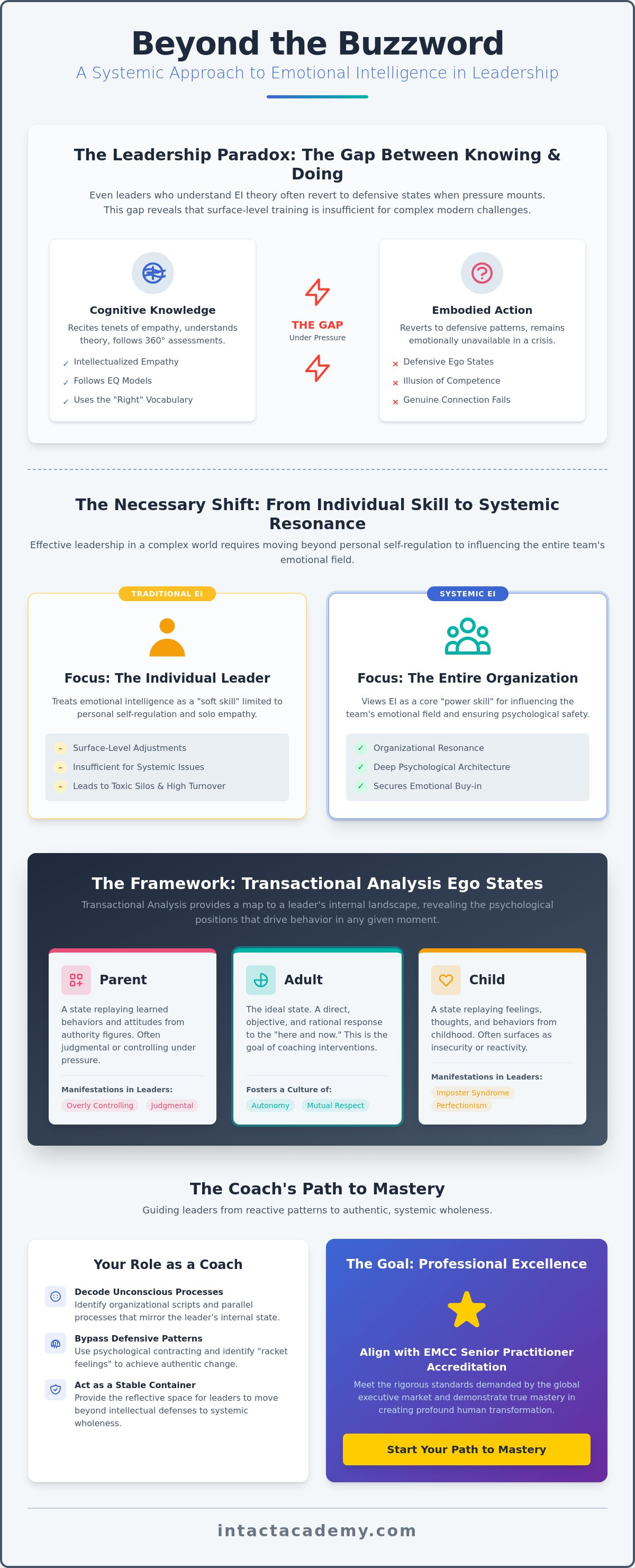
Why do leaders who can recite every tenet of empathy still fail to hold a room when a systemic crisis hits? It's a common frustration in the industry; you've likely coached executives who understand the theory of emotional intelligence in leadership coaching yet revert to defensive ego states the moment the pressure mounts. This gap between cognitive knowledge and embodied action suggests that traditional "soft skills" training often misses the deeper psychological currents that govern human behavior.
You recognize that for coaching to create lasting change, it must address the unseen systemic resistance within teams and the internal scripts of the leader. This article promises to guide you through the sophisticated frameworks required to master these psychological depths. We'll explore a methodology for behavioral change that moves beyond the surface, offering you the tools to handle high-stakes interventions with professional pragmatism. By looking at the intersection of Transactional Analysis and organizational systems, we'll preview how you can achieve a level of mastery that reflects true human transformation and prepares you for the rigor of senior practitioner accreditation.
Key Takeaways
- Shift your perspective from individual self-regulation to a systemic model of emotional intelligence in leadership coaching that resonates across the entire organization.
- Learn to identify the Parent, Adult, and Child ego states that drive reactive behaviors and prevent genuine connection during high-pressure scenarios.
- Discover how to decode the organizational script and parallel processes that cause teams to unconsciously mirror a leader’s internal emotional state.
- Master the art of psychological contracting and the identification of racket feelings to bypass defensive patterns and achieve authentic behavioral change.
- Align your coaching practice with the rigorous standards of EMCC Senior Practitioner accreditation to meet the evolving demands of the global executive market.
Beyond the Buzzword: Why Emotional Intelligence in Leadership Coaching Requires Depth
By 2026, the threshold for effective leadership has shifted fundamentally. Technical competence and strategic oversight are no longer the ceiling of professional achievement; they are the baseline. As artificial intelligence and automation handle the analytical heavy lifting of modern business, a leader's primary value lies in their capacity for profound human connection. This shift demands a more sophisticated application of emotional intelligence in leadership coaching, moving away from surface-level behavioral adjustments toward a deeper, systemic mastery.
Traditional models of Emotional Intelligence often focus on the individual, emphasizing personal self-regulation and solo empathy. While these are valuable, they're insufficient for the complexities of global executive roles. We must move toward organizational resonance. This is the ability of a leader to not only manage their own internal state but to consciously influence the emotional field of their entire team. When a leader lacks this depth, the results are rarely subtle. You'll see it in the "silent" drain on productivity, the rise of toxic silos, and the high turnover of talented staff who no longer feel psychologically safe.
The Shift from Soft Skill to Systemic Necessity
The "soft skills" label is a relic of a transactional past. In a hybrid, AI-integrated workplace, these are now the essential power skills that determine organizational survival. Leaders who cannot navigate the human element find their technical strategies failing because they cannot secure the emotional buy-in of their people. This is where many coaching interventions stall. They offer tips on active listening or conflict resolution without addressing the underlying psychological architecture. Understanding what is transactional analysis provides the missing link. It offers a structured methodology for decoding the unconscious transactions that drive systemic resistance and team dysfunction.
The Illusion of Competence in Leadership EQ
There is a distinct difference between intellectualized empathy and genuine emotional presence. Many high-achieving leaders have learned to "perform" EQ. They use the right vocabulary and follow the steps of 360-degree assessments, yet they remain emotionally unavailable during high-stakes crises. This illusion of competence is dangerous. It masks the core psychological drivers that cause a leader to revert to defensive patterns under pressure. As a coach, your role is to act as a stable container for their evolution. You provide the reflective space where they can move beyond intellectual defenses and begin the courageous work of returning to a state of genuine, systemic wholeness. This process isn't about learning new tricks; it's about becoming a leader capable of holding the complexity of the human systems they serve.
The Transactional Analysis of EI: Ego States and Emotional Regulation
To understand the true mechanics of emotional intelligence in leadership coaching, we must look at the internal dialogue that precedes every external action. It's not enough to tell a leader to "be more self-aware." We need to provide a map of their internal landscape. Transactional Analysis (TA) offers this through the model of Ego States. At any given moment, a leader is operating from one of three psychological positions: the Parent, the Adult, or the Child. When an executive is "hooked" into a reactive state, they aren't responding to the present reality; they're replaying a historical script.
In high-pressure environments, leaders often slip into the "Adapted Child" state. This manifests as imposter syndrome, perfectionism, or an over-reliance on consensus. Conversely, a leader might inhabit a "Critical Parent" state, where they become overly judgmental or controlling, inadvertently stifling the team's psychological safety. Effective coaching helps leaders identify these shifts in real-time. By fostering Adult-to-Adult transactions, you help them build a culture of mutual respect and autonomy. This is the essence of profound human transformation, moving beyond mere behavioral masking toward a state of genuine presence.
Mapping the Internal Landscape of the Leader
The first step in deep-level coaching is identifying the "Critical Parent" energy that often masquerades as high standards. When a leader uses this energy, teams stop taking risks. They stop innovating. They simply try to avoid the Parent's disapproval. To counter this, we focus on strengthening the Adult state. The Adult Ego State is a set of thoughts, feelings, and behaviors that are a direct response to the here-and-now reality, functioning as the objective processor of internal and external data. By staying in this state, leaders can process harsh feedback or market volatility without emotional flooding. Mastering these internal shifts is a core component of the TA EMCC Senior Practitioner academy, where theory meets rigorous practice.
Decontaminating the Adult State for Better Decision Making
Often, a leader’s Adult state is "contaminated" by old Life Scripts—unconscious beliefs formed early in life about how one must behave to be successful. These scripts can cloud strategic decisiveness. A leader might hesitate to make a bold move because of an underlying script that says "don't be important" or "don't take risks." Emotional clarity requires decontaminating the Adult state from these historical influences.
You can help leaders practice this through a simple Ego State check-in before high-stakes meetings. Ask them to pause and reflect:
- Which state am I in right now? (Am I judging, reacting, or observing?)
- Is my current emotion a response to this situation or a familiar "racket" feeling?
- What would the objective, Adult response look like here?
This practice ensures that emotional intelligence in leadership coaching results in clear, strategic outcomes rather than just temporary behavioral shifts. It allows the leader to return to a state of completeness, where their decisions are informed by current reality rather than past shadows.
Systemic Emotional Intelligence: Coaching the Team's Emotional Field
Emotions are not isolated events contained within a single person; they are energetic currents that ripple through an entire organization. When we discuss emotional intelligence in leadership coaching, we must expand our focus from the individual leader to the team's emotional field. A critical concept here is the "Parallel Process." This occurs when a leader’s internal state is unconsciously mirrored by the team. If a CEO feels overwhelmed and reactive, the executive team often adopts a similar frantic energy. This isn't just imitation; it's a systemic resonance that dictates the group’s capacity for clear thought and action.
Beyond individual reactions, organizations operate under an "Organizational Script." These are the unwritten rules and unconscious patterns that govern how a group survives and succeeds. Often, these scripts are rooted in the company’s history or the founder’s original vision. If the script favors avoiding conflict at all costs, the team will engage in psychological games to bypass authentic confrontation. These games, which are repetitive transactions with hidden motives, stifle innovation and keep the system stuck in a loop of dysfunction.
Uncovering the Unconscious Group Dynamics
Within these dynamics, we often see "Symbiosis," where team members function as if they are part of a single organism rather than distinct individuals. This prevents accountability and emotional growth because the boundaries between self and other are blurred. We also observe the Drama Triangle in corporate conflict, where individuals cycle through the roles of Victim, Rescuer, and Persecutor. For those leading organizational change, identifying these roles is the first step in restoring functional, Adult-to-Adult communication.
Creating a Systemic Container for Change
Systemic empathy involves seeing the emotional needs of the whole organization. It’s the ability to sense the tension in a boardroom or the apathy in a department and understand it as a symptom of the system’s health. Instead of blaming individuals, the coach helps the leader see the "why" behind the behavior. Are the psychological games a defense against a lack of clear direction? Is the team's resistance a way of protecting an old, cherished identity? By addressing these questions, we move from transactional fixes to profound human transformation.
The coach’s role is to provide a systemic container for this evolution. By modeling the "I’m OK – You’re OK" dynamic, you create a space where vulnerability is safe and autonomy is encouraged. However, working with these intense fields can be draining. This is why systemic supervision is essential; it ensures you remain an objective observer rather than being pulled into the team’s emotional toxicity. Moving toward Systemic Team Coaching Mastery requires this level of psychological hygiene and systemic awareness.
The Coach’s Path to Mastery: Rewriting Leadership Scripts
Moving beyond the theoretical understanding of emotional intelligence in leadership coaching requires a disciplined, step-by-step methodology for behavioral transformation. It isn't enough for a coach to observe a leader's reactive state; the coach must facilitate a rewrite of the underlying psychological script. This process begins with a shift from surface-level goals to deep-level psychological contracting. By inviting the leader to look inward at the historical origins of their reactive patterns, the coach facilitates a shift from unconscious repetition to conscious choice. This journey toward mastery involves four distinct stages of intervention.
- Step 1: Contracting for deep change. This moves beyond the logistics of time and place to establish the psychological distance and safety required for profound growth.
- Step 2: Identifying 'Racket Feelings'. These are familiar, defensive emotions that leaders use to avoid more authentic, vulnerable ones.
- Step 3: Challenging the 'Life Script'. Here, the coach helps the leader identify the childhood decisions that limit their current Adult autonomy.
- Step 4: Integration. The final stage involves anchoring these new emotional patterns through consistent systemic practice within their teams.
To master these interventions, practitioners often seek advanced training that bridges the gap between coaching theory and clinical-grade psychological insight. The TA EMCC Senior Practitioner academy provides the structured environment necessary to refine these high-stakes skills.
Spotting the 'Racket': Coaching Authentic Emotion
A "Racket" emotion is a substitute. It's a "favorite" defensive emotion, like constant irritation or a habitual "righteous anger," that a leader uses to mask a more authentic feeling like fear, grief, or inadequacy. When a leader is stuck in a racket, they feel a sense of repetitive "stuckness" that no amount of traditional EQ training can fix. Coaching for authenticity requires the courage to challenge these rackets. When a leader moves past their defensive irritation and acknowledges the underlying fear of failure, their executive presence shifts. They become more grounded, more relatable, and more capable of building genuine trust with their stakeholders.
Contracting for Emotional Safety
Administrative contracts cover the "who, when, and where" of coaching, but they're insufficient for deep emotional work. Psychological contracts, however, address the "how" of the relationship. They establish the permission for the coach to challenge the leader and the commitment from the leader to remain curious even when uncomfortable. Contracting establishes the clear ethical boundaries and mutual expectations required to safely navigate the leader's deep emotional territory. This clear container allows the leader to lower their defenses, knowing that the work of transformation is supported by a stable and professional framework.
Professional Excellence: The Path to EMCC Senior Practitioner Accreditation
The executive landscape is increasingly discerning. Leaders no longer seek coaches who merely mirror their thoughts; they seek mentors who can navigate the complex undercurrents of human systems. This is why general certificates often fall short in the global market. To offer true value, your practice must be grounded in a methodology that addresses emotional intelligence in leadership coaching through a systemic lens. Depth is the only sustainable differentiator in a field that is rapidly moving toward more profound psychological integration.
Achieving Senior Practitioner status with the EMCC requires more than just logged hours. It demands evidence of reflective practice and a sophisticated understanding of psychological frameworks. Transactional Analysis provides this evidence by giving coaches a precise language for the "why" behind leader behavior. When your practice aligns with these high standards, you aren't just a coach; you're a specialist in human transformation. You gain the ability to decode the unconscious scripts and ego states that govern systemic behavior, providing a level of insight that transactional training cannot match.
Systemic supervision is the pillar that prevents professional stagnation. It’s the reflective space where a coach's own "life scripts" are examined to ensure they don't interfere with the client's growth. This practice elevates a coach from being merely competent to becoming a transformational presence in the boardroom. It ensures that the work remains ethical, profound, and impactful. By modeling this level of integrity, you create a stable container for the often-turbulent work of personal and professional change.
Choosing the Right Mastery Pathway
Comparing an Executive Coaching Certification to standard, transactional programs reveals a significant gap in depth. A mastery-level program doesn't just teach tools. It reshapes the coach's identity. By engaging in an international learning environment, you benefit from diverse systemic perspectives. Leveraging Sari van Poelje’s decades of experience in organizational change allows you to move beyond the "how-to" and into the "being" of a master coach. This evolution is essential for those who wish to lead at the intersection of human behavior and business.
Your Next Step Toward Systemic Impact
The journey toward professional excellence is rarely a solitary one. It requires a community of like-minded practitioners who value integrity and psychological rigor. Joining the TA EMCC Senior Practitioner Academy is an invitation to step into this global circle. You'll find the support and structure needed to expand your systemic impact and help your clients return to a state of genuineness and completeness. This is the path to becoming a wise global mentor in an era that demands nothing less.
Explore our Senior Practitioner and Team Coach Academies
Mastering the Systemic Future of Leadership
Transitioning from surface-level behavioral tips to a deep, systemic approach is no longer optional for those operating at the highest levels of organizational change. We've explored how understanding Ego States and organizational scripts allows you to decode the unconscious transactions that often stall progress. By integrating these psychological frameworks, you move beyond transactional interactions and into a space of profound human transformation.
True mastery of emotional intelligence in leadership coaching requires a commitment to your own evolution and a rigorous adherence to professional standards. Our EMCC and ICF accredited programs, led by world-renowned TA expert Sari van Poelje, provide the structured methodology necessary for high-stakes interventions. You'll join a vibrant global community of practitioners from over 14 countries, all dedicated to returning to a state of completeness and genuineness in their professional practice.
Discover our TA EMCC Senior Practitioner Academy for Mastery in 2026
Step into your power as a systemic guide and witness the profound impact of coaching that truly reaches beneath the surface. The courage to change begins with the insight to see the whole system.
Frequently Asked Questions
How does Transactional Analysis improve emotional intelligence in leaders?
Transactional Analysis provides a structural map of the internal dialogue that drives emotional reactions. By identifying Parent, Adult, and Child ego states, leaders move from unconscious reactivity to conscious choice. This framework turns the abstract concept of emotional intelligence in leadership coaching into a measurable, behavioral methodology. It allows for a precise diagnosis of why a leader reverts to defensive patterns during stress, facilitating a return to genuine presence.
What is the difference between individual EQ and systemic emotional intelligence?
Individual EQ focuses on a leader's personal ability to perceive and regulate their own emotions. Systemic emotional intelligence expands this to the team's emotional field, addressing how a leader's state is mirrored by the organization. It involves recognizing parallel processes and the organizational scripts that dictate how a group functions under pressure. This shift ensures that the work resonates through the entire hierarchy rather than remaining isolated within one person.
Can emotional intelligence actually be learned by senior executives?
Senior executives can absolutely develop these capabilities through deliberate practice and the application of neuroplasticity. Research in 2026 confirms that shifting from a commanding style to a coaching approach is a primary developmental trend. This evolution requires moving beyond "soft skill" theory into the embodiment of power skills like empathy and systemic awareness. It's about changing the underlying psychological script rather than just adopting temporary behavioral masks.
How do I know if I need a Systemic Team Coach or an Executive Coach?
Choose an Executive Coach if the focus is on personal professional growth and individual psychological blocks. If the challenge involves team toxicity, silos, or collective resistance, a Systemic Team Coach is required to address the group's emotional field. Both roles are essential for holistic organizational change. Identifying whether the issue is a private script or a shared group dynamic is the first step in choosing the right intervention.
What are the requirements for EMCC Senior Practitioner accreditation?
EMCC Senior Practitioner accreditation requires extensive evidence of reflective practice and a commitment to continuous professional development. Accreditation is valid for five years and must be renewed with documented proof of supervision and growth. This standard ensures that practitioners maintain the depth required for high-stakes executive interventions. It reflects a level of mastery that combines psychological insight with professional pragmatism and global citizenship.
How can a coach avoid 'catching' the emotional stress of their clients?
Coaches protect themselves through Systemic Supervision and the maintenance of a clear Adult ego state. Supervision provides a stable container to process the emotional "residue" of intense sessions. By practicing psychological hygiene, coaches ensure they remain a neutral observer rather than absorbing the team's systemic stress. This boundary is essential for maintaining the coach's own well-being and professional effectiveness during the often-turbulent work of change.
What are 'psychological games' in leadership, and how do they impact EQ?
Psychological games are repetitive, unconscious transactions with a hidden motive that result in negative feelings for all involved. In leadership, these often manifest as the Drama Triangle, where teams cycle through Victim, Rescuer, and Persecutor roles. These games drain productivity and prevent the authentic communication necessary for high-level EQ. Recognizing these patterns is the first step in returning to a state of Adult-to-Adult clarity and systemic health.
Why is self-awareness alone not enough for effective leadership coaching?
Self-awareness is merely the first step; it doesn't guarantee behavioral change under pressure. Many leaders "know" they should be empathetic but find themselves "hooked" by old scripts when high-stakes crises occur. Effective emotional intelligence in leadership coaching must address these unconscious patterns to turn intellectual knowledge into systemic action. Without addressing the underlying script, a leader remains stuck in the gap between knowing and being, preventing true transformation.


