

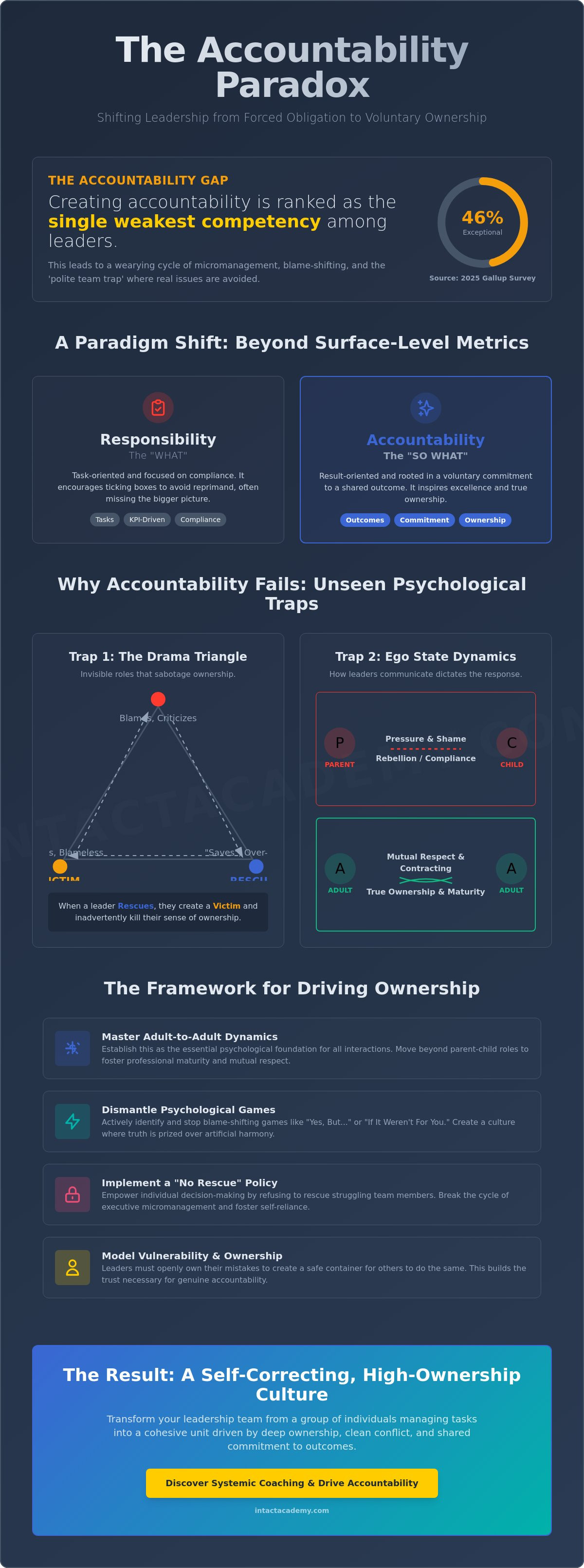
Why does a leadership team offer enthusiastic consent in the boardroom only to falter when it's time to execute? In a 2025 Gallup survey, creating accountability was ranked as the single weakest competency among leaders, with only 46% performing at an exceptional level. You've likely felt the weight of the polite team trap, where conflict is avoided and the burden of results falls back onto your shoulders. It's a wearying cycle of micromanagement and blame-shifting that drains the vitality of even the most promising initiatives.
This exploration offers a path toward driving accountability in leadership teams by moving beyond surface-level management into the realm of systemic wholeness. We'll examine how Transactional Analysis and systemic coaching can replace psychological games with Adult-to-Adult contracting. You will discover how to foster a self-correcting culture where clean conflict and deep psychological contracts ensure that every major initiative is met with genuine ownership rather than mere compliance.
Key Takeaways
- Redefine accountability as a voluntary commitment to shared outcomes rather than a forced obligation or a mere list of tasks.
- Identify and dismantle the "Psychological Games" and invisible scripts that foster blame-shifting and conflict avoidance within the boardroom.
- Master the shift toward Adult-to-Adult ego state dynamics as the essential psychological foundation for driving accountability in leadership teams.
- Implement a "No Rescue" policy to empower individual decision-making and break the cycle of executive micromanagement.
- Discover how systemic coaching frameworks can scale a culture of deep ownership and transform organizational behavior through structured, professional development.
The Systemic Roots of Accountability in Leadership Teams
Accountability is often misunderstood as a mechanism of control, a tool used by those at the top to ensure those below them are performing. This view is fundamentally flawed. True accountability is a voluntary commitment to a shared outcome; it's a state of being that cannot be coerced. While the definition of accountability often focuses on answerability and governance, within a leadership team, it's the bridge between individual intent and collective results.
We must distinguish between responsibility and accountability. Responsibility is task-oriented; it's the "what" of our daily labor. Accountability is result-oriented; it's the "so what." When we rely solely on KPI-driven metrics, we often inadvertently encourage a culture of compliance. Leaders tick boxes to avoid reprimand rather than stretching toward excellence. This transactional approach fails because it ignores the psychological contract. This is the unwritten, unspoken set of expectations that govern how we truly show up for one another. Driving accountability in leadership teams requires us to move beneath the surface of spreadsheets into the depths of human dynamics.
Accountability as a State of Wholeness
Our capacity to hold ourselves and others to account is deeply rooted in our individual life scripts. These are the unconscious patterns we developed early in life that dictate how we handle commitments, successes, and failures. If a leader's script is built on a fear of conflict or a need to please, they'll struggle to address performance gaps. Systemic awareness allows us to see that a team's failure to deliver is rarely about a lack of skill; it's often a reflection of these intersecting scripts. Moving from compliance to commitment requires a return to personal integrity, where our outward actions align with our internal values. It's about becoming a whole person who honors their word not because they're told to, but because it's who they are.
The Leader’s Role in Modeling Ownership
The most common barrier to driving accountability in leadership teams is the "Parent-Child" dynamic. When a leader adopts a "Critical Parent" ego state, demanding results through pressure or shame, the team naturally retreats into a "Rebellious Child" or "Adapted Child" state. In these roles, team members either push back or offer passive-aggressive compliance. Both behaviors kill genuine ownership.
Effective leaders model vulnerability. By openly owning their mistakes, they create a safe container for others to do the same. This approach is central to Sari van Poelje's methodology for agile leadership and systemic change. When the leader stays in an "Adult" ego state, they invite their peers to do the same. This fosters a culture where accountability is a natural byproduct of professional maturity rather than a forced management directive.
Why Accountability Fails: Psychological Games and Invisible Scripts
Failures in accountability are rarely the result of incompetence or a lack of resources. Instead, they often stem from the "Drama Triangle," a psychological model that describes the shifting roles of Persecutor, Rescuer, and Victim. When a leader "rescues" a struggling executive by over-functioning or stepping in to finish their work, they inadvertently cast that executive as a "Victim." This dynamic effectively kills ownership. The executive no longer feels the weight of the result because they know someone else will carry it. Driving accountability in leadership teams requires a conscious refusal to play these roles, moving instead toward a culture of mutual adult empowerment.
In many boardrooms, we witness "Psychological Games" that act as barriers to progress. One common game is "Yes, But," where a team member agrees to a strategy in principle but provides a constant stream of reasons why it cannot be executed in their specific department. Another is "If It Weren't For You," where setbacks are blamed on the failures of other departments or external market conditions. These games are defensive maneuvers designed to avoid the vulnerability of being held to account. As we explore the systemic roots of accountability, it becomes clear that these behaviors are often symptoms of a leadership culture that prizes safety over truth.
The Cost of the 'Polite' Team
Artificial harmony is perhaps the greatest enemy of excellence. In "polite" teams, conflict is viewed as a threat rather than a tool for growth. Senior leaders often fall into the "Rescuer" trap, smoothing over tensions to maintain a pleasant atmosphere. This avoidance creates a "Team Script," an unconscious set of rules that dictate it's safer to stay quiet than to challenge a peer. We can use Transactional Analysis to map these invisible dynamics, identifying where the team is choosing comfort over the "clean" conflict necessary for high-level results. When you stop rescuing, you allow the team to find its own strength.
Breaking the Script
To move from the Drama Triangle to the "Winner's Triangle," teams must learn to recognize "discounting." This occurs when a team ignores a problem, minimizes its significance, or denies their capacity to influence the outcome. Driving accountability in leadership teams involves naming these discounts in real-time. By replacing "dirty" politics with "clean" feedback, the team moves into a state of professional maturity. For those ready to confront these hidden patterns, specialized Team Coaching offers a structured methodology to surface and rewrite the scripts that hold your organization back. It is a process of returning to a state of genuineness where every commitment is honored.
The Accountability Framework: Moving to Adult-Adult Dynamics
To understand the mechanics of driving accountability in leadership teams, we must first look at the ego states from which we communicate. Transactional Analysis identifies three primary states: Parent, Adult, and Child. In many organizations, accountability is mistakenly viewed through a Parent-Child lens. The leader acts as a "Critical Parent," issuing directives and monitoring behavior, while the team member responds as an "Adapted Child," seeking approval or avoiding punishment. This dynamic is fragile. It relies on constant external pressure and inevitably leads to the "polite" team trap or outright rebellion.
True accountability only exists in Adult-to-Adult transactions. In this state, both parties are grounded in the present, acknowledging reality without the distortion of past scripts or future fears. It's a relationship of equals focused on a shared commitment. When a team operates from the Adult ego state, peer-to-peer accountability ceases to be an act of individual "bravery" and becomes a natural systemic byproduct. It is no longer about one person calling out another; it is about the system self-correcting to protect the integrity of the contract.
The 3 Levels of Contracting
Moving to an Adult-Adult dynamic requires a sophisticated approach to "contracting." This moves beyond a simple job description to create a multi-layered agreement that governs how the team functions under pressure. There are three essential levels:
- The Administrative Contract: This covers the tangible "what." It includes specific goals, timelines, and the measurable KPIs that define success.
- The Professional Contract: This addresses the "how." It outlines the competencies required, the methods of collaboration, and the boundaries of each role.
- The Psychological Contract: This is the most critical and often the most ignored. It addresses the unspoken expectations, the emotional safety required to fail, and the commitment to stay in an Adult state during conflict.
Comparison: Parent-Child vs. Adult-Adult Accountability
The difference between a control-based environment and a contract-based one is the difference between compliance and autonomy. When we shift toward contracting, we provide the team with a stable container for their work.
| Feature | Control-Based (Parent-Child) | Contract-Based (Adult-Adult) |
|---|---|---|
| Primary Driver | Fear of reprimand or desire for praise. | Commitment to the shared outcome. |
| Communication | Top-down directives and "checking in." | Mutual inquiry and "checking with." |
| Conflict | Avoided or handled with blame. | Clean, constructive, and result-oriented. |
| Outcome | Burnout and dependency. | Autonomy and systemic resilience. |
Drafting a "Clean Contract" for your next major initiative involves more than just setting a deadline. It requires a deliberate inquiry into what each person needs from the other to remain in their Adult ego state. By making the implicit explicit, you eliminate the space where psychological games thrive. This is the foundational work of driving accountability in leadership teams; it's about creating a state of wholeness where every leader has the clarity and agency to own their impact.
Practical Guidance: Driving Ownership Through Systemic Mastery
Mastering the art of driving accountability in leadership teams requires a transition from understanding theory to implementing rhythmic, systemic practices. This isn't a one-time event; it's a process of continuous alignment. When you move beyond surface-level management, you begin to see the team as a living organism that requires specific interventions to remain in a state of Adult-to-Adult wholeness.
The first step is to audit the existing team scripts. Every team has unspoken rules that govern behavior. You might find a script that says "never disagree with the founder in public" or "protect your own department at all costs." Naming these rules is the first step toward changing them. Once these scripts are visible, you can establish a "No Rescue" policy. When a leader over-functions to compensate for a peer’s under-performance, they prevent the system from learning. By allowing the natural consequences of a missed commitment to be felt, you create the necessary friction for growth.
A mature team also practices "Clean Conflict." This is disagreement stripped of "dirty" politics, personal attacks, or historical grievances. It's a rigorous, Adult-to-Adult debate focused on finding the best systemic solution. By resolving tensions as they arise, you prevent them from hardening into resentments that erode trust and accountability.
The Power of Systemic Questions
Systemic questioning is a tool used to surface the unconscious team agenda. Instead of asking "why" something happened, which often invites defensiveness, ask questions that reveal hidden dependencies. Inquiries like "Who are we really doing this for?" or "What are we not saying right now?" can shift the team's perspective. These questions help align the leadership team with the wider organizational system, ensuring that decisions aren't made in a vacuum but are grounded in the reality of the whole enterprise.
Reflective Practice for Leaders
Deep systemic mastery demands more than just traditional management training. Just as professional development for coaches emphasizes the necessity of supervision, leadership teams benefit from "The Witness." This is an external perspective, often provided through systemic supervision, that helps the team see its own patterns from a distance. Setting up a regular supervision rhythm creates a stable container for the team to process setbacks and celebrate successes without falling back into the Drama Triangle. This reflective practice is the heartbeat of systemic health.
To deepen your capacity for systemic leadership and master the invisible dynamics of your organization, consider our professional development for coaches and senior leaders. It's a path toward becoming the "Witness" your team needs to flourish.
Scaling Accountability: The Intact Academy Approach
The transition from managing a team to truly transforming an organization requires a fundamental shift in perspective. It's no longer enough to focus on individual performance; we must focus on the health of the system itself. This evolution from individual coaching to leading organizational change is where sustainable excellence begins. By applying systemic team coaching at scale, we ensure that accountability isn't just a localized success but a foundational element of the entire corporate culture.
At the center of this transformation is the TA EMCC Senior Team Coach Academy. This framework provides the tools needed for driving accountability in leadership teams by addressing the deep-seated psychological scripts that often sabotage progress. It moves beyond the tactical to the systemic, providing a stable container for teams to evolve. When accountability is built into the system, it becomes self-sustaining. The need for executive intervention diminishes as the team develops the maturity to self-correct and maintain its own integrity through Adult-to-Adult dynamics.
Integrating TA into Your Leadership Style
Becoming a systemic leader involves a profound journey from tactical manager to systemic mentor. It requires a return to a state of wholeness where your leadership is an expression of your genuine self. Our executive coaching certification is designed to prepare you for these complex human challenges. It provides the psychological depth to recognize the Parent-Child dynamics that often stifle growth and the professional pragmatism to lead your team back to a state of presence. In this culture of wholeness, accountability is never forced. It's the natural byproduct of a group of professionals who are fully present and committed to their shared purpose.
Your Path to Systemic Mastery
The TA EMCC Senior Team Coach Academy offers a rigorous path for those committed to professional excellence. The program integrates the principles of Transactional Analysis with advanced systemic coaching techniques, allowing you to bring these frameworks into your specific organizational context. You aren't just learning a methodology; you're joining a global community of systemic practitioners dedicated to human and organizational flourishing. This journey begins with a simple, yet profound, audit of your team's current psychological maturity.
- Evaluate the prevalence of the Drama Triangle in your current boardroom interactions.
- Identify the "unspoken rules" that prevent clean conflict and honest feedback.
- Commit to the development of Adult-to-Adult contracting for every major initiative.
- Explore how systemic supervision can maintain the long-term health of your leadership system.
The work of driving accountability in leadership teams is ultimately the work of personal and professional transformation. It requires the courage to change and the wisdom to see the system as it truly is. We invite you to step into this space of deep learning and lead your organization toward a state of genuine, sustainable accountability. By returning to a state of completeness, you allow your team to do the same.
Transforming the Architecture of Ownership
True transformation begins when we stop treating accountability as a management chore and start seeing it as a systemic commitment. By moving from Parent-Child control to Adult-Adult contracting, you create a space where ownership is a natural choice rather than a forced obligation. We've explored how identifying invisible scripts and interrupting the Drama Triangle can liberate your team from the cycles of blame and rescue. These shifts aren't just tactical; they're the foundation for driving accountability in leadership teams at a level that transcends surface-level results.
If you're ready to master these dynamics, our ICF and EMCC Accredited Programs offer a structured path toward mastery. Led by Sari van Poelje and global TA experts, our academies welcome participants from 14+ countries to explore the intersection of human behavior and business excellence. Deepen your impact with our TA EMCC Senior Team Coach Academy and join a global community of practitioners committed to profound human transformation. The journey toward a more genuine, accountable culture is a rewarding one. It's a return to the integrity and clarity your organization deserves.
Frequently Asked Questions
How do I deal with a high performer who refuses to be held accountable?
High performance in individual tasks does not excuse a failure in systemic accountability. Often, these individuals are permitted to operate in a "Rebellious Child" ego state because the organization fears losing their technical output. You must realign them through Adult-to-Adult contracting, making it clear that their impact on the team's wholeness is as vital as their specific results. If the behavior persists, the system is essentially rewarding a script that undermines the collective.
Can you have accountability without a culture of fear?
True accountability is the antithesis of fear; it's a voluntary commitment rooted in integrity. Fear only produces the "Adapted Child" response of compliance, which is fragile and leads to burnout. By driving accountability in leadership teams through psychological safety and clean conflict, you allow leaders to own their results because they value the shared mission, not because they fear a "Critical Parent" reprimand.
What is the difference between responsibility and accountability in TA terms?
In Transactional Analysis, responsibility is often task-oriented and can be held within "Parent" or "Child" ego states as a matter of duty or obedience. Accountability, however, is a systemic state that only exists in "Adult-to-Adult" transactions. It's the commitment to the final result and the impact one has on the entire organizational system. While you can delegate responsibility for a task, you cannot delegate the Adult ownership of the outcome.
How long does it take to shift a team's accountability culture?
While behavioral shifts can begin immediately, rewriting a "Team Script" typically requires six to twelve months of consistent work. This timeframe allows the team to move through the stages of identifying Psychological Games and establishing new, Adult-to-Adult patterns of communication. Lasting change is a methodical process of unlearning old defensive maneuvers and replacing them with a stable container of mutual trust and reflective practice.
What are the early warning signs that a team is playing 'Psychological Games'?
Look for "discounting," where team members minimize the significance of a problem or their capacity to influence it. Common indicators include the "Yes, But" maneuver during strategy sessions or the "If It Weren't For You" blame-shifting during setbacks. These are defensive scripts used to avoid the vulnerability of ownership. Recognizing these patterns early is essential for driving accountability in leadership teams before the Drama Triangle becomes the team's primary mode of operation.
Is it possible to drive accountability in a remote or hybrid leadership team?
Accountability is not dependent on physical proximity, but it does require more explicit psychological contracting in virtual spaces. In remote environments, the "unspoken" cues of the boardroom are lost, making it vital to name expectations and boundaries clearly. Leaders must use digital interactions to foster Adult-to-Adult transparency rather than falling into "Parent" state surveillance, which only breeds resentment and dependency.
How does 'Systemic Contracting' differ from a standard project plan?
A standard project plan is an administrative contract focusing on the "what" and "when." Systemic contracting goes deeper by including professional and psychological layers that address the "how" and the "who." It makes the implicit expectations regarding emotional safety, conflict resolution, and mutual support explicit. This creates a more resilient agreement that survives the inevitable pressures and unforeseen blockers of a complex project.
What should a leader do if they realize they have been 'Rescuing' their team?
The first step is to name the dynamic without judgment and stop over-functioning immediately. By acknowledging that you've been stepping in to "save" the team, you invite them to move out of the "Victim" role and back into an Adult ego state. Transitioning to a "No Rescue" policy allows the team to feel the natural weight of their commitments, which is the only way for genuine ownership to grow.


