

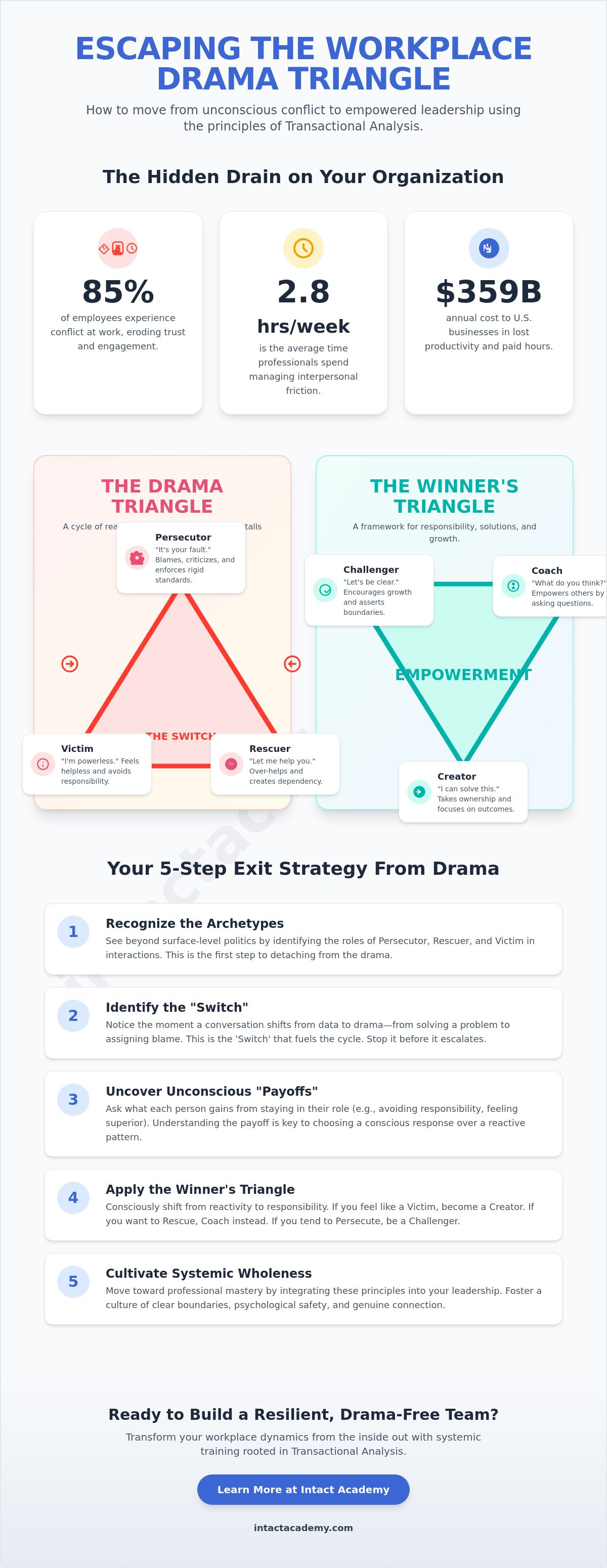
Did you know that 85% of employees experience some form of conflict at work, with the average professional spending 2.8 hours every week managing interpersonal friction? This isn't just a minor annoyance. It's a systemic drain that costs U.S. businesses an estimated $359 billion annually in paid hours. When you find yourself caught in the drama triangle in workplace relationships, you aren't just witnessing a personality clash; you're participating in an unconscious game that stalls productivity and erodes collective well-being. The pull of these dynamics often feels magnetic, yet the exhaustion they produce is a clear signal that your systemic health is at risk.
You likely recognize the heavy toll of these office politics, where trust feels scarce and disengagement rises. This article offers a path toward returning to a state of professional completeness and genuineness. You'll discover how to identify these unconscious patterns and transition from toxic drama to empowered leadership using the rigorous frameworks of Transactional Analysis. We'll explore a clear map of workplace conflict and provide the language to describe these dynamics without casting blame. This guide ensures you have a concrete exit strategy to foster a more resilient, systemic culture for yourself and your team.
Key Takeaways
- Recognize the archetypal roles of Persecutor, Rescuer, and Victim to see beyond surface-level office politics and into the underlying psychological scripts.
- Identify the mechanics of the drama triangle in workplace relationships to stop the "Switch" before it escalates into a cycle of blame and dependency.
- Uncover the unconscious "Payoffs" that keep teams stuck in repetitive conflict loops, allowing you to choose conscious responses over reactive patterns.
- Master the transition from reactivity to responsibility by applying the "Winner’s Triangle," a systemic tool for reclaiming professional agency.
- Move toward professional mastery by integrating Transactional Analysis principles into your leadership, fostering a culture of wholeness and genuine connection.
Beyond Office Politics: Mapping the Karpman Drama Triangle at Work
The Karpman Drama Triangle serves as a profound social model for understanding the reactive roles we inhabit when we lose our sense of professional autonomy. Developed by Stephen Karpman, this framework is deeply rooted in the principles of what is Transactional Analysis, a psychological theory that examines how we communicate and relate to others. In the context of the drama triangle in workplace relationships, these roles are rarely conscious choices. Instead, they are unconscious scripts we fall into when stress overwhelms our capacity for objective problem solving. This isn't just a matter of personal friction; it's a systemic drain. Research shows the average employee loses 2.8 hours per week to conflict, contributing to an estimated $359 billion in lost productivity annually for U.S. businesses. When we enter the triangle, we stop working for the organization and start working for the drama.
The Difference Between Healthy Conflict and Drama
Conflict is inevitable; drama is optional. Healthy conflict remains grounded in data and focuses on solving organizational problems. It invites debate and values diverse perspectives. Drama, conversely, shifts the focus to personalities and blame. It relies on what Transactional Analysis calls "Psychological Games," which are repetitive interactions that lead to a predictable, negative outcome. You can recognize the shift when a conversation stops being about the project deadline and starts being about who is at fault. This transition from data to drama signals that the team has moved from a state of professional mastery into a state of reactivity.
Why Organizations Become Breeding Grounds for Drama
Many workplaces inadvertently foster these cycles through unclear hierarchies and poor contracting. When expectations aren't explicit, people often revert to their internal "Life Scripts." These are the unconscious blueprints formed early in life that dictate how we respond to pressure. The drama triangle in workplace relationships often reveals a lack of systemic clarity. Without strong boundaries and clear roles, teams become stuck in repetitive loops where the same arguments resurface under different guises. Recognizing this as a systemic issue allows leaders to move beyond blaming individuals and start addressing the underlying structures that allow drama to flourish.
The Three Faces of Workplace Reactivity: Persecutor, Rescuer, and Victim
Within the drama triangle in workplace relationships, we don't encounter villains or heroes in the traditional sense. Instead, we find specific psychological positions that people inhabit to manage anxiety and maintain a familiar, albeit painful, status quo. These roles—the Persecutor, the Rescuer, and the Victim—are not fixed identities. They are fluid states of reactivity. Anyone, regardless of their seniority, can slip into any role when systemic pressure becomes too great. Understanding these positions is essential for Transforming Organizational Behavior and returning to a state of professional genuineness.
The Persecutor operates from a stance of rigid standards and blame. They view others as inadequate or "wrong" to avoid confronting their own vulnerability or fear of failure. Conversely, the Victim position is defined by an unconscious belief in one's own powerlessness. By acting as if they lack the resources to solve a problem, the Victim avoids the weight of responsibility and invites others to step in. The Rescuer completes the cycle by over-helping, often without being asked, which reinforces the other's perceived helplessness.
The Persecutor in the C-Suite
In high-pressure executive environments, the 'blame' reflex often masquerades as high standards. When a leader adopts the Persecutor role, they prioritize being "right" over being effective. This behavior erodes psychological safety, leading to a culture where 73% of employees cite a lack of trust as a primary conflict driver. It's vital to distinguish between a "Challenger," who pushes for excellence while respecting the other's capability, and a Persecutor, who uses criticism to diminish others.
The Rescuer: The 'Hero' Manager's Downfall
Many managers fall into the trap of the "Hero" complex. While it feels virtuous to step in and fix a team member's mistake, this "Rescuing" behavior contains an unconscious "discount" of the other person’s ability to solve their own problems. It creates a cycle of dependency that leads to manager burnout and team stagnation. To break this loop, leaders must transition from a reactive Rescuer to a systemic partner. Engaging in professional executive coaching can provide the necessary tools to empower others rather than carrying them. This shift moves the team from a state of dependency toward one of collective mastery and shared responsibility.
The Anatomy of the 'Switch': Why Workplace Conflicts Feel Like a Loop
Have you ever noticed how certain workplace disagreements follow a predictable, circular path? You start by trying to help a colleague, only to find yourself blamed when the project falters. This confusing reversal is known in Transactional Analysis as the "Switch." It's the moment in a psychological game where the roles shift suddenly, leaving participants feeling bewildered and frustrated. The drama triangle in workplace relationships isn't a static diagram; it's a dynamic cycle of movement. Understanding the mechanics of the Switch is the first step in stopping the loop before it begins.
To keep the triangle spinning, every participant must engage in what we call a "Discount." This involves unconsciously ignoring a vital piece of reality. A Rescuer discounts the other person’s ability to think for themselves. A Persecutor discounts the value and feelings of others. A Victim discounts their own capacity to take action. When we ignore these truths, we pave the way for the "Payoff." This is the familiar, though often painful, emotional conclusion that reinforces our internal beliefs about ourselves and others. We might feel "right" or "justified," but we remain stuck in a state of professional stagnation.
Consider a common scenario: a manager who constantly steps in to "save" a struggling team. By over-functioning, the manager acts as a Rescuer. However, when the team remains passive and the project fails, the manager inevitably switches to the Victim role, complaining that they have no support and must do everything themselves. The team, meanwhile, may switch from Victim to Persecutor, blaming the manager’s "micromanagement" for their lack of progress. This cycle ensures that no one takes genuine responsibility for the outcome.
The Systemic Switch in Large Organizations
In larger systems, the triangle often plays out between entire departments. You might see Sales acting as the Rescuer, making impossible promises to "save" a client, while Operations is cast as the Persecutor for failing to meet those demands. This departmental drama often requires a "Third Party"—perhaps a senior leader—to keep the conflict alive by taking sides. When leading organizational change, it's critical to map these systemic triangles. Without this insight, change initiatives often become just another piece of the drama rather than a solution for growth.
Recognizing Your Personal Entry Point
Each of us has a "favourite" role that we tend to inhabit when stress triggers our early life scripts. Some of us are prone to rescuing; others find safety in the Persecutor’s rigid standards. Identifying your personal entry point into the drama triangle in workplace relationships allows you to practice self-supervision. By noticing the physical or emotional signs of stress early, you can choose to stay grounded in your professional mastery rather than slipping into a reactive script. This awareness creates the space necessary for a more authentic and systemic way of working.
Breaking the Script: Strategies to Move from Drama to The Empowerment Dynamic
If the Karpman Triangle is a map of reactivity, Acey Choy’s "Winner’s Triangle" is the compass for returning to professional agency. Breaking the drama triangle in workplace relationships requires a conscious decision to trade familiar payoffs for genuine outcomes. This transformation isn't about changing your personality; it's about changing how you respond to systemic pressure. By adopting a "Winner’s" stance, you move from a position of "I’m OK, You’re Not OK" toward a foundation of mutual respect and adult-to-adult dialogue. You begin to see others as capable rather than inadequate, and yourself as responsible rather than burdened.
The shift involves three distinct psychological movements:
- From Victim to Vulnerable: Instead of acting powerless to avoid responsibility, you acknowledge your actual needs and limitations. You become a "Creator" who focuses on what is possible despite the current challenges.
- From Persecutor to Assertive: You set clear boundaries and standards without resorting to blame. You become a "Challenger" who invites excellence and growth rather than demanding perfection through criticism.
- From Rescuer to Caring: You offer support and empathy without taking over the other person’s work. You become a "Coach" who trusts the other's capacity to find their own solutions.
Central to this shift is the practice of "Contracting." By establishing clear agreements on goals, roles, and boundaries at the start of any project, you eliminate the ambiguity that drama feeds upon. When expectations are explicit, the "Switch" discussed earlier has no room to manifest. If you don't have a clear contract, you're essentially inviting a psychological game to take its place.
The Empowerment Dynamic (TED)
The Empowerment Dynamic shifts the team’s focus from "What is wrong?" to "What do we want to create?" This outcome-oriented approach transforms a team of Victims into a collective of Creators. Practical phrases act as circuit breakers when you feel the triangle’s magnetic pull. Instead of fixing a problem for someone, try asking: "What outcome are you aiming for here?" or "How can I support you as you solve this?" These inquiries prompt the other person to step out of passivity and into their own power.
The Role of Professional Supervision
Even the most seasoned leaders can struggle to see their own blind spots when they're inside the system. Professional supervision provides the external eyes necessary to spot these repetitive patterns before they settle into the organizational culture. Using frameworks like the "7-Eyed Model," supervisors help leaders analyze the complex web of relationship dynamics within their teams. Sari van Poelje has pioneered the application of these agile Transactional Analysis concepts to global organizations, demonstrating that systemic wholeness is achievable even in the most turbulent environments. To master these dynamics and lead your team toward genuine empowerment, exploring our Systemic Supervision offerings can provide the depth of insight required for true transformation.
Cultivating Systemic Wholeness: Professional Mastery in Workplace Relationships
The journey away from the drama triangle in workplace relationships is not a simple destination; it's a continuous process of returning to a state of completeness and genuineness. We've moved from the reactive roles of Persecutor, Rescuer, and Victim into the empowered stances of Challenger, Coach, and Creator. This transition requires more than just intellectual understanding. It demands a fundamental shift in how we perceive our own agency and the potential of those around us. By fostering an "I’m OK, You’re OK" organizational culture, we create a space where conscious dialogue replaces blame and systemic health becomes the priority.
The commitment to this path involves persistent professional development for coaches and leaders alike. It's about moving beyond surface-level interventions to address the deep-seated psychological scripts that drive organizational behavior. Systemic Transactional Analysis (TA) training provides the methodology to anchor these changes, ensuring they aren't temporary fixes but sustainable transformations. When a leader understands the systemic nature of the drama triangle in workplace relationships, they stop reacting to individual friction and start influencing the entire field of interaction. This perspective allows for the creation of environments where human transformation and organizational success are inextricably linked.
Integrating TA into Your Leadership Practice
Moving into the realm of professional mastery means building a culture of radical responsibility. It involves a shift where every team member is invited to be fully present and accountable for their contribution to the collective. This depth of insight is what distinguishes a transactional manager from a transformative leader. For those seeking to deepen their impact, the path toward becoming a Senior Practitioner or Team Coach offers a structured way to integrate these profound psychological concepts into daily practice. It's a process of becoming more authentic, more grounded, and more effective in navigating the complexities of modern human systems.
Next Steps for Systemic Mastery
True organizational change begins with the courage to look inward before taking outward action. Intact Academy provides the stable container needed for this developmental work, offering accredited programs that bridge the gap between psychological theory and business pragmatism. Whether you're looking to refine your own practice or bring TA-based interventions into your entire organization, the methodology remains centered on human flourishing and systemic integrity. We invite you to take the next step in your professional evolution. Join the TA EMCC Senior Team Coach Academy to begin your journey toward systemic mastery and lead your team into a future of genuine connection and professional empowerment.
Embodying the Adult Stance in a Systemic World
Breaking the cycle of the drama triangle in workplace relationships is more than a tactical adjustment; it's a profound commitment to professional wholeness. By recognizing the unconscious scripts of the Persecutor, Rescuer, and Victim, you've already begun the work of returning to a state of genuineness. True transformation requires trading temporary payoffs for sustainable outcomes. This shift from problem-focused reactivity to outcome-oriented creation is the hallmark of a mature, systemic leader.
If you're ready to deepen your impact, we invite you to join our global community. Led by international expert Sari van Poelje, our programs welcome participants from over 14 countries to explore the intersection of human behavior and organizational success. Elevate your coaching and leadership with our TA EMCC Senior Practitioner Academy and gain access to EMCC and ICF accredited training that honors your maturity. The path to systemic mastery is open. We're here to support your evolution.
Frequently Asked Questions
What is the primary cause of the drama triangle in workplace relationships?
The primary cause of the drama triangle in workplace relationships is the unconscious "discounting" of resources, feelings, or reality under systemic pressure. When individuals feel overwhelmed, they often revert to early life scripts and inhabit reactive roles to manage their anxiety rather than remaining in a grounded, Adult state. This lack of internal and external boundaries creates a vacuum where drama naturally flourishes.
How can a manager stop being a 'Rescuer' without appearing uncaring?
Managers can exit the Rescuer role by shifting their focus from fixing problems to facilitating growth. This involves offering genuine empathy for a colleague's situation while maintaining a clear boundary around who owns the responsibility for the solution. Instead of taking over the task, ask: "What resources do you need to move this forward?" This approach honors the other person’s capability and fosters professional agency.
Can an entire department be stuck in a 'Victim' role?
Yes, systemic victimhood occurs when a department perceives itself as powerless against larger organizational forces or "the system." This often manifests as a collective culture of learned helplessness where the team waits for a Rescuer to save them or blames a Persecutor department for their lack of progress. Breaking this cycle requires the department to reclaim its autonomy and focus on what they can control.
What is the 'Switch' in the Karpman Drama Triangle?
The "Switch" is the sudden and confusing reversal of roles that serves as the climax of a psychological game. It’s the moment a manager who was over-helping (Rescuing) feels unappreciated and becomes the Victim, or a subordinate who was seeking advice (Victim) suddenly attacks the manager's suggestions (Persecutor). This shift provides the "Payoff," confirming each person's unconscious, negative beliefs about workplace dynamics.
How does Transactional Analysis help in resolving workplace conflict?
Transactional Analysis provides a sophisticated, systemic language to decode human interaction in real time. By identifying whether a transaction is coming from a Parent, Adult, or Child ego state, professionals can choose to stop reactive patterns. It allows teams to visualize the "invisible" psychological scripts running beneath the surface, making it possible to return the conversation to a productive, Adult-to-Adult level.
What is the difference between the Drama Triangle and the Winner's Triangle?
The Drama Triangle is built on unconscious reactivity and the discounting of human potential. In contrast, the Winner’s Triangle is a conscious, professional model for healthy interaction. In this framework, the Victim becomes Vulnerable by stating their needs, the Persecutor becomes Assertive by setting boundaries without blame, and the Rescuer becomes Caring by supporting others without doing the work for them.
Is it possible to completely eliminate drama from an organization?
Completely eliminating drama is an unrealistic goal because organizations are composed of humans with diverse psychological histories and stress responses. The more pragmatic objective is to build systemic maturity. This means developing the collective capacity to recognize drama as it begins and having the shared language to transition back to conscious dialogue before the cycle impacts productivity or well-being.
How do I know if I am acting as a Persecutor in my team?
You may be acting as a Persecutor if your primary focus is on "who is wrong" rather than "how do we solve this." If you find yourself setting rigid, unattainable standards to avoid facing your own vulnerability or fear of failure, you've likely slipped into this role. Notice if your feedback feels like an attack on the person’s character rather than a challenge to their professional performance.


